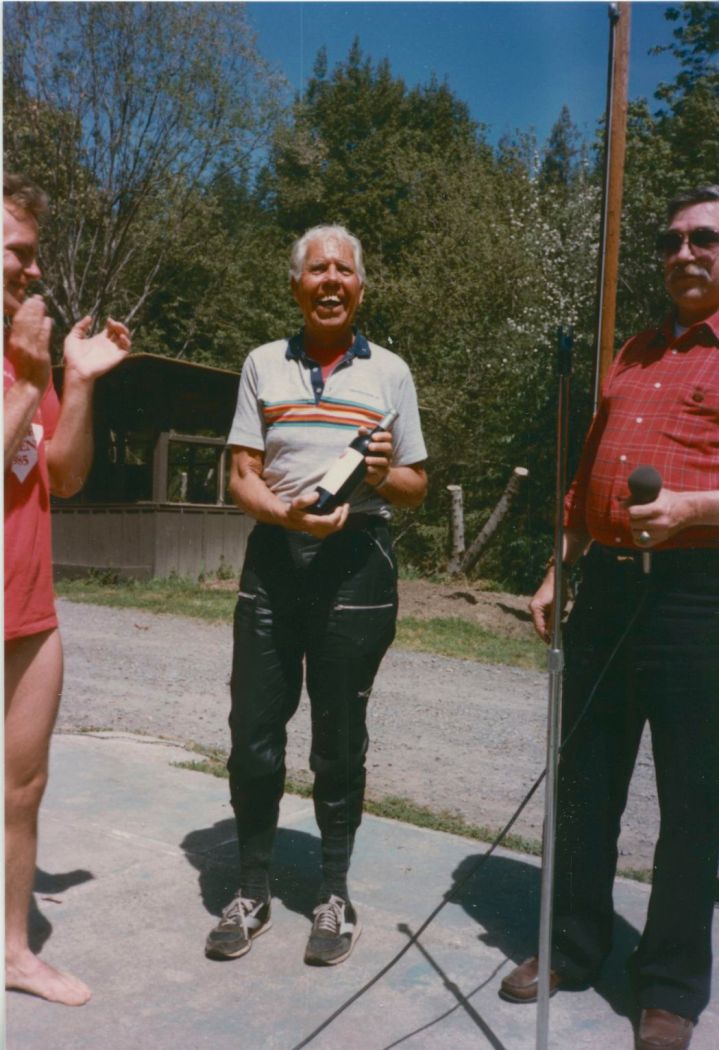
The First Bike-A-Thon Riders: Bruce Matasci

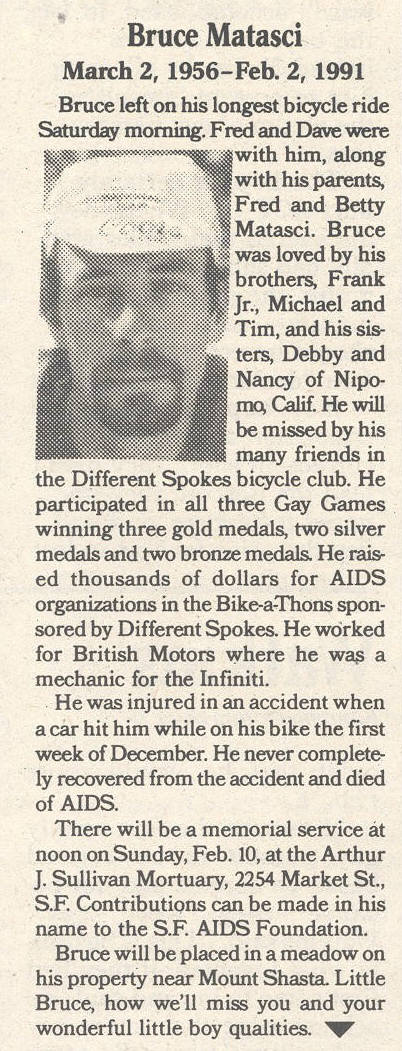
Dennis Westler, former Different Spokes President, wrote this obituary, which was originally published in the March 1991 ChainLetter. Dennis’ recollection of Bruce is spot-on. Bruce had the distinction of having having been a member of the Specialized Bicycle racing team and having raced against a young Greg Lemond. He was the cyclist that many of us in the club aspired to emulate. I interviewed Dr. Bob Bolan about that first BAT and he recalled that he rode the event at full speed and that only one guy was ahead of him. He kept trying to reach this guy and never could—he just vanished up the road. At each rest stop he’d pull in just as this rider was taking off. He couldn’t remember who that guy was. Bob asked me if I was that guy! Uh no, it wasn’t me because I didn’t ride in the first BAT due to graduate school. Who was the ultra fast rider who got to Guerneville first? Bruce. And, as Dennis mentions Bruce had a fist full of Gay Games cycling medals as his palmares! Bruce’s BAR obituary is found here.


In Memoriam, Bruce Matasci 3/2/56-2/2/91

Out on my bicycle last weekend, in every strong graceful cyclist who approached, I thought I saw Bruce. And I had to tell myself over and over again that he was gone.

Back in the early 1980s when I joined Different Spokes, bicycle racers seemed like some godlike breed. I would see them training in their bright, tight clothes. They never seemed to smile; they would snarl at you as they passed. I loved the sport, but the practitioners of it seemed so awful.

And then there was Bruce—smiling, kind of quiet, but friendly. Fiercely competitive but so full of enthusiasm for the sport, he would always offer instruction and encouragement. He was attractive. He was effortlessly masculine. He was licensed! Here was a racer with no chip on his shoulder.

I remember riding with him in the road race in Gay Games II. I had been training furiously. We were both riding in mid-pack. The race was hard and exciting, and to me it was amazing to be able to keep up with him. In the last 200 yards, he put on a sprint and just sailed off. Hammering ’til I thought I’d bust a vein, I couldn’t stay on his wheel. That man was strong!

I remember the first Bike-A-Thon, riding up to the Russian River. That night Bruce, Walter [Teague], and I were driven to a party way out in the country. It was to honor the participants, we were told. Unbeknownst to us it was a radical faery collective. Surrounded by men in fanciful costume and aboriginal makeup, we were afraid to touch any of the food or drink for fear they were laced with psychedelics. As the group began some bizarre ritual led by a man seated inside a pyramid of saplings, we knew we had to leave. Bruce, Walter, and I walked miles back into town in the rural darkness, talking and laughing, and I felt close to Bruce for the first time.

I remember riding with Bruce in last year’s Bike-A-Thon. He had not been training heavily but was still able to work my butt off. He probably already knew at that point that his health was declining but he chose to tell no one but his partner Fred. He went to the Games in Vancouver despite his knowledge, and was triumphant as he had been in the two previous Games. The last time I rode with Bruce, he seemed as strong as ever. Early in December he was struck by a car while riding, and never really recovered from the accident. He died from complications of HIV infection.

I will remember Bruce for the rest of my life for many things—his humor, his skill, his honesty and clear sight, his ability to care, his big legs. I will see his image when I strive to be better on my bike. And I will see his image when I strive to be better as a person.

-Dennis Westler

The First Bike-A-Thon Riders: Dr. Bob Bolan

Today we have the AIDS LifeCycle as the main cycling event that raises money for the San Francisco AIDS Foundation and which involves the participation of literally thousands of riders. But the progenitor of the LifeCycle was the Different Spokes AIDS Bike-A-Thon, which began in 1985, 30 years ago. As I mentioned previously in the ChainLetter blog, just 63 riders completed that ride. They were the ‘pioneers’ of bicycle AIDS fundraising . But who were those riders? I thought that current Spokers might be curious to learn more about some of those first BAT riders. Surprisingly only a few of them were members of Different Spokes. One of those riders was Bob Bolan who, although now living in LA and no longer a Spoker—but an esteemed DSSF emeritus nonetheless—is still avidly riding his bike at age 68 (although not the red Tesch mentioned below; the Tesch died in one of Bob’s hell-bent crashes and he’s currently sporting a Spectrum titanium.) Bob and I got to know each other especially well after we bought and rode a racing tandem in the mid ‘80s and early ‘90s when we routinely terrorized centuries. Bob was and is preternaturally fearless so he captained and I stoked, and that meant all the fear got thrown to the back seat. So I learned to close my eyes and trust that Bob would get down a steep descent or through an chaotic paceline in one piece. He even managed to steer us through a steep, curving downhill where we broke 56 mph!

The following club profile was published in the July 1989 ChainLetter. This was during the dark days of the epidemic before protease inhibitors were discovered, fundamentally changing the treatment of HIV disease, and when mortality was nearly certain. What’s Bob doing today? In his own words: “I’m Medical Director and Director of Clinical Research at the Los Angeles LGBT Center, where I have been for the past 19 years. I divide my time between patient care, administration, oversight of my large medical staff, doing research and working on local and national public health projects. These days I am mainly focused on HIV testing, linkage to medical care, the intersection between STDs and HIV, HIV prevention using pre-exposure and post-exposure prophylaxis and other risk reduction tools. I am married and my husband, Duke, is an RN who works at Keck-University of Southern California. Our two kids, Malcolm and Blair (American Eskimo dogs) round out our family and make for a noisy household in Pasadena. Things are very good. When my patients ask me nervously about my plans to retire I tell them not yet—I’m having too much fun!” And by the way, Bob has a few LifeCycles under his belt too.


Dr. Bob Bolan, the Man with a Mission

I’ve had the pleasure within the past year to get to know one of our more reclusive Club members, Dr. Bob Bolan. Although Bob and I have ridden together occasionally, it wasn’t until Bob diagnosed that we both suffered from Terminal Tandem Lust and a serious case of speed addiction last year that I really got to know him.

Bob rides the way he works: single-mindedly, efficiently, and fast. Having recently acquired a new red Tesch superbike, he is now burning up the pavement and making life rough for the other animals in the Club. You may see him in one of his new skin suits in a local race, or zooming up and down Mt. Tam on a weekend afternoon. Recently he completed the 100-mile route of the Bike-A-Thon and then the following weekend rode the Davis Double Century in 10 hours 25 minutes!

Who is this man who appears in a blur and then disappears up the hill at warp speed? In real life Bob is one of San Francisco’s hardworking AIDS doctors. A family-practice physician specializing in gay-related sexually transmitted diseases, Bob joined the front lines when the AIDS epidemic hit our community in the early 1980s. Bob has been an outspoken advocate for increased awareness of gay STDs both in the gay community and in the medical community. He has taught at UCSF, organized conferences, and written articles about both STDs and AIDS.

A clinician in San Francisco for over a decade with a mostly gay patient base, Bob has had firsthand experience of the devastating effect of AIDS. As you may imagine it’s emotionally stressful dealing with the daily onslaught of his patients’ chronic and debilitating illness, seeing death upfront, and with the Sisyphean task of fighting the AIDS crisis. Bob’s way of taking care of himself is cycling: ”Professionally it’s frustrating dealing with life, death, and deterioration. I feel ultimately powerless in the face of this disease, and bicycling is one way for me to be powerful and to assert my power and strength. The psychological benefit that it gives me is immeasurable.”

Although as a young boy he rode his bike on a paper route, like many of us fairies Bob was a pretty typical sissy growing up—he wasn’t athletic. He soon tired of being mashed by the bigger boys in sports such as football and put his energies into becoming a doctor. But Bob got bitten by the bike bug in the late ’70s when he was working in Madison, Wisconsin. In his cutoff Levis and tennis shoes, he would take off alone on day tours. Back then his longest ride was 45 miles, which seems paltry compared to what he rides now. “When I got home, my knees were so painful! I didn’t have any toe clips—didn’t even know about them. But shortly thereafter I got them to save my knees.”

After he and his lover Timmy moved to San Francisco in the late ’70s, Bob became a more serious cyclist. Since then he has increased his commitment to bicycling. He recognizes the important role of cycling in physical and mental fitness especially given his profession. Bicycling also helped him kick smoking and has kept the nicotine monkey off his back for the past eleven years. Nowadays Bob likes to do long, hard rides such as centuries. He’s not a big fan of touring or of mountain bikes because “you can’t go fast enough—I like to go fast!”

Other reasons why Bob enjoys bicycling so much: “I love to eat, and eat lots of junk food. When I ride I don ‘t have to be as discriminating in what I eat. But we older guys have to be careful because when we ride sporadically our appetites outlive our caloric requirements and then we get fat.” Bob’s favorite thing about bicycling? “Lycra on good-looking men.'” Now that’s something we can all get behind!

Social Ride: Brunch at Assemble!

Assemble 1
At Assemble for brunch!

Once the mainstay of the club the social brunch ride has fallen onto hard times. Whether it’s just the times we live in or unnatural selection we just don’t have many short ambles that involve dining rather than velocity and lactate threshold as the goal. There was a time when Leon’s BBQ—now long gone *sob*—across from the San Francisco Zoo was a common Decide ’N Ride destination. Nowadays Spokers prefer to ride longer, faster, and dine on Clif bars or quick and lackluster sandwiches. So Roger and I didn’t expect a big turnout. We had four RSVPs but then the weather, a rare rainfall, led us to postpone the ride to the following day and we lost a couple. DSSF old-timer Sharon Lum and relative newcomer Bill Knudsen ended up joining us in what turned out to be the perfect day for a bike stroll, a fabulous brunch, and a view from the new Bay Bridge.

Fortunately the weather turned out to be spectacularly beautiful—mid-60s, bright sunshine, and light breeze—making any trepidation about having postponed the ride on short notice melt away. For those who don’t know, Assemble is the restaurant in the old Ford assembly plant right on the Bay in Richmond. It’s conveniently located on the Eastshore section of the Bay Trail, a very popular, easy cycling route from Emeryville all the way to Point Richmond. Their signature dish is a chicken pot pie but also make a variety of American comfort foods using ingredients from their organic garden. The ride along the Bay Trail has nearly continuous views of the Golden Gate and the Bay, and wetland restoration has turned former garbage dumps into pleasant, natural retreats in our highly urbanized environment. Old-timers will recall that the area along the Emeryville section of I-80 was populated by junk and driftwood, which intrepid artists turned into whimsical sculptures; only a few remain today.

We met at Macarthur BART and rolled down 40th Street bikeway to the Emeryville IKEA, making our way under I-80 onto the Bay Trail. Because it was a sunny Sunday morning other cyclists, joggers, and strollers were out in force. But we weren’t hurrying the pace so it didn’t matter. Bill was recovering from a nasty cold, which was also keeping Wandersen too ill to ride that day. Sharon, who came out of cycling retirement for Derek’s Old Farts Confab a few weeks ago, really hadn’t been riding her bike in earnest for eons; she came up from San Jose because she was curious about the Rosie the Riveter Museum, which is next door to Assemble. The ride was essentially one long, ambling conversation. Bill and I rode mostly within earshot of each other while Roger and Sharon chatted quietly in the back. Consequently I didn’t hear much of what they were chatting about. I don’t recall all the details but Bill did recount his and Wandersen’s recent ocean cruise, the niceties of winter in Chicago, how he met Wandersen, and how icky his cold was. The excitement of the day was contending with the traffic going into Golden Gate Fields for race day. Although Roger and I had ridden through the horse track grounds many times it has never been on a race day and consequently it has been empty and barren. But not this day! Cars were streaming into their vast lot and filling it quickly. Golden Gate Fields also has the only hill on this section of the Bay Trail, a steep but mere blip.

Once at Assemble we didn’t have to wait long for a table. The interior is industrial chic and I was surprised it wasn’t jammed on such a great day; perhaps people were outside having too much fun? Roger and Sharon had the chilaquiles, Bill the sliders with fries, and I the fish and chips; Roger and I also split a bowl of potato kale soup. On paper they sound mundane but in execution Assemble’s dishes were definitely a notch above. Thusly sated we lolled a bit outside and peeked in the Rosie the Riveter Museum before heading back. Everyone decided to check out the Alex Zuckerman bike path onto the new eastern span of the Bay Bridge, so we rolled back through Emeryville into a stiff headwind coming through the Golden Gate. If you haven’t been on our very own ‘bridge to nowhere’, you’re missing something special. It’s about eight miles out and back, and if the weather is good (and it was) you’ll get unusual views of the Bay as well as an up-close-and-personal view of the deconstruction of the old eastern span. At the end you’re almost within touching distance of Yerba Buena Island. Signage indicated that the path is scheduled to be completed by this summer! I rather doubt it seeing that the gap between the existing path and Yerba Buena is still ‘challenging’. But when it is completed it will be a splendid ride out into the middle of the Bay and no doubt we’ll plan a fab brunch on Treasure Island!!

All Good Things Must Come to an End

Spokers,

It’s a fact of life that all good things must come to an end. So it is with the 2015 March Saddle Challenge. If you signed up for this year’s Saddle Challenge, please finish entering your miles cycled during March within the next few days. You can use the Saddle Challenge link on the DSSF homepage, or go directly to:
http://www.dssf.org/dssf_html/sc/

In addition, if you made a pledge, please mail a check (made out to Project Inform) to the DSSF post office box, so we can donate all money raised on behalf of Different Spokes:
Different Spokes San Francisco
P.O. Box 14711
San Francisco, CA 94114

Of course, even if you didn’t sign up or make a pledge, you are still welcome to make a tax deductible donation to Project Inform as part of the Saddle Challenge. Just send your check to the address listed above. We will forward all checks received to Project Inform.

Based on miles entered so far, I am pleased to announce that 11 riders have cycled a total 4,435 miles in March and raised $493 for Project Inform. Congratulations and thanks for participating!

Sal
President, DSSF

Den Daddy’s Secret Old Farts Confab

Old Farts!
Old Farts!

Perhaps there is no greater sin in the gay community than to become old. Lord knows there’s only so much good a jar of pearl cream can do before one is forced to throw up one’s arms in exasperation and don a veil. Or just hide. And hide we did, sort of, until at Derek’s behest this past Sunday a rather exclusive gathering of old (in both senses) Spokers convened over in the East Bay at—where else? Rossmoor!—for a ride, a nosh, and to catch up on the latest personal news (“So, what have you been doing for the past 25 years??”) I don’t know when this evil idea of an old farts confab first came to Derek. But as part of his bucket list he wanted to pull together as many Spokers from the early days of the club as he could locate and, as he put it rather unartfully, “After having been the ‘old guy’ in the club since the early days of the club, I wanted to see how all of you would feel when you were finally old!” To add insult to injury, he opined, “And some of you don’t look half bad now that you’re old!” Ah that Derek, such a card.

It wasn’t listed in the club ride calendar, as if it would have mattered since almost none of the old Spokers are still members or would even bother to look at the club website. But through word of mouth/email almost thirty of us showed up for a leisurely ride to Danville and up to Blackhawk for a coffee stop before returning back to Rossmoor for a post-ride nosh ‘n josh with a few others who forwent the ride. There was a lot more grey or white hair (or lack entirely thereof), widening waistlines, and creaking joints than your typical Different Spokes ride. For the most part these old Spokers could still turn the cranks but maybe it was at a more casual pace than one tends to find on club rides these days. Derek may have been the oldest in years. Those of us who were in our twenties or thirties when Different Spokes was formed are now older than Derek was when he joined in 1983!

In any event, the purpose of the ride wasn’t to lay waste to each other in anaerobic battle as it was to schmooze and socialize. When was the last time you did that on a club ride? We went down the Iron Horse Trail to Danville and then up Camino Tassajara to Blackhawk where we stopped at a Starbucks for refreshment. I suspect some of the livery we were sporting would either elicit guffaws or strange looks in the club nowadays. Yes, there were a few ‘contemporary’ bikes—Matt O’G’s carbon Tarmac probably being the most recognizable—but they were far outnumbered by the old school road bikes—for example, a couple of Vitus 979s, ancient Cannondale aluminum steeds, a mid-90s LiteSpeed, a lugged steel Guerciotti—and the old school mountain bikes (yes, we used to have a very active mtb group) with nary a bit of suspension or hydraulics in sight. Even some of the garb was old school: t-shirts, Bermuda shorts, tennis shoes; Eric Jansen sported the original club jersey from 1988, a true relic of the age (he also rode an original Bridgestone mtb, a brand that was probably the most popular in the club during the late ‘80s).

And what would a club ride not be without at least someone getting dropped and getting lost? That fate befell Tom Jewell and Paul Quintilian, who eventually made their way back to Rossmoor, their SF sense of navigation having been temporarily derailed by the lack of fog and Muni tracks. We followed Derek into Rossmoor proper and reconvened at the Rossmoor Gateway Club, where we met those who chose not to ride, for more refreshments and more chatting.

I won’t bore you with the entire guest list. There were many who couldn’t make it for one reason or another anyway. Peter Renteria was the only original club founder who could come, along with his husband Kevin, who met through Different Spokes and then vanished. (Me: “When was the last time you guys rode your bikes?” Kevin: “About 23 years ago!”) Dennis Westler, who was President for umpteen years in the late ‘80s and ‘90s showed up; he now leads rides for Performance Bike. Almost everyone present had ridden in at least one Bike-A-Thon; someone there had ridden in them all. Many had been in a club leadership role at some point such as board members, BAT coordinators of various flavors, and plenty of ride leaders. Joe McClinton and Rachael Ginsburg, both of whom used to lead tours for the club, came out as did Sharon Lum, who pioneered many now-eponymous standard club rides. There were a few original 1985 BAT riders: Karry Kelley, Paul Quintilian, Dennis Westler, and Peter Jenny. Strangely there were four ChainLetter ex-Editors in attendance: Doug O’Neill, Rob Bregoff, Don Lapin, and I. Overall it was an exceptionally involved group of oldsters.

On a personal note, not only was it a chance to reconnect albeit briefly with old friends but I also got an opportunity to chat with several Spokers whom I hadn’t had the pleasure of meeting before. In the back of my mind—and I suspect in the minds of others in attendance as well—were thoughts and memories of old Spoker friends who had passed on. Thirty-three years is ample time to lose many friends and club members. This was one last time to ride in spirit with them as well.

The First AIDS Bike-A-Thon

1985 BAT Gene Howard
Gene Howard, oldest participant in the first AIDS Bike-A-Thon

Those of us who lived through the early years of the AIDS epidemic recall tremendous fear and despair over a disease whose origin and potential cure were unknown, treatments just feeble stopgaps on the fast track to a final demise, and a constant background pall on the community with each passing obituary. There seemed to be nothing one could do except care for the ill and educate as many people as possible. But one thing people could do was raise money for services and out of this the AIDS Bike-A-Thon was born. The first AIDS Bike-A-Thon (BAT) took place on Saturday, April 6, 1985—30 years ago. By today’s standards the amount raised, $33,000, seems paltry; but at the time it was a substantial bonus for the fledgling SF AIDS Foundation. According to Karry Kelley, the 1985 BAT was the largest amount for AIDS work ever raised at a single event in SF and the subsequent BATs were the largest fund raisers for the AIDS Foundation until the Foundation began the AIDS Walks in 1987. Different Spokes went on to put on nine more BATs before passing the event on to Ruth Brinker’s Project Open Hand; under its aegis it lasted just one more year.

Although Different Spokes played the central role in the initial Bike-A-Thon and its subsequent success, contrary to lore we did not invent it. The San Francisco AIDS Foundation, founded in 1984, approached Different Spokes in February 1985 for assistance and advice on how to run a bicycling charity event in order to raise funds for its operations. The AIDS Foundation was not yet the mainstream behemoth it is today and like many non-profits was dependent on donations. After several meetings between the AIDS Foundation and club officers, the Bike-A-Thon fundraising ride was announced for April—just a little over two months later. Bob Humason, then-President of Different Spokes (and who later was himself to die of AIDS), along with Michael John née D’Abrosca, past President and ChainLetter Editor-in-Chief, were the main forces behind club involvement and working with the SF AIDS Foundation.

Because the BAT was pulled together so quickly it was somewhat slapdash, yet the last-minute event managed to be a success, firing the imagination and zeal of participants—many of whom went on to organize and run subsequent BATs—as well as the San Francisco gay community. Keep in mind that subsequent BATs usually took 11 months to be planned and organized! In retrospect two months to pull off a never-done-before charity event was incredible. Within the club BAT was advertised and pushed for only one month (!) before it took place, a very short time to pull in riders for a 100-mile ride, nonetheless 63 riders managed to take to the road—not bad for an initial effort. In those days Different Spokes was a very small cycling club, so finding people to do a 100-mile ride just from within the club wasn’t going to be sufficient. The main form of recruitment and PR was an information and pledge table set up in front of “Hibernia Beach” on weekends for the month before the ride. [Note for you youngsters: “Hibernia Beach” was the corner of 18th and Castro where the Bank of America now sits, formerly the site of a Hibernia Bank branch, a local SF institution.] Perhaps it seems amateurish today—more suitable, say, for selling Girl Scout cookies—but it somehow worked.

The AIDS BAT wasn’t the first charity event for AIDS/HIV by far nor was it the first mass cycling event to raise donations (the first Multiple Sclerosis Society charity ride took place in 1980). But using cycling was a new idea for the Bay Area. Mass cycling events in the Bay area to date were primarily club centuries not directly concerned with raising funds for a cause (other than the clubs’ coffers), and cycling certainly did not have the sexy public profile it now has. In those days it wasn’t so much skin-tight Lycra as it was white tee shirts and Bermuda shorts; carbon fiber bikes were a mere twinkle in the eye, and aluminum was the ascendent “wonder” frame material.

The ride was called “Pedaling for Pride in ‘85”. To encourage riders there was no registration fee (although you had to register in advance). The only material reward for participating was a commemorative tee shirt and overnight accommodations in Guerneville. The club did organize sag support and first aid. Jerry Walker, who was then the owner of the Freewheel Bicycle Shop on Hayes Street and also a club member (he later was Vice President and eventually also died of AIDS), provided repair services. There were rest stops at 25-mile intervals and checkpoints every 12 miles to make sure everyone was all right.

The route was almost the same as the club’s Guerneville Weekend ride: north up Highway 1 all the way to Jenner and then east on River Road to Molly Brown’s Saloon in Guerneville (the traditional Guerneville Weekend route goes through Occidental to River Road instead). Those hills on Highway 1 took their toll: not everyone made it to Guerneville. But most did and the last one in is the gentleman pictured above at the awards ceremony, Gene Howard, then in his 60s. I recall club members Jim King and Tom Walther, who were considerably younger than Gene and who were barely ahead of him, swearing that they would make it all the way to Molly Brown’s before Gene—darned if they were going to let an “old” man beat them!

The following day there was a big party at the Woods Resort where prizes were awarded under beautiful, warm, sunny skies. Instead of leaving riders to fend for trips back to SF on their own, the BAT kindly arranged car returns for everyone and their bikes.

Instead of calling it a day, the aftermath of the first Bike-A-Thon was tremendous interest and energy in pulling together a second event, this time entirely under Different Spokes auspices. In order to pull off an even more successful event the organizing structure, although entirely volunteer and unpaid, became more formal with the appointment of a BAT Coordinator and committees to make sure all aspects of the event—publicity, fundraising, pledge collection, training, recruitment, facilities, etc.—were on track. Instead of the SF AIDS Foundation being the sole beneficiary, the club decided to recruit community-based AIDS organizations as recipients, a practice that continued until Project Open Hand took over the event. The club went on to organize a total of ten BATS before it burned out and passed the event to Open Hand.

Bike-A-Thon had a generative impact on Different Spokes. The event created a tremendous amount of energy and enthusiasm and in return the goodwill from the event led to a much higher community profile and our highest membership numbers ever, nearly triple the current number. But as the AIDS crisis continued, running BAT took a toll on the club. Partly it was the volunteer nature of the event: unlike almost all charity events, including the California AIDS Ride and the AIDS Lifecycle that followed BAT after its demise, the event was entirely volunteer run and supported by the club. Only in the last two years of the event’s life under Different Spokes was there recognition that the event itself needed to have some income in order to be well run and consequently made itself one of the beneficiaries. BAT was the primary focus of the Different Spokes for its entire run, needing nearly yearlong planning. Although it brought in new members and their energy, it also sapped the energy of the core leadership of Different Spokes. Eventually the club just ran out of juice as the core leadership either died of AIDS or moved on. What we have today is a legacy of community involvement and service that went beyond simply having a good time on a bicycle. Nowadays we have the AIDS Lifecycle that fulfills the same function as the original Bike-A-Thon. It’s a much flashier, well-organized, and successful charity ride, and like the BAT galvanizes and transforms at least some of the participants. There are many differences between BAT, the California AIDS Ride (also gone) and the Lifecycle. But a key difference is that for its first eight years every cent of donated money went to AIDS service organizations—the overhead was covered entirely by volunteer effort and goodwill: over $2.3 million. Now that’s a legacy worth remembering!

Saddle Challenge 2015 – Half Time Report

We’re now half way through the 2015 March Saddle Challenge. Beautiful cycling weather so far this month has led to a very strong start by the 13 participants. With people rapidly racking up the miles, it looks like we could well raise a record amount of money for Project Inform. So far, the participants have raised $336 out of an expected total of $916. Please help put us over the $1K mark; it’s not too late to sign up, enter your miles retroactively, and join the fun.

Based on miles entered into the SC Web site so far, the top 3 positions remain unchanged from the last report: David Sexton with 545 miles, Sal Tavormina with 435 miles and Gordon Dinsdale with 353 miles. Ron Hirsh and Will Bir have shown a burst of activity over the past week jumping into the 4th and 5th positions with 262 and 164 miles respectively. To round out the group that has recorded over a century, we have David Gaus with 159 miles, Jerome Thomere with 138 miles, and Nancy Levin with 100 miles. Rumor has it that some riders may be saving up their miles in order to enter them at the end of the month, so be prepared for a wild, unpredictable, and exciting finish!

As a reminder, the Saddle Challenge is the Club’s annual event in March to challenge each other to get out on our bikes and ride! Choose a goal for yourself: 100 miles, 300 miles, 900 miles…! Whenever you come back on the SC page, you’ll be able to log your miles, watch your progress and see what other members are doing.

The Saddle Challenge is also a way for members to raise money for Project Inform where Ron Wilmot, a long time DSSF member who started a fund-raising ride, the Ron Wilmot ride. You can choose to pledge per mile or a lump sum. Of course this part is entirely optional.

Other stats: 2,354 miles have been ridden so far towards the total goal of 5660 miles.

Happy riding!

MARCH 2015 SADDLE CHALLENGE – Week 1

So far, 13 intrepid cyclists have signed up for the Different Spokes March Saddle Challenge. We’re on target to raise $916 for Project Inform! Please help us reach an even $1K. Remember, it’s never too late to join. Just go to http://dssf.org/dssf_html/sc and enter your first and last name, and the password and then you can retroactively enter your miles for the month. To get the password, send an email to: president@dssf.org

At the end of the first full week of cycling, David Sexton is out in front with 346 miles! Sal Tavormina is a distant second with 217 miles followed by Gordon Dinsdale at 171 miles. Two more cyclists have ridden a century or more, Nancy Levin and David Gaus, with David Goldsmith close behind at 97 miles. Other riders who have entered miles include Evan Kavanaugh, William Bir, Jerome Thomere and Ron Hirsch.

With mileage goals varying from 100 miles for the month (which is 25 miles a week, quite doable), up to 1000 miles, the Saddle Challenge makes it easy for any member to participate and not feel like they have to be a fast or high mileage rider to compete.

As a reminder, the Saddle Challenge is the club’s annual event in March to challenge each other to get out on our bikes and ride! Choose a goal for yourself: 100 miles, 300 miles, 900 miles…! Whenever you come back on the SC page, you’ll be able to log your miles, watch your progress and see what other members are doing.

Don’t forget: every mile counts. So, if you commute with your bike, it’s even better!

The Saddle Challenge is also a way for members to raise money for Project Inform where Ron Wilmot, a long time DSSF member who started a fund-raising ride, the Ron Wilmot ride. You can choose to pledge per mile or a lump sum. Of course this part is entirely optional.

Other stats: 1,264 miles have been ridden so far towards the total goal of 5535 miles.

Happy riding!

October 2014 DSSF Board Meeting Minutes

Date: Monday 20 October 2014

Time: 6:30 pm

DSSF Board Meeting Minutes: Sal Tavormina / President , David Gaus / Vice President, Ron Hirsch /
Treasurer, Roger Sayre / Secretary, David Goldsmith / Ride Coordinator

1. Call to Order – Sal called the meeting to order at 7:03pm

2. Public Comments – No public comments received.

3. Approval of Minutes – Minutes from the Board meeting of 6/18/14 were approved without comment

4. President/Membership Coordinator’s Report

a. Sal noted that DSSF currently has 122 paid members for 2014.

b. Sal also updated the Yahoo Group and it now has 73 members.

c. 2015 membership renewals: Sal will send out a membership renewal notification in early December prior to the holiday party. A second membership renewal notice will be sent out in early January.

5. Treasurer’s Report

a. Financial report: Sal thanked Ron for his work. Current financial status is: $5,200 in total current assets
$200 in income from membership dues since May. Income from membership dues has dropped in the last few months as it typically does during the latter part of the year.
$750 in income was generated by the “Jock Sunday” event at the Lookout

b. Ron will find previous years budgets for the holiday party. It was around $1000. In the past the policy has been to charge attendees a nominal sum ($10) to help with expenses. Sal would like to see if it’s possible to not charge people this year.

6. Ride Coordinator’s Report

a. The ride calendar is looking good for the rest of the year. Rides have been well attended.

b. There have been 12-15 people lead rides this year as compared to 25 ride leaders last year.

c. David Goldsmith would like to coordinate a ride leader appreciation dinner for sometime in January. He suggested a Chinese restaurant with a per person cost of $15-$20. Sal will be out of town from November 20th to mid-January, so won’t be able to attend before late January.

7. Web/Blog Editor’s Report

a. Jerome was unable to attend the meeting so there wasn’t any report

8. Secretary

a. Schedule for 2015 board elections: An email will go out to all DSSF members on December 1st requesting nominations for board positions. Nominations need to be submitted by December 31st. A second email will go out on January 1st announcing the candidates for board positions and requesting that members vote for each position before January 31st. Election results will be announced February 1st.

b. Ideas for recruiting people to run for board positions. Current board members indicated a willingness to continue on in their current positions for another year if no new candidates step forward, but new blood is needed. In addition to the board, several other positions remain unfilled. Ron will talk with Will Hayworth about possibly taking on something like membership or ride coordinator. Sal will speak with Bill Knudson to see if he’d be willing to take on a position. Jeff Pekrul also expressed interest in becoming more involved, perhaps as treasurer. Other people to approach about possibly becoming more involved might be Jacob Morgan, & Steven Sherrifs

c. David Goldsmith would like someone to replace him as ride coordinator.

9. Special Events for 2014

a. The events coordinator has been unfilled for the last year so there’s no one to plan special events. Brendan Patrick has indicated he might be willing to take on this job at some point in the future, but he’s unable to do so at present.

b. The DSSF holiday party is scheduled for December 13th after the monthly Jersey Ride. Jeff Pekrul has offered the use of his home for the party. Someone else will need to arrange for the food and clean up. Sal will contact Joseph Collins to ask if he’d be the point person in organizing the party. Chris Contos could be able to help if Joseph is unable to organize the event. David Gaus will email Sal contact information for the caterer that was used previously. In previous years DSSF also paid for the clean-up after the party. In order to make arrangements we need to get an idea of the number of attendees. Sal will send out invitations through Yahoo groups asking for an RSVP. Previous years have had 25-30 attendees.

c. There was discussion of whether DSSF should have a booth at the Pride Festival in June 2015. The general consensus amongst the board members was that having a booth at Pride was a lot of work and cost (roughly $600) for not much benefit. Participation by DSSF members has been declining over the last few years, and it hasn’t been particularly effective in attracting new members. If any DSSF members feel strongly that DSSF should continue to have a presence at the Pride Festival they’re encouraged to contact a board member to discuss. David Goldsmith suggested that an alternate possibility would be for DSSF to sponsor an on-screen ad at the Frameline film festival as a way of doing outreach during pride week instead of having a booth at Pride. The cost would be around $1,500 and includes “on-screen recognition” and two gold-level passes to the festival that could be sold or raffled, making the actual cost somewhere in the neighborhood of $1,000. The general consensus was that the potential benefits weren’t worth the time and expense.

d. Big Sur Ride: David Gaus spoke with Julie Brown and they selected the weekend of Sept 26-27 for a ride down the coast to Big Sur. These dates conflict with the DBD. Due to small group of riders in this year’s DBD there’s some uncertainty whether the DBD will be continued next year. David will discuss it with Chris Thomas. Organized rides must stay under 50 participants, otherwise permits are required. DSSF will need to pick up $140 cost for liability insurance. David Gaus will organize a series of training rides in the spring

e. A ride leader appreciation dinner will be scheduled for January 31st 2015

f. Weekend trips: Due to the vacancy in the event coordinator position, DSSF has gone for 2-3 years without a weekend trip. A weekend trip to Lake Tahoe used to be an annual event many years ago. Tony Moy has tried on several occasions to revive this trip but has had difficulty finding accommodations able to house a large group. Tony says that the large home rented for previous DSSF weekend trips has been unavailable for several years, but is available again. Tony also sent out an email via Yahoo Groups suggesting a weekend trip to Solvang.

10. Other Business

a. David Gaus distributed a “Safety & Group Etiquette” pamphlet that Sport’s Basement uses for the group rides they sponsor. Sal will review and edit, and have Jerome post to the DSSF website.

b. DSSF Apparel coordinator, Bob McDiarmid, previously reported that Primal Custom Cyclewear – DSSF’s vendor for the team kit – is running a special on custom kits – reducing the minimum number of orders required to ten pieces. (meaning one jersey and one bib = two pieces). He posted a poll on our FB group page earlier this year to determine interest. Sal will follow up with Bob McDarmid about whether there’s enough interest to put in a jersery order. DSSF hasn’t had tee-shirts many years, so we might want to consider coming up with a tee-shirt design and include that with the order.

c. David Goldsmith mentioned that he’d been talking with a DSSF member who’s on the board of another organization that’s been using “Wild Apricot” software to do many of the things DSSF needs done. They’re apparently quite happy with the software and suggest that DSSF might want to consider it for our needs. The thought is that it would integrate into one software platform many of the functions that DSSF currently has on different software platforms. There was a consensus that this would be worth further research.

11. Next Meeting

a. Sal will schedule a meeting for sometime in February after he returns from vacation in mid-January