Ride Recap: The Apple Blossom

That estimated elevation gain was so wrong. Try over 3,000 feet!

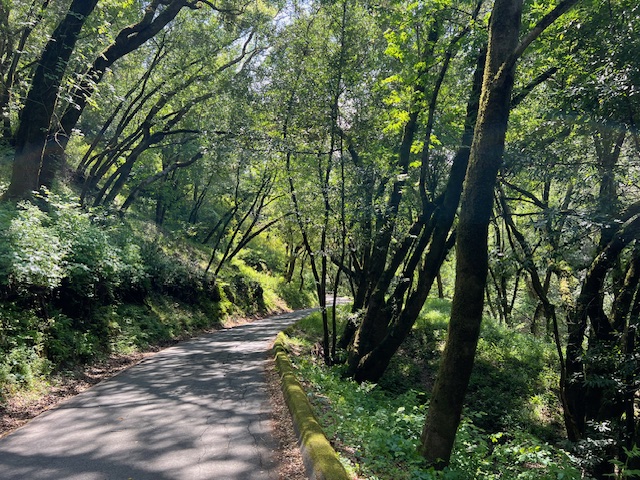
This year’s Apple Blossom ride took place a little late. The best time to see the Gravenstein apple blossoms is about mid-April although it depends on the weather. Cold, wet winters delay the bloom even if climate change is accelerating their display. We couldn’t make time to head up to Sonoma county until now and unfortunately it’s becoming a bad habit of ours to list our rides with short notice. But we currently are not in a position to plan far in advance and just have to make hay when the sun is out. I was determined to get up to western Sonoma county this year as we hadn’t done an Apple Blossom ride since 2022. That’s too long a hiatus!

Being the sole Spoker who still remembers the old days of the club albeit feebly, I am the one left to champion some of the rides we used to do. It’s partly because they are great rides even if out of fashion today and it’s partly because these rides bring back cherished memories of riding with club members who are long gone. I call them my “ghost” rides.

Speaking of “ghosts”, the originator of the Apple Blossom is Michael John (“MJ”), the club’s second president and ChainLetter editor. He was also one of the two Spokers instrumental in the club organizing the first AIDS Bike-A-Thon in 1985 along with the SF AIDS Foundation. For that very reason I’ve been in touch with Michael, who now lives back East, and you shall soon hear his story of how the first AIDS Bike-A-Thon came to be. (The other key person was Bob Humason, the club’s third president, who died of AIDS in 1989.) He first led the Apple Blossom in April 1984 and it has various incarnations all of which involve going from Sebastopol out to Occidental and back. MJ told me that he loved to ride in Sonoma and he wanted to get the club out of Marin where apparently we rode much of the time. MJ later bought a house and moved to Petaluma. He also originated the Guerneville Weekend as well as designed the 1985 Bike-A-Thon route.

A veritable horde of invisible cyclists

Sebastopol is about an hour north. We headed over the Richmond-San Rafael bridge. There wasn’t a single cyclist or pedestrian on the entire span for a sunny Sunday morning, just a couple of fisherman. To argue that the bike path should remain is a hard sell when drivers see no one using the path and are seething at the backup. Make America Drive Again! From there it’s a pleasant roll north to 116, which will take you straight to Sebastopol.

As I’ve mentioned in the past, riding in west Sonoma county is a mixed bag. It’s beautiful, a combination of rolling forested hills and rural ag land mixing fruit trees, vineyards, and cattle. But many of the roads are poorly maintained making for boneshaking adventures. It’s completely schizophrenic: one road is smooth asphalt and the next one is so degenerate that the patches are on top of patches that are on top of other patches. Although car traffic is light most of the time, there are roads that see a lot more cars because they actually go somewhere that people want to go, e.g. the coast. That combined with inconsequential road shoulders almost 100% of the time means that you can’t completely goon out on the scenery and have to keep an eye for fast cars and crater-like potholes.

You also have to like steep hills. The climbs here are not long but they go straight up. Gradients above 10% are not uncommon. But that’s part of the fun—they’re a rollercoaster of slow ups and very fast downs!

We were very much looking forward to this ride. Despite the quality of asphalt the rural ambiance more than makes up for it and is a great solace in these times. If there is development happening out there it is very slow. The impediment is likely the lack of water. With no urban sewage and water system, homes are dependent on septic systems (= needs plenty of land) and wells. Sebastopol is the “big city” in west Sonoma of about 8,000 and even it uses wells for its water supply.

Whatever the water situation in town the hills were still completely green even though almost everything in the East Bay where we live is now a dusky brown.

We always start our rides at the Sebastopol Center for the Arts for the mundane reason that it has plenty of car parking nearby and the adjacent park has a restroom. Heading west on Bodega Ave we turned south on Pleasant Hill Road and become reacquainted with gruesome asphalt; the tire tracks in the lane are decrepit and we have to hug the right edge to escape the bumpiness as cars pass us repeatedly. We’re both on pretty big tires, Roger on 32 mm and I on 42 mm. They make a huge difference on Sonoma asphalt; if you’re riding 28 mm tires, that will do but you’re better off putting on something bigger to cushion all the jarring. A southwest wind is hectoring us. Once we turn onto Bloomfield Road it becomes well paved as we pass by open farm fields with grazing cows. After we turn southwest onto Roblar we get the double-whammy: a challenging headwind and pleasure-seeking drivers zooming to Bodega Bay. Fortunately the sight lines are good for them even if there is no shoulder for us.

Late bloomers

Here and there we’re spotting blooming apple trees. The bloom is almost entirely over. But a few trees are behind schedule—late bloomers. It took them a bit longer to ‘come out’. Mostly what we’re seeing is old orchards that are either abandoned or have been replaced mainly by grapes with a few remnant trees as a historical reminder. Gravensteins are hard to get these days. But I remember getting them at the old CO-OP markets—remember them? Probably not because the last one closed in 1988. Probably the only place to get them these days is specialty produce markets like Berkeley Bowl. Gravensteins were once king in the Bay Area; now they are almost completely gone.

It’s just a short hop on Valley Ford, which has even faster traffic but it has a great shoulder. Turning north onto Bloomfield Road the wind suddenly vanishes and we have zero traffic! Whatever Bloomfield was in the past, it’s now a mere dot on the map with a liquor store, what looks to be a closed Masonic Hall, and a volunteer fire department. Now instead of constantly rolling hills we get a real climb. It’s only been about 13 miles but my legs have been sapped by the wind and rollers. I slow to a crawl while Roger rides away from me on Burnside, which is a long, steep grind. We come upon a flock of turkeys in the road, an increasingly common occurrence. Those turkeys can run faster than I can climb! For whatever reason they run up the road rather than off to the side. So I get to see them caper in front me for an entire mile.

Roger is waiting for me at the top. Except that it’s not the top; it’s just one of the “tops” as we roll along a ridge line in the hills. We cross the Bodega Highway, which is a continuation of Bodega Avenue and continue north. Part of me wanted to turn onto Bodega because Wild Flour Bakery is literally just down the road in Freestone. But we continue north on Jonive, which has a short but nasty 13% grade, which is obscured on Google Maps.

At Occidental Road we turn west to get our lunch in town. There’s a climb to a summit and then a big drop into Occidental, which we would have to climb back over after porking out at lunch. By the route we took it was 23 miles to lunch and it would be only 9 to get back to Sebastopol. Needless to say we took the long way to lunch.

We usually stop at the Union Hotel Restaurant but not always. Back in the 1980s when ‘loudmouth’ Mike Reedy got into this ride, he decided to lead it himself and he always stopped at the Union Hotel. Being Italian-American he liked the menu. It was pretty good too so I started going there for lunch when I led it. It has an outdoor courtyard for dining and had a nice selection of pastas, salads, pizzas and main courses. I say “had” because we found out when we arrived that for some reason the menu has been drastically pared down to just a couple of salads, pizzas, and grilled chicken. These are hard times for restaurants especially those in the boonies and not on Restaurant Row. So whatever!

It had been sunny all day but not hot. Sitting in the Union Hotel courtyard was perfect and you could pick your spot either in the sun or in the shade. With our bikes locked up at the gate and in sight, we were set for a pleasant lunch and needed break from all those hills. Although only half-full when we arrived, the courtyard soon filled up. It was Mother’s Day after all and there were several tables of mothers being treated to Sunday brunch. I overheard one table lamenting that Howard’s Station—another Occidental hot spot—the wait for a table was an hour and a half long. They bailed and came to the Union Hotel.

It was hella delicious but too much!

We ended up with pizza and a salad. They had only one size, ostensibly a 12-inch, that measured out larger than that and would have been plenty of food for four. Being just two and not intent upon gorging with a hill after lunch, we left a lot of pizza on the table! Besides being physically large (and delicious), it was verging on Chicago-style with how deeply the cheese had been piled. The generous mushrooms and sausage floating on the sea of melted cheese were extra good. But it’s the wrong time of year to be putting on ‘winter’ fat, alas.

Back on our bikes it was hard slog up the hill with a carb-and-fat bomb in our stomachs. But once at the top it was essentially one long downhill back to Sebastopol. Now with a tailwind we returned to Sebastopol in what seemed like a flash. Back at the car we were still too stuffed to go to Screaming Mimi’s, the traditional post-ride refreshment, for ice cream. If not for the coffee at lunch I would have been in a fat coma.

Marvelous day, a good workout—I was tired!—and a delicious lunch. All told it was just 32 miles but despite what RWGPS said—about 2,400 ft. of elevation gain—we both ended up with over 3,000 ft. on our Garmins. Maybe that will balance out the lunch.

If you’re interested in doing this ride, keep in mind that Caltrans is still working on the Highway Expansion That Will Never End: a long section of 101 by Petaluma is just two lanes each direction and traffic snarls up as the day goes on. If you head up to Sebastopol to ride in west Sonoma keep that in mind. Another option is to take the SMART train from San Rafael to Cotati and simply head west to access the Apple Blossom by getting on Roblar Road. The beautiful countryside awaits.

Ride Recap: May Jersey Ride and Short & Sassy Tib Loop

Jerseylicious!

Ginny reports: “Alas I don’t have any photos! Everyone was accounted for on the Short & Sassy including Peter, whom we met at Woodlands Market with his new bike. [Ed. New bike day = better than any birthday!] Janet met us at the bottom of Camino Alto and we sang “Happy Birthday” to her. Tomorrow is her birthday. There were ten people total including the Jersey Ride. We weren’t together long because unfortunately we had a flat tire. But we were able to fix it and get back out there. So the group split up and half left Woodlands earlier than the others. Also unfortunately, later Scott fell and broke his wrist while getting off the bike. He was in Sausalito planning to take the ferry back. Luckily Nancy was with him and went to ER and drove him home.”

Stephen reports: “The Jersey Ride started out from Peet’s on Market a little after nine on an exquisite spring day that eventually got quite hot over in Marin. There were six of us, including two non-members, Alex and Yoko, who found us through the listing on the SF Bicycle Coalition website. We enjoyed the day with them, showing them their first crossing of the Golden Gate Bridge on a bike and their first experience of Paradise Loop. We met up with the three of the Short & Sassy crew at the roundabout on the Mill Valley bike path. We had lunch at Woodlands Market together before a bunch of folks headed off a little early to catch the Sausalito ferry at 1:30 PM leaving five of us to complete the full route. The Bridge on the way back was blasted by a heavy, brutal, cold wind but we made it back safely. Alas, those at the ferry had a disaster: Scott fell boarding the ferry and broke his wrist. Nancy made sure he got to the hospital and he is now at home recovering, likely in a cast for three months.”

I’m Fixing A Flat: Index of posts

I’m fixing a hole where the rain gets in
And stops my mind from wandering
Where it will go
—Lennon/McCartney

The series of articles about considerations in fixing flat tires spans twelve posts that are spread over five months and you might not be able to find a post easily. Here is a list of the posts and a brief summary of the topic it covers.

  1. Introduction: Motivation for these articles
  2. Part 1: Preliminaries
    — Supplies to carry to handle a flat tire
    — Fix the flat now or do it later?
  3. Part 2: Getting A Flat
    — Can I ride on a flat tire?
    — What’s causing my flat?
  4. Part 3: Removing Your Wheel
    — Quick releases, thru axles
    — How to safely remove a wheel that has a thru axle
    — How to safely remove a wheel that has a quick release
    — Inspecting the outside of the tire
  5. Part 4: Removing The Tire
    — Presta or Schrader valve
    — How to use tire levers to remove a tire safely
    — Inspecting the inner tube for the site of the leak
  6. Part 5: Spare Change
    — How to properly install an inner tube in a regular or tubeless tire
    — How to remount the tire safely
  7. Part 6: Inspect Your Repair
    — How to inspect your repaired wheel to make sure it’s safe after you’ve installed a new inner tube
  8. Part 7: Pump It Up
    — Methods of reinflating your tire: types of inflators
  9. Part 8: Reinstalling Your Wheel
    — How to safely reinstall a wheel that has a quick release
    — How to safely reinstall a wheel that has a thru axle
  10. Part 9: There’s No Place Like Home
    — Repairing your flat inner tube after you’re home
    — Is it worth saving the tube or better to toss it?
    — Types of patches
    — Patching butyl, latex, or TPU inner tubes
  11. Part 10: What About The Tire?
    — Inspecting the tire for damage and wear and when to replace
  12. Part 11: Rarities
    — Low probability causes of flats: rim failure, spoke damage, rim strips

Ride Recap: Cañada Saturday-Portola Loop

Upper Alpine Road (before the dirt)

Ed. Nancy sent in this recap of her and Cathy’s ride last Saturday.

“Our ride went well. We had a chilly start but the sun eventually poked through. We did a slight variation in the official RWGPS route. It was a silky smooth ride down Cañada Road through Woodside and up Alpine Road. On the way we stopped at a lovely park for bathrooms and water at the Portola Town Center. We climbed along Corte Madera Creek, which was still running. After reaching the top, we headed to Roberts Market in Portola Valley. It’s just as nice as the one in Woodside and has a few outdoor tables, which is nicer than sitting on the wall or sidewalk in Woodside. But note – there are no public bathrooms at this Robert’s either. The rest of the ride was more trafficky especially turning left onto Sand Hill and avoiding the freeway on- and off-ramps. This isn’t my favorite part of the route but I’m not sure if there’s an alternative to getting back to Whiskey Hill other than doing an out-and-back to the top of Alpine Hill. I’d consider that although it would cut about five miles off the route. However I’m open to suggestions. All in all a lovely ride. I will list it again if folks are interested.”

Interested in doing this ride? Let Nancy know and maybe she’ll lead it again! Here’s the route more or less that she and Cathy did: https://ridewithgps.com/routes/43746247

Redwood-Norris Did Not Disappoint

This is a loop that is definitely not in the canon of ancient Different Spokes rides. Redwood Road appears a few times in club rides but they are likely all of recent origin; I don’t recall any club rides going on Norris Canyon except the old Hekaton Century, which several of us Spokers did fairly regularly back in the day. Norris Canyon in particular is literally an outlier because it’s pretty out-of-the-way for a rural road that’s smackdab in the Bay Area. That you need to ride on Crow Canyon Road in order to get to it is probably one of the reasons we avoided it because Crow Canyon is a cut-through arterial for traffic from the San Ramon Valley—Danville, Dublin, San Ramon, etc.—to get over to I-580/238 without having to endure the terrible intersection with I-680. I recall making the mistake exactly twice of riding on Crow Canyon during the week. The road has sections with no shoulder, the traffic is hella fast (when it isn’t backed up), and drivers careen with abandon when they can. Weekends are less deadly but it’s so wide open that the speed limit is merely a recommendation to be ignored completely. But if you endure Crow Canyon you get to ride on Norris, which is very empty, in fact the epitome of a country road yet it’s surrounded by development.

The last time we did Redwood-Norris was in 2022, a club ride that everyone seemed to enjoy thoroughly. Then January 1, 2023 Redwood Road collapsed and remained closed until earlier this year. That put an end to Redwood-Norris for two years. Actually on that date Roger and I were going to do that ride. We came upon the road collapse and walked around it. But after tippytoeing across, we got to Norris and encountered a river of mud: the same storm had inundated Norris with a couple of feet of mud. To get home we had no choice but to chance Crow Canyon, which we barely got through. So it’s been three years since we’ve ridden on Norris.

Despite the diminution of rain this winter—about 15% less than normal—the hills here have managed to stay pretty green. Early May is often when the hills are noticeably brown. But this year not yet! So I was hoping Norris would still be verdant and it was.

No one signed up for our ride. That we posted it somewhat late might be part of the reason. Back in the day Spokers had to get their ride listings in early because they were available only through the printed ChainLetter—remember that club monthly newsletter we used to have?—but now we can announce rides as late as we want because Internet. I used to (mentally) chastise ride leaders who posted their rides late—what were they thinking? How could people make plans to join your ride if you don’t announce it well in advance? Now I’ve become one of ‘them’!

When I checked the ride registration in the morning and still no one had signed up, I thought, “Oh goodie, we don’t have to rush to meet anybody.” I closed registration so that no one would show up at the super, very late last-minute. So we ignored the official start time and had a leisurely Sunday morning before heading out.

Today was also the Grizzly Peak Century so I was expecting to see more riders since it uses Redwood Road as well. We saw the century markers on the pavement but actually didn’t see many riders perhaps because the southern loop of the GPC comes later in the ride.

It’s delightful to ride Redwood Road again. The whole thing is surrounded by open space so it feels very much like being in the country. Roads like Redwood and Norris Canyon are rarities in the Bay Area, Development continues to scoop up private land here in Contra Costa. In theory the way housing development is supposed to happen is by infilling in order to preserve open space. Although Redwood is buttressed by regional park land and EBMUD controlled land, Norris is not—it’s private ranches. How much longer will it last? You only have to look down below Norris to see what’s in store: the remnant ranch land adjacent to I-680—and there isn’t much now—consists of just one large parcel. Next to it is a large housing development that just went up leaving that ranch an island in a sea of ugly multi-million dollar boxes. Along Bollinger Canyon the city of San Ramon has allowed another gigantic housing development to take over ranch land there. That’s the first inroad into Bollinger Canyon, which is another pleasant, dead-end country road. Well, enjoy it while you can. It will all be gone in less than a generation.

Today Redwood was strangely quiet despite the Grizzly Peak Century. There was a paucity of cars, motorcycles, and cyclists for a beautiful, sunny Sunday. Roger and I were chilling up the climb, just enjoying it. At the top we dropped down past the now repaired road collapse and stopped at the Redwood Canyon Golf Course, the traditional pit stop. On weekends it’s quite busy as duffers work to improve their game and their tan. The place has toilets, water, a diner, and a welcoming attitude for cyclists. Perfect. I noticed mountain bikers heading out behind the building towards Brandon Trail. That was closed last winter too due to storm damage but is now open.

This was our first venture past the golf course since Redwood was shut down. You have to wend through Castro Valley to get to Crow Canyon and then the fun begins: dancing with cars!

Crow Canyon is a gentle ascent. That’s probably why it’s a popular road as it was probably the lowest pass over the hills long ago. It parallels Crow Creek, which was probably quite beautiful ages ago but now has more the appearance of a big roadside gutter. The turn to Norris Canyon is just a couple of miles up Crow Canyon. Upon turning we were surprised: Norris had been completely repaved with new centerline, shoulder markings, and Botts dots. Marvelous! To my recollection this is the first repaving of Norris in my 40-some years of riding it. Norris climbs gently at first and it’s well shaded making it a respite during hot summer days. It’s just about two miles to the top and the gradient gradually gets uglier and uglier, hitting 10+%. Nearing the top you begin to see the ranches that were hidden behind the roadside trees. The hills were still quite green despite the lack of any recent rain; our cool spring seems to have preserved the grasses. Horses and cows ambled on both sides.

At the top you cross into Contra Costa county and the new pavement ended. Instead we’re greeted by “One lane ahead” signs. In seconds we see why: half the road has collapsed and is now controlled by a one-way stoplight. Completing the descent we’re in San Ramon and hyper-suburbanity. We take Danville Blvd. to Danville for a lunch stop. We usually stop at Sultan’s Kebab because it’s veg/vegan friendly and has a great falafel plate. But for a change we go to Domenico’s. Domenico’s used to be a great sandwich place. The food is still very good but the service is slow even on a Sunday. It has a large group in the deli making lunches but it’s for the massive number of online orders they get. Just two are working the long line snaking out the door. Obviously they want you to use online ordering and if you are a walk-in, you are simply inconveniencing them and you should GTFO. Next time it’s back to Sultan’s Kebab (or to Los Panchos for some extra delicious Mex gut bombs).

Over lunch I check email. There’s an urgent email earlier this morning from Brian saying he wants to join the ride and he’s on the way! Oops. Turns out Brian did come over and do the ride on his own. I’m sure he was going a lot faster than we, probably trying to catch us. Except that we were behind him, not ahead of him! Next time I’ll show Brian Brandon Trail as penitence.

After lunch it’s a gentle amble north to Walnut Creek and then to Lafayette and Orinda. Oh, and why did it seem so enjoyable to ride today? Because apparently we had a northerly tailwind all day and only when we turned north did we realize that.

Awesome day: hard but not stupid hard climbs, little traffic, green hills, good lunch. It was totally chill. You should be so lucky!

I’m Fixing A Hole (Pt. 11: Rarities)

I’m fixing a hole where the rain gets in
And stops my mind from wandering
Where it will go
—Lennon/McCartney

This is the final installment on fixing a flat tire. Lastly I’m covering some really low probability problems that can cause flats. In the future I suspect I’ll be revisiting the general topic because cycling technology is continuing to evolve in dealing with flat tires. Some new tech worth investigating include battery powered portable pumps, TPU inner tube sealant (yes!), and wireless tire pressure sensors. There is also some very old tech worth revisiting: tire savers.

The tire is part of the wheel and aspects of the wheel affect the longevity and behavior of your tires and tubes. That includes exacerbating the chance that you will get a flat tire.

The vast majority of bicycle wheels have rims made of metal, either aluminum or steel. Carbon rims are relatively new and being so expensive are a lot less common. How does this affect flats? Wheel—specifically, rim—failures are extremely uncommon but they do happen. If you’ve ever cracked or dented a rim by dropping your wheel into a big pothole, you know what I mean. I personally don’t have any wheels with carbon rims nor have I used any (yet). So I can’t speak about them from personal experience. However it doesn’t take much online research to pull up instances of carbon rims failing after hitting something hard like a rock or pothole. Carbon rims can fail catastrophically and unlike a metal rim they are not going to ‘bend’—they are going to crack or shatter. Obviously this doesn’t bode well for avoiding a flat tire as the rim is the physical structure that contains the tire, the tube, and all that air. A container failure means you are at least going to get a flat and probably a lot worse too such as a crash.

Metal rims fail too. However their mode of failure tends to be bending or denting rather than cracking or shattering. So there is less chance of the ‘container’ exploding apart. It is possible to dent a rim such as by hitting a curb and if the dent sufficiently large enough, it may no longer be able to withstand the pressure inside the tire and you’ll get a flat tire. Odds are such a significant impact is going to result in a snake bite puncture anyway.

A ‘tacoed’ wheel

Another mode of rim failure is ‘tacoing’ your wheel. Tacoing your wheel is when it collapses to one side so that the rim has a taco shape. I have tacoed a rear wheel but it was a mountain bike wheel. I didn’t incur a flat perhaps partly because it had much less air pressure than a road tire. In my case the wavy taco shape apparently was smooth enough not to cause the tire bead to unseat. If you get a flat from tacoing your wheel, you still have to deal with straightening your wheel so you can ride it home. (This is possible but it takes some technique, applying side pressure to the right spots on the rim to snap it back into alignment.)

Spoke puncture

Another way a wheel can cause a flat is if the end of the spoke inside the rim punctures the inner tube. This seems to be much less common a problem nowadays. My suspicion is that automated wheel building has become more sophisticated and precise so that the proper spoke tension is applied. Spokes generally are cut to more or less the correct length so that they don’t protude or protrude very little above the nipple inside the rim. If the spoke is too long, then it may protrude enough that it can punch through the rim strip and puncture the inner tube. There is no guarantee that cheap wheels have properly sized spokes or that they were built correctly. Wheels may have insufficient spoke tension or the spokes become detensioned through use. Also rear wheels are dished in order to center the wheel in the dropouts and make space for the cassette on the right side and the spokes on the drive side (=cassette side) either have to be shorter or under greater tension to accomplish that. Some wheels may use the same length spoke on both sides. That requires the right side spokes to have more tension more to pull the rim to the right and this will draw more spoke into the nipple potentially allowing the spoke end to protrude above the nipple. If you need to have your spokes adjusted because of a broken spoke or a rim wobble/hop, you will want to make sure that the spoke ends do not protrude too much above the nipple. Keep in mind that this depends on the rim design as well: an aero rim has a deeper rim cavity and even a lot of spoke protruding above the nipple isn’t going to cause a puncture. However a box section rim might may not have much height between the top of the nipple and the rim floor and a protruding spoke end might cause a problem. Riding a wheel with insufficient spoke tension often causes the wheel to wobble and warp. If you don’t catch this early, the metal rim can take a set so that when you try to bring the wheel into round you have to apply even more tension to some spokes and lower tension to others. This can draw too much spoke into the nipple. One more caveat: if your wheels have single wall rims—not very common anymore—rather than the typical double-wall, you definitely do not want ANY of the spoke protruding above the nipple!

Of course if you have wheels that don’t have spoke holes, this is not going to be a problem.

Any damage to a rim that causes it to go out of round, i.e. it wobbles from side to side or hops slightly up and down, is going to result in uneven spoke tension when you attempt to repair it and bring it into round because some spokes are going to have to tensioned higher to pull that part of the rim into round and other spokes have to be looser. So the spokes with higher tension are going to be pulled into the spoke nipple further and may protrude above the spoke hole and puncture a tube. If you have such a flat and pay attention, you’ll notice that the inner tube has a hole on the underside rather than the tread side. That’s the clue to look for a spoke that’s too high or a partially exposed spoke hole.

The solution is to replace it/them with a shorter spoke(s) and that’s a repair that you should leave for a professional, as sizing a spoke let alone even having a variety of spoke lengths is not for the amateur. However if you do go this route you should know that your wheel is compromised nonetheless because the spoke tension is still going to be uneven. If in order to have a round wheel you have some spokes that are very loose, you are simply delaying having to replace the rim because those spokes are not doing much to support the rim and the other spokes under higher tension are more stressed and thus more likely to fail. You are better off replacing the rim and having the wheel rebuilt even though it’s more costly than replacing a few spokes.

Incurring a broken spoke and not repairing it quickly can also cause uneven spoke tension. Riding an unround wheel seems to ‘set’ the rim into that shape, i.e. the rim is now bent. This results in needing more/less spoke tension in order to make the rim round. If you incur a flat from a spoke that was tightened so much that it protruded above the nipple and into the tube, you are probably better off getting a new rim rather than you or your mechanic trying to ‘make it work’ because that rim is now compromising your spokes.

Rim tape not fully covering spoke hole = flat tire

Rim strips are another potential cause of flats. Rims that have spoke holes must have something to cover those holes otherwise the air pressure inside the inner tube will force it through the spoke holes and cause a flat. Rim strips come in different widths in order to fit the inner diameter of the rim. Wheels intended for 23 or 25 mm tires generally have a narrower internal width than newer rims intended for gravel or dirt. These rims take a narrower rim strip. If your rim strip is too narrow it won’t cover the spoke holes completely. Even if the rim strip just barely covers the edge of the spoke holes you will want something slightly wider because rim strips move around despite the adhesive backing (if any). The air pressure at the spoke holes can cause the rim strip to move; removing tires and using tire levers can cause the rim strip to move as well. Plastic rim strips age and can crack or break; cloth rim strips also age and can stretch. The sharp edge of a spoke hole can cut an inner tube. If you’ve gotten a flat and notice that the puncture is on the underside of the inner tube, it’s likely a spoke hole that caused it and you will want to inspect your rim strip and either move it or replace it or else you’ll just get another flat.

Although you want a rim strip that is wide enough to cover the spoke holes completely, you don’t want a rim strip that is too wide because this can make it difficult to mount and remove a tire or prevent the tire bead from seating against the rim correctly.

If you are running tubeless tires and your rims have spoke holes, then they are covered with tubeless rim tape. Although you don’t have inner tubes, this tape also functions to keep the air in the rim cavity. So if the tape moves and exposes a spoke hole, air is going to go into the rim cavity and you’ll get a flat. Sealant in your tubeless tire will also flow into the rim cavity. This potentially is a problem if your sealant contains ammonia and you have aluminum rims or spoke nipples because ammonia reacts with aluminum and weakens the metal.

SF to SJ: a ‘rambling’ ride recap

Do you know the way to San Jose?
I’ve been away so long
I may go wrong and lose my way
–Burt Bacharach/Hal David

Whew, what a day! This past Sunday David, Alan, Nancy, and I did the dirty and rode all the way to San Jose. When all is said and done our foursome survived a 76-mile day, some with more grace than others.

SF to SJ is a concoction of David Goldsmith whose eyes light up whenever he opines about this ride. He just loves this ride and has led it many times for the club. That he worked at various locations on the Midpeninsula over the years means he has ridden his bike from SF down the Midpeninsula and taken Caltrain back a zillion times. But instead of getting tired of it, his commutes have only made his affection for the ride grow. When no one stepped up to lead this ride for the Winter/Spring series, David stepped forward even though he’s been back on the bike for less than two months. And he finished the ride with aplomb!

The ride name ‘SF to SJ’ describes the ride succinctly. However there are a myriad of possibilities cycling to San Jose and all of them involve getting through a bottleneck of sorts around Daly City and South San Francisco. There just are not good ways for road cyclists that don’t involve lots of traffic. This version of SF to SJ uses Skyline Boulevard. Two other main ways are the Bay Trail and El Camino. Although the Bay Trail might involve fewer dangerous interactions with cars, it’s also less direct and slower; even worse you’re stuck on busy suburban streets for almost the entire route. Another option is El Camino, which is fine if you don’t mind riding on a busy arterial amidst a lot of cars, a lot of stop lights, and you like dodging car doors being flung open willynilly. David’s route settles on Skyline even though the section just south of SF is a high speed getaway route for cars. Eventually you are able to get off Skyline and travel adjacent to or on SF Water property, and the “rural” suburbs of Woodside, Stanford, and Los Altos are snug up against the hills and open space and feel less urbanized. David forgoes a direct route to the San Jose Caltrain station, which would put you in some serious car hell in Cupertino and Santa Clara, by deviating into the hills above Stevens Creek Reservoir and Mt. Eden before descending back to the flats. After some suburban crawling in Saratoga and Los Gatos he cleverly avoids more suburbia by taking the multi-use path paralleling Los Gatos Creek all the way from Los Gatos to San Jose. All told the route has about 4,000 feet of climbing but it’s almost entirely short rollers over almost 80 miles, so this is my no means a ‘climby’ route.

Once in San Jose you can head to Ron Diridon Station to catch Caltrain back to San Francisco or a little bit further north to the Berryessa BART station if you need to get to the East Bay.

I’m wondering if SF to SJ has had its heyday. There was a time when it attracted more participants probably because of the novelty and the sense of accomplishment of doing such a long ride in the middle of the central Bay Area. Like the Death Ride, SF to SJ was a ‘feat’ but now it’s just part of the background noise. But it’s an interesting—I hesitate to use the word ‘nice’—break from riding in Marin and if you get into trouble, you’re never far from a bike shop, a Starbucks, or any other amenity that will either save you or make your plight more enjoyable.

Alan, Nancy and I joined David. Alan is getting ready for ALC so another long ride under his belt was just more grist for the mill. Nancy, presumably like me, is trying to recover some shape, although she is still eyeing the Chico Wildflower as her next stunt. Why did I do this ride? Under other circumstances I would not have considerered it but it was well-timed. I had been planning to redo the 1985 AIDS Bike-A-Thon route on my own since this its 40th anniversary would be on April 6. But I haven’t been able to get ready for it the way I would like. Plus, I’m much older now and I haven’t done a true one-hundred mile route in probably 15 or 20 years. So that has been tabled for now. Since I had done a couple of 60-milers and a 70-miler this spring, I was ready to step up, so SF to SJ fit the bill since it would be 80ish miles from my home.

If you live in SF the overall day is simple: do the ride, catch Caltrain back home. But I had to get from the East Bay to SF and back. I had to cycle to BART, take BART to the City, ride to the start, then do the ride. After the ride it was Caltrain to Millbrae, transfer to BART, return to the East Bay, and then ride home. It ended up being a 13-hour day for me and I arrived home after dark.

I had done this ride only once before, in 2014. That was a misadventure: I was unfamiliar with the route, my Garmin died midway, and I cramped badly after it died and the group took off without me. I had to struggle to keep someone in sight praying I wouldn’t get lost. It was a hot summer day to boot. By Los Gatos I was toast from cramps, heat, and dehydration and only my reptilian brain was still functioning enough to get me to Caltrain.

That experience plus struggling all spring to get back into shape left me very wary of doing this ride. At least now I have a better Garmin with a longer battery life. I also set my goal to go very conservatively even if people took off without me. I now drink electrolyte fluid instead of plain water and am more conscientious about drinking. I also planned to drink pickle juice prophylactically to stave off cramps.

I had to leave the house at 6:50 AM to make it to Peet’s for the 8 AM departure. BART is pretty empty on an early Saturday morning. That gave me plenty of time to brood over what sorry fate would befall me this time. This year David wanted to head out Golden Gate Park and check out the new Sunset Dunes Park. That was going to be a lot nicer than in 2014 when we cycled through the Mission and and Outer Mission to catch Skyline.

We weren’t sure if Sunset Dunes would even be open to cyclists given that it is still a work-in-progress. Also the City’s sand erosion project had just started up at Ocean Beach and sections of the Great Highway are supposedly closed. But it was open and there were a lot of people enjoying the cool beach breeze and morning overcast. What will this park look like in a year? Right now it’s pretty urban and scruffy; and there really isn’t a need for two two-lane roads through the park! We rode up the Great Highway Extension even though technically it’s closed, skidding over numerous small piles of sand. I was thankful for having wider tires!

Even when I lived in SF I rarely rode Skyline out of the city. In the ‘80s it was a hell pit of fast cars and innumerable random piles of broken beer and wine bottles. Dodging broken glass while trying to avoid getting sideswiped by high speed cars always made for a tense ride. In the late ‘90s on one ill-fated club ride taking Skyline I flatted no less than seven times. After the third flat I turned around and sustained four more before I got home! Had it changed much? Yes and no. Cars still speed with abandon. However in the intervening period car drivers’ indifference or animus towards cyclists perhaps has diminished. Even though they’re not going any slower, they no longer hug the shoulder line and will actually give you space. The immense amount of broken glass seems to have been replaced with copious gravel and dirt instead. What will it take for Caltrans to actually maintain the entire road? For us cyclists it’s still Jim Crow: second-rate infra for cyclists.

Skyline is a bit hilly. Alan being in the best shape of all of us was motoring up the rollers easily while the three of us took our time. We stopped at the Lunardi’s Market at the 15-mile point for a quick refueling and bathroom break. I never eat breakfast, even before a ride. Although not famished I was now ready to eat. I settled on sushi. A bento of California roll was perfect: rice for carbs, a few veggies, and soy sauce for salt! Alan got some as well only the bigger bento; David got a small pecan tart. I like Lunardi’s. It’s a very small market chain and seems to have taken on the mantle from Andronico’s after it went bankrupt of being the customer service driven market with a lot of niche products and fantastic produce and a real meat market. As I waited in line to check out, I noticed the clerk chatting familiarly with the two customers in front of me as well as the one behind me. He knew their names and asked about their family and what they were doing for Easter. Obviously this Lunardi’s was the neighborhood market. When was the last time employees at the supermarket spoke to you as if you were a neighbor?

After Lunardi’s we escaped streets for quite a distance by taking the San Andreas Trail and then the Sawyer Camp Trail. This is really the beginning of the nicest part of this route, from Lunardi’s all the way down to Stanford. Back in the day we avoided the Sawyer Camp Trail because complaints about cyclists forced the park to establish and enforce a speed limit for cyclists. It was something ludicrously low, like 8 miles an hour. Essentially they were telling cyclists not to use the trail. I recall rangers using radar guns to ticket cyclists. Instead we used the streets parallel to I-280 and even at one point used I-280, entering on one ramp and immediately exiting at the next. This was illegal at the time but the only other option was a really arduous diversion. Eventually it was made legal for cyclists to use that section of highway because there was no comparable substitute byway. Now the speed limit is up to 15 MPH–pretty standard for MUPs and we’re back to riding on it.

As convenient as these trails are—they are ‘trails’ only in name since they are fully paved–they are really just multi-use paths and are well used by walkers and many other cyclists making for ‘interesting’ encounters. Although 8 miles an hour may seem very slow there are numerous tight bends with awful sightlines where it actually makes sense to cool your jets. This day it was very busy with day hikers and families out enjoying the fine, sunny weather. I didn’t mind going slowly since that was my theme for the day and it was great for the trails to finally be open again. After the storms of 2023 both trails were severely damaged and only up until a month or so ago for them to reopened after all the repairs, fire mitigation, and utility restoration.

From the Crystal Springs Dam it was a hop, skip, and jump down Cañada Road to Roberts for lunch. Nancy was telling me she’d like to come down here more often to ride. It’s not that hard actually: just take BART to Millbrae and ride up (well, really up!) to the Sawyer Camp Trail and skip all the traffic. Or, skip the short yet horrendous climb from Millbrae up to the trail by taking Caltrain further down and taking one of the more gentle climbs up to Crystal Springs.

Whether it was due to anxiety, copious rehydrating, the lack of heat, or age, my bladder was having a field day and I was having to stop to pee whenever the opportunity arose and even a few times when there was no ‘opportunity’. I peed no less than 11 times on the ride. Unlike in 2014 my ride mates were regrouping often so I was always able to catch up.

Rolling down Cañada Road is always a delight. It’s long, rolling, and has no development to ruin the attractive views of the reservoir and the surrounding hills. Although the Filoli estate fronts on the road, all the buildings are set so far back that you’re in no danger of suffering a Dynasty flashback. The end point is central Woodside and the lunch stop at Robert’s. As usual for a weekend the intersection was a mishmosh of every kind of vehicle trying to horn its way through the four-way stop. Horns ablazing. It’s also like some faux bro version of an Amsterdam intersection with hordes of cyclists in MAAP, Pas Normal, and Rapha kit on their Cervelos, Pinas, and Tarmacs parading and preening on their way to the next Strava segment. We parked in the shade to woof down some grub. Deterred by the long deli line, I made the mistake of grabbing a “chicken teriyaki” bowl. Protein, rice, veggies—what could be wrong? Plenty it turns out: the brown rice wasn’t completely cooked, the chicken was dry, the veggies were raw, and the teriyaki sauce dauntingly cloying. Ah, fuel for the body but not the soul.

By now it was bright sunshine although not overly warm at all. I was still in my windbreaker but it was soon to come off. Once over Sand Hill we dropped to Foothill Expressway for the long leg down to Los Altos. Despite being a major thoroughfare in the middle of the Midpeninsula, Foothill never feels like you’re just a mote in Cartown USA. The shoulder is wide, the traffic usually fast but not scary fast, and not very busy at all. You can get rolling very fast on Foothill—it almost encourages you to pedal faster. But not today—I was still in survival mode and riding well within my limits. David and Alan were pushing faster but I didn’t want to risk cramps. On one of the rollers David slowed down and I could see he was flagging. Considering how little he has ridden it’s praiseworthy that he made it this far and as fast as he did. I paced him for a while but then he surged ahead.

We headed up to Stevens Canyon Reservoir and we were out of the suburbs temporarily and into the foothills, strangely quiet given how close we were to the center of Silicon Valley. Even the car traffic dwindled. After a pit stop at the reservoir Nancy waved me ahead and that was the last I saw of her. A few minutes later I looked back and didn’t see her at all. Hmm, she must really be slowing down, I thought. Ahead was the last hill, Mt. Eden. It’s by Midpeninsula standards just a moderate climb, maybe a mile or two long and no more than 6-7% at times. At the top the view of the Santa Clara Valley was a nice reward. We waited for Nancy. And waited and waited. Flagging down cyclists coming up the hill we asked if they had seen her. Nope. Hmm, could she have taken a wrong turn? After a long wait, repeated phone calls and texts and no reply we were getting concerned. But being pretty tired we were no mood to launch a search party and backtrack. Go up Mt. Eden a second time? Nope! It was starting to get late anyway so we hoped Nancy would figure it all out and make it to Caltrain somehow.

The descent down Mt. Eden I’ve done only a few times, all of them a long time ago. It’s curvy and a bit bumpy with enough gradient to make it dangerous (or at least dangerous for an old fart like me). I took it easy. Alan and David dropped me immediately. Well, my Garmin was holding up much better than the POS I had 11 years ago with battery still at 87%. So I’d make it to the Los Gatos Coffee Roastery by GPS if necessary.

It was back to suburbia. David and Alan were waiting for me at the bottom. This section was actually mega-ugly but maybe I felt that way only because I was tired and wanted refreshment (= caffeine) immediately. Downtown Los Gatos was another moshpit of cars, day trippers, and bikes all slowing to a literal crawl. Now, why do I live in the Bay Area?? Sitting down for some java and potato chips was just the break I needed. Taking stock we were overall in good shape. Alan of course was fine; David and I despite our trepidations and physical issues were not suffering at all. The legs were a little tired but our spirits were still up.

The last segment of SF to SJ is a flat ride of about six or seven miles from Los Gatos to Caltrain most of it along Los Gatos Creek. The good news is that the multi-use path gets you away from the interminable cars, stop lights, and busy traffic. The bad news is that the path is well used on weekends by every form of alien life—kids on e-motos, clueless peds, Lime scooters—you name it. The path is also quite curvy and spine-tinglingly narrow at times especially when it dips below the many overpasses. During winter storms I’m sure the path is flooded and unusable as we were almost down to creek level at times. David and Alan rushed ahead and I did my best not to collide with the ‘wildlife’ peppering the path.

We exited the trail in the Willow Glen neighborhood. The tradition is to stop for frozen yogurt but it all depends on the timing of the next Caltrain departure. It was 5 o’clock and the next train was at 5:26, so we forwent the treat and headed to Ron Diridon. We made it with a few minutes to spare. By now we were about an hour behind my planned schedule of about a ten mile per hour average for the day. But overall it had been a chill day, so no worries or complaints.

David was delighted he had done the whole route on such little training; I was relieved I didn’t have a crisis; and Alan looked fresh as a daisy. In fact, the next day he was set to do a 90-mile ride in preparation for ALC. Talk about hardcore!

This was my first experience on the new electrified Caltrain. The bike cars are also improved. In contrast to BART the ride is smooth and quiet rather than rickety and ear-splitting. (Ear plugs are de rigueur on BART!) The calm was deeply appreciated. While heading back to SF we finally got word from Nancy. She indeed had taken a wrong turn and ended going up Redwood Gulch before giving up and backtracking. If you’re not familiar with Redwood Gulch, it’s a beautiful climb up to Highway 9. But it also hits 15% or more, i.e. it’s hella steep. She got bonus climbing points as then she had to go up Mt. Eden. I was relieved she was okay as the worst fantasies of her lying in a ditch somewhere had popped into my head during her long radio silence.

I deboarded at Millbrae to transfer to BART to get home. After two prolonged transfer stops, Balboa Park and 19th Street, I finally made it to Orinda at 7:50 PM. A two-and-a-half hour commute home. The fact that I was able to do this ride multimodally and not use a car was the plus; the lengthy commutes were the minus. It had been a 13-hour day on the road. But to my relief and self-confidence I did the whole thing rather painlessly by sticking to my game plan and came out the other end none the worse for wear. Next stop: one hundred miles.

Postscript: I live in fear of painful nocturnal leg cramps after a hard ride. But this time other than some minor foot cramps I had no sequelae. David, on the other hand, related to me the next day that he woke up screaming in the night with leg cramps. Ah, no pain, no gain. We’re pedaling off into our old age creaking, complaining, and gnashing our teeth. But we are still pedaling!

Postscript 2: I spoke with Nancy after posting this account and got more details on what happened to her. She went pretty far up Redwood Gulch to the point where she had to walk her bike, where she then gave up and turned around. I know exactly where that is: there is a point where the gradient on Redwood gets stupidly steep, at least 17%. And it feels like it! Although turning around was a right thing to do, if she had continued it would have flattened some and Redwood Gulch then intersects Highway 9. From there it would have been a descent to Saratoga and she would then have been back on route. However when she turned around and got to the “bottom”, she turned left to continue up Stevens Creek, which was the wrong way. Stevens Creek eventually dead-ends at a dirt trail. At that point she was at a loss what to do. Luckily she ran into another cyclist who was able to take her back to the Mt. Eden Rd. intersection where she continued on route. Those two wrong turns were not only debilitating but long. She made it to Caltrain and just missed the train. Rather than wait she rode to BART and took it to SF. She got home after 10 PM! So Nancy takes the award for Most Miserably Long Multimodal Mishegas. Oh, and she didn’t get dinner until she got home.

Ride Recap: April Jersey and Short & Sassy

April 2025 Jersey Ride and Short & Sassy riders

The monthly JR and the Short & Sassy Tib loop took place without any drama. At the last minute Roger and I decided to do an East Bay Tiburon Loop and meet everyone at Woodlands Market. From what we could tell it looked like the entire central Bay Area had clear, beautiful blue skies and bright sunshine. It was slightly cool but it warmed up nicely by the time we were eating lunch at Woodlands. The JR consisted of David Go.; Chris, the ride leader, leading his very first Different Spokes ride; and Roger S. The Short & Sassy were Ginny, Nancy, Cathy, and newer member Michelle.

According to Chris their groups had an uneventful ride to Tiburon with David Go. and Nancy deciding to lead the pack into town. David had abandoned the JR years ago as he too had had his fill of the lemming race across the Golden Gate Bridge and instead has been doing the S&S. Now he’s back to doing the JR presumably because he’s interested in longer rides even if they are filled with more drama and near-death experiences. Our ride across the Richmond-San Rafael Bridge was in contrast practically like crossing the desert with the almost complete lack of two-wheeled traffic. As usual we were accompanied by the deafening cacaphony from the cars hurtling westward making for a Jekyl-Hyde experience, the peaceful Bay along with the 65+ MPH urban misery in the lane to our left.

For some reason traffic heading into San Rafael was very heavy and slow. No one was turning into San Quentin so it must not have been visitation causing the crowding. Thankfully we left the other ‘prisoners’ ‘in their metal buckets to their plight when we turned south to head to the loop.

What can one say? Paradise Drive is aptly named. How fortunate to have a home in such a peaceful setting even if it does mean you can’t just walk to the corner for a take-out dinner. The cyclists were out in force and we were passed by many in both directions. Dropping into Tiburon is always welcoming: the ferry pier, beautiful lawn by the Bay, and plenty of daytrippers out enjoying the sunshine and water.

We got to Woodlands about five minutes before the others rolled in with big smiles on their faces. We were shoehorned into a table on the far side of Woodlands because the usual tables had other diners. We crowded around our table while Nancy and Michelle were relegated to the adjacent tiny kids’ table. I got a chance to chat with Ginny about her recent Spanish language immersion trip to Mexico City and how it compared to one in Spain. (It’s better to go to Mexico because they’re more patient with tongue-tied Americans than the Spanish, who immediately switch to English.) There was a long discussion of the preferred way to get out of Tiburon, either detour through Strawberry Cove or take the direct route on Tiburon Blvd. The group decided to go back on Tib Blvd.

The fair spring weather obviously brought out hordes of folks as the foot-, pedal-, and automobile traffic in Tiburon was borderline ghastly. Predictably everything jammed up at the 101 intersection and that’s where Roger took the lead to head up Horse Hill rather than go up Camino Alto for our return. The others were ahead so we bid them a telepathic adieu.

Horse Hill has been the ‘easy’ way to get to Larkspur ever since I moved to SF. It has less vertical than Camino Alto and absolutely no traffic. The devil’s bargain though is that there is short but steep 12% section. On just about any other day it wouldn’t have bothered me. But this day I was flagging and I had to put the bike in my lowest gear just to stagger up the incline. That abomination done it was literallly all downhill to Corte Madera and a nice flat ride to Larkspur.

Traffic hadn’t abated since morning so we had plenty of company on Sir Francis Drake. There are two ways to get to the bridge sidewalk, one of which involves a risky move. The designated route is to continue onto the 580, as bikes are allowed on the shoulder, and then hastily leave at the next exit. For most cyclists that’s a no-go move even if legal and recommended. The other option is to cross Sir Francis Drake to catch the bidirectional bike lane on the other side of the road. That path has a reassuringly robust and tall concrete barrier between you and the metal death buckets. But to get to it you have to cross the road at the top of the hill where there is no good sightline and cars are either accelerating to enter 580 or just exiting 580 at highway speed. Today being a heavy traffic day, we did the former. It’s merely a question of time before a cyclist is killed crossing over to catch that bike lane.

On the bridge it was the usual crawl up the long uphill. The headwind out of the Golden Gate wasn’t as strong as in past days but it was giving me a whipping regardless. Roger kindly led the way and I got a little draft.

Chris mentioned that the return trip for the rest was also uneventful and they were back in the Castro by 2 PM.

I’m Fixing A Hole (Part 10: What About The Tire?)

I’m fixing a hole where the rain gets in
And stops my mind from wandering
Where it will go
—Lennon/McCartney

Sometimes with a flat you have to consider the condition of the tire as well. You’ve put a spare tube in but sometimes that is not going to be a solution if the tire is damaged. Tires don’t last forever. If you’re lucky you get a lot of miles out of your tires and wear the rubber all the way down to the casing. Tires can fail well before then if the casing becomes damaged. If you scrape and abrade the sidewall of a tire, you may have compromised the casing, i.e. the set of fibers that give the tire its shape and provide the strength to contain all that pressurized air. Tire casings can be made of cotton, silk, or from a huge variety of synthetic fibers such as nylon, kevlar, etc. If you damage the fibers, it becomes a weak spot potentially leading to a tire failure. A not uncommon case of a casing failure is riding your tire at insufficient pressure. If the tire doesn’t get enough support from the air, then the casing in the sidewalls collapses and flexes excessively. This can damage them. Running over or scraping rocks with your sidewalls is another cause. If you get a flat from a sidewall failure, putting in a spare is likely not going to work and may even be unsafe. Your tube failed because the casing was not strong enough and the tube blew out at the weakened area. Your spare is not going to be any stronger.

Sidewall casing fibers starting to fail.

The front tire is easily within eyesight when you’re using your bike and you are more likely to notice a problem developing than with a rear tire. Yet the rear tire gets more abuse since it’s carrying more of your weight and generally ends up hitting whatever obstacles you just barely avoided hitting with the front tire (or not). Since you are less likely to notice an incipient problem with the rear tire, make it a habit to inspect it regularly. Also, if you run fenders/mudguards on your bike, you aren’t easily able to espy anything stuck to your tires, cuts, and casing issues so you should take the time to inspect your tires on a regular basis.

Center tread worn through to the casing

If you wear the rubber tread all the way down to the casing, you are actually now riding on the casing, which was protected by the rubber. Rolling on the road those exposed fibers will abrade, weaken, and your tube will suffer a failure. Again, a spare is not going to be a solution.

The ultimate solution is to replace the tire immediately. That requires you to carry a spare tire, something that very few cyclists do. A possible temporary solution depending on the severity of the casing failure is a tire boot. A tire boot is just a really large piece of casing you put inside the tire to cover the area where the casing is failing or has failed. This prevents the tube from bulging out of the worn casing. You can make one to carry with you by cutting out a section of tire from one of your worn out tires but you can buy one from Park Tool and add it to your saddle pack. Obviously a tire boot does not restore your worn casing to its original strength and you should replace the tire; the boot is merely a temporary solution. (Well, it’s supposed to be temporary.)

If the cause of your flat was a large gash after running over something large and sharp such as a large shard of glass or a big nail, enough casing fibers may have been cut and do not have the strength to contain an inflated tube. In either this case of the one above the tire boot is only a temporary fix to get you home. A tire with a damaged or compromised casing is dangerous and should be replaced as soon as possible.

Casing failure at the tire bead

An uncommon casing failure is when it occurs right at the bead and tears along the bead. A tire boot is likely not going to help you here and you’ll need to get a lift home or to the nearest bike shop.

You should avoid waiting to get a flat to discover you have worn all the way through your casing. Most of us ignore our tires until something unfortunate happens such that we can no longer ignore them. A better strategy is to examine them at regular intervals: inspect the tire casing for signs of abrasion and failure as well as to remove any small sharps that are embedded in your tire but haven’t worked through the rubber and casing yet. Unless you see bare casing it may be difficult to know how much tread you have left and how close you are to exposing any of the casing. Some tire brands such as Schwalbe have a tire wear indicator molded into the tread. This is a small divot: when you wear all the rubber above the divot and can no longer see it, you should replace the tire as soon as possible. If you have a tire with deep tread, then the disappearance of tread is another indicator. However if you have a tire with no tread or a light file tread, it’s more opaque if it’s close to getting worn out. You can deflate the tire and take it off the rim and feel how thin the rubber is in the middle. The rubber in the center will wear out the fastest and it will have more away from the center giving the tire a flattish profile; you can see this and ascertain how thin it is under the center.

Tire rubber has aged and cracked

Tires do not last indefinitely even if you aren’t riding them much. They’re made of rubber and rubber ages with time, sunlight, and exposure to oxidants such as air pollution. The rubber will crack when it gets really old and it won’t provide the protection that the casing fibers need to stay whole. Unless they are visibly abraded casing fibers may be damaged even when you can’t see any external damage. So a tire that “looks” okay might actually be weak and compromised.

Sometimes when casing fibers start to fail the tire starts to warp, as if something were twisting the tire. This may happen beneath the rubber tread and thus escape your attention. Casing failures can also look like bulges in the tire. In either case you should replace the tire immediately.

The First AIDS Bike-A-Thon

1985 BAT Gene Howard
Gene Howard, oldest participant in the first AIDS Bike-A-Thon

This post appeared ten years ago to honor the 30th anniversary of the first AIDS Bike-A-Thon. I am reposting it now on the 40th anniversary. Few Spokers let alone people know about the AIDS Bike-A-Thons that the club put on from 1985 to 1994. All things must pass and so did this “little” feat that our tiny club put on for ten years. Now it’s just more ephemera. Who today recalls the first Bike-A-Thon? Many members, participants, and volunteers are long dead either from AIDS or just age. Soon everyone who participated in this event will be gone and only accounts will be left perhaps to inspire a later generation to do “little” but great things. I’ve done some minor editing to the original article and added some parenthetical history notes.

Those of us who lived through the early years of the AIDS epidemic recall tremendous fear and despair over a disease whose origin and potential cure were unknown, treatments just feeble stopgaps on the fast track to a final demise, and a constant background pall on the community with each passing obituary. There seemed to be nothing one could do except care for the ill and educate as many people as possible. But one thing people could do was raise money for services and out of this the AIDS Bike-A-Thon was born. The first AIDS Bike-A-Thon (BAT) took place on Saturday, April 6, 1985—30 years ago [now 40 years]. By today’s standards the amount raised, $33,000, seems paltry. But at the time it was a substantial bonus for the fledgling SF AIDS Foundation. According to Karry Kelley, the 1985 BAT was the largest amount for AIDS work ever raised at a single event in SF and the subsequent BATs were the largest fundraisers for the AIDS Foundation until the Foundation began the AIDS Walks in 1987. Different Spokes went on to put on nine more BATs before passing the event on to Ruth Brinker’s Project Open Hand; under its aegis it lasted just one more year.

Although Different Spokes played the central role in the initial Bike-A-Thon and its subsequent success, contrary to lore we did not invent it. The San Francisco AIDS Foundation, founded in 1984, approached Different Spokes in February 1985 for assistance and advice on how to run a bicycling charity event in order to raise funds for its operations. The AIDS Foundation was not yet the mainstream behemoth it is today and like many non-profits was dependent on donations. After several meetings between the AIDS Foundation and club officers, the Bike-A-Thon fundraising ride was announced for April—just a little over two months later. Bob Humason, then-President of Different Spokes (and who later was himself to die of AIDS), along with Michael John née D’Abrosca, past President and ChainLetter Editor-in-Chief, were the main forces behind club involvement and working with the SF AIDS Foundation.

Because the BAT was pulled together so quickly it was somewhat slapdash, yet the last-minute event managed to be a success, firing the imagination and zeal of participants—many of whom went on to organize and run subsequent BATs—as well as the San Francisco gay community. Keep in mind that subsequent BATs usually took eleven months to be planned and organized! In retrospect two months to pull off a never-done-before charity event was incredible. Within the club BAT was advertised and pushed for only one month (!) before it took place, a very short time to pull in riders for a 100-mile ride. Nonetheless 63 riders managed to take to the road—not bad for an initial effort. [57 completed the entire ride.] In those days Different Spokes was a very small cycling club, so finding people to do a 100-mile ride just from within the club wasn’t going to be sufficient. [Over two-thirds of the participants were club members.] The main form of recruitment and PR was an information and pledge table set up in front of “Hibernia Beach” on weekends for the month before the ride. [Note for you youngsters: “Hibernia Beach” was the corner of 18th and Castro where the Bank of America now sits, formerly the site of a Hibernia Bank branch, a local SF institution.] Perhaps it seems amateurish today—more suitable, say, for selling Girl Scout cookies—but it somehow worked.

The AIDS BAT wasn’t the first charity event for AIDS/HIV by far nor was it the first mass cycling event to raise donations. (The first Multiple Sclerosis Society charity ride took place in 1980.) But using cycling was a new idea for the Bay Area. Mass cycling events in the Bay area to date a club’s coffer), and cycling certainly did not have the sexy public profile it now has. In those days it wasn’t so much skin-tight Lycra as it was white tee shirts and Bermuda shorts; carbon fiber bikes were a mere twinkle in the eye, and aluminum was the ascendent “wonder” frame material.

The ride was called “Pedaling for Pride in ‘85”. To encourage riders there was no registration fee (although you had to register in advance). The only material reward for participating was a commemorative tee shirt and overnight accommodations in Guerneville [arranged by the SF AIDS Foundation]. The club did organize sag support and first aid. Jerry Walker, then the owner of the Freewheel Bicycle Shop on Hayes Street and also a club member—he later was Vice President and eventually also died of AIDS— provided repair services. There were rest stops at 25-mile intervals and checkpoints every 12 miles to make sure everyone was all right.

The route was almost the same as the club’s Guerneville Weekend ride: north up Highway 1 all the way to Jenner and then east on River Road to Molly Brown’s Saloon in Guerneville (the traditional Guerneville Weekend route goes through Occidental to River Road instead). [Molly Brown’s is long gone and the site is now AutoCamp.] Those hills on Highway 1 took their toll: not everyone made it to Guerneville. But most did and the last one in was the gentleman pictured above at the awards ceremony, Gene Howard, then in his 60s. I recall club members Jim King and Tom Walther, who were considerably younger than Gene and who were barely ahead of him, swearing that they would make it all the way to Molly Brown’s before Gene—darned if they were going to let an “old” man beat them!

The following day there was a big party at the Woods Resort where prizes were awarded under beautiful, warm, sunny skies. Instead of leaving riders to fend for trips back to SF on their own, the BAT kindly arranged car returns for everyone and their bikes. [The SF AIDS Foundation arranged a bus to take riders back to SF.]

Instead of calling it a day, the aftermath of the first Bike-A-Thon was tremendous interest and energy in pulling together a second event, this time entirely under Different Spokes auspices. In order to pull off an even more successful event the organizing structure, although entirely volunteer and unpaid, became more formal with the appointment of a BAT Coordinator and committees to make sure all aspects of the event—publicity, fundraising, pledge collection, training, recruitment, facilities, etc.—were on track. Instead of the SF AIDS Foundation being the sole beneficiary, the club decided to recruit community-based AIDS organizations as recipients, a practice that continued until Project Open Hand took over the event. The club went on to organize a total of ten BATS before it burned out and passed the event to Open Hand.

Bike-A-Thon had a generative impact on Different Spokes. The event created a tremendous amount of energy and enthusiasm and in return the goodwill from the event led to a much higher community profile and our highest membership numbers ever, nearly triple the current number. But as the AIDS crisis continued, running BAT took a toll on the club. Partly it was the volunteer nature of the event: unlike almost all charity events, including the California AIDS Ride and the AIDS Lifecycle that followed BAT after its demise, the event was entirely volunteer run and supported by the club. Only in the last two years of the event’s life under Different Spokes was there recognition that the event itself needed to have some income in order to be well run; consequently the club made BAT one of the beneficiaries. [So we could actually purchase necessary materials rather than having to depend solely on donations.] BAT was the primary focus of Different Spokes for its entire run, needing nearly yearlong planning. Although it brought in new members and their energy, it also sapped the energy of the core leadership of Different Spokes. Eventually the club just ran out of juice as the core leadership either died of AIDS or moved on. What we have today is a legacy of community involvement and service that went beyond simply having a good time on a bicycle. Nowadays we have the AIDS Lifecycle that fulfills the same function as the original Bike-A-Thon. It’s a much flashier, well-organized, and successful charity ride, and like the BAT galvanizes and transforms at least some of the participants. There are many differences between BAT, the California AIDS Ride (also gone) and the Lifecycle. But a key difference is that for its first eight years every cent of donated money went to AIDS service organizations—the overhead was covered entirely by volunteer effort and goodwill: over $2.3 million. Now that’s a legacy worth remembering!

The start in the Castro: Pedaling for Pride in ’85