I’m Fixing A Hole (Part 3: Removing a Wheel)

I’m fixing a hole where the rain gets in
And stops my mind from wandering
Where it will go
—Lennon/McCartney

Removing the wheel. Your wheels are likely attached to the frame with either quick release levers or thru-axles. To remove your wheel you will have to know how to use either. If you have an inexpensive bike (or a fixed gear/singlespeed), your wheels might be retained by regular screw-on nuts; if so, you’ll need a wrench to remove the wheel. Do you carry one with you? If not you’ll have to get a lift home or to a bike shop.

Quick release (bk.) and thru axle that has lever (ft.)

Quick Release Levers. Quick release levers are the more common wheel retention system but they are slowly being replaced by thru-axles. Quick releases do not require using any tools: you just flip the lever open to rotate a cam and then remove the wheel from the dropouts. Conversely you put the wheel back in the dropouts and flip the lever closed. It’s actually not quite that simple. Almost all bikes made in the last 40 years have so-called “lawyer tabs” on the front dropouts only. These little nubs prevent you from removing the wheel even after you open the quick release lever. After flipping the lever open, you have to unscrew the quick release nut on the end of the skewer until you can get both ends of the axle over the nubs at which point you can remove the wheel. Conversely after you insert the wheel back in the front dropouts, you have to screw in the quick release nut a bit before the quick release lever will tighten onto the dropouts. They’re called “lawyer tabs” because some people who didn’t know how to use quick release levers correctly had their front wheel come off and they crashed, of course resulting in a lawsuit. Rear dropouts do not have “lawyer tabs”. Before you try to replace your tube, be sure you know how to properly use quick release levers so you can loosen and tighten them correctly. You close a quick release lever by flipping it 180 degrees to tighten the cam onto the dropouts. The lever is not a wingnut, i.e. you do not tighten it on the dropouts by screwing it on. By the way, the quick release lever should be flipped fully so that it doesn’t stick out from the bike. If you can’t flip it about 180 degrees, then you need to loosen the end nut a bit until you can while still gripping the dropout tightly. And how tight should you tighten the lever? The traditional advice is that the pressure you use with the palm of your hand should leave an impression. It should be firm but not so firm that you cannot open the lever. Needless to say you do not want to have your quick release accidently open because it was not tightened sufficiently!

You do not need to fully unscrew the end nut to remove the wheel, just enough so the wheel drops out when the lever is fully open. By the way, if for some reason you’ve unscrewed the end cap completely and you have to reinsert the skewer through the axle, the lever should be on the left side of the wheel. (There is an exception: some front wheels with disc brakes and quick releases are designed so the quick release is supposed to be on the right side. But this is rare.) For the rear wheel this is important because putting the quick release lever on the right side potentially has it interfere with the rear derailleur; for the front wheel it usually doesn’t matter mechanically which side you put the lever is on. (But it looks strange to have the lever on the right side!) Quick release skewers also have two metal springs on them; make sure one is on each side on skewer (i.e. don’t put both springs on one side!)

Thru-axles. Thru-axles are a bit easier in concept but they usually require you have the proper tool—almost always an Allen wrench—to use them. (Some thru-axles as in the picture above have a proprietary lever for unscrewing them; others may require a Torx wrench.) A thru-axle is simply a big screw that holds your wheel in place. To remove the wheel you unscrew the axle and pull it out. The wheel just drops out. To replace the wheel you put the wheel in the dropouts and insert the axle, then screw it in tightly. This is where carrying a mini tool or the correct size Allen or Torx wrench is important. Without a tool you cannot remove the wheel. Currently thru-axles don’t have the equivalent of “lawyer tabs”. Even if the thru-axle isn’t screwed in tight, the wheel can’t come off without the axle completely unscrewing on its own and then falling out, a rather unlikely event. But you can see where this is going: someone is going to improperly screw in a front thru-axle and when it falls out and results in an injury or death, thru-axles in the future will end up having some kind of backup retention mechanism.

Quick release skewer in front wheel

Front wheel or rear wheel? To remove a front wheel with rim brakes, first open the cable release on the rim brake. This lever opens the gap between the brake pads even more so that it is easier to remove a wheel. Some rim brakes do not have a little lever on the brake to open the brake. Instead there is a button on the brake lever you push to create more slack and widen the caliper arms. Most tires are wider than the rim and you’ll need to open that lever (or push the button) to get the wheel out. Of course if your tire is already completely deflated, it may not matter much. For some really tight tire-brake combinations in order to get the wheel inserted and positioned correctly you may have to deflate the tire and then inflate the tire. But that is an uncommon situation. If you’ve got center pull, cantilever, or V-brakes, the cable is released differently than for rim brakes and you’ll have to know how for your specific brakes. Of course this is irrelevant if your bike has disc brakes.

After removing removing thru axle or opening quick release, pull the rear derailleur body back for the wheel to drop out

Removing the rear wheel is slightly more complicated than a front wheel. The chain wraps around the cassette and the rear derailleur pulleys; both will have to out of the way to get the wheel to drop out of the dropouts. Back in the day it didn’t matter what gear you were in because when it came time to reinsert the rear wheel it was obvious which cassette cog it needed to go around. But now that we have up to 13 cogs it’s harder to eyeball where it should go. You can make note of it when you remove the wheel or if you’ve got electronic shifting and it’s connected to your bike computer, you can look at the gear it is in as shown on your computer. I’ve found it easier just to shift the rear derailleur so it’s in the highest gear (= smallest cog); when you insert the wheel, it is easy to line it up over the smallest cog. So either shift into the smallest cog or make note of which cog you’re in.

If your bike has rim brakes, open the little brake release first just as you would for a front wheel. To remove the wheel after you’ve loosened the quick release or removed the thru-axle, lift the rear of the bike and gently pull back on the rear derailleur body so that the chain and the cassette are free of each other. The wheel should drop out easily.

Lay the bike down carefully. Be sure to position your bicycle now minus a wheel so that it is ‘safe’. By ‘safe’ I mean either upright—leaned against something or being held by somebody—or by laying it on the ground on its left side. Do not lay the bike on its right side. Why? Because that’s the side with the derailleurs. Laying it on its right side risks damaging the rear derailleur or bending the rear dropout or both. If you have removed the rear wheel, do not sit the bike upright and try to balance the rear of the bike on the rear derailleur! There’s no harm in balancing the bike by the fork dropouts if you’re working on a front wheel.

Wild blackberry is found all over the Bay Area and the thorns fall off onto the roadway

Looking for the leak on the tire. With the wheel off the bike it is now easier to inspect the entire tire. Inspect not just the center of the tread but also along the sides. It helps to palpate the tire as well as inspecting it visually. Run your hand to feel for something small stuck in the rubber. If you find something, note its position and attempt to remove it. If it’s really small or barely protruding, you may not be able to remove it with your finger. If the tire is already completely deflated, sometimes pinching the suspected puncture site will allow you to remove the object. Most sharp objects will come out—either now or later—in one piece. But you need to be careful if it’s a thorn especially a blackberry thorn because it’s soft enough that you think you’ve removed it but the tip may still be stuck through the tire and into the tube. Always palpate the inside of the tire casing at the puncture site to make sure there is nothing left sticking in that might flat your spare tube. The small blade of a Swiss Army knife may help you remove a recalcitrant sharp object; also some knives include a pair of tweezers. These are very helpful for removing the small metal wires from car radial tire carcasses that cause punctures.
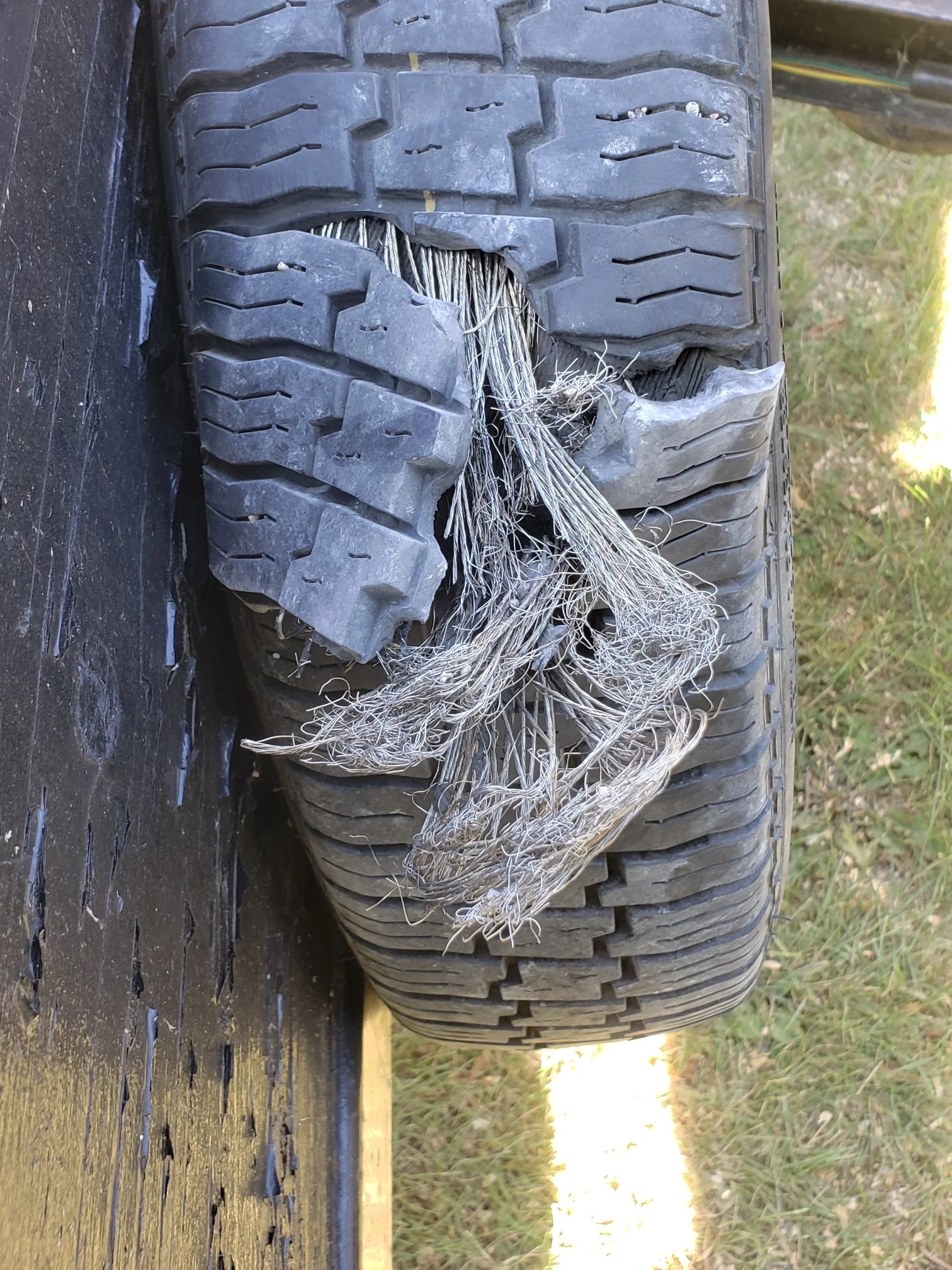
Radial tire wires fragments are extremely hard to see and remove from your tire

If your tire still has some air, you may either hear it hissing or feel the air escaping by holding the wheel by your face and slowly rotating it.

If you’re still having difficulty spotting the cause of the puncture, there are a few things you can try. First, wipe down the tire carefully and slowly. If something is stuck in your tire, you may feel it as you run your hand around the circumference. Second, with grit and dirt rubbed off, you may be able to spot the puncture more easily. There is another option sometimes: use water if your tire still has some air (or you can pump it up a bit). If you’ve got a puddle nearby and your tire is still partially inflated, you can slowly dip the tire in the puddle to see any escaping bubbles. Rotate the wheel slowly in the water until you see bubbles.I’ve used my water bottle occasionally to confirm where I think the puncture is: pour water on the site and see if there are any bubbles. If you think you’ve found the puncture and want confirmation, you can rub some saliva over the site as well.

If you find something embedded make note of the location—count the number of spokes the site is away from the valve hole (and note the orientation of your wheel). This is so you will know where to look on the inside of the tire casing to ensure you’ve fully removed the cause of the puncture and to precisely locate the hole in the tube.

If you fail to find the cause of the flat from the outside, then you should proceed to demounting the tire and inspecting the inside of the tire casing and the tube.

Sealant oozing from a puncture

A sidenote on tubeless tires. If you have tubeless tires, you’ll probably see sealant escaping. There should be an obvious wet spot on the tire with sealant oozing or spewing out. You should spin the wheel so that the puncture is at the bottom of the wheel. This lets the sealant pool above the puncture site and hopefully it will coagulate and seal. This may take several minutes. Then pump up the tire slowly and see if it can hold air. If the puncture is small enough, it will seal but it may not be able to seal at your typical tire pressure. If you have a seal and then pump up the tire but the seal fails again, you can try letting it sit longer to seal. If it won’t, then you can try tire plugs. Hopefully you’ve practiced at home and know how to insert a tire plug and remove the tool. If one plug doesn’t stop the leak, you can inserting a second plug. If that doesn’t do it, then you’ll have to decide whether to ride home on a low tire or…install your spare tube. (You do carry a spare tube and pump even though you are running tubeless tires, right?) And then we’re back to the same situation as if you were running tubes (except you have sealant in your tire and it will make a mess).

Weekend Rides Recap: Jersey, Short & Sassy, Bicycle Sunday

“Saturday/In the Park/I think it was the Fourth of July”

Saturday saw the monthly Jersey Ride and the Short & Sassy Tiburon loop take place amidst sunny but windy conditions. Comments from the participants:
“Thanks everyone who came out for today’s Jersey ride. It was a little windy, but we were rewarded with a sweet tail wind on the bridge on the return. It was so clear and beautiful. A spectacular Bay Area day!”
—Jeff

“We had a beautiful ride – sunny, crisp and windy. High tide and the birds were Loving it.
—Nancy

“It was actually pretty epic wind and our lunches were flying around on the table, but was a good, crisp January ride! “
—Janet

“Yes, I agree with Nancy. Beautiful weather with wind. A fun group as always!”
—Cathy

And on Sunday we had a ride on the Midpeninsula:

Another Cañada Road Sunday, another Portola Loop. This time we did a short version–about 30 miles–cutting out any extraneous adventures along Arastradero Road and into Los Altos Hills. “Just the facts, ma’am.” As usual it began at the north end of Cañada Road where Bicycle Sunday starts. I didn’t think there’d be much interest in this ride because the last time it was just Roger and I who undertook it. But exhortations highlighting the fabulous dry winter break we are having and a sunny day brought out eight of us including Cathy, Jamie, Roger, Carl, Stephanie, and Jenn. When it rains, it pours I guess. Espying the clear sky in the morning I thought for sure it would heat up higher than predicted so I put on just a vest over my jersey. At the last minute I threw in a very thin windbreaker since I’m such a boy scout. Boy, I was glad I brought that windbreaker because it was sunny but still chilly at the start. We had a beautiful, quiet ride down Cañada Road and along Mountain Home Road in Woodside before doing the Portola loop. A quick descent down Alpine had us stop at Amigos Grill for lunch and then we resumed our descent to Stanford and back to Woodside and Cañada Road. Other than the coolish temperature it couldn’t have been a better day for a ride!

The Road Less Traveled (for now): Wildcat Canyon

Wildcat Canyon: “Alright Mr. DeMille, I’m ready for my close-up.”

Wildcat Canyon has been left to languish after half the road collapsed during a storm in March 2023. The problem is that it’s a county road and there’s been insufficient money to do a repair. Federal money is supposed to be coming to Caltrans and the county had said that construction will begin this spring and maybe be completed by fall. Keep in mind that construction schedules are works of fiction.

But I’m not grumbling about Wildcat being closed for this long. Why? Because it’s been closed to cars, not bikes, and since closure it has been heaven to ride. I wish the county would never repair this road! Initially when it failed everybody diverted to alternate routes including cyclists. Well, one of those alternate routes is Lomas Cantadas/El Toyonal, which goes by our house. For about a week there were cyclists(and cars) thronging the road. This road, if you don’t know, is part of the Berkeley Hills Death Ride and for good reason: it’s 3.5 miles long and most of it is 10+% grade with significant chunks above 12% and a maximum of about 18% in at least two locations. So most cyclists don’t like to ride up the road. The only other nearby alternate route is to use Highway 24. (Yes, cyclists may ride on the shoulder of 24 from Orinda to Fish Ranch Road.) Then someone realized that the road failure on Wildcat left just enough roadway for bikes to get by and no one was doing any enforcement. All the bike traffic has since returned to Wildcat. A day or two after the collapse I rode out Old El Toyonal to take a look at the closure, went by the barriers (my bad), and saw that about half the road was still in place. The only hassle was having to lift your bike to go around the K barrier at the bottom. Sometime after the initial closure the K barriers and obstructive fencing were moved to make it easy for bikes (and motorcycles) to get by.

Since then Wildcat has become a sanctuary of peace and quiet. Prior to the closure Wildcat was a cut-through for cars wanting to avoid the Eastshore Highway (i.e. I-80 by Berkeley), the jam on I-580, and the back up on 24 up to the Caldecott Tunnel. If you made the mistake of cycling on Wildcat during a commute period, you were in for a series of close passes some on blind curves or the impatient driver sitting right on your ass telegraphing the message that if you didn’t get out of his way right now you were going to get fucked. Because it’s curvy just like Redwood Road, it’s also a casual speedway for sports cars and motos. For now it’s our private Idaho. Although not exactly: motos ignore the closure signs and routinely take Wildcat now that the K barriers have been moved and even some cars are still using the road from Inspiration point to Old El Toyonal. The latter are probably associated with the Orinda Horse Association, which has its stables right at the turnoff to Old El Toyonal. It’s unnerving to be blasting down Wildcat and suddenly come upon a car!

Despite being “abandoned” Wildcat is kept in shockingly good condition. Initially debris from the dense oak tree cover just rained down on the road willynilly with no car traffic to push it out of the way. Riding it was a bit of an obstacle course but nothing compared to Planet of the Apes or even Old Scenic Road to Martinez before it was reopened. Has a sweeper been run on Wildcat during the closure? I haven’t seen one but I have no other explanation for why it isn’t knee deep in debris. Some regular upkeep must be going on even if it’s a “closed” road. Recent storms knocked down some old oaks on the road and they’ve been quickly and mysteriously cut up and moved to the side. Nonetheless you still have to be attentive to random tree branches on the road as well as the copious piles of horse manure deposited by the OHA members, who no longer have to cling to the narrow dirt shoulder and can use the road full-on (until they encounter a moto or a car).

Riding Wildcat is almost like being on a BLM road except that it’s paved. Without the roar of cars it’s like being in a forest all by yourself except for the occasional fellow cyclist. The old oaks turn the road into a tunnel of sorts although you can look to the east and peek through the trees to catch a glimpse of Briones Reservoir and the hills surrounding all that EBMUD land, which since the December storms are now approaching peak green.

For bicyclists Wildcat is a significant paved road to get between Berkeley and Contra Costa. Those on the other side take Wildcat to do the Three Bears or head further afield east to Diablo or south to Pinehurst. It’s part of the Pinehurst Loop that goes up Pinehurst, Skyline, Grizzly Peak, and back to Orinda. If you’ve done the Fall Social ride, you’ve taken Wildcat from Phil’s up to Inspiration Point and dropped down to do the Three Bears and then returned the same way. It’s a nice, fast descent and the way back to Berkeley is a challenging climb sure to burn your legs and lungs but without the scary steep grades you’d find on 24 or El Toyonal.

These days I’ve been enjoying Wildcat a bit differently. I’ve been riding my mountain bike up El Toyonal and then dropping down Old El Toyonal to Wildcat and up to Inspiration Point. Then I head onto the Nimitz Trail in Tilden Park. It’s a short ride between eight and fifteen miles depending on how far I head out the Nimitz. It’s a good ride for clearing out my head since it’s peaceful and quiet and with essentially no traffic and it doesn’t take long to do the ride. If you don’t live near Wildcat, you obviously can’t avail yourself so easily of its tranquility. Of course having to travel to Wildcat from further away, e.g. San Francisco, would defeat the purpose in that you’re dealing with all the hassles of transiting to Wildcat and probably losing more repose than you’re gaining.

In the meantime Wildcat is still closed but perhaps not for very long. If we are lucky, it will still be shut for the Fall Social next October. But for now I’m taking advantage of this boon from nature.

Wildcat Canyon Road post collapse March 2023

Cycle Touring in Japan, Part 2

Our tour was not self-supported by any means. (For more information about self-supported touring in Japan, speak to David Shiver or Phil Bokovoy.) There are several companies in Japan that provide supported cycling tours. These are usually van supported tour so one’s luggage is hauled from stop to stop and varying degrees of on-road support are offered. We’re lazy so we have opted for package tours that have specific itineraries, van support, and all hotel/inn bookings handled by the tour company. In addition the company we have used, Cycling Japan, which by the way is Japanese owned and run, can provide rental bikes both regular or e-bikes (along with spare batteries if you burn through one during the day). They provide road bikes, hybrids, or touring bikes depending on your preference and they set them up according to your measurements.

Whether to bring your own bike or rent one. Taking your personal bike overseas is an undertaking unto itself. If you take your own bike, you will have to haul it in addition to your other luggage. Airlines have gone back and forth on whether to charge for bikes as oversize luggage; check airlines for the latest policy. If you plan to do any additional traveling while you are overseas after your tour, you will either have to find a way to stash your bike such as left luggage or you’ll end up hauling it with you even though you don’t need it. Sometimes it is possible to ship your bike to your start destination. If so, you need assurance that it will not only arrive intact but on time. (The same goes for flying with your bike. Airlines lose bikes occasionally and yours may not arrive on time.) If you want to use your e-bike, you will not be allowed to pack the lithium battery packs in your stowed luggage—it’s illegal. You will then have to take it with you into the cabin and there are limitations on the battery size and the number of batteries that can be brought onboard.

Renting a bike means you’ll shed the burden of packing, hauling, and unpacking your bike. But you may get a rental bike that is not to your satisfaction. When you take your own bike, you have a bike you’re familiar with and set up just as you want. Since Roger uses e-bikes exclusively, he has to rent one. Before going to Japan I had never rented a bike and had always brought my own touring bike that is kitted out the way I prefer. The first time we went to Japan with Cycling Japan I decided to try a rental because it would make the travel logistics so much easier not to lug a bike around. I’ve been fairly satisfied with their bikes even if they are more modest—but not always!—than what I would ride at home. Cycling Japan does a good job of fitting the bikes after you arrive. The other major positive is that since we are renting the bikes from the tour company, they assume the responsibility for maintaining the bikes while on tour whether that be providing fully charged battery packs, repairing flats (!), or fixing something major. On our first tour in 2016 my rental bike bottom bracket failed just before lunch one day; Kenichi swapped it out for a new one during lunch. Yes, they carry spares of everything including a fully functional road bike just in case someone’s needs repair that can’t be done immediately! Another time my freehub died just as we arrived at a ferry port. While waiting, Dai tried to fix it but couldn’t. (The pawls turned out to be shot.) So he just swapped in a spare rear wheel. If these incidents had happened with my own touring bike, I would have had to hunt for a bike shop to do the repairs. (Do not delude yourself thinking that nothing wrong can happen with your own, carefully maintained bike. We’ve seen broken derailleurs, shot shifters, broken saddles, broken seatposts, you name it, on other people’s “carefully maintained” bicycles.) If you do bring your own bike, at least have it tuned up or checked over by a pro (= not you) before you pack it.

The fitting adjustments are done on the first day of the tour, which is a non-riding day. I’ve learned over subsequent trips exactly what else I need to bring to Japan to make my rental bike work better. You are encouraged to bring your own saddle and pedals since those are highly personal contact points on the bike. Cycling Japan’s bikes have front and rear lights. But I bring more powerful lights because of the tunnels as well as a bell to use when I’m dealing with traffic. Although they provide a large rear saddle bag, I also bring a handlebar bag to carry my camera, snack food, supplies, as well as an additional place to stow clothing. By the way, in Japan brakes are set up English style, i.e. the left hand brake lever controls the rear brake and the right hand lever controls the front brake. This is the reverse of what we’re used to.

An advantage of a package tour is you’re relieved of making a lot of decisions such as where to stay, where to eat, and how far to ride or which road to take and all the associated research involved in making those decisions. Although you may not know the nittygritty details in advance, you do know the general architecture of each day and have an idea of how easy or challenging the route will be as well as the sights you might see along the way. The disadvantage is that you’re also limited to a set route and spontaneity is severely reduced. If you want to go somewhere else on a day, you’d better be able to figure out a route to your hotel/ryokan for the night! On the other hand you’re availing yourself of the company’s expertise and experience in crafting a rewarding experience. Never underestimate the value of locals’ knowledge. Another disadvantage is that because we are traveling with predominantly English speakers, we tend to cluster together rather than being forced by circumstance to interact with Japanese people. The few opportunities we have been afforded to speak directly with locals have been because they spoke some English; those interactions we cherish. Of course if you speak and understand some Japanese you’ll be able to interact more freely and likely have a much more rewarding experience while on tour. Another disadvantage of a set tour is that you’re on a schedule so even if you’d like to linger longer at a particular town you can’t. Certainly for a first-time visit to an area of Japan a tour is a great introduction and you can in the future plan to go back to explore in more depth the areas that caught your fancy.

A package cycle tour is not like riding at home. At home you can take a day off when you like or skip a day because it’s raining or unpleasantly hot. On most package tours that are point-to-point the best you’re going to be able do is maybe ride in the van. But that may not always be possible. You wake up every morning knowing you’re going to be riding regardless of the weather or how tired you feel. Unlike Northern California most of Japan can be rainy at almost any time of the year. Every tour we’ve done there has had some rain, sometimes very light all the way to torrential, all-day maelstroms. So you’re likely to be riding in the rain at some point whether you like it or not. Regarding weather summer in all but Hokkaido can be insufferably hot and humid. But even Hokkaido is getting hotter in summer due to climate change. The best times to visit Japan to cycle are spring and autumn although winters from Kyushu south to Okinawa are milder than on the northerly islands of Honshu, Shikoku, and Hokkaido and comfortable for touring.

Roads. Roads in Japan are generally in better shape than in the Bay Area. Road maintenance is serious business in Japan. Earthquakes and monsoonal storms do tremendous damage to roads whether it be by landslides, collapses, or overflowing rivers wiping them out. So there always seems to be road maintenance going on. Even in the rural areas road failures seem to be addressed quickly. Whereas county road budgets here always seem to be impoverished, Japanese fund maintenance to the extent that even potholes are rare.

Cycle on the left with traffic.

Vehicles use the left side of the roadway as they do in the UK, Australia, and New Zealand so you’ll be cycling on the left side as well, i.e. close to the left edge of the roadway. This can be initially disorienting for Americans and one can forget which lane to use when turning at intersections—turn left and stay to the left, turn right and also stay to the left! If you use a cycling mirror, you’ll need to switch it to the other side of your helmet/eyeglasses/handlebar in order to see the traffic behind you. Traffic laws as well as general expectations of cycling behavior are slightly different in Japan. For example there is no right/left turn on red: all vehicular traffic waits until there is a green light before turning. Cyclists turning right are expected to make ’square’ turns: wait for the green light, proceed through the intersection to the corner, then wait for the green light before going to the right.

Stop!
Peds only (but often ignored)
Multi-use path.

No surprise: road signage is different in Japan. The main difference is the stop sign; in Japan it’s a red triangle rather than an octagon. But occasionally you’ll see “STOP” on the road surface. Informational signs are mainly in Japanese but city names are usually also in Roman characters. Most other signs are standard. You will also see a sign allowing bicycles to ride on sidewalks as well at not allowing bicycles. But the latter are often ignored as long as you’re respectful of pedestrians.

Because Japan has a very long history its roads are similar to what you’ll find in Europe: an extremely fine and dense network of tertiary roads. These roads are used mainly by locals and local delivery trucks and businesses; people traveling point to point and larger delivery trucks instead stick to the main roads. It is not uncommon to be on a road so isolated and narrow that two cars can barely pass each other—and these are small, narrow Japanese cars! It almost goes without saying that these roads are lovely to ride on. Of course to get to these tertiary roads you inevitably have to take the major roads and many coastline roads are pretty heavily trafficked especially near the bigger cities. Roads in Japan are often narrower than what our Highway Code would require. Lanes are usually narrower and the presence of a reasonable shoulder is hit-and-miss. Bikes are expected to ride on the left edge of the lane if there is no shoulder; the idea of “taking the lane” is indeed foreign in Japan—drivers do not expect you to be in the middle of the lane. That said we’ve had exactly one incident in the thousands of miles we’ve ridden there when a driver seemed so uptight about being behind a line of cyclists that he sped up furiously to pass us even when it was patently unsafe to do so; in other words he did what would be have been matter-of-fact here!

Tunnels are common in Japan.

Tunnels. If you ride in Japan you’re going to be going through tunnels. Along the coast tunnels are cut through bluffs over which no road could be constructed. Given that we’ve cycled on 15%+ grades on coast roads—similar to the rolling hills on the San Mateo coast—that’s saying something. Their benchmark for when it’s too-steep-better-dig-a-tunnel seems a lot higher than here. Tunnels vary in Japan from short galleria like you’d find in the Alps to long and dark with dismal or no lighting. Tunnels are the “short cut” so expect to encounter trucks. No matter how much I tell myself that Japanese drivers are better and more considerate than US drivers I still am unnerved when I hear the roar of a diesel engine behind me in a tunnel. So I’ve made sure to use powerful lights to be seen as well as to see the pavement and warn oncoming traffic of my presence.

Driver behavior. Driving behavior in Japan is unlike anything we have encountered in Europe and certainly here at home: drivers actually observe the speed limit. And the speed limits in Japan are lower than they are here. Typically the speed limit is 60 KPH on arterials and 40 or 30 KPH on ‘residential’ roads. Drivers also are much more patient waiting behind cyclists before making a pass. Turning at red lights is illegal and cars observe this law making it much safer for pedestrians and cyclists. When passing automobile drivers seem to have a good sense of the ‘edges’ of their car and pass with a sufficient gap. Cars and trucks are overall smaller than in the US and even Europe and they’re going more slowly than we are used to.

Cycling on sidewalks is common.

How do locals cycle? Riding a bike on the sidewalk is very common in cities. That said those cyclists are usually running errands and going very slowly (less than 10 MPH). Cyclists occasionally do ‘salmon’ although to a lesser extent than here. We only occasionally have seen Japanese recreational cyclists and that’s usually on a Saturday or Sunday when they have time for a ride. Do Japanese cyclists obey the letter of the law? Nope. They’ll turn at a red light as long as it’s clear. They also cycle ‘salmon’ in cities. But in general they are respectful of car drivers and don’t engage in provocative behavior; in return drivers don’t mete out punishment passes and attempt to terrorize cyclists.

The Devil is in the Details

Que brutto!

January One equals Resolution Ride. We lucked out and had a break in the storms for the roads to dry out and a more or less dry day to head up. This year not only did Valley Spokesmen and Grizzly Peak head up but Marin Cyclists decided to send over a contingent—I guess Tam gets boring when you live in Marin. It was cold, as usual, about 40F or so at the start. But there was no wind to speak of so it didn’t feel super cold unlike in some past editions where we were swamped by huge gusts swirling around Diablo.

This year it was Stephen, me, Ian, Alan, and Dilan who did the nasty. The rest of you were cowering somewhere warm while i ciclisti con coglioni primped and pranced up the Devil Mountain. Ian of course took off right after the entrance on North Gate and we saw him only as he was descending while we were still climbing up. This year’s special treat was my husband Roger’s decision to participate but by car, i.e. haul a bunch of Johnny’s doughnuts and some java up and meet us at the Junction so we could refuel before the final push to the top.

It’s been a tough month for Roger and me. We did a most excellent cycletour in Japan in November only afterwards for us to come down with a nasty, gut wrenching cough and sinus infections that just wouldn’t end. We were both sick for a month. Consequently we did no riding in December. So what better idea than to go up Diablo to open up the new year?

Roger was the smarter since he could participate without killing himself. I, of course, of the nothing-ventured-nothing-gained mindset decided to cast my fate to the wind and head up despite the near certainty that this was not going to have a happy ending. And you know we always like happy endings. Well, as David says, “Bad cycling is still better than no cycling!” At least I had the sense to take the bike with the lowest possible gearing and to ride up casually rather than frenetically.

So that meant I hung out with the Kool Kids and got to hear them gossip about ALC, ALC personages, ALC history, ALC plans, and a lot of family stories that strangers really shouldn’t know about. Dilan and Stephen converse endlessly and at length about any topic so long as it’s ALC related or has high quality salacious gossip!

Turning donuts on the road our way.

Most folks go up South Gate but I’m not sure why except maybe they live closer that way. North Gate is always quieter and in my opinion more scenic especially when rains have painted the grassy hills green again. This year was no different—we hardly had any company. Roger met us at the Junction with the goodies. Thank heavens, Johnny’s apple fritters are the cat’s meow! He got a dozen donuts including chocolate covered custard donuts, maple bars, and also glazed donuts. I wanted to eat them all. I snarfed a fritter like a cat eating a mouse as well as a cup of piping hot coffee. A maple bar later I was ready to get back on the bike and maybe barf a bit before heading up. Always tastes good the second time!

But above the Junction things rapidly went south for me. Alan, Dilan, and Stephen were plodding ahead and I was content to be the tail of this group when the leg cramps hit and it was game over. I made it up above Juniper but I couldn’t shake the cramps despite trying all the tricks of the trade. And it was starting to sprinkle. So I turned around and headed down and let the others carry the DSSF flag to the summit. I ended up cutting the ride even shorter and descending North Gate rather than to Danville for lunch. I was cramping even while descending. It sucked.

But hey, nothing ventured, nothing gained. And I gained a great start to 2025 even if the only resolution I made for this year—get to the top of Diablo—was broken practically before it started!

I’m Fixing A Hole (Part 2: Getting a Flat)

I’m fixing a hole where the rain gets in
And stops my mind from wandering
Where it will go
—Lennon/McCartney

You’ve got a flat while riding and you’ve decided to replace the tube with your spare rather than fix the puncture immediately. Dealing with a flat is an inconvenience and you would like to have just one inconvenience on your ride, no more. Then it is worth being careful and not rushing the process in order to avoid flatting again due to a careless and hurried effort.

But why can’t I just ride home on a flat tire? You can try it if you’re absolutely desperate, e.g. you’re out of cell range and no one is likely to come by who might be able to help you. This is the one situation where riding a tubular tire has clinchers beat. Since tubular tires are glued onto the rims, they are much less likely to roll of the rim even when they’re flat. And since they stay in place the flat tubular provides some rudimentary protection for the rim being damaged when you roll on it. Clinchers are another story altogether: there is nothing holding the tire onto the rim despite there being a tight fit between the tire and the rim. So at the slightest turn they are likely to roll off the rim entirely. Once the tire rolls off it will jam between the fork and the wheel (front) or jam between the stays and the wheel (rear). You also won’t have any control riding just on the rim and it will feel terribly rough. Third, riding on a clincher rim hooked or otherwise—especially a carbon rim—is guaranteed to ruin it and you’ll have to replace it later.

But I have tire inserts! There is one possible exception for clincher tires: if you’ve got tire inserts in your tires, you might be able to ride it carefully since the insert provides some cushion and flotation and helps keep the tire beads from coming off the rim. Getting a tire off that has inserts inside can be difficult, so all the more reason to continue riding it if possible. Needless to say if you do try to ride a flat tire that doesn’t have inserts you can only go slowly in order to be safe. But this is an option I do not recommend unless the distance you need to ride is very, very short and for some reason you can’t just walk. Nota bene: I don’t recommend you do this!

Before changing the tube find the source of the flat. You might be tempted just to replace the tube as quickly as possible especially if you’re riding in a group and everyone is impatiently waiting for you to finish up. My advice: don’t! Take the time to ascertain the cause of the flat before you put in that spare tube. If you haven’t removed the cause of the flat, you may flat your spare shortly thereafter and be stuck. So take the time to ascertain the cause before you stuff in that spare!

There are myriad ways a tire can go flat: Something sharp poked through your tire and punctured the tube; you hit a sharp bump hard and flatted; an old patch failed; the tire valve failed; you rode on a worn tire and wore through the casing; you overheated the tire on a long descent by braking constantly (rim brake only) and it blew off; you didn’t have the tire bead properly seated and it blew off; you accidentally abraded the tire casing—I could go on. Most of these have an overt cause and you will usually be able to find the cause of the flat.

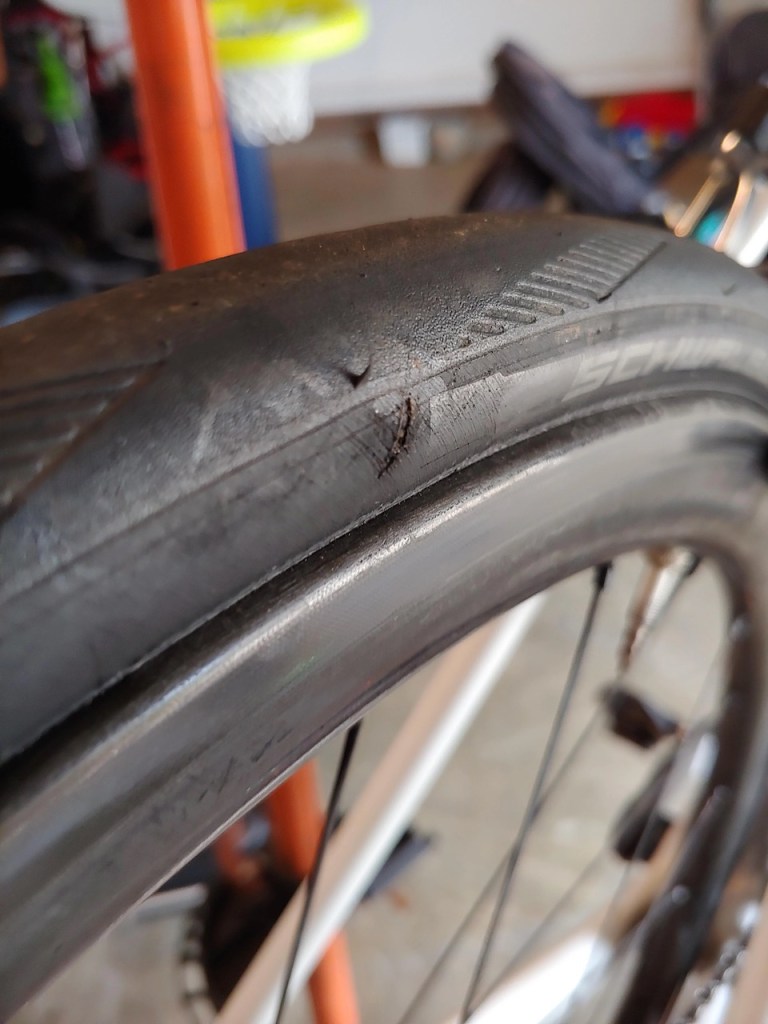
Tire case failure

If your tire deflated very quickly perhaps accompanied by a loud bang, you’ll probably not have to look too hard to find the site of the flat. But not always. The cause of quick deflations include “snake bite” punctures, casing failure, an inner tube not properly seated inside the tire, or too high pressure perhaps caused by overheating due to prolonged braking. Quick deflations mean the hole is so large that all the gas escaped immediately. If it’s caused by a large gash—maybe you ran over a large glass shard that sliced open your tire—you’ll see it easily. But sometimes there is no sign of the cause when you inspect the tire surface. Often you should see a hole in the casing or tire tread. Casing failures may be obvious and be sure to check your tire sidewall, which is where they tend to occur. If your tire overheated and blew up, almost always the tire bead is blown off the rim and you’ll spot that location quickly. But sometimes it’s not so obvious as when you hit a pothole hard and you compress the tire and tube so much that the tube is gashed in two places by the rim—a “snake bite” puncture; the tire casing may be intact and only the tube is damaged and you might not see that until you pull the tube out to inspect.

Presta (L) and Schrader (R) valves

In the case of a failed tire valve it may not be obvious. The base of the valve is subject to stress and that’s why manufacturers strengthen that point on the tube. Even so they can fail through time either from stress on the base of the valve tube or by movement causing abrasion; also, tubes are rubber and rubber ages and can crack. If you look at your tire valve and it’s cockeyed, i.e. not straight up, The tube could have shifted on the rim and this puts extra stress at the base of the valve. If you have a retention nut holding the Presta valve onto the rim, it shouldn’t shift. But Schrader valves usually do not have retention nuts so they can shift. If you’ve put a tube with a Presta valve onto a rim intended for Schrader valve tubes, you can also abrade the base of the valve. This is because the hole in the rim for a Schrader valve is larger than for a Presta valve. That extra width can allow the valve to shift back and forth and cause abrasion. (To prevent this from happening in the future, you should install a Schrader-to-Presta adaptor.)

Presta valve pulling out of tube

The base is underneath the rim and you can’t see it without removing the tire. A flat at the valve could also be due to the valve mechanism itself. Presta valve tubes almost always have a removable Presta valve core. The tiny valve mechanism is simply screwed into the inflation tube. Perhaps you or your mechanic removed it to inject sealant and failed to screw it back in all the way. Another cause could be that you failed to tighten the captive nut on the Presta valve after you inflated your tire. In the former case either a small wrench or a special Presta valve tool can be used to screw the valve mechanism down; for the latter, just screw down the captive nut tightly.

Bent Presta valve stem (with captive nut)

If you look at the top of your Presta valve, there should be a captive nut that you screw down to close the valve. The little stem that the captive nut screws onto is thin metal and it is very easy to bend by accident. It is also possible to break off accidentally. The most common way to bend the stem is when you attach a pump head to the valve to inflate the tube. Be careful! Rocking the pump head back and forth when pumping or when you release it or pulling it off at an angle is a good way to bend the stem. If you’ve bent the stem already, you may be tempted to straighten it. Again, be very careful because this is a great way to break off the stem altogether. I wouldn’t recommend trying to straighten it unless you absolutely have to, i.e. you cannot screw down the captive nut to close the valve. If you do break off the stem, your tube will probably be able to hold air but it will slowly (or quickly) leak. Presta valves are replaceable with a valve core tool and a spare Presta valve. Unless you’re carrying those along with you, you’ll definitely have to replace the tube and deal with the valve repair when you’re at home.

If your tire did not deflate quickly, then look for a puncture. If you are running tubeless tires with sealant, you should see sealant leaking if not squirting out of the puncture making the source obvious. The only reason you’re going to need to put in your spare tube is if (a) your sealant has either dried up or run out or (b) your puncture is so big that sealant is unable to seal it.

If your tire is wet you might be able to see air bubbling out of the tire; you may need to pump it a bit to check. Otherwise look around the tire including the sidewalls for a puncture or anything embedded in the tire. Sometimes whatever caused the puncture doesn’t remain embedded and it won’t be obvious. But often it is still in place and sometimes it’s very small and nearly invisible especially when it’s worn down and all you might see is a tiny dot. Needless to say that having a dirty tire may make it hard to spot the site. So wipe the tire down of as much dirt and debris as you can. (This may be difficult or pointless if you have knobby tires.) If you gently brush your hand over the tire, you may feel something stuck in the tire: lift the wheel, spin it slowly, and run your hand lightly over the surface of the tire. But be careful: if something very sharp is still in your tire, it may cut your hand or fingers; if you are wearing cycling gloves, it’s a bit safer to do this. This isn’t foolproof because the embedded object may have fallen out, not be above the surface of the tire, or sufficiently off to the side that you miss it completely.

Sidenote: If your vision is less than perfect—especially if you’re farsighted, you may end up struggling to see anything embedded in your tire. The offending object can be quite small—such as a thorn —and difficult so spot even with good vision. Make sure you have your reading glasses with you.

If you find the source of the flat, make note of its position on the tire by counting the number of spokes from it to the valve hole. You’re going to inspect the deflated tube after you remove it from the tire as well as the inside of the tire casing and this will help you find the corresponding location on both.

You may be able to find the puncture site without removing the wheel from your bike. It is also possible to patch your tube without removing the wheel. But most of the time it’s going to be much more convenient to remove the wheel in order to effect an orderly and quick repair. Note: you can’t replace an inner tube without removing the wheel. The one exception is if you have Cannondale Lefty front fork because the “fork” has only a left leg and you can remove the tube from the right side since no leg is blocking it.

What I’ll Remember About 2024

The years fly by and 2024, the club’s 42nd year of existence, is now one for the books. The club quietly does what recreational cycling clubs do: offer bicycle rides and club events for fellow LGBTQ cyclists, their family members, and allies to congregate and have fun. In the case of some challenging rides that might mean a bit of Type 2 fun though. Sometimes the club goes through periods of innovation that alter the direction of the club and sometimes those innovations become “traditions” until they become tired and dwindle away. Some of those innovations continue to today including the annual club picnic, which began shortly after the birth of the club. Mountain biking exploded and had a big club coterie in the late ‘80s and throughout the ‘90s but has since dwindled away with now just a meager presence on the ride calendar. What will 2025 bring? Surely it will be more of the same. Hopefully there will be some new events and rides that spark interest and can carry us into the future.

A “normal” winter. 2024 began with a “normal” winter after the deluge we got in 2023 when so many Bay Area roads were washed out and destroyed. Some of those roads weren’t repaired and reopened until 2024! We had the usual rain-outs of club rides but compared to 2023 it was nothing.

Will Bir. This is foremost on my mind thinking about the past year: Will Bir’s death from a heart attack while riding in the Presidio. Following David Sexton’s death in 2023, Will’s was another savage blow to the club. Will was a longtime club member whose involvement and dedication to the club was unquestioned. Will did it all and always with a smile on his face and usually while whistling. I’m going to miss him.

The return of the Ride Leader Appreciation Dinner. We hadn’t had a RLAD since January 2020. Then the Pandemic hit and we put it on hiatus for four years until this past spring at il Casaro on Church Street. It was great to gather with the club cyclorati and celebrate their club spirit. It’s the only goody the club offers to its members who volunteer to lead rides or host a club event at their house. Hopefully we’re back on our usual annual schedule and we’ll have one this spring for 2024 volunteers.

Tunnel Tops Park. The annual club picnic returned to San Francisco with some trepidation. A summer picnic is SF can either be a windblown fogfest or, if we’re lucky, a grand sunny day. We lucked out in 2024 and got the latter. Even better we held it at a new venue, Tunnel Tops picnic area in the Presidio, and it was a great choice with fantastic views, a cheery crowd, and a new, clean picnic area! A great turnout as well. It was also Will Bir’s last club event before his passing.

Pizza Night, the Marin Pizza Run. In our neverending quest to have more fun and food together we held two new events this past year. Pizza Night at Little Star Pizza on Valencia was going to be the first of several casual dinner gatherings but it turned out to be our only one last year. We had a great turnout, Little Star wasn’t crowded, and the pizza and conversation were fabulous. Hopefully we’ll have more of these in 2025! The other new event was the Marin Pizza Run held at Janet’s house in Marin. What better than a ride followed by even more tasty pizza! A fabulous jaunt out to China Camp and then camping in Janet’s beautiful backyard with slices from Cafe Verde Pizza on a gorgeous sunny day.

The Pride Ride. For many years the club was an annual presence at the SF Pride celebration with a parade contingent and a booth. But both vanished due to lack of enthusiasm—it’s a lot of work to put that together. Instead it was replaced by the Pride Ride, which has morphed into our biggest club event usually bringing out about 50-90 riders. This year was no exception with a big turnout, more donuts and coffee, and a beautiful sunny day.

Injuries. Being club president is an accursed position and maybe cursed, period! Both David Goldsmith, our past president, and current president Jeff Mishler ended up with chronic injuries in 2024—in David’s case yet again—that kept them off the bike most of the year. We hope to see them both on a ride after their eventual recoveries!

For me 2024 had three special club rides.

Old Haul Road. I finally got to ride Old Haul Road. I led it but no one other than Roger wanted to come along, which turned out to be fine. Old Haul has been on my list for a long time. I moved away from the Midpeninsula 40 years ago and it hasn’t been easy to get back to Coastside to do it. It was a complete delight: a broad, tree swaddled avenue into the redwoods on a beautiful dirt road. I’m definitely going back but next time it’ll be part of a long mixed terrain loop.

Pedaling Paths to Independence. This metric century in February has become one of my faves—it’s a small event, it’s relatively inexpensive, and it’s got beautiful terrain. But in 2024 I hadn’t been riding due to health issues and so I did this ride with almost zero miles and thus a great deal of trepidation. Fortunately David Goldsmith was also game and he hadn’t been riding much either and we sort of rode it together supporting each other. (Jeff Mishler was the other Spoker who did it. But he was killing it and we saw him only at the food stops.) Despite a slew of technological mishaps I went against my bullheaded nature and did the ride with restraint, which allowed me actually to complete the ride without dying or cramping. (I got the cramps in the car while driving home!) It was probably the slowest century I’ve ever done but it was no less enjoyable.

Pescadero loops. I did these loops three times last year. It’s another revelation thanks to David Goldsmith. Now I drive to Pescadero to skim the cream off the top instead of schlepping all the way from Palo Alto or San Francisco. It’s never not beautiful, always quiet, and I’m hooked on stopping at the Loma Mar Store for good grub! I especially like doing the loop up Haskins Hill rather than going down Highway One.