We did two club rides this weekend, Stephen’s first installment of the Fall Climbing Series and our own Flat Earth Society ride down the Iron Horse Trail, and what a pair of opposites!
The heat wave that ended today was forecast to end by Friday. Wrong! Friday was another 90+ day. The only sane ways to survive these conditions is either not to ride, ride indoors, or ride early in the morning. Even riding early we’d get home midmorning and it would already be in the 90s. Since this was the Nth grueling heat wave of the summer over in Contra Costa, we had the brilliant idea to go to San Francisco to get relief from the baking hence Stephen’s ride. What a difference! Saturday it was breezy, 60F, and completely overcast in SF. I was in knickers, long sleeved jersey, and vest for a change.
I was sort of looking forward to cycling in the City. I lived there for many years and even after decamping for Contra Costa I was still commuting to work in SF by BART/bike and continued to ride until I left my job there permanently in 2011. Since then I’ve only very infrequently done a club ride that started in SF, usually the Jersey Ride. Everyone who has lived and cycled in SF has their own routes and preferred places to ride and there is more diversity in riding in the City than one would believe. It’s not all city and even the heavily urbanized parts have their quiet and pleasant neighborhoods. What would it be like to return there after a very prolonged absence?
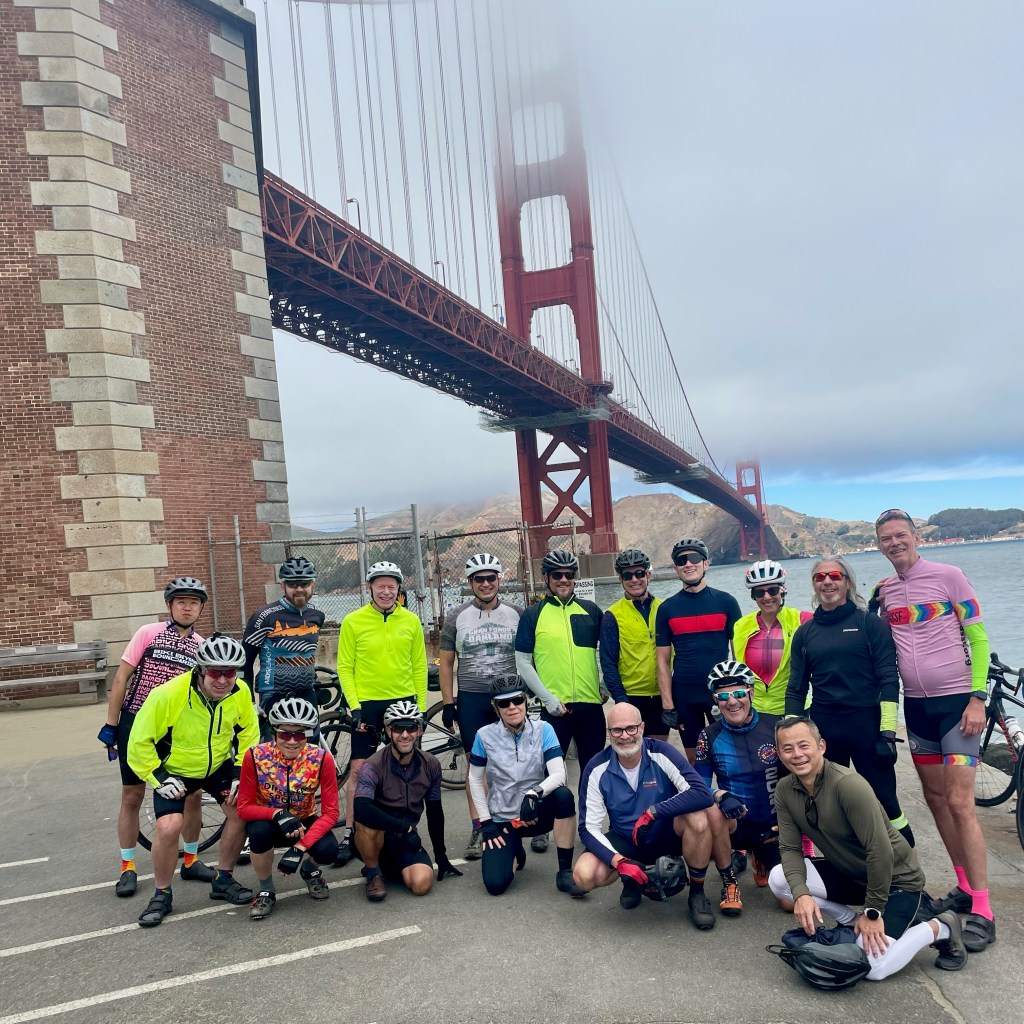
Stephen’s first Climbing ride was relatively easy: a loop from Peet’s to the Bay, up around the Embarcadero to Fort Point, and then drop down the Great Highway with the only big climb, up Twin Peaks, a route Stephen says he’s done a zillion times. If you live in the City you’ve probably done it or something very much like it many times. But familiarity doesn’t always breed contempt: the turnout was unexpectedly high, 17. By Different Spokes standards that is a very large group. A “large” turnout for our small club is anything north of 7 or 8. But since the majority of members live in SF, a City ride is very convenient and perhaps that was one of the reasons for the unusually high turnout. (The other is obviously Stephen’s fabulous personality. Oh yeah, and hotness! That queen sports only the most fab cycling kit possible.)
Stephen took us east through the Mission and lower Potrero all the way to Mission Bay, a route involving lots of traffic, lights, and nervous behavior. Despite the cool and overcast, people were out in droves by foot, car, and bike/scooter. He had us stop at La Stazione near Caltrain just so he could get his espresso fix and to give his delayed route orientation. The ride through Mission Bay to the Embarcadero was surprisingly easy because of all the “new” bike infra since I was last there. Protected bike lane? What will they think of next! Having ridden very little there since 2011 I was pleasantly surprised at how well it works in SF. Whether there are fewer car/cycle crashes and fatalities is another question though. But at least it looks nice.
Cycling in the City versus Contra Costa is a different sport altogether. Friends from outside SF think that cycling in the City must be very dangerous—all those cars! Yet all those intersections with stop signs and lights mean that speeds are generally lower whereas in Contra Costa long stretches without any speed mitigation mean higher average velocities and deadlier car-bike collisions. I admit that after a long hiatus from any intensive cycling in SF I was nervous. What an irony! The level of traffic density and distractions is high; it’s not just cars and trucks but also errant peds and rampaging scooters “coming out of nowhere”. In the suburbs people don’t walk. Except to their cars.
What’s with all those stop signs? Cyclists in SF seem to deal with them by ignoring them altogether. I thought I was in a weird city crit: the group rolled through stop signs like buttah. Because I’ve become a traffic nazi and having a healthy respect for tons of steel I stopped at Every. Friggin’. Stop sign. I had to sprint repeatedly just to hold the group in sight. I got my workout! Poor David Millard, who had volunteered to sweep, kept waiting for me until I told him not to. I certainly worked up a sweat playing catch up most of the morning. But it’s all about how you frame the situation, right? Practicing track stands, popping a sprint, hunkering down on the drops—it all makes you a better cyclist.
Save Madeleine??
I thought routing us through the Embarcadero and Fisherman’s Wharf was cheeky. It was of course hella busy on a summer Saturday morning with tourists and locals out enjoying the sights and I didn’t know which way to look to avoid the next near-collision: peds crossing the protected bike lane to their cars; pedicabs; Lyft cars picking up or dropping off fares. All that was missing was an elephant seal in the street for us to bean. It stayed more or less that busy all the way to Fort Point, another tourist hotspot. We regrouped for the obligatory group shot. No one did a Kim Novak imitation by jumping into the sea a la Vertigo. But I could tell that some were thinking about it but had forgotten to bring the flowers and opera gloves. After visiting the tea room, it was off for the first real climb of the day: Park. This short climb in the Presidio used to be part of an interval workout I did regularly when I was younger. It’s short, maybe a third of a mile, which is perfect for hill intervals. Ostensibly Stephen routed us this way to avoid traffic but the steepityness fit the point of the ride. Then it was up the next climb to the Palace of the Legion of Honor where I took it slow as well as up Clement. Down Ocean Beach for another tea room and then over to Java Beach for the next caffeine stop. The only thing left was the climb up Twin Peaks.
People left Java Beach in dribs and drabs slowly heading up to West Portal. I used to ride a lot in the Sunset because it was on my way to and from work. I also had time to kill after work since in those days you couldn’t get on BART downtown with a bike until after 6:40 PM. It’s a chill neighborhood with little traffic and lots of pleasant bike-friendly streets. No one is in a rush. Heading east is a gradual stairstep climb with a few short, steeper grunts before arriving at West Portal. There we took Ulloa to the top of Portola. Stephen warned everyone that Ulloa was “fuckin’ steep”. That wasn’t my (dim) recollection but my Garmin hit 14% near the top, so perhaps he’s right. It didn’t seem steep when I was young…
We caught up with the group at Twin Peaks Boulevard and Brian Midili just had to wind it up to get to the top first. He sure puts out the watts. Roger and I held his wheel but I wasn’t about to go around him into the howling wind. Kudos to Brian for upholding the Different Spokes animal tradition: dash and smash. Slowly riders trickled up to the top of Twin Peaks while we huddled against a dumpster to avoid the freezing gusts. Our preplanned photo op was a bust with the marine layer blanketing the town. At that point folks more or less went their separate ways down to their homes, an anticlimax of sorts to a pleasantly cool ride. We coasted back to the Castro in absolutely horrendous traffic. Is it always that way on weekends now?
Chill ride. Maybe too chill!
Overall it was a good way to start the Climbing Series with a challenging-but-not-too-challenging set of climbs and a big crowd to share the fun. I’m still mulling over the changes I saw in SF. It’s definitely more congested, which makes sense because when I lived there it was about 750,000 and now it’s way over 800,000. That’s a lot more people! I’m sure that if I were living in SF, I’d get used to the more frenetic traffic particularly east of the Castro. It’s a different kind of cycling. In Contra Costa there is more open space, longer roads without lights or stop signs, and a lot less people and the result is that I no longer care for the urban kind of cycling that I used to do every day. Or at least I’m no longer inured to that kind of cycling!
They was a-splishing and a-splashing/Reeling with the feeling/Moving and a-grooving/Rocking and a-rolling, yeah —Bobby Darin
This year’s Orinda Pool Party and Ride continued a distressing trend from last year, namely the dwindling number of actual riders, just six. Oh, the Pool Party had a healthy number in attendance and showed no sign of declining interest. But those willing to grind up Pinehurst and Skyline on a fabulous 29-mile loop before the party was small. “Back in the day”, i.e. pre-Pandemic, the riders way outnumbered the non-cycling attendees, the latter usually comprised of significant others, i.e. “the bike widows”. Now we’re in a new era in which cycling is an afterthought to mojitos by the pool and having your brunch served to you al fresco. The profuse lack of biker tanlines amongst attendees was a sure sign that the Apocalypse has come. Peak cycling is well and gone and even Spokers are content to idly spend their afternoons reposing rather than chasing each other on wheels. The porch dogs are nigh. Sigh.
No matter. We had a mahvelous time!
We had checked the BART schedule weeks beforehand knowing that BART has a nasty habit of shutting down weekend service to Orinda—why is this section of track always affected??—and set the date for the OPP to August 18 in order not to coincide with BART’s plans. Unfortunately BART decided at very short notice to delay a planned service closure by one week and it now coincided with our event, causing us at late notice to have to postpone the OPP until August 25. Proving that no good deed indeed goes unpunished—at least by BART—that morning it had yet another one of its countless snafus killing service through Oakland and delaying trains to Orinda. (Side note: And why are we throwing more money at BART for service like this??)
Carl and Roger both got caught in the mishegos and arrived late. At BART we waited patiently for their trains to arrive. We delayed the start just long enough for Carl to deboard and join but Roger was still stuck in another train behind. So off the group went while I waited for Roger to take his clothing and food. He arrived on the next train and zoomed to catch up with the group.
Meanwhile back at the manse Roger and I hustled to get the pool and food ready. This year’s brunch was a riff off of last year: smoked pork ribs, pesto pasta, a green salad, and a vegan brown rice salad. We ditched the Impossible burgers and vegan pesto in favor of some vegan barbecued riblets. Oh, and we added gluten-free pasta too. Whew. Roger’s skillz with smoking continue to refine and improve every year; he was the master at work! To add some amusement to the pool, we got some inflatables for loungees to repose upon and they were a hit. Next year’s request is for a hunky cabaña boy to serve food and drinks poolside and, uh, give “backrubs”. (Don’t hold your breath.)
Since most folks drove over we barely managed to squeeze all the cars into our driveways and not park on the street so our neighbors wouldn’t show up with pitchforks. David and Chris came despite having just returned from the South land; Peter made his way up from San Jose; Joe and Lamberto, who had relocated to Sacramento a few years ago had just moved back to Contra Costa and promptly rejoined the club and showed up at the Pool Party with their mutt Oliver, a real cutie. Other indolent Spokers included Janet who had recently ditched the grandkids and was looking forward to some adult time—are we adults yet?—and Jeff Pekrul whose excuse was that he had done a big ride yesterday. Jeffrey from Kensington was the lone non-member to attend.
This year’s riders were Stephanie, who led the charge; ex-prez Cathy; Carl; Roger; Nancy; and Darrell, who couldn’t make the pool party because he had to rush home to meet the electrician. Cathy claimed to be slow so she left Orinda BART early to get a headstart. But the group never caught up with her and she arrived first. She definitely is a pro at sandbagging!
Miss Otis regrets she’s unable to lunch today.
She is sorry to be delayed.
—Cole Porter
One who was clearly missing was Will Bir, a regular at the Orinda Pool Party & Ride. But Roger had a huge picture of Bill made and hoisted it onto the wall on the patio deck. Appropriately it was of Bill on the back deck at the Pool Party in 2017. We put out all the various generations of beer Will had toted over but I think there was only one taker. Miss Otis regrets…
People trickled in and before too long the back deck was packed. Clearly Spokers are food motivated because no one went into the pool until they were well fed. Childhood warnings—“don’t go into the water after eating or you’ll drown!”—were heeded and most folks spent plenty of time gabbing after noshing before literally taking the plunge. I’d like to say the great issues of the day were discussed at length by all—or that juicy club gossip rolled off Spoker lips like drool—but the sad reality is that I was often too preoccupied playing Perle Mesta to pay much attention to the huddled whisperings. Maybe someone can fill me in! People must have had a good time because the last folks didn’t leave until 5 PM.
Those of you who’ve been under a rock recently may not be aware that longtime club member Will Bir passed away on Saturday August 3 while riding his bike. According to his longtime boyfriend Orlando he was found unconscious on the ground in the Presidio. Someone called 911 and the EMTs were not able to revive him. Apparently he died of a heart attack. He was only 59 years old.
Will’s sudden and unexpected passing shocked us all and has left a deep emotional hole in the club. Will has a long history with the club starting sometime in the early to mid-90s. Perhaps others have had more in depth conversations with Will and know more about his history. But from comments he’s made in passing over the years I’ve had the impression that he may have had two stints with us. He moved to the Bay Area to earn an MBA from UC Berkeley in the early 1990s and may well have joined the club at that time. I am under the impression that he moved away—or perhaps was just busy with work—and then returned later on.
Although I too have had a long history with the club, I had a hiatus from mid-1992 to about 1998 and probably only met Will when I started to cycle again; I have no recollection of him before 1992.
It’s funny what you recall about those who’ve passed away. I’ve known Will for maybe 25 years and in looking back he always appeared the same. I think he even rode the same bike, a titanium Serotta with a triple crank all this time. But the bike changed slowly and so did Will. He used to ride all the time with a Camelbak but in more recent years he ditched that for a more traditional setup. Maybe it was the mountain bike influence because I have a (faulty?) recollection that he did a stint (or maybe grew up) in Colorado. He certainly knew about Rocky Mountain Bicycle Boys. He had a preference for wearing jerseys from rides or events he had done and never succumbed to the hipster Rapha/Maap/Pas Normal plague that has afflicted so many cyclists. Unlike so many of us who go through bikes, bike fads, and equipment like junkies looking for a fix, Will was not at all about the bike and entirely about the riding.
I’ve ridden with Will too many times to remember them all. That he was a longtime regular on so many club rides is evident from the extraordinary number of photographs of him on club rides; you can see for yourself in the club’s Photo Albums area. Will liked to ride long, hard, and fast. Which was pretty amazing for someone with his build—more linebacker than gaunt, skinny cyclist. One time we were riding up Morgan Territory on a club ride. It’s a tough ride with a dauntingly steep climb. As the climb worsened below the summit, Will and I were still riding together. Usually guys as heavy as Will would not be able to climb very well. But Will was almost as fast as I and yet he outweighed me by 60 or 70 pounds! That isn’t to say he wasn’t suffering but he seemed to know his limits very well, hence the triple crank with low gears. Will was quite capable of suffering on the bike. He never seemed to go slow and never seemed to need a warm-up period. On that same ride we got down to Tassajara where it’s flat and he zoomed by me like a motorcycle. I barely was able to grab his wheel and it was all I could do not to get dropped; he had a BIG motor! It was rare that Will was behind. Always at the front. He certainly made me suffer more than once!
At some time in the early Aughts Will got the century bug, nay the double century bug, and he and Jerome ended up doing some pretty long rides. He’s got a Triple Crown jersey to prove he’d done three double centuries in one year; he also has a Triple Bypass jersey and I believe he’d done all the passes on the Death Ride. Truly a beast on the bike. He’s one of the few Spokers I know that has done the Canyon Classic up Del Puerto Canyon, a relatively obscure climb. He’s also one of the few Spokers to have gone to Mammoth for their Epic ride. The list of centuries he’s done is very long.
A couple of years ago I led a ride up Patterson Pass. Will joined and at the start we found out he was just getting over Covid and was coughing his brains out. Yet we could still ride strongly. This ride goes over Patterson Pass to Tracy and takes a little known trail along the California Aqueduct before heading back over Altamont Pass. Will knew about the aqueduct trail because he had ridden it years ago while training for a double century! He was always surprising me by his willingness to take on a challenging ride as if it were a walk in the park.
Will was impressive in other ways. I never saw Will get upset or angry. He was preternaturally calm; in fact he was almost always matter of fact. Nothing seemed to perturb him or make him histrionic. And I don’t ever recall him swearing or bemoaning his fate. There was never any drama around him. But he could get quite animated when talking about something he really enjoyed…like traveling with Orlando to Europe for metal concerts!
Will was also a regular to the Orinda Pool Party. He always brought a six-pack because he loved to drink beer as much as he liked to cycle. He knew we were a dry household; whatever remaining beers would still be there for next year’s party! But of course he would bring more. For a while there he was showing up at the OPP with a different boyfriend almost every year!
He was also a very loyal Golden Bears fan and was a regular at Cal football games.
In the Aughts Will took on being the events coordinator for the club. More than once he hosted the Holiday Party as his place in San Francisco. He also came up, planned, and led the Amador County Weekend, a three-day getaway to Plymouth CA to ride the Gold Country roads.
In recent years Will cut back on cycling and instead was spending time hiking with Orlando. A few years ago Will was diagnosed with a benign brain tumor, which he had surgically removed. I like to think that that scary event got him thinking about what was important in his life and that spending time with Orlando was more rewarding than an entire day on a long ride.
Roger and I decided to add the East Bay Tiburon Loop to the usual second Saturday madness this month, i.e. the August Jersey Ride and the Short & Sassy Tiburon Loop. Although any member can volunteer to lead the Jersey Ride or the Short & Sassy Tiburon Loop, which is a shortened version of the venerable Jersey Ride, it usually devolves onto board members to do so. I’d like to say that club enthusiasm is so unconstrained on the board that we love leading those rides. But the reality is something else. A few of us have had enough near-crashes on the Golden Gate Bridge coming back on the Jersey Ride that it has become a line we won’t cross anymore. That is one of the reasons the Short & Sassy Tib Loop came into being too. Not only was it no longer relaxing to ride the bridge on a weekend afternoon but it’s also a long schlep for a lot of cyclists. After we decided we weren’t going to lead the JR anymore we came up with the East Bay Tiburon Loop, a thing that wouldn’t have been possible before the Richmond San Rafael Bridge opened a bike lane in November 2019. So this month we decided to lead it again—I guess as penance for refusing to partake in the GGB madness but also because “it was time”.
The East Bay Tiburon Loop starts in Point Richmond and hops over the bridge to Marin and thanks to the reconstruction of the previously horrible and dangerous bypass path on 101 it’s now a dream to cruise over and enjoy Paradise Drive. It’s certainly no worse or better than coming from San Francisco to Tiburon and is better in that the RSR is not crowded with bikes, pedestrians, and construction furniture.
Unfortunately, perhaps because we listed it so late, no one else deigned to join us. No matter! We were set to enjoy the day anyway. This month the Jersey Ride, led by Ginny, hooked just two other participants. But the S&S had five. So altogether we were nine at Woodlands Market.
It was chilly and overcast in Point Richmond and the RSR despite the climb up the span we barely warmed up. By Larkspur the sun was out and we soon warmed up. This was supposed to be an easy day for us as Roger hadn’t been riding much after tweaking his back and I already had had a couple of days of harder than usual riding. The good weather was bringing out the cycling masses as we soon joined the other lemmings heading around Paradise Drive. Perhaps the weather was responsible for the car traffic as well: it was packed and backed up by the Larkspur Ferry terminal and it was still a moshpit of metal when we returned in the afternoon. But once we were on Paradise the car traffic eased off. But not the bikes! Paradise is still paradise for cyclists: little traffic and a seemingly natural setting despite the housing, which is mostly hidden behind trees. It didn’t take long before we were careening at speed trying to keep up with the fitter folk. Two cyclists blasted past us like we were stationary; an older gent on a classic blue Gios with Campy Super Record and toeclips—and a hairnet “helmet”!—passed by us. I love old school cyclists! Everybody was out for a great ride.
One of the problems with three different club rides is trying to synch meeting up on the road. In the past we’ve met the JR at the Corte Madera shopping center or somewhere along Paradise. But not today. We got to Woodlands early and had to wait for both the JR and the S&S riders to arrive. Eventually everyone arrived and we had a convivial lunch. The main topics of discussion were Will Bir’s sudden death and the various upcoming cycling trips some members had in the works. There was a time when it seemed only Roger and I were heading overseas for a cycling trip. But that’s no longer the case as people were taking Backroads, Womantours, Bicycle Adventure Club, and even self-supported (!) tours.
A long lunch finally ended and Ginny did a great job of herding all of us cats into a group photo and then making sure each group got on their respective routes. We split off from the others and headed north by Horse Hill back to Larkspur. Unlike the last time we did the RSR the headwind was only mild and we made it back to the East Bay feeling comfortable rather than wasted. If they shut down the bike path on the RSR that may be the end of this ride, which would be a real disappointment. So ride it while you can. While there are plenty of places we like to ride in the East Bay, it is a great break to head over to Marin to escape the summer heat and hang out with fellow Spokers!
A couple of years ago I wrote about my initial experience with Tubolito tubes, very light TPU (thermoplastic polyurethane) inner tubes. You can read it here. Overall I was a bit disappointed because although being extremely light they didn’t feel supple. Consequently their ride quality was only so-so. I also didn’t appreciate the added difficulty in repairing a puncture as you cannot use regular inner tube repair patches and glue.
However I have continued to pound this wheelset and have to say that their lightness–due in part to the Tubolito tubes–is endearing. The wheels accelerate noticeably faster than my other wheels even if they are slightly more abusive on choppy pavement. On smooth pavement they are the cat’s meow. I still haven’t tried them with my preferred tires, Michelin Pro4’s, which as I mentioned seem to have the best ride quality. But that day is coming in the not too distant future as the Rene Herse Cayuse Pass tires wear out.
I have a few more comments to add about the Tubolitos. First, Tubolito has changed the puncture repair process since two years. Previously their repair kits consisted of alcohol wipes and special adhesive patches; you wiped down the puncture site with alcohol, let it dry, and then pressed the patch on and held it for 30 minutes. Yes, that’s not a typo: three-zero, 30 minutes. Clearly this is not something you do in the immediate aftermath of a puncture on the road. And after having patched Tubolito tubes several times I can say unequivocably that you’re much better off doing this at home because any pressure you apply with your fingers is just not going to cut it; you need to use a C-clamp or gerryrig something else that applies constant, consistent pressure to the patch. (I use a C-clamp.) Simply applying finger pressure will result in the patch not adhering adequately even if you’re patient and do it for the full 30 minutes.
Tubolito repair kits now include reworked patches and a small tube of Camplast glue. From what I can tell the patches now seem to be just cut out pieces of the same TPU they use to make their inner tubes. The glue is made by Rema Tiptop, the same company that makes excellent patches and glue for regular butyl and latex inner tubes. This is a special glue that works on thermoplastic urethane, ie. TPU. Now the procedure is shorter: wipe with alcohol, let dry, apply glue, wait one minute and then slap on the patch, and press for one minute. That’s much better.
And as fate would have it I got a puncture and could test this all out. Actually, I got the puncture months ago but didn’t realize it until today. Huh?
That brings me to my second point. A frustrating experience with the Tubolitos is that the tube I patched two years ago eventually developed a phantom leak. It would hold pressure perfectly—TPU tubes lose almost no air at all, even less than thick butyl tubes—and then suddenly one day the tire would be completely flat. It clearly wasn’t behaving like a slow leak. And when it would flat was unpredictable; I could go two weeks when everything was fine and the next day it was flat. Or in three days it would be flat. Of course I pulled the tube out (more than once) and searched for a leak by the usual methods and I never found one. Mystery. Also unsettling. Eventually I replaced that tube with another Tubolito tube I had.
Then I read that Rene Herse was coming out with its own line of TPU tubes and patches. Jan Heine, the head of Rene Herse, has until recently preferred light butyl tubes. He prefers them over latex tubes despite the latter’s performance benefits because he’s a randonneur and butyl tubes just hold air better over very long rides. Okay, fair enough. But why TPU now? He wanted to improve what he saw on the market; he noticed that some unexplicable failures were due to leakage at the valve. The presta valve is metal but its extension tube is TPU. A regular presta valve and extension tube are both metal. That difference in material might eventually result in a leak. So Rene Herse TPU tubes have metal extensions and valves just like on a regular inner tube. Aha. Maybe this was the source of my mystery leak! So if you’re experiencing mystery flats with Tubolito (and all the other TPU brands as well) tubes, it may be due to a simple design error. So of course I immediately ordered a set.
The tube in my rear wheel developed a slow leak a couple of months ago. I now suspected it was due to the valve/extension mismatch per Rene Herse. But the leak was pretty slow—it was faster than a latex tube would deflate naturally but slower than the slowest slow leak I’ve ever had before. I just lived with it since inflating the tire before a ride is something I’ve done for decades.
Today I decided finally to swap the tube to a new Rene Herse TPU tube. I removed the leaky tube suspecting I would find no leak. I was wrong: it had a pinhole, a real puncture, and it wasn’t the valve at all. I used the new Tubolito patch kit and it didn’t go smoothly. I followed the directions meticulously and left it alone to cure. I came back to the shop about a half-hour later to find the patch not even sticking to the tube! I thought I was in for another Tubolito “adventure”. However I repeated the process and this time it seemed to work: the patch actually stuck. So the Tubolito is back in the tire and I’m holding off on installing the Rene Herse tubes.
I’m not entirely sure why the first patch job didn’t work. But I have a suspicion. With regular patches the first step is to roughen the tube surface with sand paper before you apply the glue. The presumption is that this aids in vulcanization by having “fresh” butyl or latex rubber exposed to the glue. TPU tubes have an analogous step: wipe with an isopropyl alcohol. I presume this is to clean the TPU surface of any dirt or oily substance what would impede the action of the Camplast glue, which has to work differently than regular patch glue because this is not vulcanization at all. But that alcohol wipe is 70% alcohol and 30% water. The alcohol evaporates faster than the water, and if there is any moisture on the TPU surface the glue might fail. This is speculation. But I did do one thing differently the second time that leads me to believe moisture was the culprit. The second time I wiped the puncture site dry after using the alcohol wipe instead of waiting for it to dry. the instructions say to wait a short time—I wiped it with a clean towel to make sure it was dry before applying the glue. The other possible explanation is that the first layer of glue dried and acted as a better base for the second layer of glue. I actually don’t know which one is the real explanation.
In any case the tube seemed to be patched—we’ll see if it deflates overnight!—even if it was frustrating. After about six hours it’s still holding air fine. UPDATE: Yep, after several days I can say that it’s still leaking but even more slowly, more the way a latex tube leaks slowly.
This brings me to the final point: is this worth the hassle? Well, there’s no one answer to that question. If you’re a weight weenie absolutist, then of course the answer is yes (assuming you can’t stand tubular tires). TPU tubes are the lightest option out there except for tubbies. And like with tubular tires you’re willing to live with the inconveniences imposed by this technology. If you’re a regular cyclist, the answer is clearly ‘no way!’ The seductive allure of a whippet-like wheelset is dulled by the time suck and complicated maintenance routine. In fact it’s hard to argue against regular butyl tubes and Jan Heine may be right. Even light butyl tubes are inexpensive compared to TPU tubes and latex tubes and the repair process is simpler and no special glue or patches are required. It seems like a win-win. If you’re a princess-and-the-pea type, then TPU tubes are going to be a second choice because the hands-down winner is a latex tube with its velvet ride quality and relatively lighter weight compared to butyl. To be honest the wheelset with latex tubes and Michelin tires is slightly heavier. But god, the ride quality is the closest I’ve experienced to a high quality sewup wheelset. I can ride all day on those wheels even if they don’t zing quite as loudly. Finally, what about tubeless? As I’ve concluded before, road tubeless is a world unto its own. It has its own complicated care procedures and maintenance. If you detest dealing with flats, then this is your only choice at least in the short run. You do get fewer flats. But when you do get one it may be such a hassle to deal with that you’ll be revisiting this question and perhaps end up with a different answer. But aren’t tubeless tires lighter? That’s an open question. The tubeless ready tires are heavier because most of them have an added butyl rubber layer lining the inside plus you have to add at least an ounce (= 28 grams) of sealant, usually more.
But what about me: what do I prefer, you ask? I’m old school and I’m also old, which means I’ve patched so many inner tubes that in general dealing with flats is a minor inconvenience despite my propensity to flat often. I have my routine down for dealing with flats: practice makes perfect. Still I don’t like dealing with a flat tire when it’s raining or it’s very muddy. I like the temporary convenience of tubeless road tires. But it’s not a game changer for me. I don’t find tubeless road tires confer any advantage in ride quality compared to a light, supple tire with a latex inner tube. But I’m also a cheapskate so frittering money on $32 TPU tubes or even $18 latex tubes seems foolish. It’s not that I can’t afford them; it’s that they seem…unnecessary. I guess I’m just plebeian by disposition. You could take me to the French Laundry for an exceptional dinner and I’d appreciate it. But I am quite happy to eat at Panera too. So there you go.
Note: To my surprise the patch kits for Rene Herse TPU tubes include just alcohol wipes and the patches. No Camplast glue. Their instructions say to wipe with the alcohol wipe, let dry, then stick on the patch and press hard. That’s all. I’ll eventually end up using it and we’ll see if it works. Perhaps the adhesive they use on their patches is a better formulation than Tubolito’s.
How soon we forget. I certainly forgot about it when the anniversary arrived. But I attended a barbecue today that included many Spokers and David’s name came up. Then I remembered: A year ago on July 1 David Sexton was hit and killed by a car driver while cycling in Richmond across the Bay. No one has been apprehended and the police have been completely quiet. It’s as if his murder didn’t happen. Yet it did.
The world rolls on even if you don’t. His name is another one added to another long list. It doesn’t matter what list it is. Maybe it’s those who’ve died of HIV/AIDS, those killed in Vietnam, those who died from Covid, those killed by car drivers. Does it really matter? There is rarely a chance to grieve collectively and now a year has passed and he’s become just another ex-member. And we’ve moved on.
A loss it has been for his friends and family over the past year. It was also a big loss to his coworkers at Kaiser and his patients. We wish them all as good of a healing as is possible for such a traumatic event.
On Fathers Day, Roger and I rode on Point San Pedro Road through China Camp State Park. We were scouting a route and dining possibilities as a prelude to leading a club ride. The result unfortunately is that I was not impressed by the route; in fact it was like the scales fell off my eyes and I saw these roads for what they are and not what I had remembered or imagined.
Since most Spokers live in the City, getting to China Camp involves trekking across the Golden Gate Bridge and making one’s way north through San Rafael to the State Park. But we were planning to start in the East Bay in Point Richmond and traversing the Richmond-San Rafael Bridge in order to avoid the mishegoss on the GGB on weekend afternoons. The general route was to take the RSR, get through San Rafael somehow, go around China Camp, and then get to downtown San Rafael for midday refreshment. There were several possibilities for a return depending on the length.
The Richmond-San Rafael Bridge (RSR) It’s been an unexpected gift to be able to cycle across the RSR to Marin. The novelty of it hadn’t worn off. Until now. The RSR path opened on November 16, 2019—just four and a half years ago. In that time we’ve probably used it about a dozen times and always on weekends. It’s marvelous to be able to get to Marin just by bike and I was tickled pink at the prospect of being able to cycle over and catch the SMART train to get to Santa Rosa to do some of the roads on the Wine Country Century and then return without using a car.
As you know there is controversy about the bridge with car drivers and their lobbying groups wanting to eliminate the multi-use path and have it revert to (just another) car lane. I won’t bore you with the arguments pro and con. (As if you cared anyway.) But I will say this: the experience of crossing the RSR is generally an experiential bummer. The MUP is a converted car lane and if you use it when there is substantial traffic, ie. daytime, you are exposed to a deafening amount of car noise. It’s louder because vehicles are passing at freeway speeds, 60-80 MPH, rather than normal street speed. Yes, it’s no different in kind from any of the other bridges. But the proximity and being on road level seems to make the noise even louder. The only thing that would help—besides less traffic—would be a delightful traffic jam that forced everyone to slow down. Of course then you’d get to relish the extra vehicle emissions. Sunday the traffic was forceful and unremitting when we started at 9:30 AM. Our return in the afternoon was only slightly less wearing simply because by then the toll plaza on the eastern side was jammed and backed up, which seemed to reduce the traffic somewhat. Whatever past bliss I experienced by skimming along the surface of Richardson Bay in the early morning was completely obliterated by wrenching car noise.
I can’t think of a single time that our return eastward on the RSR has not had a grinding headwind and today was no different. How can that be? Well, on a typical day the prevailing wind is westerly and comes through the Golden Gate and turns north to go up the Delta into the Valley. So on the RSR the wind is primarily a crosswind, which as you know feels like a headwind when you’re cycling. On top of that, the grade on the bridge is a grind. Oh, and the bridge is hella long. So, headwind plus uphill grade plus mega length—you do the math. By the time we were heading home I was already a bit tired and having to slog uphill into that wind had me reaching for a lower gear, hunkering down, and gritting my teeth. Like a castaway sailor I was ever so glad to reach solid land!
All of this had me thinking—heresy!—that if the Bay Conservation and Development Commission eventually decides to end the MUP experiment on the RSR, I’m going to be disappointed but I won’t be shedding copious tears. In other words I like the idea a whole lot but the reality is not so great. Still if you haven’t ridden across the RSR I strongly recommend that you do it if only to have the experience once before it is taken away from you.
One more thing: on Fathers Day the toll plaza was absolutely jammed to the gills in the afternoon. I don’t know how long the backup was but it was not a short one. If you think for a moment that a possible RSR multi-use path compromise might involve removing it only during the work week, you have your head in the sand. The jams are there on weekends too and car drivers are going to lobby for the MUP to be removed completely regardless of whether the MUP is actually the cause of the jams or not.
Getting Through San Rafael Highway 101 transects San Rafael and whether that was the case before 101 was expanded or not, de facto the eastern side of 101 has a lot of light industry and low income development while the western side is the “suburban” side. Heavy truck traffic and speeding rule the roadway on the eastern side. And that’s the side you have to get through to get to China Camp. The fact that the area is littered with ejecta from trucks and cars as well as general neglect makes this section of the route feel you’re going to the dump to get rid of your garbage.
The problem is that there’s no short way to get across San Rafael Creek to get to China Camp except by going all the way west to 101. But your Calvary isn’t over yet. After you cross Point San Pedro Road, which follows the north shore of San Rafael Creek, is a four-lane boulevard with cars zooming by at 40+ MPH. Literally the saving grace is a bike lane, which is where several drivers delightfully parked their cars in order to go about their Sunday business forcing us to repeatedly hop into the vehicle lane and pray we weren’t smashed.
Back in the day I rode to China Camp, or at least I think I did. I have two recollections. In preparation for an AIDS Bike-A-Thon I did a club ride from SF to go around China Camp; this was probably 1990. I’m pretty sure this is a memory of a real event–I’m not always sure these days!–because I have the recollection of riding with Jamie Henderson, an old club member, and probably his now-husband Ray O’Loughlin and my partner at the time, Tom Walther. I recall us getting lost in San Rafael trying to figure out how to get to China Camp. But as we rode on San Pedro Point Road, which is the only way to get to China Camp, I had absolutely no recollection of any of the scenery. Was it possible that 30+ years had erased everything recognizable? What I do recall is that the road was semi-industrial (which it is at the beginning) and had car traffic (which it still does). But it seemed all different now.
China Camp State Park My memory continued to be faulty as we rode towards China Camp. None of it was recognizable, which is probably a combination of change over 30 years plus my increasingly creaky memory. Until we hit the first real hill with ugly bumps on the downhill side. Then it came back to me: I was here before. That was immediately eclipsed at seeing picturesque Bayside Park, which is a long, narrow esplanade by the shore. Something so captivating and it was like I had never seen it before. (Maybe I hadn’t!) This continued all the way around the Park. I was drawing a complete blank. Nothing looked familar.
My second recollection is that I rode on the dirt trails in China Camp with someone in the club many years ago. Most likely we had driven up to China Camp rather than riding on our mountain bikes. Yet seeing China Camp did not provoke a memory even when we went by the Visitors Center. Where exactly did we ride our dirt bikes, I wondered. At some point in the 1990s the club decided to move the annual picnic to China Camp State Park probably because everyone was tired of the fog and chill in Golden Gate Park. It was there for quite a few years yet I never attended one of them. Consequently I never rode or drove up at any other time and thus have no other recollections.
Sunday the traffic was very light through the park. Point San Pedro Road is in pretty good condition. But what struck me was the multitude of mountain bikers at China Camp. The trails are easy to get to and considered good for beginners who are trying their hand at singletrack riding. The one time I rode there I had a blast. Of course it’s all different now: there were no full suspension bikes back then and today that was practically all we saw being unloaded from cars. And there were lots of them!
Eventually we made your way out of China Camp to the Marin Civic Center and then somehow we had to get over the hill to San Rafael. Back in the day the main way was an odd path that was immediately next to 101. If you’ve ever wanted to avoid taking Camino Alto over to Corte Madera there is a similar bike path next to 101 that dumps you on Meadowsweet Drive. This one was like that. But now it had changed apparently due to the construction of the SMART train whose right-of-way sits adjacent to the path. It certainly is much more developed because of it and is in great condition. This trail takes you right into downtown San Rafael where we were going to get lunch.
San Rafael I’ve never, ever spent appreciable time in downtown San Rafael. It’s always been a dot I’ve gone through trying to get out of or back to the City. But today we were looking for a lunch stop for a club ride and it had to have an outdoor patio. Fourth Street seems to be the main drag and has a lot of places to eat. There’s a Crepevine on 4th with a small patio in front. Even though we were arriving well before lunch time, the warm, sunny weather and Fathers Day meant it was full. Just around the corner was a Mexican joint, Taqueria Bahia. It had an outdoor dining area and it was completely empty. So we ended up stopping there and despite my trepidation at its run-of-the-mill demeanor the food turned out to be quite good. The plus was the portions were large; the minus was the portions were large.
This part of San Rafael had a little bit of everything. By that I mean a crazy dude screaming profanities, cool millenials looking for a bite, some tie-dye (hey, it’s Marin!), Central Americans hanging out everywhere, and plenty of Marinites doing what they do best, ie. shopping or dining while trying to ignore the crazy dude screaming profanities. At least the area is fairly well-kept and didn’t reek of urine. Or feces. And I didn’t see any tents on the sidewalks. Like some other city we know.
Lovely Wolfe Grade By now it was getting hot—not atypical for San Rafael at this time of the year—so we skedaddled. I had in mind three different possible returns. The shortest was just to head east and make our way under 101 until we got to Francisco Street, which is the frontage road to 580, and take it to the bridge. But coming over in the morning we saw that a big portion of it was currently under reconstruction, all for the better since there seems to be an extra-wide sidewalk/MUP being put in. Francisco gets a lot of truck traffic, so having a MUP really makes sense. We decided to skip it and take a longer route going over Wolfe Grade, avoiding Francisco entirely. I hadn’t been over Wolfe since the early 1990s. This is a straight up and down road to get over a hill; it’s ridiculously steep but short. It’s not particularly pleasant and has no redeeming feature other than being direct. The shoulder varies between tolerable to nonexistent and it is moderately trafficked. (Which is why I’ve ridden it maybe less than two or three times altogether!) Coming after a big lunch Wolfe was a regrettable decision. It is short but if you’re lacking the horsepower it’s just a grueling ordeal. I wasn’t so quick anymore with a burrito bomb in my stomach. But we got over it and then it was simply making our way back to the RSR by the pleasant Corte Madera Creek MUP and then go past San Quentin. This section we’ve done many times and it’s pleasant and strangely bucolic for something in the middle of the suburbs.
Who’s Zoomin’ Who? Once past San Quentin you climb a small hill and take the entrance ramp to I-580. A lot of cyclists ignore the signage and don’t realize that the entrance ramp is the bike path and instead they attempt to cross over SIr Francis Drake at Andersen Drive to catch the separated bikeway coming from the bridge. Besides being unnecessary it’s a dangerous maneuver because there is no stop sign for oncoming traffic just exiting the freeway at high speed. Some cyclist is going to get killed there one day if not already. In any case we merged onto the freeway and it’s a hoot. It’s one of the few places in California that legally allow cyclists to ride on the freeway. The bike lane is marked and part of it has plastic bollards. But there is no physical separation between cyclists and car traffic. So maybe one day some cyclist is going to get killed on the freeway.
The RSR, Part 2 By now I’m tired and it’s headwind city. It’s a steady climb for about two miles with no relief until you get to the top of the span. There is no protection from the wind. The only thing worse would be if the winds were unpredictably gusty. (That happens too!) The RSR MUP is a bidirectional path with just a painted dashed line separating eastbound and westbound cyclists. It’s not very wide. Westbound cyclists get a crazy fast descent, almost like a bobsled chute. Which means eastbound cyclists get to contemplate a moment of doubt each time they espy a downhill cyclist: is that cyclist really in control, are they going to bean me, and how fast are they going anyway?? The positive is that unlike the Golden Gate Bridge, which is a heady stew of hordes of cyclists blasting past each other in tight quarters with nary a care for safety, the RSR has so little bike traffic even on a weekend that the risk pales. I sure hope there isn’t a Strava segment on the RSR! There are occasional walkers; the other obstacle is people fishing off the bridge (!). Some people think the RSR MUP is a pier and they might as well go out on a sunny Sunday, park their butts on some crates along with their coolers and gear, and spend a nice morning trying to hook some mercury-laden bay fish for dinner whilst humming along to the freeway music in the background. I suppose they’re no worse to crash into than the copious furniture on the GG bridge and certainly a bit softer. Today there was just one group of people fishing on the bridge and the total number of cyclists coming at us could have been counted on one hand.
They weren’t there today but at other times we have also seen the Couple Taking Photos As If No One Else Was Around Them. You know them, right? They’re the ones abruptly stepping backwards into the middle of the narrow MUP too preoccupied with their phone to realize that they are about to be beaned by a cyclist. Fortunately the walk across the RSR is very long so pedestrians are a rarity. However we did encounter the Cyclists Taking A Selfie…and they were doing it on the south side of the bridge! Think about that: the south side has the scenic view of SF, the GG Bridge, Alcatraz, etc. And it also has no sidewalk. To get there they had to run across all the lanes of cars travelling at freeway speed to stand on a narrow ledge to take their selfie. And then somehow get back to the MUP. We saw them sprint across the lanes and leap over the barrier just in time not to get killed and high-fiving themselves smugly. I bet the drivers’ adrenaline also went up.
Grumpy As with any ordeal it’s merely a matter of time before it eventually ends. We were back in Point Richmond and at the car. Why was I so disappointed with the planned route? I think part of it is a change that’s been happening slowly to what I expect out of a ride. These days I’m more interested in riding rural (or “semi-rural”) environments and away from cars. Much of this ride is quite urban—the RSR and the east side of San Rafael. I also realized that the reason why I’ve hardly ever ridden to China Camp State Park is because getting there isn’t as pleasant as going to other parts of Marin, even other suburban parts. Will I go back to China Camp by bike? I’ll have to let time kill more memory cells…
If you live in the South Bay, you probably already know about the dirt and gravel paths that encompass the southern end of San Francisco Bay. Starting with Palo Alto there is the Palo Alto Baylands; Mountain View has the Moffett Field levee, Sunnyvale has its Baylands Trail, and Alviso has a loop around the Slough. It’s possible to put together a nice, flat loop that takes in all of these since they’re near each other and connected by paved sections of the Bay Trail.
Yet there is another unpaved trail that completely escaped my attention: the Shoreline Trail. I stumbled across this trail by accident while looking at Google Maps of the Dumbarton Bridge. Although I’ve ridden across the Dumbarton by bike many times there is no obvious signage that this trail exists when you’re cycling along Marshlands Road, the frontage road that you must take to get onto the Dumbarton from the eastern side. In order to find it you have to know about it because it’s tucked away underneath the bridge after the turn onto the Dumbarton. (Crossing from the western side you never even see that Marshlands Road continues behind you to a trail.) Continuing a short distance beyond the turn you reach a small parking lot, which is especially convenient for walkers, and after turning under the bridge onto the dirt there is a storm fence with a gate that is open during visiting hours (7 AM to 9 PM). From there you can take the trail four miles along the former levee to the mouth of Alameda Creek.
The views along the trail are entrancing. Once you leave the roar of the Dumbarton Bridge behind you, you find yourself on a peaceful, placid dirt trail surrounded by water with only the wind and the calls of sea birds. If the weather is clear, you will see the San Mateo Bridge in the distance and across the Bay on both sides. Of course the eastern shore is closer and those brown (or green during the wet season) hills belong to Coyote Hills Regional Park. It’s possible to start the trail at the northern end by taking the Alameda Creek Trail, a very well-maintained and wide multi-use path along the entire creek from anywhere as far east as Niles all the way to the Bay. If you’re planning to ride the trail as a loop and not as an out-and-back, I recommend you ride it north (clockwise) because the sun won’t be in your eyes and you’ll have the Bay in front of you rather than staring at the Dumbarton. There is one disadvantage to heading north: the prevailing wind. Usually it’s from the north or northwest and depending on its severity you could be fighting it all the way. You’re exposed and there’s nothing to provide any protection. On the day we rode it we had a wind but it was “normal” it didn’t faze us; if anything it was invigorating.
The beginning of the trail is a doubletrack that eventuallly turns into a slightly uneven, narrow dirt road. The surface is mostly packed dirt but there are a few sandier sections that aren’t troublesome. We did it on our “gravel” bikes and it was fine. We saw mountain bikes as well as road bikes with bigger tires and they seemed to be handling the trail fine. I think even a road bike with narrow tires would be able to do this trail by going slightly more slowly. Overall there were just a handful of cyclists on the trail the day we rode it; there were about the same number of walkers but they clustered where the Alameda Creek Trail ends at the northern end of the Shoreline Trail. Perhaps due to its remoteness and having to compete with sexier places like Mt. Diablo or even the Coyote Hills Regional Park nearby, it seems to be very lightly used. And that’s a good thing because it is a great place to stop and take in the wonderful views from the levee amidst the peace and quiet.
What do you see out there? Well, there are a zillion sea birds along the other abandoned salt pond levees. With only one exception all the other levees have all been breached so you can’t ride on them. I presume this was done to help them revert to a more natural state as well as improve the movement of Bay water. The trail is part of the Don Edwards San Francisco Bay National Wildlife Refuge. Birds are nesting on the old levees probably because predators have a difficult time getting to them. There is also narrow marshland along the west side of the trail. By the way there was no garbage or litter on the trail. Is that due to lack of use or that it all gets blown or washed away? About midway the one other intact levee connects and you can take it east to Coyote Hills Regional Park if you wish. Otherwise turn left and head north again to get to the end and the Alameda Creek Trail.
Breached levee: a sea bird sanctuary
The Alameda Creek Trail is by comparison urban and civilized: it’s fully paved, wide, and a dream. As I mentioned already it continues all the way to the entrance of Niles Canyon in Fremont, a distance of about 12 miles. We didn’t take it all the way but we saw enough to guess that like other MUPs in the East Bay Regional Park System it’s very well maintained. If you’re interested in getting to the trails by BART, Alameda Creek runs not too far from the Union City BART station.
After getting a good glimpse of the Alameda Creek Trail, we turned around and headed back in order to explore the views from the Coyote Hills Regional Park. Although the park has about a dozen trails, the two with views of the Bay are the Bayview Trail and the Red Hill Trail. The former is paved until you turn onto the Apay Way Trail; the latter is dirt and instead of being closer to Bay level follows the ridge of the hills. We took the Bayview. After a short incline you reach a more-or-less level section that parallels the Bay. The views are scenic; there were a few walkers on the Saturday we were there and the trail was not crowded at all. Midway, where the other remaining levee trail actually intersects the Bayview, we turned onto the Apay Way Trail, which rolls and eventually brings you to Highway 84. An overpass for pedestrians and bicycles was constructed over the busy highway and we took it back to the National Wildlife Refuge parking lot where we started our ride.
All told our ride was about 18 miles and we could easily have extended it by exploring the park or by continuing further up the Alameda Creek Trail. This is an easy dirt ride with great views. Highly recommended!
Bob used to live in San Francisco and rode with the club in the early days until he relocated to LA about 30 years ago. He’s an old fart like me and has been riding bikes since forever. His latest N+1 is a Pinarello gravel e-bike that he purchased this past winter. He’s one of the few club members who’s regularly riding a gravel bike. Here are his comments on “gravel”.
“Hi Tony, I’ve been having a great time with my new bike and now that summer is here, the longer days are giving me more time to ride. After the first several weeks of exclusively riding the Pinarello I started mixing in rides on my road bike and was happy to find that I had gotten stronger and found the routes that had become challenging now a bit less so. My search for suitable off road gravel trails has not been very successful, however. There just aren’t good ones close by (i.e. within riding distance from home) and removing the battery so I can hoist it (still heavy) into the back of my car is not something I’m often motivated to do. But it’s OK. There are a couple of tame rides in the arroyo by the Jet Propulsion Lab in Pasadena that keep me entertained for now.
When I saw the email about a DSSF Dirt Curious ride and your footnote about it perhaps being a good excuse to get a gravel bike, I thought I would offer a few observations that, if you think the club members might find useful, you could add to one of the club emails.
Before I settled on the Pinarello gravel bike I bought this past January, I rode an assortment of gravel and mountain bikes. Mainly I wanted two things: a more upright position on the bike (to give my neck and shoulders an easier time of it), and my first e-bike. I’ve been really happy with the Pinarello even though I have not found many suitable trails for it. The first thing to know about a gravel bike (e- or otherwise) is that it is decidedly not a mountain bike. The narrower tires, even when deflated to about 25-30 psi, simply do not have the same mountain bike tire contact surface with the ground to give you a sense of confident control. Another thing is that unless the gravel trail you find has a fairly high ratio of hard surface to gravel (or sloppy sand), you need to be very careful with sudden, sharp course corrections—much more so than with fatter mountain bike tires. That being said, however, if you are so inclined and are fortunate to have more money than you know what do do with, you can buy another set of wheels to broaden your choice of trails. Most good gravel bikes can accommodate wider tires.
But here’s the second kinda big thing: gravel bikes don’t have suspension. That also makes control on an uneven surface a bit of a teeth-chattering added challenge. I may get a shock-absorbing handlebar stem—I have one on my old hardtail mountain bike and always found it quite sufficient, even on the gnarliest Marin trails.
Oh, and regarding the e-bike part—you only have an easier time (i.e., cheat) if you so choose. Otherwise, if you ride as hard as you did before, you just go faster. Plus, you get the added feeling that you just turned back the clock a few decades. Pretty sweet.”
Bob is right: today’s “gravel” bikes are not mountain bikes. At least they’re not like mountain bikes as we know them today. Bob hits the two things that make “gravel” bikes different: tire size/type and lack of suspension. Note that both of these are blurring these days with experiments in adding suspension to gravel bikes and making gravel bikes that accept mountain bike sized tires. I wholeheartedly agree with Bob about riding on dirt: mountain bikes generally feel a lot more planted on dirt than does a typical gravel bike. Those fatter tires usually with more aggressive tread and lower pressure just provide more traction and cornering confidence. However unlike riding on asphalt where tires going sideways is a rare—and usually dangerous—occurrence, riding on dirt involves getting used to the tires moving laterally under you. Yes, drifting is for real. Since I don’t ride a mountain bike with suspension I don’t have anything to add to what Bob has said about that topic. But I do ride a road bike—okay, it’s an “all road” bike—with front suspension and it definitely makes life a dream when I roll over pavement incongruities with nary a worry.
So if you’re looking into a “gravel” bike as your N+1, keep that in mind: it’s not a mountain bike even if it gets you about part way there. For many of us that’s all we need. You’ll find riding a “gravel” bike on pavement familiar to riding your road bike and then you’ll be able to ride some dirt with more confidence and comfort. Maybe it’s more appropriate to think of a gravel bike as a N-1 since you can live pretty well without a typical road bike. But a gravel bike is not going to be much fun on gnarly trails and going through rock gardens. It’ll be fine on most fire roads and unpaved roads around here and you can ride to the dirt instead of having to drive.
This is a belated recap of a ride we led on May 19 but it’s also a reflection on the changes or lack thereof on this venerable set of roads. We led a ride on the Midpeninsula, a loop down Cañada Road through Woodside and onto the Portola Valley loop and then back via Foothill Expressway and Sand Hill Road and back. We’ve led a variation of this loop many times but they’ve all been longer. This time we cut out the hills in Los Altos Hills to shorten the route as well as reduce the elevation gain. Absolutely no one joined us, which is no great shakes since we intended to do this ride whether or not anyone from the club deigned to accompany us. (Carl wanted to attend but he couldn’t get a lift down the Peninsula and William had to back out at the last minute.) I’ve been doing this ride since I was a teenager and the enjoyment hasn’t diminished over the years. That’s partly because these roads have hardly changed at all in any significant way. Specifically, these areas have had very little “development” since the 1960s and so their charm has remained much the same.
The club has had rides down Cañada Road, Woodside, and Portola Valley since the early days. The club first went down there in August 1984 for a Bicycle Sunday. Early members of the club such as Derek Liecty, Ken Leeds, Bob Humason, Mike Reedy, Mark Reverdy, and I all led rides down there, some variation of Cañada Road, the Portola Loop, and the environs such as Stanford. As part of the 30th anniversary and then again for the 40th anniversary Roger and included it as part of the monthly ride series to commemorate special club rides.
DSSF ride to Filoli March 21, 1984
The start is at the north end of Cañada Road where it ends at Highway 92. But that’s just because so many club members live in San Francisco. You could just as easily start at, say, Stanford Shopping Center or Woodside. Every Sunday is “Bicycle Sunday” and the road is closed to cars. Back in the day it was never closed off even after I-280 opened up and slurped up most of the north-south traffic. Before I-280 was open it was another matter: Cañada Road was a high speed arterial for commuters seeking to avoid getting stuck in the morass on 101. Believe it or not I-280 is fairly young—it was completed sometime in the early 1970s. I remember driving north on Cañada Road on the way to San Francisco looking at an empty I-280 still under construction. In that era traffic on Cañada Road could be quite dangerous because drivers were hellbent on getting to work and home. It was essentially an undivided two-lane freeway with cars racing by you at 60+ mph. The only thing holding drivers back was the occasional presence of the Highway Patrol or the county sheriff. The opening of I-280 was a godsend for commuters as well as for us relieved cyclists. With the opening of I-280 instead of being relegated to scurrying about Cañada Road only on weekends, we could scurry about during the week as well with less fear of being smashed.
Bicycle Sunday came about as a reaction of the traffic on Cañada in 1982. If I recall correctly, originally it was just once a month and then not at all in the winter. Some years later it became popular enough to warrant closure every Sunday. The original south closure point was Edgewood Drive, which is at the southern entrance to the Filoli estate. This closure produced a nice, long section that was swarmed with cyclists, walkers, runners, nordic skiers, and inline skaters. At some point Filoli must have objected because it wanted visitors to enter at its northern entrance instead and so the closure point was moved a mile further north. Still the shortened closure section is about four miles and is very popular.
Cañada is not flat, just flattish. It rolls—mostly gently—and each uphill although not long is sufficiently steep and long enough that you feel it in your legs. Often in the late morning or early afternoon the wind from the northwest picks up and so the return leg is more effortful. Incidentally Cañada Road is a great place to practice time trialing. It’s flat with smooth rollers, the traffic generally isn’t horrific, the shoulder is wide, and the sightlines are very good. Not being entirely flat means you also have to work on keeping your position going downhill and powering uphill but staying in a tuck. Needless to say that headwind is an incentive to stay in your tuck.
A mile or so from the start is the Pulgas Water Temple, a faux neoclassical structure that marks the terminus of the Hetch Hetchy Aqueduct bringing water from Hetch Hetchy in Yosemite to San Francisco. It’s seemingly in the middle of nowhere with no other buildings or structures visible anywhere nearby. There is a lot more vegetation now than when I was teenager. Back then it really stood out, a small Greek temple amidst the scrub brush and oaks. It’s also now surrounded by a stout fence and gate. When did that go up? It used to be completely open and high school kids could drive out there and have parties at all times of the day or night. Oh…that’s why it has fencing! It used to be that in the middle of the small temple was a downward portal where you could see a veritable flood of water pouring out of the underground pipe into Crystal Springs Reservoir. I recall the first time I visited it my high school buddy John Youden told me that previous generations of Paly High students would jump into the hole and get carried into Crystal Springs. It was impossible for us to do that, not just due to fear but because the portal even back then had a metal grate to prevent idiot kids from jumping in. In any case it would have been a long walk out and probably unavoidably through a shitpile of poison oak to boot. I understand that the bulk of the water no longer enters through the temple anyway, so it really is just a cosmetic artifact. Nonetheless it’s worth a visit and it’s also a place to get water—duh!—and use their convenient portapotties. By the way the grounds are much better kept these days than long ago. There is a reflecting pool, a manicured lawn, and wellkept foliage, almost too wellkept to fit in the near-wild and natural scenery of Crystal Springs. But it’s also a pleasant place to plunk down on the lawn and have a picnic or take a nap. You should know that the natural areas along Cañada Road contain serpentine rock and rattlesnakes. More than once I have seen rattlesnakes sunning in the road. Serpentine rock contains naturally occurring asbestos, which is a known carcinogen.
Pulgas Water Temple
Otherwise Cañada has not changed much in the 55 or so years I’ve ridden it. The northern end is SF Water’s property, the Crystal Springs Reservoir, and then just below it are Filoli and the old Phleger estate, large private parcels. Filoli was made famous by the early 1980s TV series Dynasty. The Filoli mansion is shown in the opener during a flyover. The Filoli mansion masqueraded as the Carrington’s mansion and if you are a fan of the program, you’ll scream with delight when you see it in real life. Dynasty was not only a popular TV series, it was THE program to watch in the LGBT community mainly because of Joan Collins’s character Alexis Colby. Drag was never the same! In 1984 Ken Leeds, who later was a club president, led a ride down Cañada just to visit Filoli. The following year Jim King and John Digneo also led that ride and called it “Dynasty Revisited”!
D’Arcy Drollinger as Alexis at the Filoli mansion aka “the Dynasty house”. Courtesy of KQED
Then you enter Woodside. The central part of Woodside, i.e. between Robert’s and Sand Hill, the residences are not cloistered together and the lots are probably two acres or more. For a suburb it feels awfully “semi-rural”. It’s like a time warp to some pre-tech, pre-YIMBY age. Except for the incredible congestion in Woodside proper especially on weekends: at Robert’s store you’re rudely made aware that you are at Ground Zero for growth as motorcyclists, automobile day trippers, and the Peninsula’s cycling masses collide at the four-way stop. Obviously Woodside isn’t interested in ruining their semi-rural lifestyle by installing a stop light, so everyone gets to do a do-si-do at the stop sign leading to honking horns, a lot of rudeness, as well as “no ma’am after you!”.
By the way when you enter Woodside along Cañada Road there are two stop signs. Cañada Road slopes downward towards the town center and over the years those two stop signs have engendered a culture war. In the 1960s and ‘70s there was so little cycling traffic on the road that we were an afterthought. Sometime in the 1980s apparently cycling picked up enough that local Woodside residents asked for enforcement. Compared to today the number of cyclists back then was still a trickle. On weekends there would be a Woodside cop parked on the side doling out tickets to cyclists who dared roll through the stop sign. I recall a club ride when one of us ran a stop sign and immediately the flashing red lights came on as a cop car pulled over and given a citation to the hapless rider. Fortunately I was behind so I was able to see this transpire and avoid getting cited. We soon learned to come to a complete stop. I’m not sure what enforcement is like these days when the number of cyclists peppering Cañada is like a non-stop parade. But on this particular day there weren’t any cops. (We stopped anyway!)
There are several ways to get to the Portola Valley loop from Woodside but the most direct is Mountain Home Road, which goes right past Robert’s. Cyclists moseying on Mountain Home probably piss off the residents. But on this day there really wasn’t much traffic at all except for other cyclists. Mountain Home is quiet, shaded, gently rolling—in other words a perfect road to enjoy on a bike. When I was a teenager someone pointed out Joan Baez’s home along there.
Portola Valley loop is probably the most ridden route in the Palo Alto/Stanford area, at least it was when I was living down there. Like Cañada and Woodside, little has changed in Portola Valley and it will remain that way even if the YIMBYs get ultraviolent. Like Woodside the average parcel size is big, one to two-and-a-half acres as the community was originally agricultural. In the 1970s we’d ride out to Portola Valley to buy strawberries from Webb Ranch’s farm stand next to I-280 and pick up manure for our garden. By the way Webb Ranch is still in business; the family must really like farming in Silicon Valley because just about everyone else has sold out and their farm is sitting on some of the most expensive real estate around. I’m not sure if it has made much of a difference for hindering growth but the town sits squarely on top of the San Andreas fault. The result is that PV is still a strange rural mecca in the middle of Silicon Valley and thus a favorite for cyclists. After passing through the “town” proper (i.e. the city hall area) the road ends at Alpine Road. Back in the day we’d turn right and head up Alpine to where it turned to dirt and ride up to Page Mill Road and Skyline. But dirt Alpine suffered a series of roadway failures in the 1980s and early 1990s and was abandoned by all but mountain bikers. Interestingly Alpine has just reopened after a major repair of the old dirt road so we can once again get up to Skyline without having to deal with cars.
The usual route is instead to turn left at Alpine and head towards Stanford. This is a long, steady descent that eventually meets Arastradero Road; if you continue down Alpine past Arastradero, you’ll pass under I-280 and eventually get to Junipero Serra Boulevard and then Sand Hill Road. At the intersection with Arastradero still stands the old Alpine Inn aka Rossotti’s or “Zott’s”. This roadside beer garden has been there “forever”, i.e. since 1852. Being so close to Stanford it was naturally a big hangout for students especially since Stanford used to be completely dry and Zott’s wasn’t too far to head to for a beer or two. The burgers there used to be really good. Perhaps they still are but each time I’ve ridden by it recently the crowds in front have been a deterrent; I like a mid-ride meal stop but I’m not sure I want to hang out for a half-hour waiting for it. I’ll have to bite the bullet some time soon and check it out. Zott’s used to be a big biker hangout too.
We almost always turn right onto Arastradero as we did today. Arastradero used to be a deserted back road, really a cut-through. Other than a couple of research centers associated with Stanford there wasn’t much there. But that’s all changed. Housing has encrouched from the Page Mill Road side and the Arastradero Preserve was created in the middle with a convenient parking lot and trailhead. The Preserve keeps that open space open and is a pleasant place to go for some easy mountain/gravel biking. But it also has brought more interest and hence traffic to Arastradero. The Arastradero Preserve parking lot has a nice place to stop for water, rest, and restrooms—not the usual pit toilets! (This is Palo Alto, mind you!)
Arastradero ends shortly to the east at Page Mill and now you’re really in the suburbs, ie. higher density and no more “semi-rural”. The only way to avoid that is to head up Page Mill for some miles until you’re back into open space. But that’s a big climb. So instead we did our usual, turned left and headed to the hillier part of Los Altos Hills along Purissima Road. Except this day we were cutting those hllls out and instead avoided Elena and headed back to the flatlands on La Paloma and Fremont Roads. Then you’re in Palo Alto in the tech campus area—VMware, SAP, Broadcom, PARC, Google. At least on weekends the traffic is very light. At this point you’ve lost the rural or semi-rural ambiance and are solidly back to civilization as we know it albeit with much better asphalt than you’ll find in most cities in California. Earlier we were where the rich and not-so-fabulous live and where they work, or at least feign to telecommute from. It’s funny how the Midpeninsula has changed. Back in the day the really rich were all in Atherton and Hillsborough. They’re still there but the nouveaux riches settled next door in Palo Alto, Woodside, PV, and Los Altos Hills with their ostentatious trophy homes and security perimeters. Even East Palo Alto, which used to be a low income neighborhood—I used to visit frequently because I had friends who lived there—the houses now lack metal bars on their windows and doors and they have Porsches in their driveways and solar panels on the roofs. Even one of the poorest neighborhoods in the Midpeninsula has been made solidly uptown. Palo Alto used to be so boringly middle class and now it’s some weird mashup of tech, money, and well, somnolence.
Then it’s back to Woodside along Junipero Serra. By the way Junipero Serra is the de facto bike “highway” in the area: if you want to get anywhere north or south, the fastest way is Junipero Serra/Foothill Expressway. It’s got very good shoulders/bike lanes and runs from Sand Hill all the way down to Cupertino. It’s much, much safer and less trafficked than El Camino and even though it’s closer to the hills it’s just slightly more rolling than cycling on the flatlands, enough to make it interesting and pleasant. Although everything has pretty much remained the same from Page Mill south, there were a few subtle changes from Page Mill north along the western edge of the Stanford campus. Now there is a short, paved bike path on the west side of the road, one of the few bike-specific changes although it’s hardly needed given the wide shoulder. Further north there are several median dividers where there used to be none at all; apparently as part of the bike lanes suddenly become separated from the vehicle lanes I’m presuming to ensure that cars don’t lean into the bike lane to avoid the median separators. JS/Foothill is another undivided two-laner with few stoplights and is quite popular for cars to speed on.
After making the convoluted turn to get onto Sand Hill it’s always a long slog up to I-280. Sand Hill was probably best known for being the home of SLAC, the Stanford Linear Accelerator. But it was also—to me at least—known as where Linus Pauling had his offices. It’s now a breeding ground of venture capital offices. Cycling up Sand Hill is never easy. It’s not steep but it’s steep enough! And it’s long enough that you have to keep enough fuel in the tank to make it to the top. Then there is a short descent to I-280 and things used to get very interesting because cars would be blasting down to quickly enter the I-280 ramps at the same time cyclists are trying to move left to continue west on Sand Hill. When I was younger you expected no mercy from the cars, so timing your move to the left was critical to staying alive. Then once you’re past that obstacle you had to contend with traffic coming off I-280 merging in from your right who, again, were exiting at high speed and giving hardly a thought to cyclists. Now it’s a little bit better: there is green paint on the road to warn cars that the bike lane is continuing across the entrance ramp zone.
Sand Hill then ramps up, a short but steep hill to the equestrian center at the top and then a very fast downhill to a right turn onto Whiskey Hill. You’d hardly know it but the western side of the Whiskey Hill has a series of giant estates. They’re all discreetly hidden behind trees and long driveways from the road. After college I briefly ended up painting houses and helped stain a gigantic all-redwood house off Whiskey Hill. The owner was a young guy high up in Eagle Computer Company in the 1970s. He’d made his fortune and it showed in the huge estate he now owned. Lovely. And yes, he had a Porsche. You remember Eagle Computer, right? Probably not. It was an early computer company during the “hobbyist” era and they went on to make IBM PC clones and had quite a name. Unfortunately the CEO died when he crashed his Ferrari just before their IPO and the company went into the graveyard with him. But I digress… That right turn off of Sand Hill is a mother: you’re going fast and have to take a quick right turn at speed to keep momentum to get as far up Whiskey Hill as you can. It’s better now but back in the day there was often gravel in that curve that tested your resolve. In high school I was riding with my buddies and one went down in the curve, just going too fast. Ouch. By the way, did you know that “Whiskey Hill” is the old name for Woodside? in the 19th century this was redwood logging territory and the Pioneer Saloon at the corner of Whiskey Hill and Woodside Road—still there!—was the “refreshment” center, hence the name.
Back in central Woodside we stopped at Robert’s to get a bite. Robert’s has been the town grocery since I was a kid but it’s a bit more uptown than it used to be. Back in the day the owner didn’t like cyclists, or at least he didn’t like cyclists trying to use his restrooms. He had a portapotty outside in the back installed for a while but it’s now gone. While there we ran into a club ride of classic bike enthusiasts. There was another old fart on the oldest Masi I’d ever seen. He didn’t know the exact year it was built but he said it was probably 1950s. It was so un-Masi-like—the lugs, the indented chainstays (!), and the decals. Another old dude was on a classic Peugeot. We had a nice chat as Masiphiles tend to do. Glad to see these “old” bikes can hold their own on the road!
After our snack we rolled north on Cañada back to the car. It’s afternoon so of course we had a steady headwind all the way back. Oh, and we stopped at the two stop signs too. Past the Pulgas Water Temple the wind picked up as did the grade and I slogged behind Roger trying to get as much wind break as possible. It was a beautiful day on the bike as always riding on the Midpeninsula.