The San Jose Mercury News reported that October 21 was the deadline for remediation of the infrastructure for BART’s as-yet unopened Milpitas and Berryessa stations in order to open by the end of this year. If you recall last June the opening date for the new stations was delayed yet again until “November” or “late 2019”. Everything was set back when “thousands” of problems were still unresolved between the VTA-constructed stations and BART. Apparently those problems are now down to a “handful” and BART blew its deadline yet finally began testing the new line a week late on October 28. Nothing ever seems to go smoothly with BART especially its dismal PR. Since BART never appears to rush headlong (yeah, we wish!), the odds of it being able to open Milpitas and Berryessa by Dec. 31 are about zero. One would think that being one week behind schedule means it will open a week late. Well, originally it was “November” or “late fall”. I think we might see it before June 2020 keeping in mind BART never admits its timelines are always ludicrously unrealistic.
On the other hand we just had dinner with a German friend who commented that the new Berlin Tegel airport was originally set to open in 2011. But due to the 2008 recession subcontractors went bankrupt disappeared and along with them the schematics of their work. So now the airport is “done” except that nothing works and they’re untangling that mess slowly. New opening date is now late 2020. Does that sound familiar to you? In another example of stellar German planning the Hamburg opera house, the Elbphilharmonie, finally opened in 2017 but ran into cost overruns that put construction on hiatus twice, I believe. It eventually opened six years late. So maybe BART is actually ahead of the curve. Whoa, what a thought!
We hope you’re all planning to come to the Lookout (3600 16th St. @ Market, across from Cafe Flore) on Sunday, November 3 for our important fundraiser. The fun begins at 3:30 pm when your fellow Spokers will be the hostesses with the mostestes, selling raffle tickets and jello shots to raise cash for our club. Funds raised will go towards our 2020 budget.
What can be more fun than jokes and drinks on a balcony on a sunny (or even cloudy) afternoon overlooking the passing Castro parade? These Sunday afternoons/early evenings guarantee a hot, friendly, and frisky crowd of athletic supporters in an afternoon schmooze and booze with door and donations benefitting LGBT sports teams. We call on all DSSF members—both boys and girls, as it’s all gender friendly—to come out in their kit and gear to support and promote our club. In previous years we’ve raised a princessly sums of money ($400-1,000!) for club activities.
You’ve probably never heard of Decathlon stores but there are now two of them in the Bay Area, in Emeryville and soon to be in San Francisco on Potrero Hill. Decathlon is a cross between WalMart, Performance Bike, and Sports Authority: it sells sporting goods including lots of cycling stuff for distubingly low prices. The catch is you’re not going to find any familiar brands in its stores. You look around and there isn’t anything from Castelli, Pearl Izumi, Sugoi, or any other brand you’re familiar with. They carry bikes from B’Twin, Van Ryssel, and Triban. Never heard of those brands? The reason is that they are only found in Decathlon stores as they’re all made-up brand names coming directly from Decathlon. Decathlon is a practioner of vertical integration. It tries very hard not to be a reseller of other manufacturers’ goods. Whatever it can make (or arrange to have made) Decathlon will sell. That allows it to avoid markups for other companies’s marketing and cuts out the intermediate cost so Decathlon can offer goods at low cost. So you see cycling shorts for $50, inner tubes for $4, and bicycles of every level at anywhere from hundreds to thousands of dollars less than you’d pay for a Trek, Specialized, or Colnago. The trick is you have to be satisfied with non-name brand stuff made in god-knows-where. The good news is that some of their cycling stuff is either decent or pretty good.
We walked into the Emeryville store and were simultaneously blown away and skeptical: how can you have decent cycling shorts for $40 or $50? Then you run across product reviews on the blogosphere like this or this or a review from a mainstream cycling sites like this or this and you realize that although their stuff may not be quite as good as, say, Pearl Izumi, it’s still good enough and it’s a whole lot cheaper.
My closet is filled with Rapha, Assos, and Castelli garb. But you know what? It may look nice but I’ve had quality issues with every brand including the “best”. Wearing $250 cycling shorts and $200 jerseys that PRO racers supposedly also use is a signifier more than it is a realistic and practical reflection of need. But we all know what our needs are abundantly manufactured, don’t we? It’s a lot like having that Porsche 911 in your driveway when all you do is run errands or commute on clogged Bay Area roads. Yeah, you look hot in that German Autobahn machine but a Prius would serve the same function. So it is with a lot of cycling stuff.
Commuting done on the cheap
Back to Decathlon: their bicycle prices are also eye-opening. We saw a starter bike for $199. That’s cheaper than Costco and probably Sears too. They also had full-on carbon road bike with a full Dura Ace group and Mavic carbon wheels for around $4,500. That’s the kind of bike that Trek or Specialized sell for at least $7,000 these days. Canyon Bicycles out of Germany is also selling the latest-and-greatest carbon wonder machines for thousands less than you’d pay for the Big S or Waterloo. But its road to lower prices is selling directly to cyclists through the Internet. The advantage that Decathlon has is it’s a brick-and-mortar store: if you have a problem with your bike/apparel/accessory you can take it back and get it fixed or replaced immediately rather than having to ship it back to Canyon’s North American distribution center, wherever that is. And those Decathlon bikes fare well against Canyon’s.
Decathlon is like WalMart, Costco, or Ikea in another way: your local bike store is going to take a hit now that France’s megaretailer has arrived in town. Fortunately for LBS’s Decathlon doesn’t do small stores so you’re never going to see lots of them in the nearby communities. In a way Decathlon is doing what Performance Bike did only half-assed, which was to sell some of its own branded stuff on the cheap; in Decathlon’s case it sells ONLY its own stuff. If I were REI or maybe Sports Basement I’d be worried. Although Decathlon is more of a “traditional” sporting goods store and REI is outdoors oriented, there is enough overlap (cycling, running, hiking, camping) that Decathlon is going to undercut REI with its super-low prices. Also, Decathlon unlike REI or most local bike shops I’ve seen doesn’t trade in the same up-market mystique. You walk in and it looks more like a Sears for sporting goods (eg. Sports Authority) than a Rapha store. No snob appeal here and that’s partly because its stuff isn’t on point for fashion or trend. That isn’t to say their clothing is unfashionable—it’s just done simply. For your average consumer that’s a very good thing even if Rapha freds couldn’t stand the stench of off-brand knock-offs.
There’s no doubt that the Decathlon in Emeryville is going to be a player. But for the moment its zeitgeist is nakedly value-for-dollar. So much of cycling—well, recreational cycling I mean—is about Walter Mitty, faux racer fantasies and projecting the PRO image and Decathlon just isn’t aiming for deluded aspirational cyclists. Yet. (There was a time when Decathlon did in fact sponsor a pro team. Maybe that will happen again.)
One thing that Decathlon doesn’t have going for it is customer service. We walked in and there were staff around. But it was more like Home Depot: you are going to have to hunt for a staff person if you need assistance. We walked in, perused the goods in the cycling area, which wasn’t small, and didn’t see a single staff person around nor did we see a repair shop; perhaps it was in the back (they have to assemble those bikes somewhere!). Well, you have to cut your labor costs if you want to offer low prices and make your owner wealthy. (Decathlon is privately held).
UPDATE (10/30/19): Apparently merino wool is so en vogue in athletic or ‘active’ wear that even Decathlon now sells a merino wool long sleeve jersey in the UK for about £50 (=$64). I don’t see it on the US site but you can view it on the UK site here.
$64 Rapha killer
It’s a nice looking jersey that would probably be very comfortable for Bay Area winter riding. It also got a very good review at road.cc here. For comparison look at similar wares from trendy apparelists Rapha and Cafe du Cycliste. Rapha is the company that started the merino cycling apparel craze about ten years ago. Their current merino jersey, the Classic II, is $175. Cafe du Cycliste, a Rapha wannabe company in France, offers its Claudette merino jersey for $210 (!) I don’t foresee Decathlon cratering either Rapha’s or Cafe du Cycliste’s sales anytime soon. But the fact that Decathlon can come out with a comparable handsome jersey for a third the cost will raise some eyebrows (and open some wallets, maybe a lot of wallets). If you’re hanging in there for a Rapha sale—something that has been perhaps too regular—you may be out of luck as this article points out. Rapha’s has been posting a loss despite being a luxury brand, showing that even the velominati have their limits when it comes to being asked to hand over $270 for a pair of cycling shorts. With Rapha retrenching as the Louis Vuitton of cycling wear you can be sure that those of us who are déclassé will find it literally too rich for our taste and will be eyeing Decathlon’s goods with relief.
Oh joy. I was thinking this was just not going to happen: a bicycle lane on the Richmond-San Rafael Bridge. But construction actually started a few days on the aforesaid pedestrian-bicycle lane. There had been vociferous pushback from Motordom to quash that project when it was announced and instead wanted to turn the maintenance lane into a full-fledged automobile lane. Car drivers deemed it frivolous to give that lane to mere cyclists when they that have better and more important things to do and could make good use of all that wasted roadway. Things had been quiet for months and I was half-expecting an announcement that the bike lane was to be eliminated. Maybe we cyclists are more potent than we realize. However note that studies will be done on the impact of going ahead with a third car lane, so the possibility of eliminating bike-ped access is still alive.
This project has been a fantasy of mine ever since the prospect of a bike lane appeared: the ability to ride a bike from Orinda all the way to Marin where I can do even more riding or hop on the SMART train and head to northern Marin or Sonoma county to ride on roads I rarely get to do anymore.
The article in the East Bay Times mentions mid-November being the earliest opening date! Say what? It is incredible that they can get this up and running in so short a time. It’s four miles long and it will likely be windy much of the time but I’ll take it! This also brings up an interesting take on Bay In A Day: we won’t have to hazard riding on Highway 37 to circumnavigate the Bay Area. Yes, I know some of you will think this is cheating but cycling on Highway 37 scares the dickens out of me at least at certain times of the day.
Once it opens stay tuned for a club ride to Tiburon Loop the Really Long Way, or how about a Jersey Ride that starts in Oakland instead of Peet’s in the Castro?
Ah, it’s time again to play “Guess The Opening Date”—money wagers only, please. Although the details weren’t revealed (if they even existed), we all knew that when BART announced last June that the Milpitas and Berryessa stations would open before the end of 2019 that it was another conjuring act for the easily duped. Yesterday BART as much as admitted that. With the “discovery” of over “1,000 problems” in the new stations and track, there likely isn’t enough time to resolve them and get testing done to open those stations this year. But thank goodness BART has assigned “its very best engineers” to do testing! Whatever. I’m sure they’re on it.
There hasn’t been a construction deadline that BART hasn’t blown by years, so whatevs. And to think the original opening date was projected to be 2016. Well, that’s just three- no, four years late. But arriving late is so fashionable, n’est-ce pas? We are going to be damn lucky if Berryessa station is open in time for next year’s Mt. Hamilton ride in November.
And with its track record [pun intended] BART has the gall to come to the table to ask for another fat tax measure to line its dysfunctional coffers. Aren’t you getting the feeling that BART is an endless black hole of tax money? We just passed Measure RR and now BART is already planning its next mugging. It’s like building more freeways: you never catch up because expansion just induces more demand, which leads to BART needing still more money. People have already realized that in the Bay Area we can’t continue building more freeways. When are we going to come to the same realization with BART?
You may use BART to get to work. But how many Spokers actually use BART to get to rides? On the rides that Roger and I lead, which we try to start at BART stations to encourage use of public transportation, I’d say only about a quarter of riders do; most people drive to the start. But parking at BART stations on weekends is awesome!
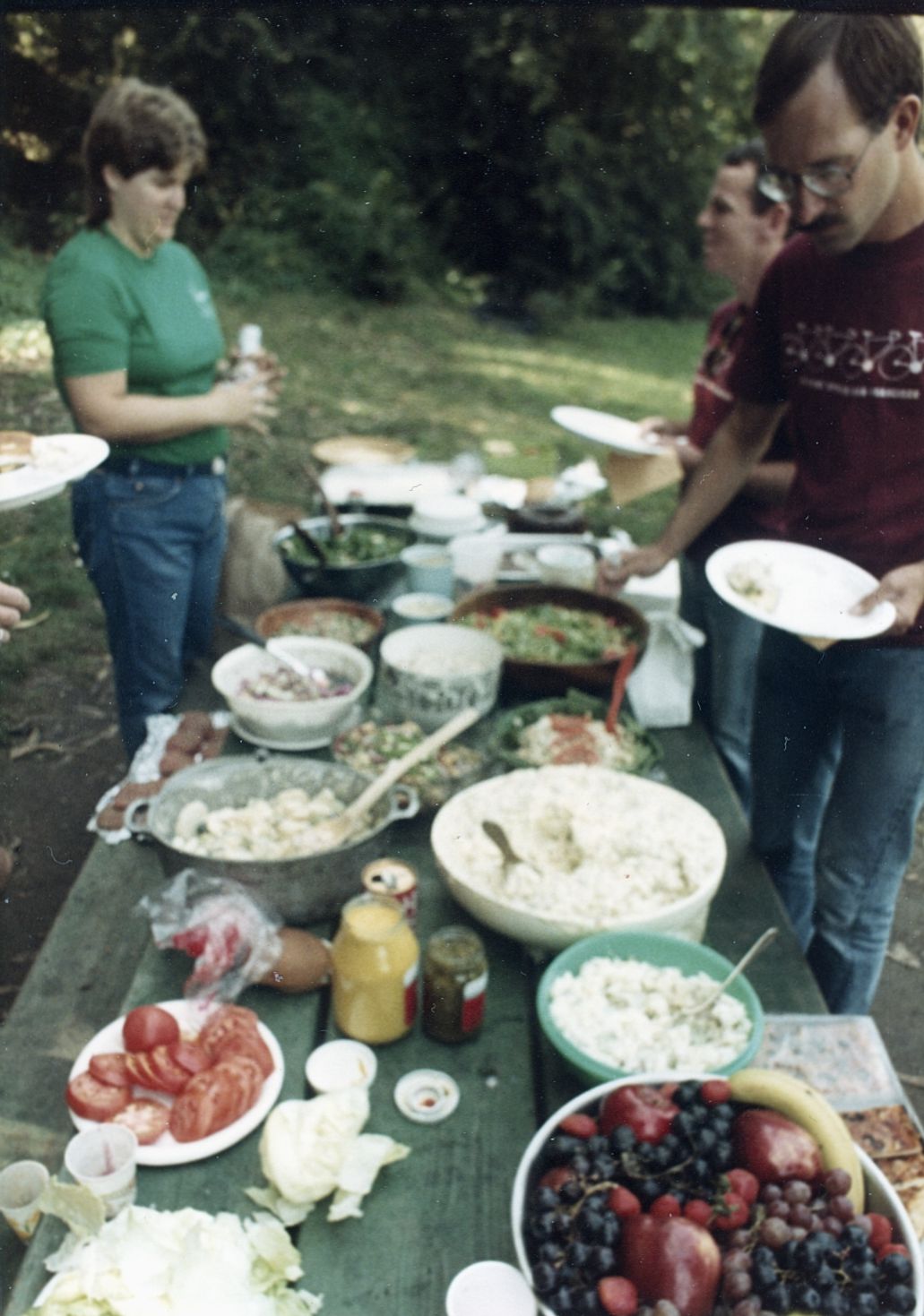
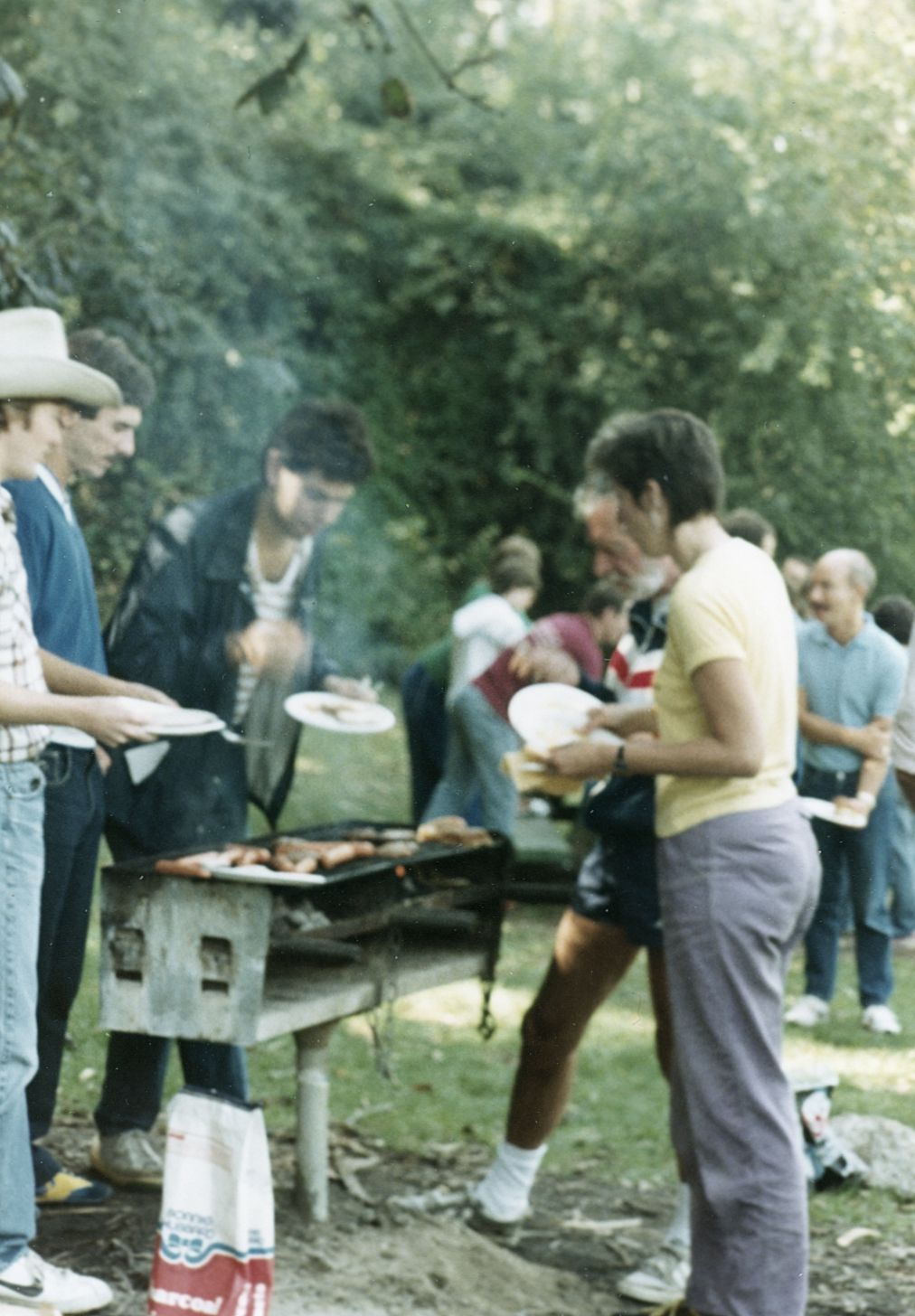
The club picnic, which is nigh upon us, is one of the oldest extant club events with the first one taking place in October 1983. Considering that the club formally “opened business” in November 1982, the picnic appeared just before our first birthday. It was held in Lindley Meadow in Golden Gate Park, which is just east of this year’s picnic site at West Pioneer Meadow. At that point the club’s membership was probably about a hundred yet the turnout was huge—60 people! Perhaps it was due to the shrewd marketing, which in those days consisted of posting flyers in local businesses and bike shops. There was no email or Internet then. It’s possible that we posted an announcement in the local gay rags but it must have been a freebie. Or, you could look at the large turnout as a sign of the prolific thirst for a club like Different Spokes. One of the organizers of that first picnic was Shay Huston, one of the first women members of the club. Shay wasn’t one of the founders but she almost certainly was a member before we formally announced our existence in the ChainLetter. Shay was, like many of the key early members, an avid bike tourist. Shay participated in the club’s very first official ride, the overnight tour to Santa Cruz and back over Thanksgiving 1982. The others who planned the picnic were Tom Chalmers and Ed Fitzgerald. I don’t recall Tom but I have a vague recollection of Ed. It was in many ways a ‘trite’ event: it had all the standard picnic things such as grilled burgers and dogs, picnic tables, volleyball, and a treasure hunt. Feeding that many people was a task but people brought a lot of food to share. The club was pretty broke in those days so we asked for donations of food! The following October the picnic was held in Elk Glen picnic area, which is just south of Lindley on the South Drive side of the park. Then followed a break from 85-87 where we had no picnic for some reason, probably because no one stepped up to organize it. By then several key members were either gone or dead even though the club was continually growing due to Bike-A-Thon. The picnic returned in 1988 and 1989 also at Elk Glen. I recall these more clearly because I helped organize them. In September 1989 Bob Humason had just died and secretly left a bequest of $700 to the club. Bob was an early member and later became President and was instrumental in the very first AIDS Bike-A-Thon in 1985. By early 1989 he was fading fast due to AIDS and was gone in what seemed like a flash. Anyway, part of that $700 was put to good use in buying plenty of food for the picnic only to turn out to be an extravagant waste when hardly anyone showed up!
Bob Krumm hovering over the grill in Lindley Meadow.
With this year’s picnic taking place in late September it’s returning to its roots. Originally the picnic was conceived as a farewell-to-summer-and-riding, which is why it took place in October. Not coincidentally that’s a good time to hold a picnic in Golden Gate Park since late summer/early fall usually has less fog and we get an Indian [sic] summer. That said I recall the picnic in either 1984 or 1988, although not frigid, was a tad windy and the fog rolled in later in the day. That’s probably what encouraged the club to look for a venue with more reliable weather and that would allow it to be held during mid-summer rather than just in the short window of balmy weather we get in SF. I don’t recall whose idea it was to move it to Samuel P. Taylor State Park but I do recall at least one picnic there that was absolutely broiling. I remember panting in the heat despite sitting beneath towering redwoods. Perhaps it was like being stuck between the proverbial devil and the deep blue sea. I’m speculating but in later days I suspect that’s why it was moved again, this time to China Camp, which being on the Bay is sunnier than GGP and although it could be warm there the bay waters provide such an ameliorating influence. Moving the picnic out of SF may have been a blessing weather-wise but the logistics became more complicated. Now folks had to get to the picnic site by car unless they wanted to do a significant bike ride. That didn’t seem to hurt attendance much as pictures in the club photo gallery show that for many years Sam P. Taylor and China Camp had good turnouts. Moving the picnic back to SF makes it easier for most folks to get to the picnic (although it’s debatable for those of us who live outside of SF that getting to SF can still be called ‘easy’!) See you Sunday September 22!
In case you missed the news we now have a RideWithGPS club account as a member benefit. This all came about because Project Inform unexpectedly shut its doors leaving this year’s Saddle Challenge without a beneficiary. Saddle Challenge participants voted instead to donate their proceeds back to the club to use in opening up a RideWithGPS account for all members.
What is RideWithGPS? RideWithGPS (RWGPS) is an all-purpose Internet tool for creating, maintaining, logging, and storing GPS routes and tracks. You can easily create a GPS route, load that route into a portable GPS device such as a Garmin, Wahoo, Lezyne, and many others so that you can view and follow your route. This is better than most car GPS systems, which you are probably used to, in that you can lay down the exact route you want to follow rather than just inputting a destination and having your car GPS select the route for you. RWGPS automatically generates a cue sheet for a route, so if you don’t have a GPS device, you can still follow the route. Since most cycling and fitness GPS devices can record a track of the route you actually take, you can load that track up to RWGPS to view it or the various metrics such as elevation gain, gradient, average speed, etc. The RWGPS site is full of tracks and routes that members have created from around the world. You can view them and if you like them, you can download them to give their route a spin. What makes RWGPS such a nice tool is that it is supremely easy to use. The interface for creating or viewing routes and tracks is intuitive and not ‘techy’ at all, making it a great tool for everyday users.
Why Would I Use RWGPS? Unlike the “old days” when ride leaders would show up with a fistful of xeroxed AAA maps with a route highlighted in yellow marker and some wonky cue sheets that were likely very time-consuming to create (plus the trip to Kinko’s to make copies), the club is more and more relying on Internet mapping tools like RWGPS to do the heavy lifting. This allows members to view a club route in advance, print their own copy of the map and cue sheet, or load them into a device to use on the day of the ride. If you have an Android or iPhone, you don’t even need a dedicated GPS device to take advantage of guidance along unfamiliar routes: RWGPS makes phone apps that will do it for you! After you’ve downloaded and installed the app on your phone, you can download routes from RWGPS and the app will provide turn-by-turn voice guidance! You don’t even need the screen on your phone so that saves battery life. And you don’t even need a cell phone connection because RWGPS allows you to download the entire map of your route so that you can use it offline and get navigation just from your phone’s GPS chip.These are features that usually require a paid account to access but are available to members through our club account. RWGPS, like Strava and Garmin Connect, also allows you to upload your tracks to your own ride library so that you can amuse yourself later or just keep track of where you’ve been. And if you decide to lead a ride, guess what? It’s going to be super easy to create the ride you want, find a ride, and make a cue sheet, map, and GPS file available to participants. No more going to Kinko’s or burning through another toner cartridge in your printer.
Club Ride Library. We have a route library in the club RWGPS account. At the moment it’s mostly rides from a few board members. But it will grow through time. Currently we have about 400 routes, almost all of them in the greater Bay Area with some in Central California and the Pacific Northwest. You can view and sort rides to find exactly what you’re looking for by distance, elevation, location, name, etc. Looking for inspiration? This is where you can go to find your ‘Goldilocks’ ride!
If you have questions about the club RWGPS account and how to access it, contact our Vice President or go to our website’s ‘How to’ area after you’ve logged in.
Again while looking for information in old ChainLetters on another topic I ran across another Ride Rumor about Bolinas Ridge Trail, this time from the July 2004 ChainLetter, five years after Doug O’Neill’s Annual Picnic ride there that I mentioned in a previous post. Kim Walsh led the ride with some newbies including Chris LaRussell, who crashed while going downhill although apparently without breaking anything. Here’s the ride listing from the Yahoo! group:
“Bolinas Ridge Mountain Bike Ride on Wednesday, June 30. Distance: 22.5 miles; Pace: B; Terrain: 3, mildly technical.
Ride Description: Come join me for a rollicking good time on the Bolinas Ridge trail. The ride is a mildly strenous, mildly technical mountain bike ride suitable for advanced beginners and more experienced mountain bikers. The ride is a fabulous out-and-back on fire roads and double track through a cattle ranch and parkland. It’s listed as one of the “Northern California’s Best 100 Trails”. You’ll see great views, wide-open grasslands, and cool redwoods. It can be warm and dry on the ride, so bring your Camelbak or two water bottles. Bring some dough and we can go into Olema or Pt. Reyes Station for an aprés-ride snack.
Ride Start: 10:30 am. Meet at the trailhead on
the Olema side. From the Golden Gate Bridge take
101 north to the San Anselmo/Sir Francis Drake
exit. Bear left and take Sir Francis Drake west,
following it to the trailhead, about 20 miles.
When you see the sign that says “Olema 1 Mile”,
the trailhead and parking area are just around
the next bend. Park on the wide dirt shoulders
on either side of the road.
Kim thought the trail was “mildly technical”, which is what I recalled it being. Note she doesn’t mention a parking lot. Either it was gone by then or it was a complete figment of my imagination! Here’s the Ride Rumor that followed in the ChainLetter:
“Bolinas Ridge Mountain Bike Ride – June 30, 2004 There were four motley riders on Kim’s mid week ride: Katrina who was on a borrowed bike as she has never done any mountain biking, Chris was also on a borrowed bike (just too lazy to change out the slicks on her bike), but at least Francois and April came with their own bikes. Katrina’s bike kept shedding parts she didn’t want while Francois, being the only boy, tried to learn how to use a really butch multi-tool. He finally handed a little pile of multi-tool metal back to Kim and she then figured out how the hell to put it back in one piece. While trying to do a downhill (and trying is the operative word here) Katrina-Bambi-Madsen made Chris-Vixen-LaRussell laugh on a little ledge teetering on a ravine with boulders. Yup, down into the abyss she went. Lying in a little heap, bloody road rash and all, it was Nurse Kim-Sneezy-Walsh to the rescue (deer names were given to all because Katrina was convinced that we were going to be eaten by Mountain Lyons, and we wanted to make sure Katrina was eaten first). She had proudly shown us her brand new first aid kit at the beginning of the ride and saw this as an opportunity to use everything in it. She tried to use the space blanket, brought out the tweezers (everyone tried their best to find something to use these on), but when everyone started talking about putting Chris to sleep like a horse that had a broken leg, she got up rather quickly and started back down the hill ahead of the pack, blood and all. At the end of the ride we all went to Pt. Reyes Station for snacks and beverages at which point we gave April (a guest), who has been on other DSSF REAL mountain bike rides, this disclaimer “if you EVER see a mountain bike ride listed by ANY of these people ever again, it’s best to just stay home!” A good time had by all!”
It looks like the trail was degenerating by 2004, as it sounds like conditions that we experienced this past July. Finally Jaime chimed on Bolinas Ridge on the Yahoo! group on 6/23/04:
“FYI, Rico, Victor, Victor’s boyfriend Kyle, and I did part of this route on Sunday prior to the Club Picnic at Samuel P Taylor State Park. Bolinas Ridge is a terrific trail, and we agreed it is best done out-and-back rather than as the loop we did. Our loop included a horrendously steep initial climb of 1,400 ft. The out-and-back route that Kim is planning involves instead a gradual climb and a long but modest descent. It’s easy, and safe–no cliffs to worry about if you fall. Highly recommended.”
This is probably the final update on my experience with road tubeless tires.
Although the rains had ceased a couple of months ago in July I still had fenders on my bike. Normally I’d have pulled the fenders by May but we had some late spring rains that delayed that minor maintenance. Then we did a ride where copious marine fog made the roads wet under the trees and I was glad to have the fenders. So they stayed on even longer. I used to be a weight weenie and fenders were relegated to my commuter bike. The bike I’d ride for pleasure was almost always stripped down to the minimum of baggage. Back in the day I used to look quizzically at Jerome’s bike because he always carried a handlebar bag plus other stuff on his bike. Why would you carry all that? It just weighed you down and made you slower. As for fenders, skip them—I’d just wipe the bike down after a wet ride (if I wiped it down at all). But if you were to look at my bike now you’d see a veritable laundry list of “Boy Scout” items—front and back lights (with battery packs), saddlebag with not just a tubes but multitool, patch kit, nipple wrench, quick patches, tire bolt, chain tool, spare battery; a bento bag with more stuff, a bell, a full size bike pump (no CO2 or minipump for me!). Oh, and like Jerome I often ride with a small handlebar bag that has more junk in it—pen, wipes, Advil, Swiss Army knife, pickle juice, emergency snacks, sunscreen, lip balm, crash kit, electrolytes, bike lock(!), etc. etc. In other words I’m completely fredded out these days thinking that the bike-ocalypse could happen on any ride. One day I weighed it all and it was like four pounds of extra “essential” stuff. It’s true that we become our parents when we get older, isn’t it? Maybe I’ll hitch a Green Egg grill and tow it so I can cook up a really good lunch on my rides! Which brings me back to those fenders: so what that they add a couple of pounds to my bike? I’ve already drunk the Fred Kool-Aid, plus they keep grime off of me and most of my bike. It’s just one more chore to take them off and put them back on. However if you’re using road tubeless tires those fenders actually come in handy. If you have a puncture, all that sealant doesn’t get flung all over you and the rear of your bike. In a momentary brain infarct I decided to remove the fenders anyway. Maybe I was thinking I’d go faster and make up for my lack of conditioning. Maybe I was engaged in magical thinking—I’ve come to realize that that’s most of the time—and thought that I just wouldn’t need them with a dry summer ahead. In any case taking off the fenders was not laborious although it did induce me to spend more time than I wanted or should have cleaning the bike after this wet winter. The next day Roger and I went out for a really nice ride—perfect weather—and when I got home I noticed the entire rear of the bike was coated in dried sealant. I’m not talking about a little sealant, I’m talking about so much sealant that it dripped to the bottom bracket and formed a hanging booger underneath. I was half tempted to say oh-f**k-it and in frustration just leave it a mess. But after cleaning the bike the day before, damned if I was going to let that shit stay there. I checked the tire to make sure it wasn’t a really bad puncture (tire plug time?). The tire was actually quite hard and when I checked the pressure it was down only a few pounds. Whoa, all that sealant got out and the pressure was still really good! Definitely a plus. Inspecting the tire I couldn’t find the puncture—a mystery. Usually there is sealant dried around the puncture but apparently just riding along scraped away the remains on the outside. What are my thoughts on road tubeless now? As you know I’ve learned using road tubeless tires is not without negatives. It’s not quite obvious that they can be messy—messy to set up and messy if you have a puncture. If you’re fastidious in your bike maintenance, you’ll potentially find that the time and convenience you’ve saved in not having to fix flats and repair tubes either by the side of the road or at home is somewhat offset by any cleaning up you’ll encounter as a result of a puncture. If you don’t care how your bike looks, then sealant muck on your bike will just blend in with all the other wheel spray you’re letting fester there and road tubeless will definitely a big plus. But if you like a clean rig, you’re going to find some of that saved time offset by wiping sealant spray off your bike. Mind you, it goes everywhere. Which brings me back to the fenders. With fenders sealant is not going to get on you or your bike. When I took the fenders off I did notice that there was dried sealant all along the inside (which I dutifully cleaned off!) from the past winter. So I had some punctures that I didn’t even know about. But if you’re in your weight weenie stage there is no way in hell you’re going to ride with fenders. But consider this: PRO isn’t just having a pristine, well-kept bike—PRO is riding that beast in all conditions including rain. So when people with $8,000 bikes tell me they don’t ride in the rain and would never put fenders on their bike, I wonder. Yes, even pros use fenders in training. The fenders are going back on the bike to join the rest of the junk that’s living there. But at least I won’t have to clean the rig up as often. I must confess I’m torn: if I weren’t using tubeless tires I wouldn’t leave fenders on this bike. So for the dry season that’s a trade-off for me. I’ve had at least four punctures that have given me pause. The first one had sealant spraying everywhere (it was pre-fenders); the second wouldn’t seal with Stans and I had to switch to Orange Seal; the third was when the sealant all dried out and I flatted; and now this one, no impact at all on the ride but boy, what a cleaning job afterwards! There is one situation I have yet to encounter: the puncture that’s so bad you have to put in a tube and maybe a tire bolt as well. I’m dreading that because wet sealant is really messy, which is why I now carry latex gloves and paper towels. (No, I’m not planning on giving someone a prostate check “in a roadside emergency”.) They’re to wipe off the inside of the tire and the resulting mess, which is unavoidable regardless of where you are when it happens. Ironically before I started playing with tubeless tires the only thing that would get me to phone for a ride home was if my bike became unrideable from having a broken derailleur hanger, a trashed wheel, or some such thing. You would think that tubeless tires would reduce my concern about needing a rescue. But I’ve found instead that my concern has gone up. Years ago Roger and I were riding the tandem in the Solvang Century and we flatted the rear tire. Upon inspection—and to my embarrassment—it turned out the tire was so worn that we had worn it down to the inner tube! Hey no problem: I put a tire bolt over the worn-out spot and slipped in a new tube, which shows you that with standard inner tubes you really can handle just about anything. (We probably could have ridden that tire all the way but we found at the next rest stop that we could buy a tire. So we replaced it in just a few minutes.) So what am I saying? Doing roadside maintenance on tubeless tires can be much more tiresome and frustrating than with regular tubed tires. But with tubed tires you are guaranteed to be doing roadside repairs whereas with tubeless this is going to be rare. But if it does happen to you, it will likely be not just a minor inconvenience like the flats you’re used to having but a major PITA. And a mess. And, if you like a clean bike but eschew the weight of fenders, then you’re going to have to weigh the one against the other because you can’t have both with sealant. For now I’ve put more sealant in the tire and the fenders are going back on. But I am leaning more towards going back to lighter and better tires with latex tubes instead of running tubeless. Then I could ditch the fenders during the dry season (but why bother?) The ride is definitely better with other tires, eg. Michelins, than the tubeless Schwalbe Pro Ones (although Schwalbes are better than average) and I have some misgivings about the independence I may give up by having a set up that’s less friendly to roadside repairs. But I do like that I can ride on these wheels with a much reduced likelihood of a flat. But let’s face it: I’ve been riding bikes for almost sixty years and have fixed literally hundreds of flat tires. It’s second nature to me and merely irksome that it happens at all. So although my experience with tubeless is improving as I learn more how to work with this technology, I have to ask, “Is this really an improvement?” and the answer is a mixed one. If someone told me today that tubeless road tires stuff went out of existence, I’d shrug my shoulders and ‘whatevs, bro’. If you’re coming to cycling now and growing up with road tubeless, then maybe you’d have a different reaction. Do I feel the same about other bike technologies? No, I don’t. For example, when indexed shifters came along and especially brake/shifter levers (“brifters”), I was sold even though I had grown up with non-indexed downtube shifters. I immediately recognized that the convenience far outweighed any inconvenience or extra weight that this technology would introduce. For me brifters are a huge improvement with no serious downside, so I’m no curmudgeonly retrogrouch. I don’t feel the same about tubeless tires, at least not yet. It seems to me that with road tubeless the trade-offs are serious enough that you are going to have to think about your individual use case and what you are willing to tolerate. For me it’s nice to have fewer flats to repair. But the prospect of a serious tubeless failure out on the road still gives me pause. I do like a clean bike and since I don’t mind the weight of fenders, having to use them with tubeless tires isn’t enough of a deterrent to completly drop tubeless for now. And of course during the rainy season having to use fenders is a joy rather than an imposition. And fixing a flat in the rain? No thanks. Been there, done that (a few dozen times). Lastly keep in mind that burping tubeless tires is a real but low possibility and as I mentioned in the last post about tubeless tires burping high pressure road tires can mean a crash due to the sudden, immediate deflation of your tire. In my case I’m very light and have 25 mm wide rims with 30 mm tires. I run my tires at 40-60 psi depending, and those medium pressures reduce the risk of burping and catastrophic failure. But if you have narrower rims, narrower tires, and thus have to pump them to higher pressures, you need to be careful. So there you have it—after almost three years of playing with road tubeless my curiousity has been sated and this technology—for me—is not a must-have but a mixed bag. Maybe you’ll feel otherwise if you try it. It’s a plus if you either don’t know how or hate to repair a flat tire. But tubeless tires do not eliminate flats nor do they make your cycling life problem-free. You will still have flats, just fewer of them, and your maintenance shifts from one task to another. So you are losing perhaps the inconvenience of more minor repairs by the side of the road and having to pray you don’t have a total tubeless failure that will guarantee you’ll be screaming at the gods for the shit show you’re having to endure. I will say that if you’re a slob, then road tubeless is probably the way to go. You’re not going to clean your bike anyway, so a layer of latex sealant on top of yesterday’s wheel spray, tar, and filth is not going to give you pause. Just be prepared to call for a ride when that day comes when your tubeless tire is hopelessly hosed and you’re miles from home or a friendly bike shop.
What’s up next? I’m going to experiment with Tubolito tubes, a 38 gram inner tube. Back to weight weenie…
Memory is the fourth dimension to any landscape. —Janet Fitch
About a month ago I led a mountain bike ride to Bolinas Ridge Trail on which I crashed and broke my collarbone, my very first fracture in 65 years. What puzzled me about that day was, how could I have been so wrong about this trail? I hadn’t ridden this trail since the early or mid-90s and although I was expecting it to have changed, riding the trail was like visiting a foreign country for the first time. My recollection was of a fire road, non-technical, with a few short, steep stairsteps but mostly a pleasant slow climb up Bolinas Ridge to Ridgecrest where you turn around and then descend back to the parking lot. I thought it would be a good ride in our reintroduction of mountain biking back in the club.
I called the few remaining mountain bikers and they all couldn’t make it for one reason or another except for Roger Sayre and my husband, who was trusting in me to select a trail he could handle. Just the three of us wasn’t too surprising as dirt riding, which used to be so popular in Different Spokes, has all but vanished.
Right from the get-go I started questioning the accuracy of my memory when we got to the trailhead and there wasn’t a parking lot that I distinctly remembered was there. There wasn’t a lot in sight, and furthermore there was a seemingly aged, wooden fence with a very narrow stile as the only entrance. I looked around and nothing resembled what I had “imprinted” in memory. Could the lot have been removed? But the weathered fence belied that possibility.
Once we were rolling the general terrain was familiar but something was terribly different. The fire road was in horrible shape, pocked with rocks and potholes. But worse on every short incline the double tracks had become eroded mini-trenches demanding that you steer carefully and straight in order to proceed. The option of rolling outside these twin trenches was virtually impossible because the center was uneven, rocky and full of tufts of overgrown weeds and the sides of the trail had grass at least four feet tall with a surface of uncertain quality. The three of us lunged forward and a couple of times we ended up walking when we just couldn’t steer around the mini-trenches.
After almost two hours we had barely made it five miles. Roger turned around when the Marin Municipal Water District boundary had a sign that clearly forbade e-bikes. Roger S. and I continued on only a little bit further to a shady spot to rest before we turned around as well. At this rate it was going to be a long day and I didn’t want to miss lunch at the Olema Inn. On the way down I crashed; separately my husband also crashed—twice—but was comparatively unscathed. I ended up walking out to the car and we both headed to the ER.
Having to deal with a broken collarbone is painful and miserably inconvenient. But the most upsetting aspect of the day wasn’t the injury, it was the apparent unreliability of my memory. Was it a senior moment, a sign of impending decrepitude, or—hopefully—just the lack of trail maintenance? Not being able to do much of any value with a broken wing, I spent my recovery hours working on miscellaneous club tasks such as tying up the loose ends before the Marvelous Monterey Weekend. I was also doing some research on the club picnic by perusing my old ChainLetters when I ran across a ride listing for the Bolinas Ridge Trail in 1991. Who was the ride leader? To my surprise it was me! Actually there were two ride listings because I led the ride twice in a matter of months. Here is the listing and the two ride rumors:
July 1991 ChainLetter, Sunday July 7 Bolinas Ridge Run Join Dennis [Westler] and Tony on a mountain bike jaunt over Bolinas Ridge that overlooks Mt. Tam and the Pacific Ocean. Starting just outside the town of Olema, a fire road rolls gently along Bolinas Ridge for 11 miles through redwood groves and open fields with terrific views. At Bolinas-Fairfax Road we turn around and go back the same way, and after the ride have a late lunch in town. Bring water, snacks, and a windbreaker (the weather is unpredictable). 3-B-22. Look for a very small parking area at the top of Bolinas Ridge on the left side of the curve.
October 1991 ChainLetter, Bolinas Ride Run Alas, Prez Dennis Westler’s parents and nephew showed up in town and filial responsibilities required that he attend to their needs rather than ours, so he wasn’t able to co-lead this ride with me. Too bad, ‘cause this one turned into a real winner. I too had an out-of-town visitor, my old college roommate. But I borrowed Dennis’s bike and hauled Paul up with me for his first mountain bike ride. Ten folks showed up , and mostly new I might add, since the only “old timers” were myself, the Den Daddy, and Dr. Bob. The weather was windy and thick with fog. But the gradual ascent up Bolinas Ridge was still beautiful. There were fewer wildflowers to entertain us, but plenty of cows. Things got a bit muddy when we entered the redwoods—the fog dripped down steadily and turned the forest floor into a muddy obstacle course. There were big puddles and slippery tree roots, but no one seemed to flinch except wimpy old me. Most of the group was ahead of me and so I took my time picking the least muddy route around pools, mud patches and roots. Fortunately I managed to stay less muddy than everyone else (remember, this is relative only), no doubt a victory of Fashion over Speed. I’m not sure how things were going with the main group since mostly everybody was ahead of me. Poor Anne [Dunn] was struggling far behind. Having just moved, she couldn’t find any of her bicycling clothing and had to ride in jeans and a borrowed helmet. Being last meant she had to close all those cattle guards too. At the top it was easy to tell who was fearless. Generally they and their bikes were coated in a brown film. The descent back was terrific. The gonzos took off, and in a fit of insanity I actually tried to stay with the Den Daddy. I was screaming down rutty, gravelly sections at 35 mph—a tribute, I suppose, to demonic possession. Big fun! At the end, most of the group trundled down to the Olema Inn for a stately lunch on white linen tabelcloths set on the outside deck, as the sun finally showed itself. Just another bodacious dirt ride.
Hitting 35 mph downhill? That would be impossible today with the utterly degraded terrain. My friend Paul had never ridden a mountain bike before and it’s impossible to believe I would have taken him on a super-technical ride!
November 1992 ChainLetter, Bolinas Ridge Run (October 19) A small band of six dirt-o-philes showed up to climb Bolinas Ridge. The last time we did this trail, we had to put up with dense fog and muddy conditions. This time it was a picture-perfect day: brilliant sunshine, no fog, no smog, and warm. The climb up sure seemed harder than I remembered it, and the “2” terrain rating was probably conjured up in one of my rosy but hazy recollections of the undulating trail, which at times forced all of us into our lowest gears. It’s probably more of a “3”, or maybe even a “4”. Unfortunately this was an unpleasant surprise for Paul, a newcomer to the Club. Sorry about that, folks. (Hope you come back, Paul.) The only untoward incident happened when the group unceremoniously left Paul and me behind, and then for the first time in my life my chain decided to snap in two, leaving me gearless on the hillside. What was irksome was that because I don’t have Hyperglide–which is notorious for chain breakage–I stupidly thought I would never need to bring a chain tool with me. Now I know better. Luckly Paul was able to forge ahead and the group was politely waiting for us under a tree. Prez Dennis zoomed back with a tool and in no time I was back in the saddle. The sunny weather brought out the hordes as we passed many other hikers and bikers. At the top we ran into an enormous group from Single Cyclists preparing to descend Bolinas Ridge. We beat a hasty retreat after snarfing our PowerBars. Without the Den Daddy to inspire us, no one was in the mood to kamikaze, so our return to the cars was uneventful, although that gave us time to enjoy the view. Afterwards we converged at the Olema Inn, which graciously reopened its kitchen to prepare a late lunch for our dusty little group. Just another fabulous Different Spokes mountain bike ride!
In the ride listing and ride rumors there is no mention of technical difficulty on the trail. Plus, the relatively benign terrain listing we gave it supports the recollection that the trail was just your standard fire road back then.
Then I ran into another ride rumor from 1999. In that period the annual club picnic was held at Samuel P. Taylor State Park, not China Camp, which is just down the road from the Bolinas Ridge trailhead and as part of the picnic festivities that year Doug O’Neill led a dirt ride on the Ridge:
July 1999 ChainLetter, Different Spokes Goes to the Cows Perfection: bright sunshine, a gentle ocean breeze, and a challenging yet fun trail. This is what six riders enjoyed on the Samuel P. Taylor offroad ride. Three particularly brave riders, Ellen, Kevin, and Michael, were on their first offroad ride, completely unaware that they were witth the club’s only certifiably insane ride leader. The initial climb to the Bolinas Ridge trail was a bit of a challenge, but not for studly Dan, who pedaled by some others who succumbed to the desire to walk a bit, or in David’s case, the need to adjust his seat height. At one particularly stunning crest, the group was stopped by a herd of cows in the middle of the trail. Not to be outdone by Dan’s earlier show of studliness, Michael cleared the path and saved the group from a charging bull. (The family nature of this publication prevents us from disclosing the technique used.) The determined group made it up the final set of hills to the promised “big rock”—no, it was not some mythical place. Tired after their earlier feats, Dan and Michael decided to relax a bit, enjoying the rock, sun, birds, and the cirrus cloud formations—a moment away from the bustling and foggy city. Ever-ambitious Pam, apparently not challenged by the climb, decided to do a bit of crosscountry on the way back. Everyone enjoyed the long and picturesque descent to the feast waiting at the barbecue.
Again no mention of the trail being particularly technical and this was eight years later. To boot there were several newbie dirt riders that day!
So it is likely that my memory wasn’t playing tricks on me and that something happened to the trail after 1999. That’s still 20 years ago so one shouldn’t expect things to be exactly the same! Perhaps I was expecting it would receive regular trail maintenance. The Bolinas Ridge Trail runs through the GGNRA and Mt. Tam watershed area. The section where I crashed was under GGNRA control, which also controls the Marin Headlands trails, which do receive grading and maintenance. Yet the trail looked like it hadn’t seen a grader in years.
Perhaps one day it will see some love and be restored to what it once was. Although it behooves those of us who do ride dirt trails to volunteer to do trail maintenance, working on a fire road is really the provenance of heavy machinery operators. Nonetheless it was an exclamation point that trails don’t just take care of themselves and that human care through hard work, taxes, and donations is how we keep the trails we love. Will I go back? Probably. But memory will serve me right the next time.




 The Chain Letter