RideWithGPS isn’t just a boring, pedestrian drawer full of local routes. It’s a gateway drug to getting your full-on bike exploration addiction. Fantasizing about cycling in the French Alps? Go into RWGPS and search for routes of any length and starting in any town you can find on a map. Looking for interesting gravel or mountain bike trips? You’ll find those in there too. Even if you aren’t looking for routes in the Malaysian highlands or in the Italian Dolomites—perhaps you’re looking for something closer to home—you’ll be able to draw on the riding experiences of thousands of other cyclists in your neck of the woods. Maybe you’re thinking of riding in the Mendocino area for a weekend. You can look up routes other cyclists have ridden and/or created in that area. You’ll get detailed information about routes allowing you to check out possibilities in advance.
Many cycling clubs use RWGPS to host their club libraries. You’ll probably encounter them if you prowl around an area. Once you find a route from, say, Different Spokes, you can search for other routes from that club or creator leading you to their collection. This will help you see what kinds of rides that club likes to do in their area.
Many cycletouring companies store their routes in RWGPS. This allows them to manage their own collections of routes and trips and distribute GPS routes to each tour member. However most companies keep their routes private. Club on the other hand keep their route libraries public since not every ride participant is a member. Exploring club routes will give you a great idea of the kinds of rides they like to do and what is popular in their area. Different Spokes Southern California, Windy City Cycling Club (Chicago), Outspokin (Denver) and Outspoken (Seattle and San Diego) all have RWGPS libraries.
From from the madding crowd. Back in the day club rides tended to be ‘simple’ routes using main roads. Why? Because it was too hard to lead a group on a complicated route with many turns and unfamiliar byways without losing people. No one liked to read cue sheets and maps often were not detailed enough if you did end up off-route. With GPS devices that is no longer an issue and ride leaders can select roads with less traffic even if they involve lots of turns and “hidden” roads because participants are kept on route by their Garmins. This allows for far less hectic and dangerous conditions by keeping riders away from main roads where most of the car traffic travels. And guess what? RideWithGPS also handles off-road routes and tracks. So if you’re looking for interesting trails or fire roads, you’re covered as well.
Are we there yet? Have you ever been out on a ride where you were wondering when you were going to get to the lunch stop, or the toilet, or just get to the end? With a GPS track you’ll know exactly how far you have to go instead of wondering how much longer before you can scarf down a Magnum bar.
Speak to me. Staring at your Garmin is bad habit and don’t we have enough already? Not only can it be dangerous but when the scenery is beautiful do you really want to be figuring out where that turn-off is? Yes, your device will give you a generic audible alert when it thinks you need to look at the map for something important like a turn. But you can go next-level with the RideWithGPS app in your phone: spoken directions. If you don’t want to stare at your Garmin while cycling, you don’t have to with RWGPS. With the RWGPS phone app you can load in your route and have it speak all the cues and the turn-by-turn directions. You can black out your phone screen to save battery life while running the app and still get audible cues. Such a deal!
RideWithGPS is an Internet service where routes for cycling, hiking, and driving can be created, viewed, and stored. It has users around the world and you’ll be able to search for and look at routes just about anywhere you can ride a bike. Many cycling clubs use RWGPS because it is easy to use and it’s easy for club members to access from home, their phone, or anywhere via the Internet. RideWithGPS is one of a multitude of Internet based mapping systems for cyclists. Others include Komoot, MapMyRide, BikeMap, and even Strava. RideWithGPS allows anyone to create routes, keep a library of routes, record the tracks of rides, search for and look through the routes of a zillion other users, and of course it has all the relevant data to scare you from or entice you to check out a route: distance, elevation profile, a map, cues, and turn-by-turn navigation. In addition to hosting your route library, RideWithGPS also allows you to upload tracks of your rides for you to keep a record of your riding history.
Most of our club rides have an associated RideWithGPS route. If you use a cycling computer with GPS capability such as a Garmin Edge, Wahoo, or Hammerhead Karoo, you can download the GPS route and install it in your device. You can then enjoy turn-by-turn navigation without having to check a paper map or cue sheet. No longer fear getting lost (well, as long as you have battery life). Whether you’re on a club ride and end up by yourself or you’re just out cycling alone on an unfamiliar route, using GPS navigation with a RWGPS route allows you to ride and always make it back to your destination.
Interested in a club ride but don’t know anything about it? Just check out the RWGPS link in the listing to view the map, an elevation profile, number of climbs, hill gradients, and places you’re going to hit along the way including pit stops and food.
Even if you do not have and are not interested in using a cycling computer, you can still use RWGPS to get the map and cue sheet for a club ride or any ride in the vast RWGPS site. This gives you the freedom to download and print your own cue sheet and map of the route and not depend on the ride host to show you the route nor to hand out a route slip. And, if you’re a ride leader, you no longer have to provide any maps or cue sheet—just refer participants to the RideWithGPS route where they can get their own copies.
RWGPS also provides a free app for both Android and Apple phones. You can get a route directly through the app and then either refer to it in lieu of a paper cue sheet and map or, even better, use the app’s built-in navigation to guide you along the route. If you’re concerned about burning up your phone battery, don’t worry: the RWGPS app allows you to turn off your phone screen and it will give you turn-by-turn navigation by voice! I can’t think of a cyclist who does not have a mobile phone but there are still some who don’t use a GPS-enabled cyclocomputer. If you’re in that category, you won’t have to spend any additional money to take advantage of RWGPS–just use your phone.
RideWithGPS allows you to create your own routes and maintain your own ride library. But even if you’re not interested in creating routes, you can take advantage of the enormous RideWithGPS library to look for routes that might interest you. Visiting a new place? You can check out rides in the area with full details. RWGPS provides search tools for you to pin down interesting routes by location, distance, type, name, photos, etc. Some users even upload pictures they’ve taken along their routes so you can get an even better idea of what you’ll encounter. There are so many users on RWGPS that you can find new and interesting routes you’ve never set your bike on in your own backyard.
In the early days of Different Spokes in the 1980s we had an actual club library. This was pre-Interent. If you were interested in a ride, you could look at our collection of guide books, some specialty cycling maps, our diverse collection of AAA maps, and a wad of cue sheets and xeroxed maps with routes outlined with Magic Marker. Or you could talk to someone in the club about a ride because we had monthly in-person meetings! The boxes of books, binders, and paperwork—our “library”—were brought to each meeting. This wasn’t too hard because they were stored in the back of the Park Branch library on Page Street where we had our meetings for many years. We simply lugged them out just before the meetings started and spread them out on a table. Later the library was closed for a prolonged renovation and we had to move our meetings to a new home. We relocated to the Metropolitan Community Church in the Castro, and without a store room we had to lug them to and from the meeting room. How do I know this? Because the library was kept in my old garage! And guess who was in charge of the library?
For those who wanted to lead a ride, this ‘primitive’ way of researching rides was actually pretty good. Print books almost always had accurate information if eventually outdated and you could talk to someone who had perhaps ridden the route if you hadn’t and could give you an idea of what you might encounter. But books are updated infrequently if at all and the information can go stale. Is that road still open? No way a book is going to help you with that.
Fast forward forty years and the club has a very different tool for ride research and creation: RideWithGPS. New guide books are a rarity and even AAA has closed its mapping division. It’s all Internet and GPS mapping now. So whether we like it or not, the new reality is Internet and computer based maps and guidance. New cars often come with GPS systems and even if they don’t, people are using their phones with Google or Apple Maps. So it is with cycling. In the Bay Area I haven’t seen a cyclist with a paper map in many years—just whip out your phone and look at a map application. I don’t miss the old days because now there is a thousand-fold increase in information about riding and routes on the Internet compared to print books. Whereas so much of route information had to be transmitted orally before—i.e. you had to meet someone who had already ridden a route—there is so much more information available digitally. And it’s often up-to-date and very detailed.
As a member of Different Spokes you have access to our club RWGPS library as well as many of the features of a premium account—it’s part of your membership fee!
Next up: What is RideWithGPS and how can it help me?
Ride Leader Kate Dresher sends in this report on last Sunday’s ride to Stinson Beach:
Four riders—Nancy, William aka Milo, Darrell, and I—tackled the Mill Valley-Stinson Beach loop, returning via the climb to Pantoll Camp out of Stinson. It was a gorgeous ride, pedaling into and out of fog several times during the morning. Weather was superb—nice mix of cooler temps on the hills and the warmth of the sun shining in clear skies elsewhere. We considered shortening the ride when we arrived at a somewhat foggy Four Corners on the way out—to avoid possible pea-soup conditions along the coast between Muir Beach and Stinson—and are so glad we didn’t! Gorgeous day, fun outing and a great hill workout. No pictures were taken of the group. Oops! I think Milo took some vids of the fog….
Ride leader Chris Chiang submitted this report on last Saturday’s Mt. Diablo ride.
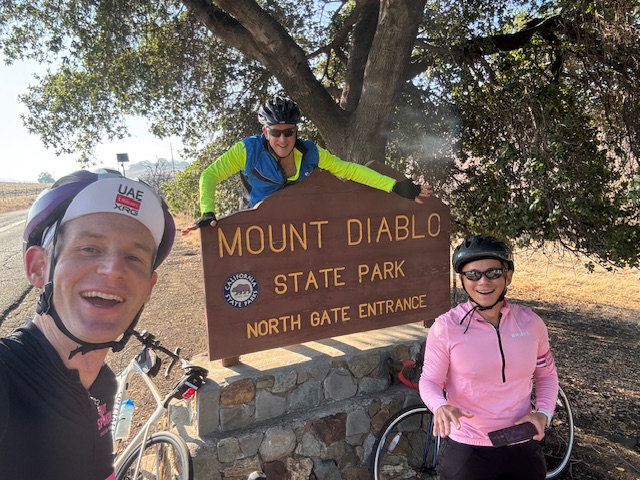
On this inaugural Spicy Saturday ride Kevin, Peter, and I formed a mighty trio as we aimed for Mount Diablo Junction. I put the ride together last minute when the day became vacant without a club ride. I was relieved that both Kevin and Peter joined to keep me honest and committed to the ride and thought it was phenomenal with just two-day notice. They’re both good riders and pretty chill road companions. From Pleasant Hill BART we made an easy and efficient pedal. At the North Gate ranger booth, we stopped to chat with the ranger to confirm road and weather conditions. There have been online chatters about certain ranger(s) issuing tickets to cyclists for seemingly technical and minor infractions. We did our best to establish rapport and flash some pearly whites before getting underway.
The climb is no joke and there are 8-12% sections right from the start. Kevin, being the superstar climber, pulled away like a little billy goat while Peter and I focused on our own rides. We passed multiple cyclists and were passed by others. There was hardly a single car as the day begins to warm. The road is narrow for two-lane traffic with moderate cracks in places and no shoulders. There are bike pullouts in places which cyclists are expected to use to allow trailing vehicles pass. A-okay and no problem. But it was also at a bike pullout where a cyclist got ticketed for not hand-signaling the return/merge back to the traffic lane. Apparently that ranger followed the cyclist and issued the citation even though there was a hundred feet or more separating them with no effect to any flowing traffic. Not even a warning, but a ticket!
I took plenty of water breaks while Peter passed me. I then passed him for the next few turns. We kept up this game of leapfrog until Kevin descended to us about a mile from the Junction after getting there himself. This time of year is Mount Diablo’s tarantula mating season. Male spiders from four to seven years of age leave the safety of their burrows to look for female spiders, including crossing the road. Someone showed Kevin a male spider and helped it gingerly to the other side safely. Typically the male dies in the winter after mating while the female lays eggs and get to live up to 25 years. The female might even kill and eat the male after mating especially if she’s hungry! If I were a tarantula, I’d gratefully be a fabulous gay one that safely climbs uphill to meet with my buddies.
Looking for a hook-up
Kevin showed us a rest stop with water spigot a quarter mile from the Junction. We then made a beeline to the Junction for some selfies and more hearty laughs about the poor male spiders. The descent was cautious but efficient as Kevin stopped to take pictures of Peter and me going downhill. When we were near the bottom where Mount Diablo Scenic Boulevard widens and begins to flatten, we each instinctively accelerated and started spinning. Peter chasing Kevin, and me behind responding, us laughing about the seemingly easy effort when we stopped at traffic lights.
We arrived at Lunardi’s in Danville in what seemed like 30 minutes, but…er…probably closer to 40. Kevin’s husband, Christian, joined us there and we had a quick meal together. Lucky Kevin then got in the car with hubby to spend the day with family. Peter and I decided to go off the planned route and just ride leisurely down the Iron Horse Trail. This is the nicer part of the Trail because it’s in between established residential area and mostly under the shade. We returned to Pleasant Hill BART a little past 2 PM. A quite enjoyable few hours on a Saturday with no worries to optimize weekend plans or commodify experience. Spicy climb indeed, and that’s why we ride.
This evening, I came across this 1 hour documentary on PBS about a disabled cyclist named Jeffrey McElfresh. “In this documentary, we follow Jeffrey over the course of ten days as he cycles along the Ohio River, from Pittsburgh to Cincinnati.” Maybe not the sexiest route, but definitely one of the better shows I’ve seen about bicycle touring or cycling in general. Just wanted to recommend it to anyone who has done bicycle touring, or is interested in bicycle touring, or is just interested in how one person uses cycling to deal with adversity, reflect on life, and learn more about himself. – Sal Tavormina
“We forgot to take a photo!” Chris blurted out at the end of our little Ladies Who Lunch confab. So sorry, you will all have to settle for words, probably too many of them and of slight import to boot. But occasionally quantity does not belie quality–you be the judge.
It’s become a formula: start in downtown Lafayette and head up the Lafayette-Moraga Regional Trail to Moraga Common and back, then relax and enjoy some food and maybe an adult beverage of the hoppy kind. That last meal to Tutu’s had me thinking of doing a repeat but I also wanted to try someplace different. This time we ended our ride at Batch & Brine, which is just around the corner from Tutu’s and the Lafayette Public House.
It was the usual East Bay crowd: Roger and me, Lamberto and Joe, and Chris. Joining us this time were Kevin, a brand new member hailing from Seattle, and our club president Stephen. Kevin moves fast in more than one sense. While flying down here from Seattle for an extended work assignment he joined Different Spokes! He’s a member of Outspoken, the newish Seattle/San Diego LGBTQ club. Stephen intended to join us a couple of months ago but punted when he got too busy. This time he managed to show but minus the bike, so he met us just for the post-ride meal. Kevin on the other hand had to take off for a meeting so he couldn’t hang out over a meal. (Or, at least that’s the story he told us… maybe he’d had enough of us. Talk about hooking up!)
Although I didn’t get a chance to converse with Kevin more—he was up ahead most of the time and I was at the back—he did tell me he was relishing the Bay Area weather because Seattle is moving quickly into winter. I didn’t tell him that this wasn’t exactly normal. It has been an unusually mild summer and early October often brutalizes us with raging heat, which may be great for taking in Fleet Week and the JR but also can be a gruesome hurrah for raging wildfires. I expect we’ll see more of him on club rides unless he’s kidnapped by the ALC crowd.
When I greeted Kevin at the start he said he’d just met Stephen on BART coming over. Huh? Just an hour before Stephen had told me he couldn’t make the ride but would come afterwards. Yet he was already in Lafayette? A mystery. When we met Stephen after the ride, he said he decided to come over to inspect Lafayette, a burb he’s never been to. I suspect a lot of SF Spokers rarely set foot in any of the Contra Costa communities except on a club ride. That brought back a chuckling memory. (WARNING: club history dead ahead!) Back in the 1980s a particularly vitriolic hate organization, Lou Sheldon’s Traditional Values Coalition, was active in the Walnut Creek area. The Reverend Lou got his start with Anita Bryant saving children from evil homosexual men and lesbian gym teachers who preyed upon America’s youth. Lou started his own organization and a chapter promptly popped up in Walnut Creek. Back then Contra Costa was a red state. Pretty much everything east of the Caldecott was conservative. Club rides out here were jokingly referred to as secret forays into enemy territory ‘to gather intel’ despite the fact that Contra Costa was crawling with gay people who just weren’t as visible as the ‘newsworthy’ freaks paraded on TV every Gay Pride. Walnut Creek must have been a den of iniquity with its two rather non-discreet gay bars at that time.
We started the ride an hour earlier because the days are shortening quickly and we didn’t want folks to have to bring lights. Plus, it’s just safer to ride in broad daylight. The jaunt up the trail was a bit busier this time but not at all crowded. I ended up at the back talking with Joe all the way up. We did a quick turn-around at Moraga Common and zoomed back down arriving at Batch & Brine with plenty of daylight. By the way if you haven’t been on the trail yet, I highly recommend it. The Iron Horse Trail gets all the glam attention yet there are actually several rails-to-trails in Contra Costa that are a soothing getaway from traffic. The LMT is, in my opinion, the nicest and has the most rural ambiance of them all.
Although Roger and I had eaten lunch at Batch & Brine before, we weren’t sure how crowded it might be after work. It turns out Lamberto and Joe also had eaten there once when they couldn’t find another place that was open and they thought it was pretty good. Our fear was unfounded: it wasn’t crowded at all and we were able to grab a set of tables on the front patio without any problems and with our bikes parked right next to us. That’s when Kevin had to go to his meeting.
It was another long dinner that ended well after the sun had set. We didn’t leave until almost 8 PM. Roger and I got the fish & chips, Chris got a fried onion blossom, Lamberto the ribs, and Stephen an ahi tuna bowl. Joe had what I should have gotten, eggplant with curried lentils. It all looked great when it arrived. Unfortunately Roger didn’t like his fish and chips whereas I thought they were a solid “B”: the fish was cooked just right and the batter wasn’t soaked with oil. This time no one got dessert. Hmm.
This was another atypical Spoker meal confab: not a word was mentioned about club business or goings-on. Instead the conversation veered off into family histories; what growing up Catholic was like in the “old days”; why parent’s don’t raise their kids bilingually; dialect variation in France, Japan, and Italy; “world Spanish” versus Castilian; ex-pat life in Panama, segregation in New England; and cycling in Taiwan. Whew! There was a time when Spoker conversations unerringly ended up on three topics: club happenings, juicy gossip, and bikes. Times have changed. Or have we?
Daylight Savings Time ends on November 2. So the next Happy Hour in the East Bay will likely be next March or April after we’re back on DST. I’m thinking we may start in Walnut Creek next time to ride one of the other MUPs. On the other hand there’s a Filipino restaurant in Lafayette that might be a good place to end the ride. Stay tuned!
Rummaging through old boxes last night I found a bunch of long forgotten photographs. Here are three that relate to Bike-A-Thon. The first is from the 1986 BAT (the second one). A few police officers at Mission Station decided to ride in the event and this is a photo by Tony Plewik of a few of them along with four DSSF/BAT organizers–Karry Kelley, Bob Humason, Jim King, and Tom Walther. That cops would ride in the Bike-A-Thon probably raised a few eyebrows then and it was good publicity for the event. By the way Tony Plewik was a gay photographer in San Francisco and he died of AIDS in 1995.
Mission Station officers to ride 1986 AIDS Bike-A-Thon
The second is, from the looks of it, at the start of a Bike-A-Thon. It wasn’t the first BAT because the only person I can immediately recognize is Tom Walther, the person without a helmet and with the megaphone and dressed in a DSSF sweatshirt. Tom rode in the first Bike-A-Thon so this photograph must be from a later one. My guess is Bike-A-Thon 3 because that year he was the Coordinator. But Tom was heavily involved with BAT until about 1990, so it could have been any of those years that had dreary weather at the start. This photo was by Mick Hicks, another SF photographer, who now lives in Southern California. [Update: Karry remarked that the ride start of the BAT originally was on Castro Street until BAT4. So this photograph is either at BAT2 or BAT3 as I suspected.]
At the start of a wet AIDS Bike-A-Thon
The third is a publicity photo. I do not recall the year but I do recall that the call went out for Spokers to show up for a publicity photo for the Bike-A-Thon, probably to be used to recruit riders, and this is it. This was also shot by Tony Plewik. I recognize several faces in this group but the only name I can recall is Abel Galvan, who is the fourth person from the left. Abel was a delightful person, a very good rider, and as I have mentioned in the past rode a impressively red full Campy Derosa. Sporting a “real” race bike in those days especially with the heritage of Derosa was very, very rare in the club. Most Spokers had bikes that came off a factory line and were quite modest. Not Abel though, and he wasn’t rich at all. But he loved cycling and must have ploughed most of his savings to get that bike. Abel died of AIDS in 1996.
AIDS Bike-A-Thon publicity shot
If you compare this photograph with almost any contemporary Different Spokes pic, you will get a sense of how “unfashionable” the club was. Back then even members of other recreational cycling clubs wore bike jerseys and shorts. Of course back then there was a lot more wool than there is today. But our club was a mishmosh of cyclists most of whom were not coming from racing or racing culture. So you’d see a lot of t-shirts, gym shorts, and street clothes at club rides along with a few members like Abel or Jerry Basso, who were some of the earliest members to embrace the traditional racer look.
The club has always had lurkers—members who don’t show their faces at a ride or any other club event. I was a lurker once. After I joined the club it was about a year before I got up the courage to attend either a club ride or one of the monthly meetings. (Aside 1: We used to have monthly meetings at the Page Street library and then later at MCC in the Castro.) In the meantime those ChainLetters piled up in my living room. (Aside 2: We used to have a monthly newsletter, the ChainLetter.) I’d read them front to back, which wasn’t hard since they weren’t very long—each sheet of paper would increase the postage and we were a broke club so it was kept short. This went on for about a year maybe and when I had to renew my membership, I thought, “Why am I spending $12 for a club membership that I’m not using?” But I did re-up and I think sometime in that second year I finally showed up and stopped being a lurker.
In the early days there must have been other lurkers because our membership was hovering about 120 or so. If you look at the old club photographs, the attendance at rides was actually very good. When Derek led the first American River bike trail ride in 1983 he got over 35 participants, which was extraordinary. Having ten to fifteen folks show up for a ride wasn’t unusual. Even so there were members who never showed their face. Attending a club ride can be intimidating just as it would be anytime you’re new at an unfamiliar social venue. Coming out back then was harder, I think, than it is today where we see school age kids coming out. Keep in mind that venues like Different Spokes were a fairly new development. Only a few years beforehand gay social environments were heavily weighted towards bars and baths. Social gatherings like bike rides, bowling alleys, and baseball teams as well as knitting circles and car clubs were beginning their efflorescence. Coming to a club ride or meeting took some courage—it wasn’t just going for a group ride, it was a way to come out.
That was certainly true for me as well even though I was by that time living in the City in the lower Haight. Part of my delayed entry was that I was a runner in those days. But my running was extremely frustrating due to chronic, repeated injuries. I was also in graduate school and working so free time was very limited for me.
I do remember reading an ad for Different Spokes and that’s when I joined even though I was running. I rode my bike for errands and very occasionally would go out for a “real” ride. I even raced back in the day. But I loved running more and went back to cycling only because I couldn’t deal with yet another running injury. Showing up on my first club ride surely gave me pause—who were these people and would I fit in? I guess I did because I’m still here and efforts to throw me out have all ended in failure.
Once the AIDS Bike-A-Thon became an annual club event we started to have another kind of lurker. Our membership count swelled but it sure didn’t seem like it when you went on club rides. There were a few more people but not in proportion to our apparent club size, which easily doubled. It turned out that we had a lot of members who just wanted to support the club because of BAT. Maybe they had no interest in cycling or they lived too far away to attend rides. The AIDS Bike-A-Thon turned out to be great advertising for the club. It didn’t hurt that we were putting on the BAT the way the PTA does bake sales: it was a completely volunteer effort to raise money for a good cause. We didn’t earn a cent from it. (Aside 3: Did you know we actually did do bake sales and garage sales to get enough money to run the club, the biggest portion of which was putting out the ChainLetter?) Some lurkers wanted to help us out financially—“angels”—and we didn’t object.
Fast forward a couple of decades and guess what? We still have lurkers! There are still a few “angels” even though it’s been over thirty years since we put on BAT. (Aside 4: But we did put on other fundraisers—the Saddle Challenge went on for years; Ride for Project Inform; and Double Bay Double.) Why some members lurk may be the same as before—still mustering the courage to come out. Some of the newer, recent members may be lurking because they’re coming from AIDS Lifecycle training groups. Attending a club ride is an afterthought for them because their friendships are already cemented in their training group. It’s like a parallel universe of cyclists in our club. And why not? There’s no need to break into a new social circle when they’ve got plenty of friends with whom they have history. For them Different Spokes is largely redundant. When you go to a party, do you can hang out with the people you already know or are you the social butterfly introducing yourself to every Tom, Dick, and Harry? Maybe what we need is a mixer where the Spokers and the ALC folks are gently forced to interact! Anyone for a round of Twister?
There is another population of lurkers. These are the folks who think they’re joining a well-rounded recreational cycling club and then slowly find out it may not be the case. These are the mountain bikers or other dirt afficionados; those who like shorter rides; those who like going on real adventures; those who enjoy self-sufficient touring. The list goes on. Many do not realize how one-dimensional our club is. If you like riding moderate distances on the road on a weekend, this might be the club for you. Most recreational cycling clubs aren’t much different than we are. It’s rare for a club to do it all and those that do are usually much larger than we. But is that a cause or an effect? From roughly the late 1980s to the early Aughts we had a small but robust subgroup of mountain bikers. Touring? That used to be a big thing in the club. Now it’s gone replaced by increasingly infrequent “getaway” weekends. Short rides? Don’t have any. Weekday rides? A rarity. So those members continue to lurk because the kind of rides that might pique their interest rarely show up on our ride calendar. Until they get tired of waiting and let their membership lapse.
At this point the club is consigned to losing these folks. We have no rides to offer them and we do not take steps to remediate this. And is there any reason to offer them the rides they like to do? Does that question even make sense given we’re a completely volunteer based club? It’s a classic chicken-and-egg dilemma: having ride leaders who offer those rides leads to more folks who enjoy that type; but to get ride leaders you need to offer the rides.
I get why people lurk. Showing up at a social event where you don’t know anyone can be intimidating. Will they like me? (Will I like them?) Am I hideous? (Are they all trolls?) Will anyone speak to me? (How do I get away from talking to these nerds?) Add bicycling to the mix and you have to deal with, “Can I keep up? Will I get dropped in a flash and left to die on the Sausalito bike path? Am I dressed correctly??” But a modicum of bravery gets you in the proverbial front door and before you know it you’ve become a familiar face and have a group of cycling friends. You warm up and find out what Spokers do with the rest of the lives, enjoy conversing with them, maybe find other common interests. A welcoming first contact can make a huge difference in whether a lurker comes back or never shows their face again at a club ride.
I don’t recall how I felt at my first club meeting even though I recall what I realized later were constant themes in the club: Mike ‘Loudmouth’ Reedy yelling at someone and Jim King and Tom Walther responding in kind; the ride coordinator pleading for people to lead rides next month; the board sitting at the front of the library room enduring playful taunts from the peanut gallery. By the lack of decorum clearly these people were very comfortable with each other! I probably chatted with a couple of folks. But I don’t have a recollection that anyone present made any effort to welcome newcomers.
However I do recall my first ride. It was across the GG Bridge to Marin and there were ten to fifteen riders. Derek Liecty came right up to me and asked, “Is that bike a Teledyne Titan??” Apparently he was the only bike nerd in the crowd and it was my bike that caught his eye. (Aside 5: The Teledyne Titan was one of the first commercial titanium bike frames. Teledyne is a big aerospace company that made titanium tubes for jets and tried to make a commercial bike frame. That effort lasted about two years. I got mine at a fire sale when they were emptying the warehouse, so cheap! That bike was eventually stolen, alas.) I laugh at that encounter now because it’s so Derek and because no one other than he even noticed the rare bike, which shows you where the club was at back then, essentially cycling ‘hicksville’. It definitely wasn’t about the bikes back then! I do recall a few I rode with that day: Matt Algieri, who was also new; Dennis Westler; Derek; and Ron Decamp. I do recall enjoying the ride and I remember talking to Matt Algieri as we rode.
After that I attended rides only occasionally because I was super busy. I could almost never hang out because once a ride was over, I had to attend to other weekend errands or hit the books as I was in graduate school. But the ice was broken and I met other Spokers. One of the nice things I recall was that Spokers hung out even when we weren’t cycling—it was a really social group and although cycling may have been the initial glue that brought folks together, friendships extended beyond mere cycling. Maybe that’s still true today?
So, you lurkers out there there’s no real reason to lurk unless you’re into some weird kind of cycling like unicycling, BMX, enduro, cross-country, trail riding, track, racing, long distance touring, bikepacking, fixies, Bromptons, gravelgrinding, randonneuring. But if you’re into moderate distance road riding, you’re good! We look forward to you making the effort to check us out.
from Scott Lechert; East Hampton after their bike-a-thon.
AIDS Lifecycle, the annual fundraiser for the San Francisco AIDS Foundation and the Los Angeles LGBT Center, recently ended its last iteration. The fundraiser was first offered in 1994 and back then was called the California AIDS Ride (CAR), and it was organized not by the two non-profits but by Pallotta Teamworks, a for-profit corporation. Apparently unhappy with the proceeds from Pallotta, the two organizations eventually ended their relationship with the company and then went about organizing the same fundraising ride but now under their own auspices starting in 2002. It was rebranded the AIDS Lifecycle.
But did you know there was an earlier “LifeCycle”? In 1986, eight years prior to the AIDS Lifecycle, a man named Scott Lechert from New York organized a cross-country bicycle ride to raise money for AIDS organizations and to increase awareness of the AIDS crisis at a time when there was no concerted national action was taking place. Scott, taking inspiration from the 1985 AIDS Bike-A-Thon “Pedaling for Pride”, first organized an ad hoc bike-a-thon fundraiser in New York, which took place in September 1985. Interestingly he got 62 riders to do the one-way, hundred mile route on Long Island out to East Hampton and netted about $30,000. Those stats are almost the same as our first Bike-A-Thon.
Following that coup Scott apparently was inspired to organize a bike ride that would be much more challenging: a cross-country, self-contained ride from New York to San Francisco. He called the ride Life-Cycle ’86. But at other times it was referred to as Cycle For Life.
Here is an interview with Scott published in the March 1986 ChainLetter:
Interview: Scott Lechert (March 1986 CL) Different Spokes/San Francisco is not the only organization planning a major fundraiser this year. Diff’rent Spokes/New York has an ambitious ride planned for this year—Life-Cycle ’86. The ChainLetter talked with Scott Lechert, DS/NY member and organizer for this event.
CL: Why are you doing this ride? SL: The purpose of Life-Cycle ’86 is to raise money for a national AIDS foundation, educate people on AIDS-related issues and display a healthy, positive response to the AIDS crisis. And most importantly, for the participating bicyclists, the ride will be a lot of fun, a chance to meet a lot of very giving and caring people, and an opportunity for some personal growth. I, myself, think it look great on a resume as well. CL: I understand you are planning on getting across the country and be in San Francisco in time for Gay Games II. When are you beginning? SL: The starting date is May 26th, Memorial Day. CL: What will the route be? SL: We’ll be going through major cities along the way—Cleveland, Chicago, Madison, Minneapolis/Saint Paul, Des Moines, Lincoln. We should be in Denver July 7th. We’ll be arriving at the Youth Hostel in Sausalito on August 2nd and crossing the Golden Gate Bridge sometime in the afternoon on August 3rd. CL: What support will there be on the ride? SL: Life-Cycle ’86 will not have sag wagons except for maybe a selected one- or two-week segment. As I said before, one of the goals of this ride is to display a healthy response to the AIDS crisis. By having people carry their own gear, being totally self-sufficient, a certain strength and determination is conveyed to the public. So participating bicyclists are required to be self-sufficient—carrying their own sleeping bag, tent, and other necessary supplies. Not everything is needed though—stoves and other group-use equiupment need not be carried by every person. CL: Riding loaded across country. How are you going to manage that? SL: Bicyclists are not required to stay together, ride pacelines or anything. Some people are going to want to be alone on the road. But we will be sleeping and eating dinner together. A typical day will start with everybody being given the route for the day, the finishing point, and potential stops for lunch. We will be riding 65 miles a day, six days a week. Realize though that 65 miles is not a real lot when you start early and go to sleep when the sun sets. CL: Some people might accuse you of being insensitive about the riders. SL: I don’t mean to sound like we are not going to be concerned about the welfare of the people on this ride. We want people to participate! The whole concept of Life-Cycle ’86 is to give people the opportunity to participate in a major fundraiser for AIDS organizations. We will help and encourage you during the ride. There will be a contact phone number if anything goes wrong during the ride, and we will try to accommodate people as much as we can. We just want bicyclists doing the whole route to be fairly independent, and to realize that the ride is going to be strenuous at times—and that you may not have a shower for a week sometimes. CL: You mention fundraising. Will you be doing some? SL: A lot of the local events will be determined by the involvement of the local communities. We will probably have press conferences in all the major cities, and hopefully benefits as well. Since funds raised in local cities will be split 50/50, we expect a lot of organizations to become involved. CL: How do you plan on covering the expenses of the ride? SL: We are trying to arrange to have funds raised to cover expenses of bicyclists riding the entire route. Probably about $700 a head, which really is plenty of money. CL How many people have expressed interest? SL: So far there are about 8 people who want to ride the entire distance. This will probably grow as we start to get publicity. The number of people doing segments is hard to determine. Certain segments will be very popular—Madison to Minneapolis, Los Angeles to San Francisco (Ed. note: being planned by members of LA Spokesmen [now renamed Different Spokes Southern California]), and New York to Philadelphia. One thing, this is not a gay event. We have had responses from many non-gay bicyclists, and so far there are more women interested in the ride than men. We’ve also sent soliticitation overseas, so Life-Cycle ’86 will be international in scope. CL: Any last comments? SL: I’d like to invite San Francisco riders to join us anywhere along the route. We’ll be staying at the hostel outisde Sausalito and you’re welcome to come spend the night and ride across with us on Sunday the 3rd.
The September 1986 ChainLetter documents the arrival of Life-Cycle in San Francisco:
“CYCLE FOR LIFE SAN FRANCISCO WELCOME On Sunday, August 3, a contingent of 35+ Spokers met to ‘welcome home’ the 19 cross-country bicyclists who participated in ‘Cycle For Life’, the New York to San Francisco trek. The 55 bicyclists were met at Twin Peaks by 20 members of Leather and Blues MC Club and the Eagles MC Club. With plenty of flash, honking of horns, blowing of whistles and cheers along with some tears, the crew took off down Market, through the Castro, past the AIDS vigil to the finish point at the Ringold Alley Street Fair. The cyclists were welcomed to San Francisco by Board of Supervisor President, John Molinari, who presented them with a proclamation from the City. San Francisco was the only city to officially welcome and acknowledge ‘Cycle For Life’. The welcome ended with a party hosted by the Raw Hide II, the country and western dance bar.”
When Life-Cycle/Cycle for Life was announced, my reaction at the time was along the lines of, ‘this is a crazy idea’. To spend over two months on the road with the prospect of a small amount of money being raised seemed like a lot of bang for a little buck. But the same could be said of the first AIDS Bike-A-Thon. I mean c’mon, ride a hundred miles in a day to raise, what? $33,000? But a spark can light a fire.
I don’t know how much money Life-Cycle eventually raised nor who directly benefitted from their fundraising. Remember too that AIDS wasn’t well-known then except as a source of fear. So Life-Cycle’s awareness raising in the communities through which it rode was equally important. You can read more about the ride in the Bay Area Reporter. In the article the writer Jim Sutherland mentions that four of the seventeen participants were from the Bay Area. By the way two of them, JT Blazer and Jill McIntyre, were members of Different Spokes!
By the way, Diff’rent Spokes/New York disappeared a long time ago. I’m not sure why but probably for the same reasons that Rainbow Cyclists in San Diego, River City Cyclists in Sacramento, and Different Spokes Seattle all eventually folded: the initial leadership cohort moves on and there isn’t a new generation of energized members to take over and direct the club. I can’t find any online references to Diff’rent Spokes, which suggests that it died well before the Internet became a reservoir of ephemera. But gay cyclists end up getting together even in the absence of an existing club and before you know it there’s another club. New York now has Outcyclists and perhaps Fast ‘N Fabulous is still alive although largely moribund after Bob Nelson, the figurative heart of the club, died in 2019.



 The Chain Letter