


This interview was long in the making and finally it’s done. Although I continue to research the history of the club’s AIDS Bike-A-Thon, it will be the last interview I publish. I had asked Karry earlier last year if he would consent to be interviewed and he was enthusiastic about it. However we were not able to get together to talk until December shortly before both of us were going in for medical procedures that would put us both out of action for a while. Predictably I was not able to transcribe the interview soon after. After it was done we did some back and forth to polish up the interview. Then I realized that unlike the previous interviews Karry’s was replete with references to many members who long ago either died or left the club and that members today would know nothing about them. So I added some “footnotes” about who these members are/were in order to flesh out the individuals we were talking about. To make that even more readable I had to search my enormous collection of old club photographs for appropriate images of each of them. That’s why this interview is arriving so late. Consider this interview as not only a record of the BAT but as a fond in memoriam to our friends.
In the early days of the club Karry was a stalwart member, throwing himself into the club practically from the time he first showed up at a club meeting. I have not yet researched a complete list of club officers through the years but I know Karry was the Secretary in 1986 and I believe was President in 1987. In addition to riding in the first AIDS Bike-A-Thon in 1985, he went on to work on logistics for many more. Karry did it all—touring trips, led club rides, BAT training rides, and regularly rode in local centuries. When he was starting a family he “vanished” into the East Bay and although he made one surprise appearance at an Apple Blossom Ride in 2012 he did not return to the club until the 40th Anniversary Banquet, which inspired him to rejoin. Although we started this interview with the intention of talking about the first Bike-A-Thon, it quickly devolved into multiple side remarks about the many friends we both had in the club in those early years. Almost all of you will have no idea who these Spokers were. Most are long dead; some we saw off together at the portal to the next world. The early days of the club were of course littered with the dead, almost all from AIDS (but not all). In order to ‘tell the story’ more clearly I’ve included explicatory side remarks and pictures of these people who are essentially your club ancestors.
TM: What do you remember about your early history with the club and how you came to join the club?
KK: Oh, that’s easy. I moved into San Francisco from the East Bay in 1983, and I didn’t know anybody. I was living there for about six months, just sort of figuring it all out. I hated the bars and I hated all that stuff. I wanted to figure out how to meet people, and then I discovered the bike club. So, I went to a meeting in the basement of the library on Page Street and started riding. That’s where I met Jim King and that’s where I met a bunch of people. [Ed. For my interview with Jim King, go here.]
TM: Had you been a cyclist before that?
KK: Yeah, a little bit. When I was a teenager, I had a bike and we did some riding but not a lot. I had an old, crappy steel bike. So I bought a new bicycle and the next thing I know I’m riding all over the place! And then that next year—I’m losing track of time—I think it was ’84 when we started the bike club? [Ed. The club officially opened in late November 1982.] Anyways, in that spring they started talking about doing the Bike-A-Thon (BAT) and there was a real great feeling of connection with people, the community. It was a really great community thing for me. And so that’s what I really loved about it.
TM: Had you come out before that? Were you out before you moved to the City?
KK: No, I came out and the same day I moved to the City! [laughs]
TM: [laughs] Wow! “And by the way, I’m moving to San Francisco!”
KK: That’s exactly right! I had been living with a bunch of high school friends in Concord. I moved out of the [family] house when I was like 21. So I spent a couple of years out in Concord trying to figure out how to get into San Francisco. And then when I finally found this apartment [in SF], that was when I came out. I was trying to live the Tales of the City dream! [Laughs] Which I did sorta!

TM: Except you weren’t on Russian Hill! [laughs]
KK: No, but I was on Twin Peaks! That’s pretty good!
TM: Yeah, that’s close! At the time that you joined the club, how involved were you with the Gay community, if at all?
KK: Not particularly, no. I hadn’t really met a lot of people. Yeah, [the club] really launched me into understanding what that community’s all about and finding a place. I look back on all those years with the bike club very fondly because it really was my community, yeah.
TM: -Everything, yeah: coming out, moving to the City. It was all-[together]
KK: My friends, all of that stuff were wrapped up in the bike club, or an extension of it.
TM: Do you remember anything about that first club meeting that you went to?
KK: A little bit. I remember walking in and they were going over something that they were working on and I was struck by it. It was really like my first public meeting sort of thing. And the opinions! [laughs]
TM: That’s what I remember to! [laughs]
KK: And the ones who carried on and on and on! That just really struck me. And the other thing that struck me about it was everybody seemed to be having a good time. They really enjoyed what they were doing as far as the community.
TM: You mentioned Jim King. Were you greeted by anybody when you went to that first meeting or you just sorta walked in and you were an anonymous face? Who did you meet there?
KK: You know, I don’t remember who I met at the first meeting. I don’t remember being greeted by anybody. I do remember walking into the room and I was nervous because I didn’t know anybody and just sort of sitting there and taking it in. And then I religiously went back every month for months until I started to really get involved.
TM: That was my first contact too. I went to a club meeting at Page Street [Ed. The meeting room at the SF Public Library on Page Street in the Haight.] and I don’t remember being greeted but I remember talking to MJ. I think he was ride coordinator. He was either ride coordinator or president at the time. [Ed. You can read the interview with Michael D’Abrosca “MJ” here.]
KK: He was one of the two, right.
TM: Yeah, anyway I remember talking to him. I didn’t go to every meeting because I was very busy working pretty much fulltime and going to graduate school. So it was tough for me to make the time. But I remember going to more than one meeting and I remember being asked to lead a ride ‘cause they were always asking people to lead rides.
KK: Right.
TM: And the other thing I remember is exactly like you said, the give and take, because the board meeting happened at the beginning of the meeting [with the board sitting in front of the room] and there was this audience sitting in the chairs, and I remember Mike Reedy saying- I can’t remember what he said but I remember he shouted something! [Ed. Mike was a real ‘character’—his nickname was Mike ‘Loudmouth’ Reedy. He was one of the few openly Republican members of the club–maybe the only open member–and also a “devout” atheist (!) and had an opinion about almost anything. I don’t recall what he did for a living. But he also owned a lot of property in SF, which he rented out, i.e. he was a landlord although not quite at the level of greed of an Angelo Sangiacomo. He was also very kind, a blue collar gentleman, and a wonderful friend to many in the club. Gruff on the outside, a real teddy bear on the inside. He was voted in as club President in 1988 but soon resigned due to conflicts with Jerry Walker, the owner of the Freewheel Bicycle Shop, who was voted in as the Vice President. Mike was the first manager of Coming Home Hospice. He owned a huge land yacht, a Lincoln (?), which we all called the “Burgundy Brougham Bordello”, that was a regular feature on club trips to the Great Western Bike Rally, the Nevada Explorer, and Guerneville and Lake Tahoe weekends. Mike died of AIDS in 1992. Karry, Tom Walther, I and I think Jim King were taking care of him at the time.]

KK: Some loud opinion! [laughs]
TM: Yeah, some loud opinion, and then I remember Tom [Walther], although I didn’t know it was Tom at the time, barking back at him [laughs] and probably Jim King laughing. I remember thinking, “Whoa! Who are these people??”. Whatever Mike said it was said in an insulting fashion. [Ed. Among many other things, Tom was an early member and another club devotee. Tom edited and published the ChainLetter after MJ, rode in the first Bike-A-Thon, was the Director of the Third AIDS Bike-A-Thon, and also was on many a BAT Steering Committee. Tom being a leftist often sparred with Mike both seriously and humorously. Outside of the club Tom was, among other things, very involved in BACABI (Bay Area Committee Against the Briggs Initiative) and had been a disco promoter! He worked as a fundraiser for non-profits as well as in health care administration. Tom was also amazingly kind and caring of his friends. He once spent a day comforting a friend who was contemplating suicide with a gun. Tom managed to spirit away the gun secretly before she did anything rash. He cared dearly about the club and BAT. When there was a suspicion that certain members wanted to take control of BAT and turn it into a profit making enterprise, he quietly went down to City Hall to re-register the DBA in the club’s name to ensure we had the rights to the name. Tom died in 1994 due to a car accident.]

KK: That’s what he loved to do, right.
TM: So that was what I remember about that first meeting.
KK: He was probably at that first meeting, which is probably where I met him for the first time. I do remember MJ being at that meeting, I remember Jerry, bike shop Jerry-

TM: Oh, Walker. [Ed. Jerry was then the owner of the Freewheel Bike Shop on Hayes Street after being a bicycle messenger in SF. He was also club President in 1988 after Mike Reedy resigned. Jerry provided repair services on at least the first AIDS Bike-A-Thon and probably subsequent ones. He regularly hosted bicycle maintenance nights at the Freewheel where you could do repairs, learn how to do repairs, and buy supplies at a discount. Although appearing very straightlaced, Jerry was definitely a hippie. Jerry died of AIDS in May 1993.]

KK: Jerry Walker…Jerry Basso…I think I remember Tom [Walther] being there. Those were some of the people that sort of struck me. And I met Ernesto Moran and John Ruzicka there. And my first bike ride was shortly after I went to that first meeting. There were those rides that always began at McLaren Lodge. [Ed. Jerry was an early member who died of AIDS, probably the second prominent member, first being Hal Baughman, who had been the club librarian. He was one of the first members to start wearing ‘racing’ attire—black lycra shorts and cycling jersey—and rode a celeste Bianchi tenspeed when most were riding cheap touring bikes. Jerry had a wry, fey sense of humor. He started having symptoms—I remember double-vision was one and I thought he might have MS—and then he disappeared, briefly reappeared months later complaining he had double vision, and then vanished. We found out later he had died and his Italian parents denied he had AIDS. But we knew better.]

TM: Yeah, the Decide ’N Rides. [Ed. When the club started there were a limited number of rides every month. The Decide ’n Ride was for weekends when there was no scheduled ride. Whoever showed up would decide where to ride, which was the usual suspects—Headlands loop, Tiburon, Tennessee Valley, Lake Merced.]
KK: Yeah, and we always decided to ride to Sausalito [laughs]’
TM: [laughs] That was always my reaction: “Oh god, it’s going to be another Tiburon loop! Nobody can make up their mind. Okay (sigh), that means I guess we’re going to Tiburon.”
KK: [laughs] That was my ride! I would ride from where I lived on Castro Street or on Corbett I would ride to the end of the bike path and back like four or five days a week.
TM: Oh, so you really got into it!
KK: Oh yeah! At my peak I was riding probably five to six thousand miles a year.
TM: My recollection is that you worked at Emporium. [Ed. For you youngsters: Emporium Capwell—later to become just Emporium—was a large department store chain that was later bought out by Macy’s in 1996. Its flagship store was on Market Street where the San Francisco Centre is now.]
KK: I did, yeah.
TM: Did you have a day job there?
KK: Yeah, I worked at Emporium in downtown Oakland.
TM: So when did you find time to ride?
KK: Early in the morning usually. Usually I would get up and I would go riding at 6 AM and I could spin out there and back in two hours and then go to work.
TM: Wow!
KK: Or on the weekends or if I had to be in early on Labor Day.
TM: So you were a morning person. The only time I could find to ride during the week was after work or school, which usually meant like 6 o’clock at night, and then when it got dark it was “I guess I’m not riding”. [laughs]
KK: There was this old guy. He was a San Francisco character. In those days there were a lot of those. And in those days he used to run from somewhere along the Marina or the waterfront-
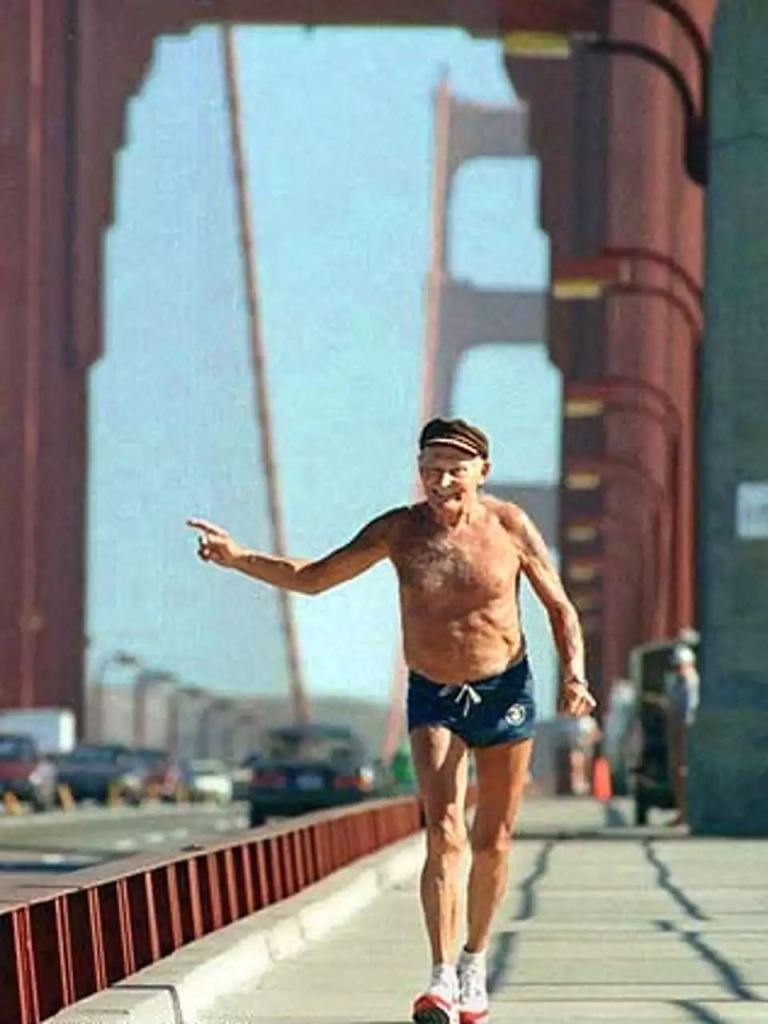
TM: Walt Stack! Without a shirt? A big barrel chest?
KK: Without a shirt, 80 years old. Yeah, and I would see him almost every morning and I would wave to him and he would wave to me. [Ed. Walt Stack died in 1995 at age 86.]
TM: I used to see him- yes! Walt Stack, oh my god, that’s a blast from the past!
KK: Was that his name?
TM: Oh yeah, Walt Stack was famous in running circles. He was totally into it. He wasn’t fast but-
KK: He must have been in his eighties by the time I was seeing him.
TM: Oh yeah, he was definitely up there. Walt Stack was a retired San Francisco longshoreman, [Ed. I was incorrect. He was not a longshoreman but a ship’s fireman. But he was a union organizer.] and he was one of the organizers in the ILO, the International Longshoreman’s Organization. He was basically a communist and god, I remember him. He was a real character. He was a really sweet guy. I used to do the same thing but I didn’t see him as often because I wasn’t riding across the bridge [as often]. But I waved to him because everybody knew Walt, Walt Stack, and he always ran without a shirt for some reason even when it was cold. No shirt!
KK: Right, on those cold mornings across the Bay, the Golden Gate. [laughs]
TM: You already answered one question, which is you were a member of Different Spokes before you did the BAT. Do you remember how you heard about the BAT?
KK: Well, it was at a meeting. Somebody brought it up. I don’t remember the exact details as to how it got raised. I do remember the whole thing with the AIDS Foundation and them approaching us about wanting to do something and them having no idea what it was they were doing. And so there was a bunch of back-and-forth meetings about do we do this, how do we do this. The thing that I most remember is the first [BAT] ride. The preparation up towards it I don’t remember an awful lot about that. I wasn’t really involved in the organizing committee for that first ride. It wasn’t until the second one came along. [Ed. when he became involved in organizing the BAT.]

TM: So my guess is that you were probably at the meeting [when the SFAF speaker came to ask for help]. After talking to Jim, I got a clear idea of how that all played out. MJ didn’t really have good recollections but apparently MJ recalls the AIDS Foundation contacting- they called Bob Humason because Bob had just become president and Bob called MJ to say, “what do you think we should do about this?” [Ed. MJ was then past president.] Subsequently from Jim it sounded like what happened was that instead of Bob and MJ coming to the club and saying ‘hey, we were approached’, somebody from the AIDS Foundation came to the meeting. Because Jim was saying that people at the meeting were asking questions like: “So riding up to Guerneville how are they getting back? and the answer was, “They’ll just ride back” [laughs] and Jim saying, “Um no, that’s not gonna happen!” So it sounds like the AIDS Foundation actually came to the meeting.
KK: Yeah, I do remember that.
TM: So you were probably at that—and they [SFAF] probably came to just one meeting so you were probably at that meeting.
KK: Well, I’m sure I was because I don’t think I ever missed one of those meetings.
TM: Ah, okay. So this idea of [the club] doing the BAT, was your reaction, “Yes I’m going to do this!” or “I’ll think about it” or…?
KK: I pretty much jumped in! I mean, I had never ridden a hundred miles in my life prior to this. Maybe I rode 50 at the very most. But I got way caught up in the excitement of doing it and I really knew that it was sort of a way for me to get involved in what was going on. And it was exciting! And by the time the BAT came along I had been with the club six months or more and I was friends with Jim King, and I knew Bob and Tom, I knew all those people fairly well by then. So it was exciting for me to be a part of it.
TM: Was this during the time when you also were riding a lot? So you had actually been doing some training?
KK: You know, yes, I was riding. I wasn’t doing the level of riding that I had done later. But yeah, I mean I was doing the Decide N’ Rides and whatever the organized ride was [for the week], we were doing a lot of driving to Sonoma county to ride in the hills and that kind of stuff.
TM: So, you were doing club rides. [Ed. There were no “official” training rides for the first BAT as it was less than two months from inception to the day of event. In subsequent BATs the club organized training rides.]
KK: Yeah.
TM: Okay. So, you think you might have done 50 miles before that but you’d never done a hundred miles.
KK: No.
TM: Do you remember what bike you rode? Whatever it was you had before the Klein. [laughs] [Ed. Klein bicycles were relatively expensive, high-end aluminum bikes coveted by many in the 1980s and ‘90s. Karry was the only member who had one.]

KK: Oh…well, before the Klein I had a Cannondale touring bike, which I still own. I don’t remember what brand it was but it was some steel ten-speed bicycle that I moved to San Francisco with and I rode that up the coast. That’s what I rode because I didn’t buy my Cannondale until I did my first tour with MJ.

TM: Ah okay. Before the BAT did you personally know anybody who had AIDS or had died of AIDS? [Ed. Hal Baughman, the club librarian, early on had AIDS. He wasn’t around much and Karry may not have known him.]
KK: No.
TM: No, okay. So, that didn’t affect your decision to participate because you didn’t know anybody.
KK: No, but I was living in the middle of the Castro and knew what all was going on.
TM: Okay. Were you involved with any kind of HIV or AIDS work before the BAT?
KK: No.
TM: No, none, okay. So, this ride’s announced, you say, “Yes, I’m gonna do this”. Do you recall doing any special preparation for the ride?
KK: I went on every ride I could go on. I did some riding on my own. I tried to up what it was that I was doing.
TM: How old were you when you did the BAT?
KK: 24.
TM: You were 24.
KK: Was 1984 the first BAT?
TM: ’85.
KK: Well, I was 24 ‘cause I turned 25 in August that year.
TM: Do you remember Glen Goon?
KK: Yeah!
TM: So, Glen was a high school student when he joined the club. He was really, really young. Do you recall anyone younger than you at the time?

KK: Well, there probably were but I don’t remember specifically. I don’t know. I mean, Jim King is four years older than me. I’m trying to remember who else was actually along with us.
TM: I’m just thinking of everybody that I knew in the club. Jerry was definitely older than you, so was Bob Humason and Tom, and Walter Teague of course was older. Bob Krumm, he’s a year older than I am so he’s 73. Also Howard, Howard Neckel is my age. Jerry Walker-
KK: Yeah a lot of people were older. In those days most of my friends were older than me. That’s probably why, because of the club and the people I connected with. I mean, I became best friends with Ernesto Moran and he’s a couple of years older than me and John Ruzicka’s a couple years older. Neither one of them rode on that first BAT, but we rode a lot bike rides together. And Reedy was 20 years older than me. [Ed. Ernesto Moran is a hairdresser/stylist known for his fey sense of humor. As the house Republican, Mike Reedy was always teasing him by accusing him of being here “illegally”.]
TM: Yeah, you might have been one of the younger members of the club at that time. Day of the ride: What do you remember about the day of the ride, if anything?
KK: I remember the excitement of taking off. I’m trying to remember where we took off from.
TM: It was in the Castro, just north of the Castro Theatre, on the next block up.
KK: Right, so it was on Market Street basically- or on 19th Street?
TM: No, it was on 18th Street. [Ed. It looks like the start was on 18th Street across from the Castro Theatre.]

KK: I remember the excitement of doing that and the thing that I remember most was riding into a headwind [laughs], coming up the coast and by the time I got to Stinson Beach y’know feeling pretty good. But then as I trudged up past Bodega Bay I really started to feel like “Oh my god, I can’t do this!” You know, it was hard! And then those last ten miles up River Road, just keepin’ at it, I was gonna do this until I fell off the bicycle!
TM: [laughs] Did you ride alone or were you riding with anybody else?
KK: I kind of rode alone. I mean there were people around. But my experience of biking was that I would ride with this club all the time but we all kind of rode on our own because we rode at our own pace, right? And there were periods when I rode next to somebody and chatted and that kind of thing.
TM: But you didn’t start the ride like-
KK: I didn’t do this with anybody specifically.
TM: I know that Jim and Tom agreed to ride together and Jim mentioned that Tom was slower but he agreed he would stay with Tom until they both got in. And Peter Jenny rode alone as did Bob Bolan, and MJ. There weren’t that many. There were only like 65 or so. [Ed. 63 finished the entire route.]
KK: There was another guy and I have pictures of him but I cannot remember his name… He did the first BAT, he did a lot of the Guerneville campout things. I’ll send you a photo and you’ll know who he is the minute you see him.
TM: Okay. So you remember the excitement of the start. You know Louise Renne came, the [San Francisco] Supervisor, came to send people off. Do you remember that?

KK: Uh-huh, right. I do remember that. That was the first one?
TM: The first one, yeah.
KK: Okay, yeah yeah, I remember her specifically. I was impressed that a politician showed up, even in San Francisco for that kind of thing.
TM: MJ definitely was impressed because he thought there would be no press at all. But the fact that Renne showed up brought some press as well.
KK: I think I raised…I might have raised $2,000 for that thing.
TM: Wow, that’s a lot!
KK: Maybe it wasn’t that much.
TM: No no, it wasn’t that much.
KK: It wasn’t that much. We raised $33,000 total for 65 riders. Maybe I raised…
TM: ‘Cause you weren’t one of the top four fundraisers were up on the stage [at the Volunteer Appreciation Event the next day.]
KK: Yeah, I was not one of the top fundraisers.
TM: And Tom raised like $1,400.

KK: Yeah, maybe I raised like seven or eight hundred dollars. But I remember going around in my office at the store—I worked at Emporium in downtown Oakland at the time—and getting coworkers to donate, and family members. That’s where I got most of money from. And then I did donate a chunk of my own money for it.
TM: That was one of my later questions was: how did you go about doing fundraising? It sounds like you hit people up at work, maybe some friends, and your family to get some donations.
KK: Yeah.
TM: And also you chipped in money of your own.
KK: And that was a thing back then, right? I’m asking people to put money towards AIDS and the gay thing, and that was out of my box! [laughs]
TM: I think [that was] unlike today where being gay is a commonplace, certainly in the Bay Area. There are a lot more straight people raising money now because of AIDS Lifecycle, a lot more straight people raising money for AIDS awareness and HIV prevention. But in those days it was a new thing. It was almost like coming out. If you were saying “I’m collecting money for the AIDS Bike-A-Thon”, it was almost like coming out, that you would do this. I think you’ve answered this question but: what was the hardest part of the day or the ride for you?
KK: Just that struggle of getting up the coast.
TM: The headwind.
KK: Yeah.
TM: Okay. There were these rest stops, the checkpoints. Do you remember anything about the rest stops, the checkpoints?
KK: No.
TM: Actually I have a picture of you [laughs]. I’m pretty sure it’s you, it’s from behind. “That’s Karry!” [laughs]
KK: Along Highway One somewhere?
TM: MJ just sent me these photographs. I can show it to you…let’s see…So here’s a picture of a rest stop but it’s not you. It’s Jamie Moran and Peter Jenny. This is a photo-

MJ took his camera when he rode up the coast.
KK: He always had a camera with him.
TM: Okay, here’s a rest stop. You’re not in this photograph. I don’t know why he took pictures of people’s butts! [laughs] Here’s a picture of Dennis. That’s Dennis Westler. [Ed. Dennis was “President for Life” because he was elected to that position for about five or six years, around 1990 to 1995.]

KK: Oh yeah! Alright.
TM: And there’s Mark Jolles. [Ed. Mark’s notoriety was due to making disparaging remarks about women, proving that sexism was alive and well in the club.]
KK: Right.
TM: That’s Peter Jenny. There you are! See if you can spot where you are.
KK: Oh yeah, that’s me right there! Yeah. That was fun doing that.

TM: So this is what you were wearing that day.
KK: Right. That was kinda my outfit.
TM: Was it?
KK: It was a Different Spokes t-shirt. Remember those black and red stripes…
TM: Oh right, so that’s what you were wearing! Okay. That’s the only picture I have of you that day. Would you consider the ride itself a positive experience, a negative experience?
KK: Oh it was a hugely positive experience! Hugely positive. It really had a profound effect on me. I really felt part of something, which I had been longing for for years.
TM: I think Jim felt the same way. And MJ felt that way. But I didn’t get that sense from Peter Jenny. No, I guess a little bit from Peter. Actually, I take that back. Bob [Bolan] did too. You know for Bob it was very different because he was basically chasing Bruce Matasci all the way up. He had his head down and he was going as fast as he could. So he has no other recollection of the ride other than trying to chase this guy, catch up with him which he never did. But afterwards he talked about how- he had been this AIDS doc and was just seeing patient after patient get sick and die and it was the one time he felt like we were doing something about this. So I guess that was a commonality for you guys.
KK: I remember showing up at Molly Brown’s at the end of the ride. And people y’know out there on that deck cheering us as we came in.

TM: I think there might have been two Guerneville weekends before…maybe one. There was at least one and maybe two Guerneville weekends before the BAT. Had you done either of those?
KK: Probably. I did several Guerneville weekends. I was there when Michael John unveiled the Cosmo Girl dream cake [laughs].

TM: Okay! [laughs] That became a mainstay!
KK: Uh-huh. I think that was before all that. Yeah, I probably had done a couple before, at least one.
TM: But that would have been like 90-some odd miles if you had…
KK: Well, I wouldn’t ride there. So, I would have gone up and done the camp and then we did the rides around the area. So, if we were doing training rides, I didn’t do any training rides up the coast. I’d have to go back and dig through pictures to try and date when all this was. But we did a bunch of Fife’s weekends, at least several Fife’s weekends.
TM: Yeah. There was at least one every year and there was at least one year when there were two. There was one year when there was one in March. It wasn’t MJ, it was somebody else. I can’t remember who it was but somebody else led it. [Ed. It was Peter Renteria.] That might have been the second Guerneville weekend and then MJ led it again later in the summer; that was the third one. What was it like to arrive at Molly Brown’s?
KK: It was incredible. I mean I showed up and I was probably somewhere in the middle to the second half of the pack. I just remember coming around the corner and there were a pile of bicycles leaning up against the deck and Molly Brown’s was one of those sawdust on the floor kind of places and there were a bunch of women out on the deck cheering us as we came in. I remember that. Yeah, it felt like a great accomplishment. It was kind of thrilling in a way.

TM: Do you remember roughly what time you arrived?
KK: Late in the afternoon, so it would probably been around 5.
TM: Late in the afternoon? Oh okay so pretty late. Do you recall waiting for Gene?
KK: Yes!
TM: So you stayed there waiting for Gene. [laughs]
KK: Oh yeah! I don’t remember what time Gene came in but he was the last one and oh yeah. I just remember Gene because Gene was very sweet. He was such a nice man.

TM: How tired were you?
KK: I was exhausted. But I was 25 so y’know we relaxed, we drank, we hung out, and then later that evening I went to my first Radical Faeries party up in the hills. [laughs]
TM: Tell me about this!
KK: I don’t remember how I got there. But somebody who was part of the group-
TM: Dennis was part of the group.
KK: It might have been Dennis.
TM: ‘Cause I remember Dennis telling me about the Radical Faeries.
KK: —took us out to this place down River Road a ways and then up into the hills and it was y’know…it was tiki torches and twinkle lights and y’know Radical Faeries running all over the place! It was uncomfortable because it was out of my experience zone but it was also thrilling at the same time.
TM: People were farmed out to different places to spend the night. You didn’t stay up there?
KK: I didn’t stay up there. I don’t know where I stayed! I think I camped at Fife’s. I don’t think I stayed at anybody’s house. I don’t honestly remember where I stayed. I’m pretty sure that I camped at Fife’s.
TM: Okay, so that’s interesting because…Peter Jenny mentioned something about- he said “I think I camped at Fife’s” and at that point I had done the interviews with MJ and Jim King, and “No, you couldn’t have because the AIDS Foundation provided lodging for people”. But maybe that’s what Fife’s did was provide a camping spots for people.
KK: Yeah, I don’t remember staying at anybody’s house or anything like that.
TM: Okay. So that’s…Do you remember anybody else up at that Radical Faeries gathering?
KK: No.
TM: So the next day, Sunday- I didn’t understand this until I had interviewed some people. There was a volunteer appreciation event and it seems like it was not at Molly Brown’s, it was at the Hexagon up on..

KK: Yeah, Armstrong Woods, the Woods. Was it there? I can’t remember. It was either there or Fife’s. Yeah, it might have been there. I remember sitting around in the morning, hanging out with people and then the buses showing up and us all piling our bikes in heaps in the storage containers, in their standard coaches kind of thing. That’s one of the things that really stuck in my mind.
TM: So that’s how you got back to the City, you took the bus back?
KK: Yeah.

TM: Okay. What do you remember about the volunteer appreciation event?
KK: I don’t actually. I know it happened but I don’t remember anything about it.
TM: Okay. So you don’t remember who you hung out with that day?
KK: No.
TM: Was it hard to get pledges?
KK: It was only hard for me to ask for pledges. But when I asked for them I pretty much got them from everybody.
TM: Okay. Do you recall when you asked for pledges- was it like ‘What are you talking about?’, or did they know about HIV/AIDS?
KK: I just remember it being a positive experience. People wanted to help, people were willing to do it.
TM: So they must have known something about it already.
KK: Yeah, I didn’t- I never experienced- one of the things that was interesting for me is that I never experienced any negative, outright discrimination about anything in my coming out experience. My coming out experience was more about my own fears and anxieties.
TM: Oh, you were lucky then!
KK: Yeah, I know. I was! My family was very accepting, friends and coworkers. I worked in the Capwell’s in downtown Walnut Creek when I first came out in 1984 and everybody that worked for me knew about it. Even the little old ladies from Blackhawk [laughs] were just fine with it all! So I was very lucky in that regard. But I know so many people who did not have experience.
TM: My recollection of that period- I wrote about this in the blog—Lou Sheldon opened a chapter of the Traditional Values Coalition in Walnut Creek and there was all this shrieking coming out of Walnut Creek, and I remember at least one ride listing—it might have been Ernesto’s, somebody about [whispering’] “We’re going to ride in Contra Costa. Be prepared!” [laughs]
KK: I never wanted to go back out there again. I mean there was a lot of that. I lived in Concord, which was even worse, and when I got out of that life I didn’t want to go back. I really didn’t go back to Contra Costa County for years after I first moved away.
TM: But you visited your grandmother though. [in Rossmoor in Walnut Creek.]
KK: I did visit my grandmother. But even in the first few years I didn’t. I was doing my own thing in the City and it wasn’t until my grandfather died that she started needing help. So that was the late 80s when I started going out there a lot. And then my parents left Orinda in 1983 so they were already gone by the time I came out and moved to the City. It just had this…really what it had for me was that I was leaving this old life behind and I wanted to do something radically different because I spent so many years in the closet dreaming of doing what I was doing.
TM: Okay. So how did BAT affect you, that first BAT?
KK: You know, I think that first BAT was really a launch to having some purpose and really feeling like I was participating in the community. That’s really what it was for me. I remember coming away from that and doing more riding and we like immediately started talking about what the next BAT was going to bring and all of that. It really gave me something to anchor to.
TM: You were involved in quite a few of those subsequent BATs.
KK: At least the next six.
TM: Oh wow, you were involved in a lot of them!
KK: How many of them were there?
TM: Altogether there were ten the club did. The eleventh was Open Hand.
KK: So maybe I did seven of them. I remember doing a lot them. I remember doing the ones we did in Collingwood Park and then when we were out in the Presidio. I always did Logistics. So I drove a lot of trucks, hauled a lot of tables, picked up a lot of bottles of water and that kind of stuff.
TM: I thought you did Day of Event.
KK: I did. But I was running around day of event setting up stands and then I’d end up at the start doing whatever it is I could do to help there. I was never really involved in [organizing]. I mean I went to all the meetings but I was not part of “the committee”, the core, that spearheaded the whole thing. I never was a coordinator or anything like that.
TM: I know Char did logistics but she was probably the one who was talking to people to get donations. [Ed. Char O’Neil was on the BAT Steering Committee and regularly ran Logistics, which included getting as many donations and free stuff as possible from businesses and individuals.]
KK: Yeah, I kind of worked with that. I spent a lot of time working with Char throughout that whole thing. And I had a lot of experience because I worked in shipping and receiving and moving things around, so I was pretty good at that. [laughs]
TM: I know you held several officer positions in the club. Do you remember what you were?
KK: I was president at least once. I don’t remember what year. I was…was I treasurer? I might have been treasurer one year, something like that. I was never secretary because I was no good at taking notes. I might have been vice president one year. I don’t think I was ever ride coordinator.
TM: So there was the year that Mike Reedy resigned because he couldn’t work with Jerry Walker.
KK: Right.
TM: Were you one of the- Jerry Walker became president so he must have been vice president. Mike must have been president and said, “I can’t work with Jerry, I’m resigning.”
KK: Right.
TM: So you must have been president another year.
KK: Yeah. I don’t think it was that year. Mike, as you know, he was always having explosive conversations with people. [laughs]
TM: I just have this recollection that Mike did not get along with Jerry but I can’t remember why. I didn’t get along with Jerry, not because there was any personality problem, but the thought bubble above my head every time Jerry spoke was ‘What drugs are you doing? That comment is so out of left field. Have you been following the conversation??’
KK: Right, he was very out in left field. I liked him, he was a nice guy but we weren’t particularly close. He would ride with us a lot though, you know he was out there [riding].
TM: After doing the first BAT, did that spur you on to ride even more, to be even more involved in the club?
KK: Yeah definitely. Yeah, I started religiously doing the Decide ’N Rides or whatever. Pretty much every weekend I could, I was out doing a club ride somewhere. I was one of those people that would go out and dance in the bars until 2 in the morning and then get up at 6:30 and drive to Napa to ride 50 miles! [laughs] I would go out to the clubs sometimes but I wouldn’t go by myself very much and I wasn’t a bar person. So this was a way for me to meet people. And honestly Tom, Jim King, Ernesto Moran, John Ruzicka, Bob Humason, you, Jerry Basso…I mean so many people that I made friends with in those early days. And a lot of them, who are still with us, I’m still connected to 40-some odd years later. So it really, really cemented my connection to the gay community.
TM: That’s somewhat true for me, maybe less so. The very first person on a Different Spokes ride I met was Derek Liecty.
KK: Yeah, Derek of course, yeah right.
TM: I can’t believe it: he’s turning 94 this summer.
KK: Derek used to make me nervous because Derek was always flirting with me and trying to pick me up.
TM: Oh, but he-
KK: He did that with everybody!
TM: Yeah!
KK: But in those early days that was kind of a thing, Derek was like 40 [Ed. Derek was more like 50!] and that was like ancient! [laughs] Don’t tell him that! And I couldn’t think past somebody who was more than four or five years older than me.
TM: My first experience of Derek was quite different. I’m probably going to exclude this from the interview [laughs]. I won’t transcribe this! But my first experience at some ride, I think it was my very first club ride. I went to meetings first. I was too busy. I was riding on my own because the only time I could ride was after work. But I finally had made time to do a club ride and I remember we were going to cross the Golden Gate Bridge and I think we may actually have met or were waiting at the bridge plaza. But anyway Derek came up to me and the very first thing he said, “Is that bike a titanium bike?” This is the bike that was later stolen. But I had a titanium bike, which was very unusual. And that was the very first thing he said to me, “Is that a titanium bike??” It was even before hello. He was just so- there was no flirting going on. If there was any flirting going on he was flirting with my bike. [laughs]
KK: He was always just sort of- it was always more innuendo and that kind of thing and after a while it just became a fun thing. But at the beginning I was not dating and I didn’t know how to date and so it made me uncomfortable to try and deal with it. Kevin Anderson was there in those days—I don’t know if he was involved in the first one. [Ed. Kevin was the club humorist. He wrote a column called “Dear Dr. Derailleur” for the ChainLetter that ‘solved’ your repair problems. He also had a persona named Flo Velcro who wrote a ‘Dear Abby’-like column. Then he went on to write “The Adventures of Rex Flash, Mountainbiker”, his second persona. I suppose his humorous writing came about because he was tired of writing legalese all day as an attorney. Kevin once attended a club ride and at each rest stop he went into the restroom and came out dressed in a completely different wardrobe! Kevin now splits time between Vancouver BC and Hamburg, Germany with his husband.]

TM: The BAT? No.
KK: I don’t think he was ever actually involved in the BAT. He rode in them, I think.
TM: No, he did not ride in the first BAT. He might have ridden in subsequent [ones].
KK: I doubt it. He and I sort of dated for a few months in those days.
TM: I remember that.
KK: But I couldn’t handle all that. And he lived in Pleasanton, which is on the edge of the planet and all kind of that! [laughs]
TM: I actually remember you making a comment about that, about him living in Pleasanton and “It’s not gonna happen because he lives way out there in the boonies.”
KK: Crossing the bridge in those days—I was one of those people: it’s like another world! [laughs]
TM: I don’t remember exactly what you said but the thought bubble I had, the impression I got was ‘Kevin wants you to move to Pleasanton.’
KK: Oh he did! Yeah! [laughs]
TM: It’s like, “Yeah, that’s kind of not Karry’s bag anymore. Not gonna happen!” [laughs]
KK: I never thought I’d leave San Francisco.
TM: And you did!
KK: Well, life changes.
TM: I’m so happy I’m in the East Bay.
KK: So am I. I love being back here.
TM: That’s pretty much it for the standard questions I have. Is there anything else you want to add about that first BAT experience, what it meant to you, what it left you with? Any reflections?
KK: Yeah, just the real sense of community, people coming together for a common cause that nobody else is paying any attention to. And it was really evident in those days that we were on our own, right?
TM: Reagan wouldn’t mention the word AIDS.
KK: Right! 60,000 of us died before he would mention it in public, right? And you know when it was announced that we raised $33,000 it just- it’s doing it to me right now- it sent shivers down my back because it was a huge amount of money. No one had ever raised that kind of money before, right? And I was proud to be a part of that experience. And the characters that went along with it, you know. I mean, that’s where I met Reedy and Reedy became one of my closest friends and the practical jokes we played on one another, oh my god!
TM: The Virgin Mary statue! [Ed. Mike grew up as an Italian-American Catholic but the result was he became a card-carrying member of the American Atheists. A real contradiction: a rabid Republican atheist. Around 1989 or 1990 Mike sold all of his properties in SF and bought a house in Guerneville. As a “house warming” gift, Karry and Jim King got Tom and me to distract Mike and get him out of the house while they went up and installed this kitsch statue of the Virgin Mary in his front yard. When we arrived back at his house he was shocked and started yelling. But he knew it was a prank all in good fun. He never removed the statue.]
KK: It’s still in that front yard!
TM: Is it really?
KK: Uh-huh, ‘cause you know my friend Barbara’s parents bought that house after Mike died and Barbara still lives there, and it’s still sitting in the corner of the front yard. [laughs]
TM: [laughs] I remember when you unveiled that. We had to get Mike out of the house. Tom and I were part of that, we got him out of the house. [laughs]
KK: Yeah! So Jim and I could go up in Jim’s Mercedes and cement that [in place] and we were digging a hole and while we were digging a hole, right next door there was this older couple and I forget what his name was but the man came out and he’s leaning over the deck and he’s looking at us-
TM: “What mischief is going on!”
KK: He goes, “You know, you need to dig that hole deeper ‘cause you need to put more cement in.” [laughs] So we did, we anchored her in cement in the front yard. And he loved every second of it. Mike had a really great sense of humor. It was really offputting for some people but he knew how to laugh at himself.
TM: The most offputting thing about Mike was Dinah, that dog.
KK: Oh the dog, yeah.
TM: That dog was incredibly nervous. It made me nervous to be around Dinah. Her level of anxiety was so high, I thought I’m going be like Dinah if I have to be around her. [Ed. Mike got Dinah literally the day after his previous dog died. Dinah was so jittery and ‘love starved’ that she would greet anyone who came to the front door with wild abandon including losing control of her bladder and peeing on you.]
KK: She liked me but I’ve always been really good with dogs. But definitely. I think Dinah went with his sister-in-law.
TM: I think you gave it to Reedy’s mother initially.
KK: No, ‘cause she lived in a low-income senior housing complex in Sacramento, a little one-bedroom apartment. I’m pretty certain his sister- ‘cause his sister-in-law- he had a brother that died. He had a brother that lived in north Sacramento that he didn’t talk to and he had an older brother that died and the older brother’s wife and his nephews came down after Mike died ‘cause I was the executor of Mike’s estate, and took a bunch of his stuff and then took the dog and took Mike’s ashes and buried Mike’s ashes on the grave of his brother up in Oregon, somewhere near Portland. I’ve always wished that I had taken a little bit of ashes—she offered me some—so that I could spread them down here for him.
TM: I vaguely remember you telling me that Dinah was on a farm.
KK: Yeah.
TM: I’m going to turn this off.

THE END


 The Chain Letter