Ride Recap: New Speedway Boogie

A spur of the moment decision to go to Yosemite in January led to the Feb. 6 ride up Altamont Pass. Being disconsolate at the cancellation of our Austria tour and finally getting cabin fever after almost two years of sheltering mostly in place, we jumped in the car and went to Yosemite Valley for a couple of days. On the way out and back we drove I-680 into the valley and we were mesmerized by the emerald green grass on Altamont—no surprise, I guess, given the inordinate rain in December. This is the time to go, I thought, and began mulling over when would be a good time to ride up there. Of course, silly me, I was thinking that the rains would start up soon since we hadn’t had any for almost two weeks. By February the long range forecast was for “sun, sun, sun, ’til her daddy takes the Colnago away”. Well, there’s no time like the present so up went the ride posting.

The day of the ride was perfect: sunny, absolutely no clouds, and still air albeit chilly. There were seven of us including stalwarts Will, Roger S., and Alan. Alan is new to the club and as I found out also new to cycling. Moving from upstate NY to California apparently meant cycling might just be enjoyable! In any case Alan is a classic case of MAMILs gone wild and he’s grinding out the miles like there’s no tomorrow. Stephanie emerged from her house remodel and other domestic responsibilities to join the ride. In fact I consulted Stephanie while planning the ride because she’s usually the one who’s leading a jaunt up the Altamont hills and I hadn’t ridden up there in two decades or more. Her response was, “oh, any of those roads are great.” A non-Spoker Paul also joined us for his first club ride.
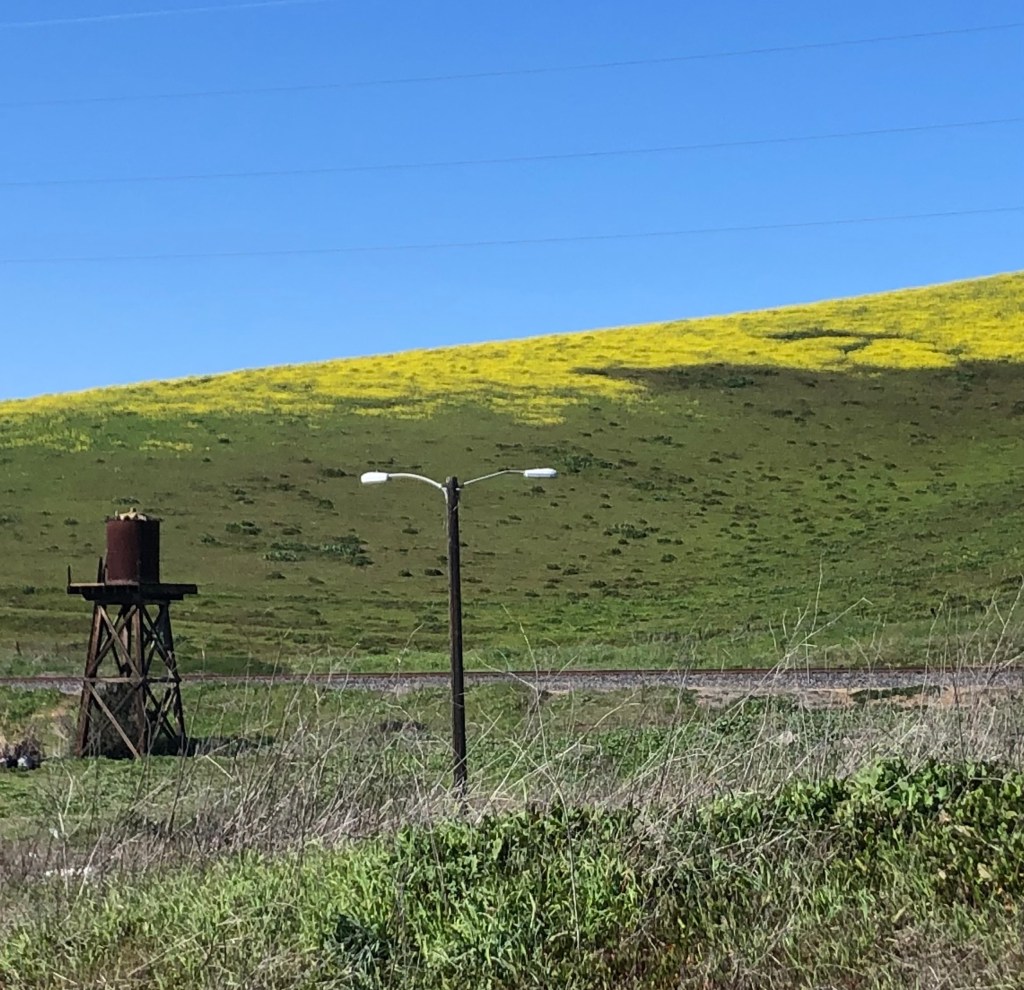
Carpeted with mustard for now, soon to be multimillion dollar homes.

There are only three public roads over Altamont: Patterson Pass Road, Altamont Pass Road, and Tesla/Corral Hollow. We did the first two. But any permutation will do when the hills green up since the roads are primarily used by local traffic while everybody else is either hauling ass or creeping along at five miles per hour on I-680. We went up Patterson to the outskirts of Tracy and then climbed up Altamont to return to Livermore.

Livermore is a city in transition. It’s aspiring to Pleasanton or Danville grandeur but it’s still got farming roots. It already has a sign of greatness: homeless people sleeping in cars at the Livermore library where we parked. With growth pressure breathing down its neck, Livermore is going to be a “big” city in short order. East and north of downtown Livermore is either vineyards or ranch land with a few farms stuck in there for show. Nothing a little rezoning and lots, lots, lots of subdivisions won’t solve… But I digress. We headed east on Tesla Road, which is all wineries and vineyards, and starting climbing at Cross Road, which eventually takes you to Patterson Road where the real fun begins. Cross is a gentle ascent in absolutely deserted grassland. After turning onto Patterson the slope became more severe. It was all so beautiful that I was caught up in the splendor and forget that the grade was creeping up. We started to glimpse wind turbines but today there was no wind to speak of so they were as still as statues. The summit of Patterson was only about eight miles from where we started but the last half-mile was like climbing up a wall. It’s 15-16% just before the pass and that ain’t no momentary blip. Everybody was scrambling for their lowest gear and some were probably wishing for something lower. Suddenly those crazy 46- or 50-tooth rear cogs don’t seem so absurd. Roger H. made it to the top first just in time to snap a shot of Alan who was just behind him.

“All this land be mine!”

Everybody made it up fine and we soaked in the view all the way to Tracy: rolling green hills, wind turbines, and powerlines. The descent was crazy fast and everybody else shot off like rockets whereas I creeped down quite cautiously; the pavement is aging chipseal, there’s no shoulder, and the road winds like a snake. On one left curve there was an ominous “15 MPH!” sign obviously placed there because vehicles and cyclists have occasionally done their best Space-X imitation and launched into space. Other than passing the gigantic PG&E Tesla substation it was all beautiful countryside. The road flattened out as we were now in the valley. Usually you head north to the Mountain House community before heading west. But after crossing I-580 the road becomes full of traffic including a fair number of trucks from all the logistics centers in Tracy for companies like Amazon and Costco. But there is an alternate route, the California Aqueduct Bikeway, that gets you off the road away from traffic. In fact we rolled over the Aqueduct and stopped at a Valero gas station at the intersection. I had suggested that people bring snacks because I didn’t think there were any services on the route. But the Valero proved to be a veritable cornucopia of delectable gas station food. The Valero was doing its best Costco imitation with aisles that had to be the longest I’ve ever seen in a gas station convenience store. The temptation was too great and just about everyone piled in to use the restroom and, uh, stock up. The front window was advertising their “Krispy Krunchy fried chicken”. I was going to buy some but the thought of hurling all that good food on Altamont restrained me. In Roger S.’s case it didn’t and he emerged with a five-piece bag to gnaw on. Next door was a taqueria, which I’ll try the next time, as well as a Subway and a Wienerschnitzel. I’m telling you this oasis has everything you need.
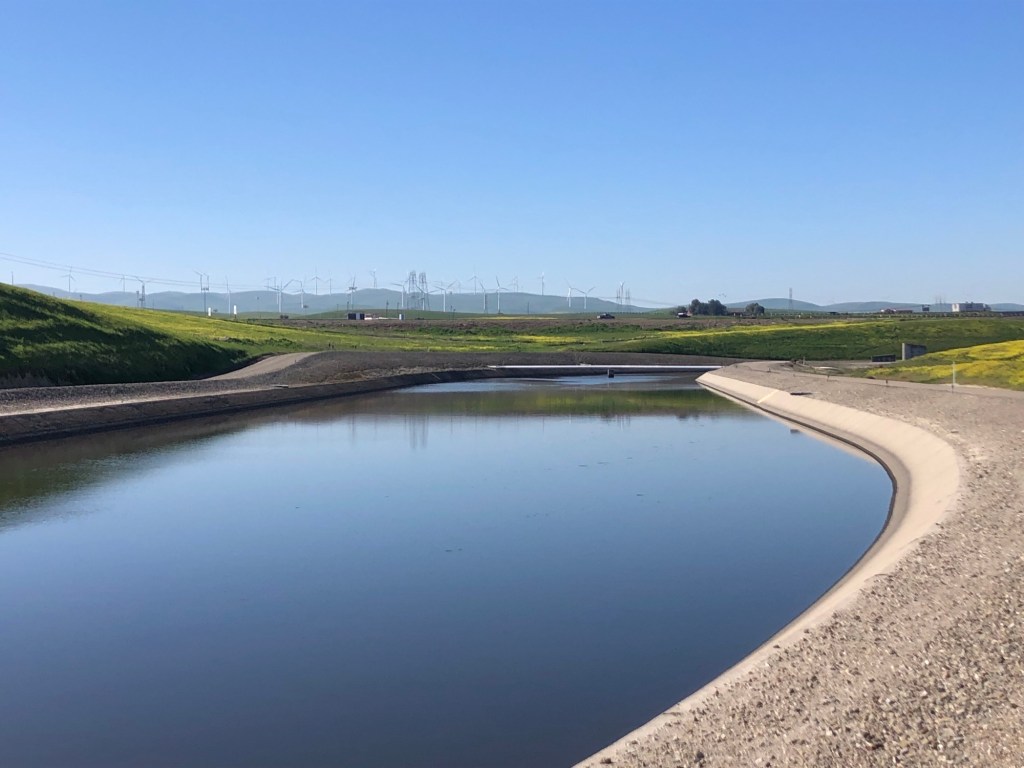
Way better than fighting semis on Mountain House Parkway.

Suitably restocked we turned around and turned onto the Aqueduct Bikeway, which has a gate under which you can carefully roll your bike. Only Will had been on the Bikeway before, long ago when he was training for double centuries. Stephanie, who knows this area like the back of her hand, had never taken it before. The pavement was surprisingly rideable: aging chip seal, slightly bumpy but wide and free of obstacles. The Bikeway rolls about 3-4 miles to Grant Line Road. We stopped in the middle to take in the view and munch on goodies. Roger S. chowed down on his fried chicken. Lucky me, he offered to share a piece. Yum. There isn’t much more goodness than fried chicken when you’re hungry from cycling. The whine of cars on adjacent 580 was the only thing that destroyed the peacefulness.

At Grant Line we headed west and had to put up with traffic just until Altamont Pass Road about a mile away where all of the cars turn onto 580. The climb up Altamont is more gradual and nowhere is as steep as Patterson. Everybody spread out and was rolling at their own pace. The last run-up to Altamont, where you pass over 580, is the only really steep section, about 12% for a half-mile. Alan was waiting for us about midway. Why not the top? “It just looked like a good place to rest!” After we regrouped we took the rest of the climb at a more sociable speed. Once you pop the top the descent to Livermore is sweet: no traffic, only moderately steep so you don’t have to ride the brakes, decent sightlines. Back on the flats it was a pleasant victory stroll back to the library.

I think next time I’m going to do this route in reverse so I can grab that fried chicken later in ride for a real “smack” down!

Can this really be February?

I spent a little time on the mountain
I spent a little time on the hill
I saw things getting out of hand
I guess they always will.

-Robert Hunter & Jerry Garcia

Adios, January. I’ll Miss You!

Happy, Happy, Joy, Joy!

After a drenching December we unexpectedly got a dry January—somebody turned off the spigot! The club has taken full advantage of our unfortunate dry spell however. We had seven rides this month with six of them on the weekends. That’s pretty good for a month that is usually cold and wet. It may not have been wet but it certainly has been chilly yet that hasn’t deterred Spokers from clogging up the local roads with turnouts we usually see only in the height of summer and early fall: a dozen or so per ride! David Goldsmith’s dream has been to have “mo’ rides, mo’ rides, mo’ rides” and he may be getting his wish. Four years ago he said he wanted a hundred rides per year or about two per week. Call him ambitious (or Ahab). Maybe we’ll get there this year?

Keeping with tradition (a nice way of saying ‘lack of inspiration’) we started the month with the Resolution Ride: up Diablo with a bullet! Ten butch boys checked that one off. The following week’s Jersey Ride had thirteen riders. The Davids had planned a short outing across the Bay Bridge from Oakland the week after but the Tongan tsunami put paid to that escapade. David Goldsmith immediately replaced it with a short jaunt to Nicasio on MLK day that managed to roust five Spokers to join despite it being a ‘flash’ ride. The Davids then led the second in their training series the following Saturday, Jan. 22, around the Three Bears in Orinda. Was it boredom in San Francisco or did somebody not explain that this wasn’t Folsom Street—we had sixteen riders! The next day Roger and I led the first Forty & Fab (maybe that should be “Fab despite Forty” or better yet “Fab because Forty”!) ride around Portola loop that attracted thirteen riders. The one and only Early Bird ride this month garnered four participants before closing out the month with this past weekend’s training series ride around Stage Road and Highway One near Pescadero with nine of us. That’s a total of 70 riders out of club of 112 members!

Will we be so fortunate in February? I hope not—I mean, for the sake of our water supply!

Eating Dessert First

The Davids as part of their Winter/Spring training series led a loop ride this past weekend from Pescadero up the Stage Road and then back south on Highway One to Gazos Creek before returning to Pescadero. It’s about 30 miles. If you’ve been around the club for a while or you’re a regular cyclist from the Midpeninsula, you’ll recognize these roads and you’ve probably ridden them many times because they’re marvelously scenic, beautiful, and serene, comparable although different from what you may experience in Italy, Japan, New Zealand, or almost any other touristy part of the world.

The difference this time was that we started in Pescadero rather than some distance away. When I lived in Palo Alto I used to head out to the San Mateo coast on my bike and it was always a long ride. In high school on a 32-pound Schwinn bike it was an exhausting trek up and over the Coast Range and then up and over to get home. When I lived in San Francisco, it was a really long ride down Skyline to 92 and then down to Pescadero before returning to the city. The most popular way the club does this ride is to start in Half Moon Bay and cycle down to Gazos before returning up the Stage Road as well as a couple of additional inland forays. That ride is quite a bit shorter than starting in San Francisco but it’s still nothing to sneeze at, coming in at over 55 miles.

That’s not the sort of ride you want to do when you’re starting out your riding year unless you’ve already been riding all winter. So the Davids’ little trick is to cut out all the lean meat and leave just the delicious fat. And yummy fat it was! Stage Road is quiet, almost devoid of cars (except for the occasional car rallies), and a pastoral sensorium guaranteed to quiet your uneasy mind. Highway One takes in the beautiful San Mateo coast with its blooming coastal daisies and iceplant as you roll over one short hill after another. We passed the Pigeon Point Lighthouse, which incidentally is part of the club’s very first ride in 1982, before turning up Gazos Creek, another isolated country road that follows the rushing creek up a serpentine canyon. Then it was past Butano State Park and quiet ranches before returning to Pescadero. This short loop leaves out the long slogs up to Skyline from the Bay or the very long trek through surburbia down the Peninsula. Those additional miles might do wonders for your conditioning but the tedium of getting to the good part takes away a lot of the enjoyment. That I had never realized until I relented and joined the ride at my husband’s urging. Being the kind of child who was lectured incessantly about eating everything on my plate and by nature obediant—we didn’t have a dog, unfortunately—I was often too full to enjoy dessert. To this day for me dessert is still the least significant part of a meal. And I still always eat all my vegetables. The Davids’ ride philosophy is like being told that I can eat dessert first. Skipping the sloggy parts of a ride to get to the good part is like taking a helicopter to a mountain pass—the long, hard trek to the top is what makes the view so impressive, right? Well, it turns out, no. That’s just propoganda. You can take it easy and enjoy the view even more. So much for all that training to tolerate delayed gratification, the value of hard work, yadayadayada…

It’s going to make getting over to coastside a lot more pleasurable now that I’m hooked on just driving over there to ride. Of course this philosophy is what is destroying Western Civilization, right?

2022 Centuries: August-October [Updated 9/11/22]

August

6 Saturday. Marin Century. $60-100. 122-, 101-, 86-, 61-, and 24-mile routes. No additional information on the 2022 Marin Century yet.

7 Sunday. Civilized Century. $40. 100-, 75-, 60- and 35-mile routes. Registration opens June 1. Limited to 200 riders. Here’s the ‘new kid on the block’. The 100-mile route starts in Redwood City goes up to SFO and returns before crossing the Dumbarton and returning around the South Bay with a total of only 1,000 feet elevation gain–flat! SOLD OUT.

20 Saturday. Cool Breeze Century. $85. 125-, 107-, 95-, 60- and 34-mile routes. A pleasant, not-too-difficult century down in Ventura county with great weather. No Class 3 e-bikes allowed. Registration is open. Limit of 2,000.

?. Crater Lake Century. No information yet. This event was cancelled in 2021.

21 Sunday. Tour of Napa Valley. $90-80. 64- and 3-mile routes. The 2021 event was cancelled. No information yet whether Eagle Cycling Club will put on the Tour this year. The club is no longer offering the Tour of Napa Valley and apparently it is now being operated by a local cycling/running shop in Napa, The Athletic Feat. However the event is substantially different than in the past consisting now of two flat routes on the Silverado Trail. SOLD OUT.

September

3 Saturday. Tour de Fuzz. 100-, 62-, and 35-mile routes. $89-$109. Registration opens 3/21. is open. The 100-mile route is similar to the Wine Country metric century but has a long excursion up Rockpile Rd. and a jaunt up to Cloverdale and back. SOLD OUT.

10 Saturday. Best Buddies Challenge. More information and registration opening in late January. Last year there was a $50 fee plus $1,550 minimum fundraising. 30, 62, or 100 miles but will be different routes than in past because of closure of Hearst Ranch.

10-17 Saturday to Saturday. Cycle Oregon. $1,250. 272 to 443 miles. Limit of 1,500. Cycle Oregon is back! Awesome week-long road tour of Oregon’s small towns now with gravel road options. Registration not open yet is now open! Registration will close on August 30. REGISTRATION NOW CLOSED.

17-18 Saturday & Sunday. Bike MS: Waves to Wine. $350 minimum fundraising goal. Two-day ride with routes from 100 to 40 miles. First day starts in San Francisco, the next in Rohnert Park. Registration is open.

24 Saturday to Sunday. Napa Valley Ride to Defeat ALS. Registration fee and then minimum fundraising amount. 100-, 62-, 47-, 28- and 9-mile routes. Registration is open.

24 Saturday. Lighthouse Century. $85. 100-, 75- and 50-mile routes. Limit of 1,000. San Luis Obispo Bicycle Club’s other century. From Morro Bay a detour inland before heading back to the coast and halfway up Highway 1 and back. SOLD OUT.

25 Sunday. Jensie Gran Fondo. No information yet other than date. Rides through West Marin on a route similar to the Marin Century.

October

1 Saturday. Best of the Bay. Double century (197 miles) only this year. $155. A grand tour of the East Bay including up Mt. Diablo. Registration doesn’t seem to be open yet. Registration is now open.

1 Saturday. Sacramento Century Challenge. $85-55. 101-, 60-, 35-, and 15-mile routes. Flat rides in the Sacramento River delta similar to TOSRD. Registration is open.

8 Saturday. 3F Century. $60-40. 100-, 63-, and 39-mile routes. Out of Colusa, CA. Flat rides near and around the Sutter Butes. Limited to 600. Registration is open.

15 Saturday. Foxy Fall Century. $70-35. 100-, 62-, and 31-mile routes. No information yet. Limited to 1,500. Registration is now open!

15 Saturday. Tour de Lincoln. $65-45. 100-, 50-, and 25k routes. Riding in the hills north of Lincoln, CA. Registration is open.

?. Tour of the Sacramento River Delta (TOSRD). No information yet. Annual ride from Brannan Island to Sacramento via the Delta on Saturday and return on Sunday. Stay at La Quinta near old town. Includes lunch on Saturday and a post-ride bbq on Sunday. Brannan Island State Recreation Area is closed without an operator, so the event is in question for the moment.

2022 Centuries, May-July [Updated 6/8/22]

May

1 Sunday. Grizzly Peak Century. $80. 52-, 76-, 102-mile road routes. Capped at 1,000 riders. Starts in Moraga so very easy to get to except not by BART because BART doesn’t open up early enough. The GPC is most definitely not a flat route–it’s a climber’s ride. The end-of-ride meal is most definitely homemade and delicious. Registration is open.

7 Saturday. Wine Country Century. $100-70 Registration opens January 14 is now open. 100-mile, metric, and 34-mile routes. Another club fave. Good lunch, great after-ride meal, awesome tandem friendly rural roads. SOLD OUT as of 3/31.

7 Saturday. Siskiyou Scenic Bicycle Tour. $65-45. Registration is open.  Limit of 450. 85 registered as of 3/15/22. 101-, 67-, 40-, and 21-mile road routes and a 39-mile gravel route. End-of-ride meal. This ride is run by the Yreka Rotary Club and takes you on rural roads north of Mt. Shasta. Just 218 registrations as of 5/1 so still room.

7 Saturday. I Care Classic. No information yet except date. $90. 100-, 62-, 31- and 10-mile routes. $20 discount if you register before March 13. Covers the valley and hill roads from South San Jose to Gilroy.

7 Saturday. Mr. Frog’s Wild Ride. 55-, 45-, and 21-mile routes. $75-40. Sheep Ranch Road and Jesus Maria–say no more! Awesome hills in Calaveras. Limit of 300.

13-15 Friday to Sunday. Climate Ride Green Fondo. $40 registration with a $480 minimum fundraising commitment. Limit of 200. 101-, 65-, and 33-mile routes on Saturday; 67-, 36-, and 19-mile routes on Sunday.

21 Saturday. Davis Double. $140. Information will be available at the end of January and registration will open in early February. Registration is now open. This is one of the easier double centuries as long as it’s not hot.

14 Saturday. Tour delle Vigne  $75. 100-, 50-, and 30-km routes. Formerly the Lodi Sunrise Century. Registration is open. Online registration is now closed but you can still do day-of-event registration. Starts in the Valley in Lodi and tours the flat ag roads.

15 Sunday. Strawberry Fields Forever. $100. 30-, 61-, and 101-mile routes. Registration is open. A pleasant ride in the Santa Cruz and Watsonville area.

27-30 Friday through Monday. Paso Robles Cycling Festival. Registration not yet open; no current information. 3/10/22: Not happening; now on indefinite hiatus.

?. Devil’s Slide Ride.  $?. No information on whether this ride is taking place. A benefit for PARCA. Now definitely cancelled for 2022.

June

5 Sunday. Sequoia Century. $150-130. 101-, 68-, and 57-mile routes. Registration opens February 2. is now open. Price includes the 2022 Sequoia jersey.

5-11 Sunday to Saturday. AIDS Lifecycle. $75. $3,000 minimum fundraising amount; $5,000 suggested. You know the routine: raise money for the SF AIDS Foundation or the Los Angeles LGBT Center to fight AIDS by riding 545 miles from SF to LA. Registration is open. SOLD OUT.

?. Castle Crags Century. Mt. Shasta Rotary is assessing whether to hold this ride this year. They’ve decided not to host a 2022 event but hope to be back in 2023.

11 Saturday. Gold Country Cycling Challenge.  $80-70. Registration is open.  100-, 75-, 55, and 33-mile routes from Grass Valley north to the South Yuba River and back. There are three road rides and two “gravel” rides.

18 Saturday. Mile High 100. Formerly the Lake Almanor Century. $85-55. 108-, 56-, and 33-mile routes. Registration is open although website erroneously still says “2021”.

25 Saturday. Alta Alpina Challenge. $150-90. The other “Death” Ride. Registration is open.

18 Saturday. Climb to Kaiser. $105-75. 155 or 95-mile routes. If you enjoy heat and climbing, this is the ride for you. “Only” 15,000 or 7,500 vertical feet ascents but you have the pleasure of baking in the Central Valley. Starts in Clovis.

?. RBC Gran Fondo Silicon Valley. $?. No information yet. In case you’re unfamiliar with this ride, it costs $725/$245. Yes, $725 for a 71-mile ride from Palo Alto to the San Mateo coast and back along the roads we ride all the time—Kings Mtn., Tunitas Creek, Stage Road, Pescadero Creek, La Honda Road. For the venture capitalist in your family. Well, you don’t have to drive far to do this one. Or you could just do the Sequoia, which is not only way less expensive but supports a great local club, Western Wheelers who donate their proceeds to local non-profits, instead of lining the pockets of profiteering carpetbaggers. Doesn’t seem to be happening this year.

June 18-25. Sierra to the Sea. $1,500. Registration is now open. opens January 18 at 6 PM. Awesome eight-day supported tour from the Sierras to the Bay Area run by fellow club Almaden Cycle Touring Club in San Jose. Limit of 90 or 130 (website has contradictory information); 62 registered as of 6/15.

July

16 Saturday. Death Ride. $149. Registration is open.

16 Saturday. Fall River Century. $75-50. 200k, 100 mile, 100k, and 25 mile routes. Registration is open. Limit of 500 riders. Ride in the area near Mt. Shasta.

16-17. Saturday-Sunday. Seattle to Portland (STP). $170-190. 206 miles. “The largest, most iconic and fully supported group ride in the Pacific Northwest, with up to 8,000 riders pedaling from Seattle to Portland over one or two days. Reg. fee includes luggage transport, SAG support, five free food and hydration and aid stations, mechanical and medical support, camping at halfway point in Centralia, WA, on grounds of Centralia College.” You can ride it in one or two days. Registration is open.

23 Saturday. Santa Cruz Mountain Challenge. $70-55. Still in planning but hope to Will offer 45-, 62-, 100-, and 135-mile routes. Registration opens February 1. is now open. This venerable event not only got hit by Covid but also by the CZU fire last year that burned portions of the route. Limit of 650.

23 Saturday. Giro Vigneti Healdsburg. 75-, 55-, 37-, and 22-mile routes. $125-25.

Impressions of Fulgaz

Fulgaz on HD television
Now I’m in France!

If you’re familiar with online virtual cycling sites, you know that they skew heavily towards training and racing. You can race against yourself or others, or you can do some kind of structured training such as intervals, threshold training, and the like. The best known of these is Zwift but there are many others such as Sufferfest, Rouvy, TrainerRoad, and Xert. They all pretty much hew to the same idea of simulated racing. Racing online isn’t such a new idea; it actually goes back to the Computrainer in the 1986. But nowadays the level of graphics and online participation is much higher making for a more entertaining experience.

What is mostly lost in all this is a focus on the joy of cycling outdoors. If you’re not into racing or competition, then Zwift and its ilk are less persuasive of cycling indoors. There is likely a historical reason for why these sites dwell so narrowly on competition. Indoor cycling—originally on rollers, then later on trainers, then smart trainers—was a way to get through the winter in parts of the world (ie. not California) that had real winters with snow. The most entertainment you got while spinning away on the rollers was perhaps watching a videotape of a cycling race and imagining yourself riding with the pros. Of course that was after VCRs had been invented. Before and even after the invention of the VCR, a typical “ride” on rollers was a short—maybe an hour—structured workout. There were actually books that provided sample workouts. You also have to think about who would be desperate enough to want to ride indoors. It was the most fanatical cyclists many of whom were amateur racers. (The pros would just go outdoors and cycle or they’d crosstrain.) In any case riding on a stationary bike is boring and that was all the more reason to make it brief and therefore intense to get the most out of your short workout.

But what if you ride because you like being outdoors or enjoy cycletouring? If you like to cycle in beautiful places, then Watopia is a letdown. There are a couple of sites that try to provide a more realistic and immersive experience focusing on the joy of riding: Fulgaz and OpenRoad. Both provide video footage of rides from a cyclist’s perspective trying to replicate the actual experience of riding rather than entertaining you with a game-like ride in a completely computer generated fake world. I don’t have much to say about OpenRoad because it is PC only. It’s not even available on Android whereas Fulgaz is available for Mac, PC, Android, AppleTV, and iOS.

Our setup is an AppleTV box hooked up to a large screen TV. You could use an iPad or laptop screen but I wanted to see how immersive the experience would be looking at a large screen. You can try out Fulgaz for two weeks for free, which is what we did since we didn’t know what we were getting into. It costs $12 per month or $100 annually. We didn’t even use a smart trainer, just a bike on a fluid trainer. With a smart trainer you can have your speed/cadence/power data sent to Fulgaz where it appears on the screen. Conversely inclination data is sent to your smart trainer to increase the resistance to replicate the harder effort of going uphill. You can find the details of how Fulgaz works at its website. You can compare it to OpenRoad if you’re a PC person.

You can download a ride and then view it or just stream it; we did the latter out of convenience. Fulgaz has about 1,200 videos of rides from around the world including a lot of the classic climbs of the Alps and Dolomites. But it also has a lot of other unexpected but interesting rides, for example a ride around Uluru (Ayers Rock) in the Northern Territory of Australia. Videos are shot by Fulgaz staff but users can also submit videos for curation. This leads to some slight variability in quality but for the most part the video quality is decent to good since Fulgaz provides guidelines on shooting video and also edits and curates everything submitted. Since we were streaming the rides, there was some pixellation but it wasn’t disturbing enough to jar you out of the faux experience of riding outdoor. If we had downloaded the rides instead of streaming them we suspect the pixellation would disappear. Most of the videos if not all seem to be shot using GoPro cameras that are mounted at handlebar level. This makes for a slightly strange perspective but that oddity soon goes away. This doesn’t seem to be the case with OpenRoad videos, at least the ones I can see on its YouTube site. The perspective seems to be almost normal eye level. But that could just be due to mounting the camera above the handlebars rather than below. In any case you don’t see the handlebars or shifters, which is nice. It would be too much to ask those who submit videos to Fulgaz to use a special setup for their submissions. But for Fulgaz’s inhouse videos it wouldn’t.

GoPro camera lenses have a very wide field of view of 170 degrees. This causes a distinct ‘warping’ of your view that leads to a prominent—at least to me—artifact in Fulgaz videos: the camera is mounted to the handlebars so every panning motion is visually exacerbated. I found it at times unnatural but usually got used to it and didn’t notice it except when the bike in the video was turning sharply. This doesn’t seem to be the case with OpenRoad—perhaps they’re using a different camera than GoPro or they set their cameras to a medium field of view. Going into a turn the visual field tilts but you don’t since you’re on a trainer, and since I happen to be prone to motion sickness, the disconnect between what my eyes see and what my inner ear is sensing for balance is occasionally disorienting to the point of me feeling nauseous. This was most noticeable on a couple of videos with a lot of quick, sharp turns—both happen to be on multi-use paths. On roads in the videos this doesn’t happen because the turns just aren’t that sharp.

Another artifact you’ll notice is how smooth a cyclist the camera person is. When going slowly uphill we all move the bars side to side but some of us are smoother than others. This all becomes apparent when climbing up a steep hill. When we do it in real life, we don’t notice it. But on camera it becomes very evident as the camera perspective hunts back and forth with each tug on the bars. In one Provence ride the cyclist was a total animal and seemed to be going 20+ mph all the time. When he went uphill there wasn’t any back-and-forth motion since he was going so strongly in the saddle. On the contrary in a ride shot in coast of Japan up a steep hill, the cyclist veered sharply left and right accompanied by some very noticeable yet appropriate huffing and puffing.

You don’t often think about how your brain processes all the motion your eyes are actually exposed to—the bumps in the road, eye scanning back and forth, head turning, etc. But it all is spun into a seamless, smooth experience and you end up not being cognizant of all these actions. On the contrary, the camera movement on the bike is very noticeable. If you’ve ever watched a GoPro video on YouTube of a mountain bike going downhill, you realize just how jarring the experience actually is, yet when you ride downhill in real life your brain factors almost all of that out in creating a smoother experience.

There is also audio so you get to hear the sounds on the ride such as the gear shifts, heavy breathing, cars passing, etc. I found it to be more sensorily immersive to listen to the soundtrack but you can always mute it and/or listen to music instead.

All this nitpicking is not intended as a putdown of Fulgaz. I’ve enjoyed the experience of virtual riding and one gigantic plus is that every day you ride on Fulgaz is a good day—no heat wave, no wildfire smoke, no freezing temp, no rain, no sunburn! Not every video is shot on a grand summer day but you’ll always be cozy in your boy/girlcave. When it’s dreary and pouring down hard outside you can go ride Old La Honda on a pleasant spring day. Speaking of Old La Honda, Fulgaz has quite a geographically diverse set of rides including a lot of the ‘famous’ ascents in Europe and elsewhere. (The Alto de Letras in Colombia is noticeably absent.) There are plenty of rides in Italy, France, Switzerland, and other European countries. Unfortunately there are only about a dozen rides in Japan, a place I love to cycle. But it was fun to revisit the country and ride albeit by video. The Bay Area is represented as well with rides up Diablo, Mt. Tam, Old La Honda, and several others.

So how immersive is Fulgaz? Overall I would say that Fulgaz is a more convincing argument against riding outdoors when conditions are unpleasant—very cold, wet, windy, dark, or smoggy/smokey. If you want to race or ride with others, you can also do that on Fulgaz. It’s just that it’s not the focus of the application. Instead it provides a chance to tour the world by bike without leaving your home or just do local rides when the weather is terrible. With the large screen HD television the experience was generally quite good, probably as immersive as it can be given you’re inside your home. With a laptop or small screen I’m not so sure I’d be as interested in using Fulgaz. If you’re like me and find riding a stationary bike somewhat mentally agonizing, then you’ll appreciate the extra distraction of a large screen. Given that we haven’t been able to travel—we’ve had to cancel three overseas cycling trips and probably will end up cancelling a fourth due to Covid—being able to get a taste of riding elsewhere, especially revisiting actual locations we’ve ridden before, is a very welcome addition. And on days when I just have to get outside I can don the raingear and do an actual ride. I don’t think Fulgaz is going to pull me indoors completely. But it’s nice to have the option on days when I’m wavering on whether to head out into the storm or when the day is full of to-do’s and I can’t find the time to ride before it’s dark.

Getting On The Good Foot: Resolution Ride

3,849 feet, baby!

They’re dancing on the good foot
I got to get on the good foot
Got to do it on the good foot
Do it with the good foot

—James Brown

Yeah, soulful people knows what it’s all about. And they showed up to ride up Diablo on New Years morning, hangovers be damned. I woke up Saturday morning and checked the weather on top of Diablo at 3,849 feet: whoa, 26ºF. But it was going to be clear and sunny, as bright as your eyes can bear. I couldn’t get a road report, or rather the recorded road report mentioned nothing. So I presumed that meant all the snow that fell earlier in the week was not going to be a problem.

At the start everyone who had registered showed up including one who hadn’t preregistered. Coincidentally I happened to have brought a paper waiver with me, which is technically a no-no since Covid, so all the bases were covered. There were ten of us, which is a big group for the Resolution Ride—why was it popular this year?—Roger and I, Roger S, Mark, Alan, Stephen, Bud, and three non-members, Ofer, Julian, and Robin. Club use of BART still hasn’t recovered: everyone from SF came by car except Stephen and Ofer. Everybody was dressed for the cold with multiple layers, shoe covers, tights, full-fingered gloves, you name it. Several of us had little heater packs shoved into our gloves—they worked perfectly all day! Julian had the awesomest piece of kit: battery heated gloves! But at the summit he said he didn’t need to turn them on, so it proved to be overkill.

I’ve gotten into the bad habit of leading the Resolution Ride the same way—up North Gate, down South Gate—and I probably should mix it up one of these years or else someone else should lead this ride another way. Someone at the start asked me which way was “steeper”. I have no idea although I probably should since I’ve been going up Diablo since most of you were in diapers. They’re both challenging and when you’re doing about 4,000 feet of gross vertical it all comes out the same in the wash: it’s hard.

This morning it was pretty quiet. Hardly anyone was stirring about. I led the group through the side steets of Walnut Creek rather than taking Walnut Ave., which is a dreary arterial, up to the entrance station and then everybody started climbing at their own rate, stopping at times to take pictures or to strip off layers now that we were sweating. A few years ago I was so hot I took off my gloves and rode up barehanded. Not this year—it was just too chilly. The crystal clear air and intensely green grass on Diablo’s slopes made for some acid-like moments you would only appreciate if you stopped pedaling to take it all in.

We regrouped at the junction and there were hardly any other cyclists—now that’s a change! New Years brings out all the local clubs and in all previous years it’s been a mosh pit with hordes converging from South Gate and North Gate. It was as if everyone was taking the year off from riding up. Alas, no rangers with coffee and donuts this year either for the obvious reason. After the obligatory selfie shot, we continued upward. The segment from the junction to the summit is only 4.5 miles but it has over 1,600 feet of unrelenting vertical. Plus, once you pass the junction you’re now exposed to the wind making for a bracing, at times onerous effort. On the one hand you want to go as fast as possible to get out of the cold and the wind; on the other hand you’re getting your ass kicked by the unrelenting grade, the headwind, and the chill. We passed patches of old snow by the side of the road. More cars were appearing and passing us at random despite the double yellow line and the numerous signs not to pass cyclists on blind curves. A couple of times cyclists cursed out the drivers and deservedly so. I was surprised at how abundant car traffic was this year. It must have been everybody’s bright idea to get out on NYD by driving up Diablo.

Cars weren’t the only company we had. There were boatloads of electric mountain bikes riding up…on the road (!). Like WTF, clueless dudes, there’s an awesome trail open to dirt bikes, Summit, that goes to the top! Interestingly I was able to overhaul and pass all of them, which proves either that I’m superbutch or they’re total noobs. (I think I know which is correct.) There were also more hikers than I have ever seen going to the top of Diablo on NYD or any other day. They were all shapes and sizes, lots of families with kids. Awesome.

Roger and I got to the top first. More butch points perhaps but in exchange we had to wait the longest for everyone to show up, enduring the bone-chilling northeast wind. Eventually everyone made it to the top but in the meantime the small parking lot filled up fast. We had just beaten the crowd up the road and now they were swamping us. A cyclist asked the ranger overseeing the parking lot, “Is there water up here?” “Yes”, he responded, “But the faucet is frozen. You’ll have to use the restroom over there.” Everyone was jubilant to have made it to the top despite some being frazzled by the effort and the cold. There were a few wise cyclists who knew the NYD routine: get out the extra cold weather gear you hauled up and put it on! We did exactly that. I had carried up an extra windbreaker, wind chaps (you never know who you might run into…), a fleece neck gaiter, and lobster gloves with heater packs dropped inside.

The descent may be physically easier but mentally it can be harder. A typical New Years Day ascent has the road swarming with delighted cyclists and fewer cars. But this year it was exactly the opposite, lots of cars and fewer cyclists. For the most part cars were patiently waiting behind slow cyclists but every now and then a car would zoom around in the oncoming lane—oh, that would be the lane we were on—much to our aggravation. Dancing with elephants couldn’t be more fun. With the higher number of cars that meant we were often slowed down behind them. A decade ago I would have been irked, but not today: those cars were taking care to descend and so should the cyclists. Did you know the speed limit on Diablo is 20 mph? That’s for cars AND bikes. Given how crowded it was we were pretty much held to that speed limit. This was the first time I can remember where I was not passed by harebrained cyclists going warp speed, crossing the center line and passing cars. Julian led the descent and if he hadn’t been slowed by the cars I don’t think I would have seen him until the bottom.

We all made it down safely without incident, cut through Diablo—which was also eerily quiet—and ended up at Lunardi’s in Danville. I had been dreaming of hot soup on such a cold morning and Lunardi’s deli counter had a choice of several. We had the outside tables all for our little group. It was about ten degrees warmer and nicely sunny. Hot chili stew with a steaming cup of coffee hit the spot. I was reenergized. We were chattering now and it wasn’t because we were cold! Stephen happily opined that this was the only proper way to start the new year: go up Diablo! “Accept no substitutes.” A bag of evil-looking butter cookies from Lunardi’s was passed around. Much grabbing ensued. Roger S. stared at the bag, sighed, and remarked, “Well, there goes that New Year’s resolution!”

The cats were eventually herded to head back to Pleasant Hill. It was a ‘chill’ crowd in both senses. But being preternaturally skinny I get cold easily and so I took off to warm up. Only Ofer followed me. We soon lost the group and waited for them in Walnut Creek. However they had diverted onto the Iron Horse. We saw Stephen pass by heading to BART, which is where Ofer was also going. So I took off to catch the rest of the group, which I only did right at the PH BART station. By now it was about 3:30 and the temp was dropping again. I was glad to get into the van and turn on the heater!

Now, that’s getting the year off on the right foot!

Where people do the sign and take your hands
And dancin’ to the music James Brown band
They’re dancing on the good foot
I got to get on the good foot
Got to do it on the good foot

—James Brown

In The Rearview Mirror

Don’t look back!

While 2020 was almost completely forgettable for the club, 2021 proved to be much better even if it was not as good as we had hoped. After the lockdown in March of 2020 Bay Area cycling clubs including Different Spokes went silent for months. Offering social events and even rides, which are a lot safer since they’re outdoors, was contrary to county and state health orders for the first half of 2020. We started offering group rides in the fall of 2020 when outdoor recreation with social distancing and face coverings was allowed in more counties than just San Mateo. When most Bay Area counties decided not to use their own health orders and instead fell in line with the State’s, then it truly became possible to host group rides without having to navigate the differing regulations by county. We ran a couple of experimental rides to see how people behaved and the results were positive. So we went ahead with Jersey Rides, which would not have taken place without Secretary Jeff Pekrul’s willingness to host them; the rest of the board was still not ready to gather with others yet. In the meantime like everybody else we had Zoom meetings to keep Spokers in contact.

2021 began on a positive note with the vaccine roll-out. But it took a lot of time for them to be made available to most in the Bay Area. So there was no Ride Leader Appreciation Dinner, usually in January, and our annual Kick Off meeting, usually in February, had to be on Zoom rather than at Sports Basement. But we kept up a low level of activity, a few rides—mainly the monthly Jersey Ride usually led by Jeff Pekrul—and an online workshop on basics of using RideWithGPS led by David Gaus. By April we started to have more rides mainly because Roger H and I finally started to feel comfortable—more accurately, less anxious—about riding with others and, well, we were gonna do these rides anyway so we might as well invite others along!

In June David Goldsmith and Joan Murphy started leading short, before-work morning weekday rides and they really took off. Who knew that some people liked to get up early to ride their bikes? And they continue to this day! The club held its annual Pride Ride and had a huge turnout due to some savvy marketing on social media and a significant change in format. Somewhere around 54-plus people showed up and they had a choice of two routes including a tour of the pink triangle on Twin Peaks. And the free rainbow donuts from Bob’s didn’t hurt! By July it looked like we were heading back to normal—plenty of club rides as well as the first social event of the Pandemic, the annual club picnic, which also had a great turnout. This year we moved the event out of foggy Golden Gate Park and up to Old Mill Park in sunny Mill Valley. The prospect of sunshine, no shivering, and a balmy clime apparently did the trick. Half the group rode up and the other half rode up too…in their cars. But finally we were able to hang out, eat, and catch up with other Spokers. And Benson’s homemade Japanese cheesecake had me spellbound!

Then the Delta variant really hit and we saw a summer surge in Covid cases. That seemed to cut down on rides whether it was due ride leaders’ fear or participants’ wasn’t clear. It also put a nail in the coffin of a getaway weekend at Pajaro Dunes that we had planned for the second year in a row. But we didn’t have to cancel any of our annual social events other than the Orinda Pool Party, which wasn’t because of Covid but due to personal circumstances. The Fall Social was almost cancelled because of Covid but instead was moved to Orinda from Berkeley and became an all-outdoor event. The big surprise was the Holiday Party—a mainly indoor event—took place thanks to the courage of Jeff Pekrul and his husband Lance, and it also had a big turnout!

Besides the record setting number of Pride participants we had a couple of other accomplishments this year. At President David Goldsmith’s urging Club Express, our website software provider, implemented a new pronouns selection for members and non-binary choice in the member profile panel. Who knew we were cutting edge? Our membership number has gone up to over 110. This may not seem like much and it certainly pales compared to our heydey in the early 90s when we went over 300 due to the popularity of the AIDS Bike-A-Thon. But just a few years ago we were down to about 65 members—that’s an 85% increase!! The board has had an eye on growing our membership but it’s happening at a faster pace than we anticipated. Finally we had two members join the board to assume some vacant positions. Tim Oliver took over membership and Greg Mahusay events coordination. Now, if someone would like to take over the reins of ride coordination, that would a great start for the new year!

What To Do On A Rainy Day

Fulgaz on HD television
Here Comes That Rainy Day Feeling Again…

Living in the Bay Area we are spared the usual indignities of winter—snow, slush, and freezing weather—and that allows us to cycle year-round. Unless you don’t abide rain. Our weather is so hospitable for riding that when it does rain we set aside the bike knowing that in a day or two it’ll be back to dry weather and we can ride again. In places such as the Pacific Northwest this isn’t an option—it rains so much that waiting for a dry day could take weeks. Climate change is making California even drier, so that’s even more riding days! That’s a good thing, right?

What if you want to bike but the weather outside is frightful? You could get some good raingear and head out into the storm. Even if you stay dry—more accurately, less wet—your bike is going to get soaked and require more maintenance to stay in running order. Braving the elements comes with the price of your time or a shop’s time to work on your bike. (Or you could do what I do, which is to let things rust and deal with it all later, later being when things stop working.)

The other option is to ride indoors—it could be a spin class or riding your own trainer. The obvious advantage of a trainer is that you can do it at home; the disadvantage is the upfront cost of the trainer, which these days can run in the thousands of dollars.

I have a long history—more accurately, an un-history—with stationary bike trainers. Way back in the day I had a Racermate. You probably have never heard of it. Racermate had the distinction of producing the first computerized stationary trainer back in the ‘90s, the Computrainer. But I didn’t have a Computrainer—I had a Racemate Windtrainer, which was their prior product, in the late ‘80s. This was one of the first, if not the first windtrainer. What made it so fantastic was that prior to the Racermate we rode rollers, which have very little resistance, and took skill to ride so that you didn’t fall off the rollers every five seconds. With the Racermate your fork was locked securely in a stand so no skill was required to stay upright. It had rotary fans driven by the rear wheel of your bike. As you went ‘faster’, the resistance increased proportional to wind speed and it felt like real life. Except it wasn’t. You didn’t even have a screen image you could stare at and fool yourself into thinking you were actually riding. Riding a trainer back in those days was a form of mental torture: it was brain cell destroying to ride on it for any length of time. I was bored no matter how many artificial carrots I dangled—“I’m getting stronger!”, “Wow, I’m not getting drenched outside!”, etc. Consequently I didn’t use it much except in desperation. Instead I got used to riding outside in the rain. Think about that: riding in the rain with all that entails—raingear, extra sweating, possibly getting soaked anyway, rusting bicycle, changing a flat in the rain—was more pleasurable than riding an indoor stationary bike. That’s how unpleasant it was.

Decades later in a moment of insanity I purchased another trainer, a Kurt Kinetic. The sales pitch was it was a fluid trainer—resistance blades moving in oil rather than air—and so was a lot less noisy, I’m not sure what I was thinking but whatever it was it soon dissipated when I mounted up my bike and tried to ride it: the same old feeling. It quickly got relegated to the storage room and has only been pulled out for rehabbing knee injuries. To this day I still prefer to ride in the rain. Unfortunately the enjoyment and satisfaction—if it can be called that—of doing my own bike maintenance has faded. So the extra bike maintenance induced by riding in the rain has become just another irksome task I prefer to postpone, hence rusting bikes.

The good news is that the world of trainers has evolved dramatically since the good old days. We now have ‘smart’ trainers along with Internet training websites. Smart trainers send data on speed and power to a training app site so that you move along a simulated route and you can race against other users. Conversely training sites can send resistance information to your trainer to simulate wind or ascending. (The Computrainer was the first stationary bike to do this however they didn’t innovate fast enough and got passed by the competition.)

Zwift is the app getting the most buzz but there are plenty of others including Rouvy, Trainerroad, Sufferfest, BKool, RGT. However the one that may finally get me indoors and prevent my bikes from turning into rust buckets is Fulgaz. My impressions of Fulgaz in the next post. To be continued…

2022 Century Rides, Jan-Apr [Updated 4/21/22]

“The club is having a fabulous time! Wish you were here!”

Clubs and organizations that have regularly mounted century rides mostly got burned in 2021 and 2020. Only the earliest rides in 2020 got off the ground before the Pandemic hit and shelter-in-place orders ended all public events. Thinking that COVID-19 was going to be one-and-done, quite a few decided to postpone rides to the fall only to have to cancel them altogether when the summer surge put paid to regathering. Time and money spent on planning and logistics were in vain; upfront expenses were likely a complete loss. With vaccines being introduced at the end of the year, there was hope that spring rides could take place and that by late summer 2021 we’d be back to normal. Not quite. In the end most rides that took place were virtual rides and the few that actually took place were far away from urban centers with one exception being the 2021 Foxy Fall up in Davis.

What’s going to happen in 2022? In our favor, rides take place outdoors and social distancing and mask protocols have become commonplace. Public events are even taking place indoors so it’s likely that state and local mandates will not preclude permits for century rides. Whether clubs and organizations will want to risk planning and putting on an event only to have to cancel or postpone it later is another story. But at the moment a few are going ahead with publicity and advance registration even though they don’t know whether there will be a winter surge and a subsequent clampdown let alone interest from cyclists with the shadow of the Omicron variant.

Here’s what we know so far for the first months of 2022. April is when the calendar really starts to get packed. As new information becomes available, this listing will be updated.

January
1 Saturday. Resolution Ride/New Year’s Day Up Diablo. This isn’t a century but it’s the first “big” ride of the year and practically a club tradition. See the listing in the club calendar.

February
12 Saturday. Tour of Palm Springs. 100-, 50-, and 25-mile routes. $90-30. This is by today’s standards a huge ride—thousands of cyclists. It’s a long drive south but hey, it’s Palm Springs! Masks required outdoors when social distancing is not possible. Registration is open.

13 Sunday. Velo Love Ride. 63 miles. No fee. This event has been put on by Chico Velo for ages—at least going back to the mid-aughts if not earlier. It’s a much lower key event than their Wildflower attracting only a couple hundred cyclists in a good year. But it’s pleasantly flat and tours the scenic valley area around the Sutter Buttes. Unfortunately Chico Velo hasn’t been able to find a member willing to organize this long held ride. But Different Spokes is going to go up there to ride it anyway as long as it doesn’t rain. See the listing in the club calendar after January 1. You can read about two previous rides here and here.

19 or 26? Saturday. Pedaling Paths to Independence. 65-, 45- or 20-mile routes. The Community Center for the Blind and Visually Impaired puts on this annual fundraising ride out of Linden, which is just east of Stockton. It’s a small event of about 250-300 riders. It tours the rolling ag land south and east of the town. It’s unclear if CCBVI will run this event in 2022 but last year they announced their virtual event late. You can read about a previous ride here.

March
5 Saturday. Solvang Century. 96-, 68- and 52-mile routes. $125-105. Now limited to 1,000. As of 2/26 still not sold out. SOLD OUT. After not being allowed to run the Solvang in 2020 and 2021, Randy Ice, the longtime organizer of the Solvang Century, has passed the Solvang Century on to Planet Ultra, a business that puts on ultramarathon events and tours. Post-event meal (tacos or hot dog) is an extra $18. Tentatively planned for March 5 but not confirmed. PU is also putting on the Solvang Double Century on March 19 as well as a Solvang Spring Tour March 21-26. A side note: it’s probably a good thing that Randy Ice is no longer involved with the Solvang since he believed that COVID-19 is a hoax. Although the Solvang has never been short of participants—several thousand is the usual number—it’s always been priced at the high end of curve and provided disappointing, perfunctory food and then had the gall to charge extra for a post-ride meal. Planet Ultra will have its work cut out for it to improve the event’s reputation. Looks like Planet Ultra is following the same script: gouging. Seriously, a hot dog for $18? Bite me.

27 Sunday. King Ridge Supreme. 80- and 60-mile routes. $125. This is a mixed terrain ride. The 80-mile route has timed segments so it’s a race with age groups and podium places. But if you don’t want to compete, you can ride at your own pace. The 60-mile route is not timed. Starting in Duncan Mills you go to Occidental and then up Highway 1 to Fort Ross before returning to Duncan Mills. Perfect for you gravel bikers. Registration not yet open is now open. Limit of 500. Sold out as of 3/16.

April
7-10 Thurday through Sunday. Sea Otter Classic. 91- and 49- mile road routes; 30-mile gravel route; and 19-mile MTB route. $115. Sea Otter returns to its usual April slot. Registration and exact schedule not yet available is now available. Gran fondos and tours are on Saturday and Sunday.

9 Saturday. Cinderella Classic & Challenge. 100-, 65-, and 31-mile routes. $65-40. Limit of 800 riders; women/girls only. The Classic starts at Las Positas College near Livermore and traverses a big loop counter-clockwise through Danville, Dublin, and Pleasanton. Registration opens January 12, 2022 is open.

10 Sunday. Primavera Century. 90-, 63-, and 25-mile routes. $90-25. Starting in Fremont the 100-mile route heads up Calaveras, around the reservoir and then out to Patterson Pass before turning west and going over Palomares to Fremont. Registration is now open. 100- and 65-mile rides are sold out now.

16? Saturday. Mr. Frog’s Wild Ride. 55-, 45-, and 21-mile routes. $75-40. No exact April date set yet. Mixed terrain ride. NOW SET FOR SATURDAY MAY 7.

23 Saturday. Tierra Bella Century. 95-, 64-, 55-, 51-, and 33-mile routes. $75. Limit of 1,500. Starts in Gilroy and takes in the climbs and reservoirs in Santa Clara valley. New routes this year. Registration is now open. opens Dec. 14 16 22.

23 Saturday. Levi’s Gran Fondo. 81-, 69- and 32-mile routes. $263-140. New routes this year heading up to the Geysers rather than King Ridge. Registration is open. SOLD OUT.

23 Saturday. Bike Around the Buttes. 100-, 60-, 40-, and 20-mile routes. $55-40. No date set yet but they say they’ll be back in 2022. This ride covers much of the same area as the Velo Love Ride. Registration is open.

24 Sunday. Chico Wildflower. 125-, 100-, 65-, 60-, 30-, and 12-mile routes. $75-20. No exact date in April set yet. This used to be the ‘must do’ club ride qua getaway weekend. Terrific riding despite the incineration of Paradise three years ago during the Camp Fire. Note that the Wildflower is now on a Sunday, not a Saturday as it has been for ages. Registration opens in ‘early January’. is now open.

30 Saturday. Devil Mountain Double. 200 miles. $110. Cancelled in 2020 and not offered in 2021, no word on whether Quack Cyclists will offer their very challenging ride in 2022. The DMD might just happen this year if they can get permits–see their website. 194 miles and 16,000 vertical gain. Limit of 50. Registration is open.

29-1 Friday to Sunday. Eroica California. 108-, 81-, 72-, and 36-mile routes. $150. Limit of 1,500. Only ‘classic’ bikes—usually 1987 or earlier—are allowed. See site for detailed rules. Mixed terrain routes.

30 Saturday. SLO Wildflower. 100-, 80-, and 50-mile routes. $75. Limit of 1,000. SOLD OUT. New routes this year with all three doing the same 50-mile loop and then the 80- and 100-milers heading out to do different loops. This is turning into an ad hoc getaway weekend for the club with quite a few members heading south for this scenic riding. See the ride listing. Registration opens Jan. 2 is now open.

30 Saturday. Delta Century. 100-, 67-, and 26-mile routes. $65-45. Very flat rides in the Sacramento Valley just north of Lodi.

30? Mount Hamilton Challenge. 125- and 70-mile routes. The classic up Mt. Hamilton and down Mines and back via Calaveras, or climb up and down the front of Mt. Hamilton. This ride has not been taken place in several years but Pedalera keeps announcing it. No date set but usually the last weekend in April. Website says more information in February. UPDATE: Unfortunately no more Mt. Hamilton Challenges, alas!