Revisiting Fred-dom: Cycling Mirrors

Fred and mirror
Just add white knee socks!

Back in the day no racer or wannabe racer would be caught in public sporting a cycling mirror. That shame was relegated to touring cyclists and nerdy safety geeks, i.e. “freds”. No pro racers ever used a mirror, instead preferring to quickly glance back if necessary. Of course no one seemed to care or notice that pro racers almost always raced on closed roads and thus had no need to spot a semi hurtling towards them from the rear. However there has always been a silent group of cyclists who, fred-dom be damned, tried a mirror and “never looked back.” My descent into fred-dom may have begun with wearing a Bell Biker helmet in 1975 (who among you even remember when bike helmets didn’t exist?) but was confirmed when I started using my first mirror, a Third Eye attached to that very helmet! Fashion? Who cares! For the first time I could glance backwards to see traffic without having to crane my neck all the time. My anxiety about being unexpectedly rear-ended was allayed. I was sold! Fortunately nowadays our sport is so large that what was once a fashion faux pas is, well, passé. I see lots of recreational cyclists roaming the Bay Area (and the world!) with cycling mirrors. Apparently I am not alone in being drawn to the fred side. And with good reason: as in a car, a well-made rear view facilitates being able to see behind quickly and assess the traffic situation (or just check out the hunk who’s sucking your wheel). If you’re thinking of bucking the PRO mentality or if you’re just pragmatic but have never considered the utility of a mirror, let me enlighten you on mirror basics.

Not all cycling mirrors are the same. Not by a long shot. Not only are there different types of mirrors but some seem to have been designed by someone who’s never ridden a bicycle. When you think ‘bicycle mirror’, you’re probably imagining a heavy, metal contraption that your dad once bolted to the handlebars of your Schwinn Stingray (if you’re as old as I am) or if you’re younger, maybe your bmx rig. You can still get that kind of mirror, but you also have a plethora of lighter and more elegant (if such a word can be used to describe a cycling mirror) choices. The most common kind attaches either to your helmet or to glasses, but you can also get mirrors that attach to the end of your handlebars. Bar end mirrors supposedly eliminate the disadvantage that helmet and eyeglass mirrors have, which is that they are easy to knock accidentally and either dislodge, break, or throw out of alignment; A bar end mirror is supposed to solve that problem by being placing away from your face, where you’re most likely to brush it with a hand. However you’ll see in the comments below that they have their own set of problems. My own experience is entirely with eyeglass and helmet mirrors and my comments will be restricted to this type. I’ve also drawn upon Bing Wu, Nancy Levin, and David Gaus to comment on their experience with their cycling mirrors. Other general complaints about helmet and eyeglass mirrors are that they tend to be too flexible and bounce, that they are small, and that they constantly need to be adjusted; actually the latter problem also afflicts bar mounted mirrors.

If you’re already using a mirror, you’ve probably figured out what works for you and are sticking with it. If you’ve joined the Children of PRO cult, you’ve already stopped reading this blog post. If you’ve made it this far, you’re on the cusp and are at least open to the idea of going fred. First of all, a mirror is not going to solve all your cycling woes. It’s not going to cure cancer or stop climate change. It might make it easier for you to look to the rear—that’s all. For about $20 you can give it a try—that’s not a lot of dough to invest on an experiment. Some people just don’t like mirrors for whatever reason. More power to them. But I can tell you why I use a mirror. For years I just turned around and looked. Maybe it was because I heard something, I was changing lane position to avoid an obstacle or another cyclist, or I was just anxious. A mirror can make that quick glance a tad easier. That was the key: it was quick even if not always thorough. If thorough were important and I had enough time, then I’d turn around and look. Over time I have come to use the mirror very frequently because it’s so easy to check the rear; it’s now second nature to me. Even if I have to move evasively to avoid glass or road debris, I have learned how to do a really quick glance backwards before veering. A mirror also allows me to check on anybody who’s in my draft: I can see if they’re losing contact, how close they’re on my wheel, and how hard they’re working. If someone is losing contact in the back, a mirror allows you to check quickly and then slow down. Conversely if you’re trying to lose someone, a mirror allows you to assess the situation and respond accordingly, i.e. stomp harder! So a rear view mirror isn’t just for safety—you can used it to check your overall traffic situation and that includes your fellow riders’ position and status. And it certainly allows you to check well before you hear the rumble of a car engine.

Finally a mirror, no matter what type, brings its own set of minuses. Yes, it’s one more thing you can lose or break. Yes, they can go out of adjustment. They’re mostly smaller than you’d prefer and the mirror is probably of just adequate quality. I’ve found that these cheap plastic mirrors scratch if you clean them with paper towels. So just don’t. Another minor annoyance I’ve experienced is that although they’re all light, it’s still enough mass to cause my helmet to rotate slightly forward unless I have my chin strap very tight, which I don’t like. It’s no big deal but it’s annoying if you’re wearing tall sunglasses that then start to hit the helmet brim. Whatever. You decide what is or is not a deal breaker for you. Nobody’s invented the perfect cycling mirror yet.

3rd Eye Foam

Third Eye. Third Eye makes four kinds of helmet and eyeglass mirrors and I’ve used them all. I’ve had the most experience with their mirrors. They cost between $10 and $17. The Hardshell Helmet mirror is now a misnomer. It was intended for helmets such as the original Bell Biker or MSR helmets that had a distinct and separate outer hardshell to which it could clamp. I’m not aware that any such helmets are made these days. Nonetheless it worked very well as it attached quite firmly and didn’t move at all. Unlike the other Third Eye models it had limited adjustment—if you needed to see at a different angle that you couldn’t attain by pivoting the mirror on its tiny ball joint, you simply moved the whole thing around the perimeter of your helmet and reattached it—but that was its strength because it had a short plastic arm that reduced bobbing. Third Eye makes a Pro mirror that is ugly as sin: it has a hideous foot that you stick directly to the side of your helmet. The arm is long and was prone to oscillating when riding over rough road. And, you can’t detach the mirror, so traveling or packing the helmet was a pain. I never cared for this model. Strangely, the model that I like the best and have used for years is the “Foam Helmet” mirror. This model was supposed to stick directly to the EPS and was developed back in the day when the best helmets were just EPS forms covered with lycra such as the first Giro helmet. Those helmets are long gone but I’ve found that this model works very well with modern helmets. It has a Velcro-like pad (they call it Dual-Lock) that adheres to any helmet surface; you then attach the mirror to it. You can easily remove it if you’re traveling or just want to ride without it. The arm is relatively short (but not as short as the Hard Shell) and thus bounces less. The mirror is on the small side but it’s big enough because it’s held closer to your face than other helmet mirrors. If I need to see more, I just sweep my head  ever so slightly to take in a larger angle of view. One minor problem is that the Dual-Lock system, although more reliable than the Velcro that they used before, requires a firm push to remount the mirror or else you might lose that mirror at an inopportune time. (Side story: I lost one going around a GG Bridge tower when a huge gust blew it right off and into the Pacific!) Finally, Third Eye also makes a model for eyeglasses. There are better eyeglasses mirrors than these. Because they’re made of plastic—like all the Third Eyes—I’ve found the mounting tines break easily in attaching and detaching them from different glasses. They’re just not sturdy or durable enough unless you intend to put them on one pair of glasses and leave them there. All the Third Eyes are made of a black plastic that seems to become more brittle as it ages—they all end up breaking eventually. The ball joints tend to be too tight initially and thus finicky to make fine adjustments but then loosen annoyingly as they age and need more readjustment as time goes on. But it doesn’t matter because they end up breaking anyway. The one positive is that they’re cheap and easy to find in just about any bike shop, so replacing them is no big deal. I find I get a few years of heavy use out of one until either the ball joints go south or the plastic breaks. Did I mention they’re cheap and easy to find?

Blackburn

Blackburn Helmet Mirror. Despite an inexpensive cost of $13, avoid this mirror. It’s similar in design to the Third Eye Pro mirror but with a more discreet mount. Unfortunately the arm is made of thin, long black plastic so the mirror bounces violently on rougher road and you can’t make out what’s behind you. It’s very light but that very lightness contributes to the problem. The mirror adjusts easily and seems to hold its adjustment better than the Third Eye models. The mirror is, like the Third Eye Foam Helmet model, on the small side. I’ve toyed with the idea of either putting down a thin layer of rubber putty on the arm or of gluing a thin rubber strip to it in order to damp the oscillations. Did I mention that it bounces a lot?

Reflex

Cycleaware Reflex Helmet Mirror. Now we’re moving up the price ladder to $20. This is the other mirror that I’ve had years of use. Obviously I liked this one otherwise I would have dumped it a long time ago. Unlike the Blackburn or the Third Eye mirrors, the Reflex has a thicker mirror arm, a plastic encased metal wire, that is not only very durable but also bendable, allowing you to get it exactly *just so*. The mirror and arm are easily detachable from a small plastic base, which you stick onto your helmet, so it’s good for traveling or packing. You can also rotate the entire arm and mirror upward and out of the way if you don’t want to use the mirror temporarily or need to wipe sweat from your face. After more than a decade (yes, ten years) I’m still using the same Reflex mirror! Over the years the ball joint at the base has loosened a bit so that the mirror can rotate downward slowly over bumpy roads. The stickum adhesive has also gone south but my home fix was simply to replace it with easy-to-get double-stick tape, and it’s still working fine. I bought a replacement about three years ago thinking that the original one was on its last legs, but it just keeps working! The Reflex vibrates slightly, just slightly more than the Third Eye. But it’s not enough to be bothersome. The shape of the mirror is vertically oblong; it would be better if it were oblong horizontally in order to increase the angle of view.

Hubbub

Hubbub Helmet Mirror. Costing $29 by mail order, the Hubbub uses a different construction and attachment method than the other mirrors. It’s constructed of thin but durable wire that you bend to clamp to the underside of your helmet by simple mechanical force. Although it’s easy to detach and change position, it’s decidedly low-tech and may result in compressing or slightly indenting the EPS on the inside of the helmet. It’s probably not compromising the safety of the helmet, but any time you dent EPS you should think twice as the integrity and safety of the helmet is due to its ability to compress upon impact. The mirror shape is large and octagonal and provides a nice angle of view without annoyingly obscuring your forward vision. This mirror is also easy to detach for traveling, packing, or just to take it off if you don’t want to use a mirror. It’s quite rigid and does not vibrate very much (all mirrors will vibrate some) probably partly due to the lack of any ball joints and no plastic. But the lack of easy adjustability is also a pain as for example when it’s cold and you ride with a cycling cap under your helmet. Now the mirror’s position is very likely to be incorrect and it’s not easy to change without bending the metal arm. And then you have to bend it back when you ride without a cap. By the way, the metal is springy so it’s not easy to bend. But as long as you don’t ride with a cap or balaclava under your helmet (or always ride with a cap), this mirror works fine.

Take A Look

Bike Peddler Take A Look Eyeglass Mirror. It took me years to get around again to using a cycling mirror that attaches to an eyeglass frame rather than a helmet after using the cheap Third Eye version. This type of mirror is probably the most popular type and I can see why: it’s simple, very adjustable, fits any eyeglass frame, and provides an excellent rear view. Keep in mind that eyeglass mirrors can be bumped just as easily as helmet mounted ones. The mirror is rectangular and longer in the horizontal direction—exactly what you want in a cycling mirror. Instead of ball joints the Take A Look uses friction-fit cylindrical metal joints, one for each spatial axis, so you set the mirror at exactly the correct angle. Unfortunately, for moving the mirror inward or outward you’ll need to bend the main arm. To move the mirror closer, you simply move the attachment further back on the eyeglass frame. It goes without saying that wearing a cycling cap under your helmet does not affect the placement of the mirror because it’s not attached to the helmet in the first place. Another advantage is that you need only one mirror if you have, as I do, several helmets. The cost is a reasonable $13 to $20. The main disadvantage? You need to wear eyeglasses. On the other hand since they fit glasses rather than a helmet, I’ve found them useful when I’m walking on trails or multi-use paths, as I’ve discovered that 95% of cyclists don’t give an audible warning when passing pedestrians. So, it allows me to be fredly even when I’m not riding my bike! As expected they do add a slight weight to your glasses, and if you’re picky about eyeglass weight, this may be a deal breaker.

Safezone

Safezone Mirror. This is a helmet mirror on steroids. The price is also on steroids (or maybe the manufacturer is on drugs): $40! It’s much larger than the other helmet mirrors and the mounting system is, uh, “industrial strength”: it’s OMG large. I guess the fashion philosophy of the Safezone is ‘say it loud, say it proud—I’m FRED!’ You attach the Safezone to your helmet using zip ties, so this one isn’t super-easy to remove. But it is easy to adjust: the arm is made of Locline, interlocking plastic bits (similar to the arms of a Joby Gorillapod, if you’re a camera person) so you can get the mirror into any position you want. I haven’t used one but Bing has. He opines: “I haven’t had anything besides the Safezone mirror. But I do like it, mainly because of its huge surface area which gives me a really clear view of everything behind me. I can see the road, the sky, the cars and other bikers. Downsides – because it’s so big, it can partially block the view of what’s in front of you. It’s a bit of an art to adjust it so that you optimize rear and front view. It attaches to your helmet via cable/zip ties, so it’s never seated all that snugly and can wiggle around. So you constantly have to fiddle with it. But it’s fairly flexible and will usually go the way you want it to. It’s just that the moment you take your helmet off and put it back on, it needs a bit of readjustment. It looks dorky and won’t win any fashion prizes. People say I look like Robobiker. You get used to it though. Bottom line, I have no desire to get any other mirror. This one does the trick quite nicely. My first, and hopefully last. At least until it breaks.”

Mirrycle mirror

Mirrycle Mirror. If helmet or eyeglass mirrors aren’t your thing, you might consider a bar-mounted system. Nancy uses a bar-mount mirror but instead of mounting to the brake lever of drop bars it attaches at the bar plug. Hers is made by Mirrycle but a quick search on Amazon.com shows that there are dozens of bar-end mirrors available. They run about $18. The Mirrycle has a short arm that moves the mirror outward, presumably so that your left arm won’t obscure your view. Nancy prefers a bar mounted mirror because she hasn’t had good luck with eyeglass and helmet mounted ones—they don’t fit well or they fall off too easily. She likes her mirror because it’s large and she can see a lot, but because it protrudes outward from her bars she says it’s sometimes in the way, say, when you want to lean it against a wall on the left side. She hasn’t had any problems with it. Keep in mind that if you’re concerned about weight, most bar mounted mirrors including the Mirrycle are going to weigh more because of the larger mounting system and mirror. But seriously, if you’re sporting a mirror, low weight is probably at the bottom of your check list, right?

Roadie

Cycleaware Roadie. This is another bar end mounted mirror but it’s decidedly more PRO (if any mirror can be PRO). The Roadie seems to be a copy of a Swiss-made mirror, the Sprintech Racing, but at a lower cost, $20 versus $28 for the Sprintech. The Roadie has a flat mirror whereas the Sprintech Racing has a convex mirror. Unlike the Mirrycle the Roadie (and the Sprintech) does not protrude outwards; in fact It’s sleek and aero but consequently also smaller. Because the mirror is further away and not upsized you may find that the view is somewhat restricted. (The Sprintech compensates for its diminutive size by using a convex mirror but that potentially introduces another problem: spatial distortion. You get a wide angle of view but it makes it harder to gauge how close a car or other rider is or how fast they’re approaching you.) The mount is a ball joint that allows you to pivot or rotate the mirror for a better angle. But David has found that the joint loosens in time and doesn’t stay put. David moved to a bar mounted mirror after he got new glasses which did not allow him to attach a mirror. After he used a mirror he got hooked just as I did, so he got the Roadie as a replacement.

The First Bike-A-Thon Riders: Bruce Matasci

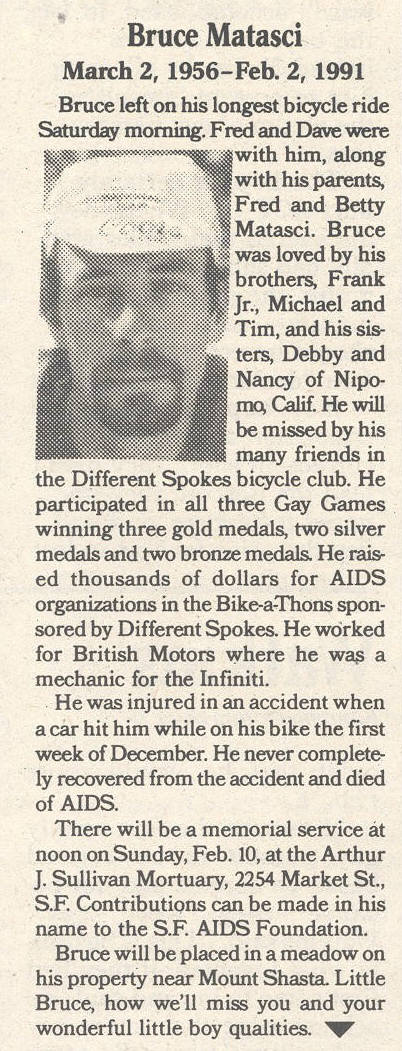
Dennis Westler, former Different Spokes President, wrote this obituary, which was originally published in the March 1991 ChainLetter. Dennis’ recollection of Bruce is spot-on. Bruce had the distinction of having having been a member of the Specialized Bicycle racing team and having raced against a young Greg Lemond. He was the cyclist that many of us in the club aspired to emulate. I interviewed Dr. Bob Bolan about that first BAT and he recalled that he rode the event at full speed and that only one guy was ahead of him. He kept trying to reach this guy and never could—he just vanished up the road. At each rest stop he’d pull in just as this rider was taking off. He couldn’t remember who that guy was. Bob asked me if I was that guy! Uh no, it wasn’t me because I didn’t ride in the first BAT due to graduate school. Who was the ultra fast rider who got to Guerneville first? Bruce. And, as Dennis mentions Bruce had a fist full of Gay Games cycling medals as his palmares! Bruce’s BAR obituary is found here.


In Memoriam, Bruce Matasci 3/2/56-2/2/91

Out on my bicycle last weekend, in every strong graceful cyclist who approached, I thought I saw Bruce. And I had to tell myself over and over again that he was gone.

Back in the early 1980s when I joined Different Spokes, bicycle racers seemed like some godlike breed. I would see them training in their bright, tight clothes. They never seemed to smile; they would snarl at you as they passed. I loved the sport, but the practitioners of it seemed so awful.

And then there was Bruce—smiling, kind of quiet, but friendly. Fiercely competitive but so full of enthusiasm for the sport, he would always offer instruction and encouragement. He was attractive. He was effortlessly masculine. He was licensed! Here was a racer with no chip on his shoulder.

I remember riding with him in the road race in Gay Games II. I had been training furiously. We were both riding in mid-pack. The race was hard and exciting, and to me it was amazing to be able to keep up with him. In the last 200 yards, he put on a sprint and just sailed off. Hammering ’til I thought I’d bust a vein, I couldn’t stay on his wheel. That man was strong!

I remember the first Bike-A-Thon, riding up to the Russian River. That night Bruce, Walter [Teague], and I were driven to a party way out in the country. It was to honor the participants, we were told. Unbeknownst to us it was a radical faery collective. Surrounded by men in fanciful costume and aboriginal makeup, we were afraid to touch any of the food or drink for fear they were laced with psychedelics. As the group began some bizarre ritual led by a man seated inside a pyramid of saplings, we knew we had to leave. Bruce, Walter, and I walked miles back into town in the rural darkness, talking and laughing, and I felt close to Bruce for the first time.

I remember riding with Bruce in last year’s Bike-A-Thon. He had not been training heavily but was still able to work my butt off. He probably already knew at that point that his health was declining but he chose to tell no one but his partner Fred. He went to the Games in Vancouver despite his knowledge, and was triumphant as he had been in the two previous Games. The last time I rode with Bruce, he seemed as strong as ever. Early in December he was struck by a car while riding, and never really recovered from the accident. He died from complications of HIV infection.

I will remember Bruce for the rest of my life for many things—his humor, his skill, his honesty and clear sight, his ability to care, his big legs. I will see his image when I strive to be better on my bike. And I will see his image when I strive to be better as a person.

-Dennis Westler

The First Bike-A-Thon Riders: Dr. Bob Bolan

Today we have the AIDS LifeCycle as the main cycling event that raises money for the San Francisco AIDS Foundation and which involves the participation of literally thousands of riders. But the progenitor of the LifeCycle was the Different Spokes AIDS Bike-A-Thon, which began in 1985, 30 years ago. As I mentioned previously in the ChainLetter blog, just 63 riders completed that ride. They were the ‘pioneers’ of bicycle AIDS fundraising . But who were those riders? I thought that current Spokers might be curious to learn more about some of those first BAT riders. Surprisingly only a few of them were members of Different Spokes. One of those riders was Bob Bolan who, although now living in LA and no longer a Spoker—but an esteemed DSSF emeritus nonetheless—is still avidly riding his bike at age 68 (although not the red Tesch mentioned below; the Tesch died in one of Bob’s hell-bent crashes and he’s currently sporting a Spectrum titanium.) Bob and I got to know each other especially well after we bought and rode a racing tandem in the mid ‘80s and early ‘90s when we routinely terrorized centuries. Bob was and is preternaturally fearless so he captained and I stoked, and that meant all the fear got thrown to the back seat. So I learned to close my eyes and trust that Bob would get down a steep descent or through an chaotic paceline in one piece. He even managed to steer us through a steep, curving downhill where we broke 56 mph!

The following club profile was published in the July 1989 ChainLetter. This was during the dark days of the epidemic before protease inhibitors were discovered, fundamentally changing the treatment of HIV disease, and when mortality was nearly certain. What’s Bob doing today? In his own words: “I’m Medical Director and Director of Clinical Research at the Los Angeles LGBT Center, where I have been for the past 19 years. I divide my time between patient care, administration, oversight of my large medical staff, doing research and working on local and national public health projects. These days I am mainly focused on HIV testing, linkage to medical care, the intersection between STDs and HIV, HIV prevention using pre-exposure and post-exposure prophylaxis and other risk reduction tools. I am married and my husband, Duke, is an RN who works at Keck-University of Southern California. Our two kids, Malcolm and Blair (American Eskimo dogs) round out our family and make for a noisy household in Pasadena. Things are very good. When my patients ask me nervously about my plans to retire I tell them not yet—I’m having too much fun!” And by the way, Bob has a few LifeCycles under his belt too.


Dr. Bob Bolan, the Man with a Mission

I’ve had the pleasure within the past year to get to know one of our more reclusive Club members, Dr. Bob Bolan. Although Bob and I have ridden together occasionally, it wasn’t until Bob diagnosed that we both suffered from Terminal Tandem Lust and a serious case of speed addiction last year that I really got to know him.

Bob rides the way he works: single-mindedly, efficiently, and fast. Having recently acquired a new red Tesch superbike, he is now burning up the pavement and making life rough for the other animals in the Club. You may see him in one of his new skin suits in a local race, or zooming up and down Mt. Tam on a weekend afternoon. Recently he completed the 100-mile route of the Bike-A-Thon and then the following weekend rode the Davis Double Century in 10 hours 25 minutes!

Who is this man who appears in a blur and then disappears up the hill at warp speed? In real life Bob is one of San Francisco’s hardworking AIDS doctors. A family-practice physician specializing in gay-related sexually transmitted diseases, Bob joined the front lines when the AIDS epidemic hit our community in the early 1980s. Bob has been an outspoken advocate for increased awareness of gay STDs both in the gay community and in the medical community. He has taught at UCSF, organized conferences, and written articles about both STDs and AIDS.

A clinician in San Francisco for over a decade with a mostly gay patient base, Bob has had firsthand experience of the devastating effect of AIDS. As you may imagine it’s emotionally stressful dealing with the daily onslaught of his patients’ chronic and debilitating illness, seeing death upfront, and with the Sisyphean task of fighting the AIDS crisis. Bob’s way of taking care of himself is cycling: ”Professionally it’s frustrating dealing with life, death, and deterioration. I feel ultimately powerless in the face of this disease, and bicycling is one way for me to be powerful and to assert my power and strength. The psychological benefit that it gives me is immeasurable.”

Although as a young boy he rode his bike on a paper route, like many of us fairies Bob was a pretty typical sissy growing up—he wasn’t athletic. He soon tired of being mashed by the bigger boys in sports such as football and put his energies into becoming a doctor. But Bob got bitten by the bike bug in the late ’70s when he was working in Madison, Wisconsin. In his cutoff Levis and tennis shoes, he would take off alone on day tours. Back then his longest ride was 45 miles, which seems paltry compared to what he rides now. “When I got home, my knees were so painful! I didn’t have any toe clips—didn’t even know about them. But shortly thereafter I got them to save my knees.”

After he and his lover Timmy moved to San Francisco in the late ’70s, Bob became a more serious cyclist. Since then he has increased his commitment to bicycling. He recognizes the important role of cycling in physical and mental fitness especially given his profession. Bicycling also helped him kick smoking and has kept the nicotine monkey off his back for the past eleven years. Nowadays Bob likes to do long, hard rides such as centuries. He’s not a big fan of touring or of mountain bikes because “you can’t go fast enough—I like to go fast!”

Other reasons why Bob enjoys bicycling so much: “I love to eat, and eat lots of junk food. When I ride I don ‘t have to be as discriminating in what I eat. But we older guys have to be careful because when we ride sporadically our appetites outlive our caloric requirements and then we get fat.” Bob’s favorite thing about bicycling? “Lycra on good-looking men.'” Now that’s something we can all get behind!

Social Ride: Brunch at Assemble!

Assemble 1
At Assemble for brunch!

Once the mainstay of the club the social brunch ride has fallen onto hard times. Whether it’s just the times we live in or unnatural selection we just don’t have many short ambles that involve dining rather than velocity and lactate threshold as the goal. There was a time when Leon’s BBQ—now long gone *sob*—across from the San Francisco Zoo was a common Decide ’N Ride destination. Nowadays Spokers prefer to ride longer, faster, and dine on Clif bars or quick and lackluster sandwiches. So Roger and I didn’t expect a big turnout. We had four RSVPs but then the weather, a rare rainfall, led us to postpone the ride to the following day and we lost a couple. DSSF old-timer Sharon Lum and relative newcomer Bill Knudsen ended up joining us in what turned out to be the perfect day for a bike stroll, a fabulous brunch, and a view from the new Bay Bridge.

Fortunately the weather turned out to be spectacularly beautiful—mid-60s, bright sunshine, and light breeze—making any trepidation about having postponed the ride on short notice melt away. For those who don’t know, Assemble is the restaurant in the old Ford assembly plant right on the Bay in Richmond. It’s conveniently located on the Eastshore section of the Bay Trail, a very popular, easy cycling route from Emeryville all the way to Point Richmond. Their signature dish is a chicken pot pie but also make a variety of American comfort foods using ingredients from their organic garden. The ride along the Bay Trail has nearly continuous views of the Golden Gate and the Bay, and wetland restoration has turned former garbage dumps into pleasant, natural retreats in our highly urbanized environment. Old-timers will recall that the area along the Emeryville section of I-80 was populated by junk and driftwood, which intrepid artists turned into whimsical sculptures; only a few remain today.

We met at Macarthur BART and rolled down 40th Street bikeway to the Emeryville IKEA, making our way under I-80 onto the Bay Trail. Because it was a sunny Sunday morning other cyclists, joggers, and strollers were out in force. But we weren’t hurrying the pace so it didn’t matter. Bill was recovering from a nasty cold, which was also keeping Wandersen too ill to ride that day. Sharon, who came out of cycling retirement for Derek’s Old Farts Confab a few weeks ago, really hadn’t been riding her bike in earnest for eons; she came up from San Jose because she was curious about the Rosie the Riveter Museum, which is next door to Assemble. The ride was essentially one long, ambling conversation. Bill and I rode mostly within earshot of each other while Roger and Sharon chatted quietly in the back. Consequently I didn’t hear much of what they were chatting about. I don’t recall all the details but Bill did recount his and Wandersen’s recent ocean cruise, the niceties of winter in Chicago, how he met Wandersen, and how icky his cold was. The excitement of the day was contending with the traffic going into Golden Gate Fields for race day. Although Roger and I had ridden through the horse track grounds many times it has never been on a race day and consequently it has been empty and barren. But not this day! Cars were streaming into their vast lot and filling it quickly. Golden Gate Fields also has the only hill on this section of the Bay Trail, a steep but mere blip.

Once at Assemble we didn’t have to wait long for a table. The interior is industrial chic and I was surprised it wasn’t jammed on such a great day; perhaps people were outside having too much fun? Roger and Sharon had the chilaquiles, Bill the sliders with fries, and I the fish and chips; Roger and I also split a bowl of potato kale soup. On paper they sound mundane but in execution Assemble’s dishes were definitely a notch above. Thusly sated we lolled a bit outside and peeked in the Rosie the Riveter Museum before heading back. Everyone decided to check out the Alex Zuckerman bike path onto the new eastern span of the Bay Bridge, so we rolled back through Emeryville into a stiff headwind coming through the Golden Gate. If you haven’t been on our very own ‘bridge to nowhere’, you’re missing something special. It’s about eight miles out and back, and if the weather is good (and it was) you’ll get unusual views of the Bay as well as an up-close-and-personal view of the deconstruction of the old eastern span. At the end you’re almost within touching distance of Yerba Buena Island. Signage indicated that the path is scheduled to be completed by this summer! I rather doubt it seeing that the gap between the existing path and Yerba Buena is still ‘challenging’. But when it is completed it will be a splendid ride out into the middle of the Bay and no doubt we’ll plan a fab brunch on Treasure Island!!

Den Daddy’s Secret Old Farts Confab

Old Farts!
Old Farts!

Perhaps there is no greater sin in the gay community than to become old. Lord knows there’s only so much good a jar of pearl cream can do before one is forced to throw up one’s arms in exasperation and don a veil. Or just hide. And hide we did, sort of, until at Derek’s behest this past Sunday a rather exclusive gathering of old (in both senses) Spokers convened over in the East Bay at—where else? Rossmoor!—for a ride, a nosh, and to catch up on the latest personal news (“So, what have you been doing for the past 25 years??”) I don’t know when this evil idea of an old farts confab first came to Derek. But as part of his bucket list he wanted to pull together as many Spokers from the early days of the club as he could locate and, as he put it rather unartfully, “After having been the ‘old guy’ in the club since the early days of the club, I wanted to see how all of you would feel when you were finally old!” To add insult to injury, he opined, “And some of you don’t look half bad now that you’re old!” Ah that Derek, such a card.

It wasn’t listed in the club ride calendar, as if it would have mattered since almost none of the old Spokers are still members or would even bother to look at the club website. But through word of mouth/email almost thirty of us showed up for a leisurely ride to Danville and up to Blackhawk for a coffee stop before returning back to Rossmoor for a post-ride nosh ‘n josh with a few others who forwent the ride. There was a lot more grey or white hair (or lack entirely thereof), widening waistlines, and creaking joints than your typical Different Spokes ride. For the most part these old Spokers could still turn the cranks but maybe it was at a more casual pace than one tends to find on club rides these days. Derek may have been the oldest in years. Those of us who were in our twenties or thirties when Different Spokes was formed are now older than Derek was when he joined in 1983!

In any event, the purpose of the ride wasn’t to lay waste to each other in anaerobic battle as it was to schmooze and socialize. When was the last time you did that on a club ride? We went down the Iron Horse Trail to Danville and then up Camino Tassajara to Blackhawk where we stopped at a Starbucks for refreshment. I suspect some of the livery we were sporting would either elicit guffaws or strange looks in the club nowadays. Yes, there were a few ‘contemporary’ bikes—Matt O’G’s carbon Tarmac probably being the most recognizable—but they were far outnumbered by the old school road bikes—for example, a couple of Vitus 979s, ancient Cannondale aluminum steeds, a mid-90s LiteSpeed, a lugged steel Guerciotti—and the old school mountain bikes (yes, we used to have a very active mtb group) with nary a bit of suspension or hydraulics in sight. Even some of the garb was old school: t-shirts, Bermuda shorts, tennis shoes; Eric Jansen sported the original club jersey from 1988, a true relic of the age (he also rode an original Bridgestone mtb, a brand that was probably the most popular in the club during the late ‘80s).

And what would a club ride not be without at least someone getting dropped and getting lost? That fate befell Tom Jewell and Paul Quintilian, who eventually made their way back to Rossmoor, their SF sense of navigation having been temporarily derailed by the lack of fog and Muni tracks. We followed Derek into Rossmoor proper and reconvened at the Rossmoor Gateway Club, where we met those who chose not to ride, for more refreshments and more chatting.

I won’t bore you with the entire guest list. There were many who couldn’t make it for one reason or another anyway. Peter Renteria was the only original club founder who could come, along with his husband Kevin, who met through Different Spokes and then vanished. (Me: “When was the last time you guys rode your bikes?” Kevin: “About 23 years ago!”) Dennis Westler, who was President for umpteen years in the late ‘80s and ‘90s showed up; he now leads rides for Performance Bike. Almost everyone present had ridden in at least one Bike-A-Thon; someone there had ridden in them all. Many had been in a club leadership role at some point such as board members, BAT coordinators of various flavors, and plenty of ride leaders. Joe McClinton and Rachael Ginsburg, both of whom used to lead tours for the club, came out as did Sharon Lum, who pioneered many now-eponymous standard club rides. There were a few original 1985 BAT riders: Karry Kelley, Paul Quintilian, Dennis Westler, and Peter Jenny. Strangely there were four ChainLetter ex-Editors in attendance: Doug O’Neill, Rob Bregoff, Don Lapin, and I. Overall it was an exceptionally involved group of oldsters.

On a personal note, not only was it a chance to reconnect albeit briefly with old friends but I also got an opportunity to chat with several Spokers whom I hadn’t had the pleasure of meeting before. In the back of my mind—and I suspect in the minds of others in attendance as well—were thoughts and memories of old Spoker friends who had passed on. Thirty-three years is ample time to lose many friends and club members. This was one last time to ride in spirit with them as well.

The First AIDS Bike-A-Thon

1985 BAT Gene Howard
Gene Howard, oldest participant in the first AIDS Bike-A-Thon

Those of us who lived through the early years of the AIDS epidemic recall tremendous fear and despair over a disease whose origin and potential cure were unknown, treatments just feeble stopgaps on the fast track to a final demise, and a constant background pall on the community with each passing obituary. There seemed to be nothing one could do except care for the ill and educate as many people as possible. But one thing people could do was raise money for services and out of this the AIDS Bike-A-Thon was born. The first AIDS Bike-A-Thon (BAT) took place on Saturday, April 6, 1985—30 years ago. By today’s standards the amount raised, $33,000, seems paltry; but at the time it was a substantial bonus for the fledgling SF AIDS Foundation. According to Karry Kelley, the 1985 BAT was the largest amount for AIDS work ever raised at a single event in SF and the subsequent BATs were the largest fund raisers for the AIDS Foundation until the Foundation began the AIDS Walks in 1987. Different Spokes went on to put on nine more BATs before passing the event on to Ruth Brinker’s Project Open Hand; under its aegis it lasted just one more year.

Although Different Spokes played the central role in the initial Bike-A-Thon and its subsequent success, contrary to lore we did not invent it. The San Francisco AIDS Foundation, founded in 1984, approached Different Spokes in February 1985 for assistance and advice on how to run a bicycling charity event in order to raise funds for its operations. The AIDS Foundation was not yet the mainstream behemoth it is today and like many non-profits was dependent on donations. After several meetings between the AIDS Foundation and club officers, the Bike-A-Thon fundraising ride was announced for April—just a little over two months later. Bob Humason, then-President of Different Spokes (and who later was himself to die of AIDS), along with Michael John née D’Abrosca, past President and ChainLetter Editor-in-Chief, were the main forces behind club involvement and working with the SF AIDS Foundation.

Because the BAT was pulled together so quickly it was somewhat slapdash, yet the last-minute event managed to be a success, firing the imagination and zeal of participants—many of whom went on to organize and run subsequent BATs—as well as the San Francisco gay community. Keep in mind that subsequent BATs usually took 11 months to be planned and organized! In retrospect two months to pull off a never-done-before charity event was incredible. Within the club BAT was advertised and pushed for only one month (!) before it took place, a very short time to pull in riders for a 100-mile ride, nonetheless 63 riders managed to take to the road—not bad for an initial effort. In those days Different Spokes was a very small cycling club, so finding people to do a 100-mile ride just from within the club wasn’t going to be sufficient. The main form of recruitment and PR was an information and pledge table set up in front of “Hibernia Beach” on weekends for the month before the ride. [Note for you youngsters: “Hibernia Beach” was the corner of 18th and Castro where the Bank of America now sits, formerly the site of a Hibernia Bank branch, a local SF institution.] Perhaps it seems amateurish today—more suitable, say, for selling Girl Scout cookies—but it somehow worked.

The AIDS BAT wasn’t the first charity event for AIDS/HIV by far nor was it the first mass cycling event to raise donations (the first Multiple Sclerosis Society charity ride took place in 1980). But using cycling was a new idea for the Bay Area. Mass cycling events in the Bay area to date were primarily club centuries not directly concerned with raising funds for a cause (other than the clubs’ coffers), and cycling certainly did not have the sexy public profile it now has. In those days it wasn’t so much skin-tight Lycra as it was white tee shirts and Bermuda shorts; carbon fiber bikes were a mere twinkle in the eye, and aluminum was the ascendent “wonder” frame material.

The ride was called “Pedaling for Pride in ‘85”. To encourage riders there was no registration fee (although you had to register in advance). The only material reward for participating was a commemorative tee shirt and overnight accommodations in Guerneville. The club did organize sag support and first aid. Jerry Walker, who was then the owner of the Freewheel Bicycle Shop on Hayes Street and also a club member (he later was Vice President and eventually also died of AIDS), provided repair services. There were rest stops at 25-mile intervals and checkpoints every 12 miles to make sure everyone was all right.

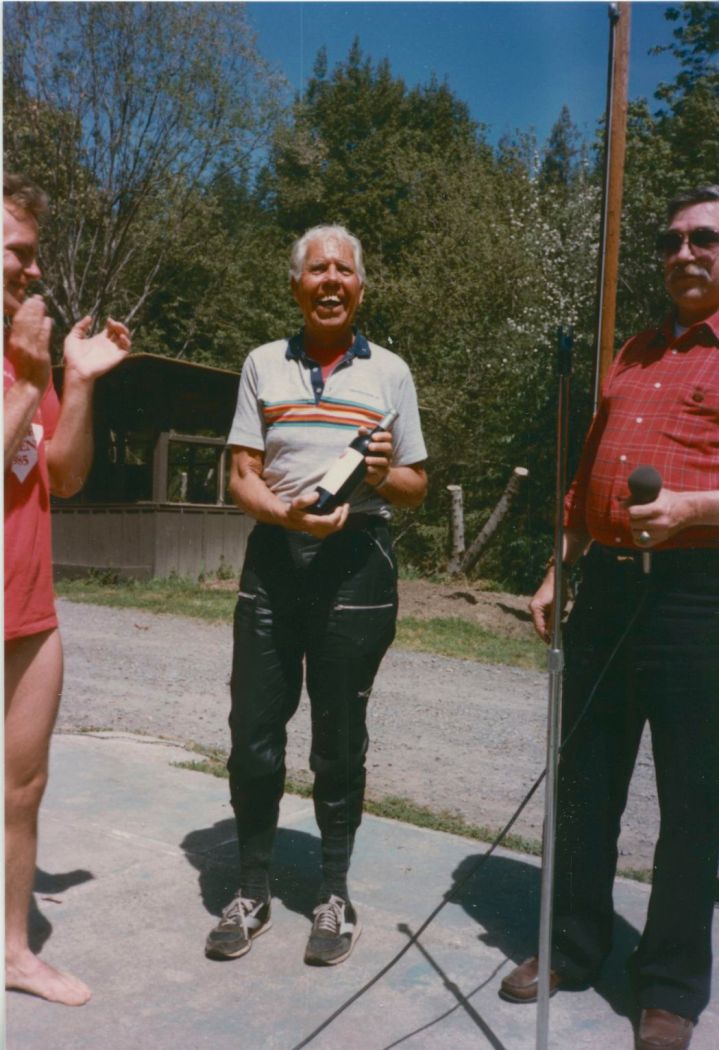
The route was almost the same as the club’s Guerneville Weekend ride: north up Highway 1 all the way to Jenner and then east on River Road to Molly Brown’s Saloon in Guerneville (the traditional Guerneville Weekend route goes through Occidental to River Road instead). Those hills on Highway 1 took their toll: not everyone made it to Guerneville. But most did and the last one in is the gentleman pictured above at the awards ceremony, Gene Howard, then in his 60s. I recall club members Jim King and Tom Walther, who were considerably younger than Gene and who were barely ahead of him, swearing that they would make it all the way to Molly Brown’s before Gene—darned if they were going to let an “old” man beat them!

The following day there was a big party at the Woods Resort where prizes were awarded under beautiful, warm, sunny skies. Instead of leaving riders to fend for trips back to SF on their own, the BAT kindly arranged car returns for everyone and their bikes.

Instead of calling it a day, the aftermath of the first Bike-A-Thon was tremendous interest and energy in pulling together a second event, this time entirely under Different Spokes auspices. In order to pull off an even more successful event the organizing structure, although entirely volunteer and unpaid, became more formal with the appointment of a BAT Coordinator and committees to make sure all aspects of the event—publicity, fundraising, pledge collection, training, recruitment, facilities, etc.—were on track. Instead of the SF AIDS Foundation being the sole beneficiary, the club decided to recruit community-based AIDS organizations as recipients, a practice that continued until Project Open Hand took over the event. The club went on to organize a total of ten BATS before it burned out and passed the event to Open Hand.

Bike-A-Thon had a generative impact on Different Spokes. The event created a tremendous amount of energy and enthusiasm and in return the goodwill from the event led to a much higher community profile and our highest membership numbers ever, nearly triple the current number. But as the AIDS crisis continued, running BAT took a toll on the club. Partly it was the volunteer nature of the event: unlike almost all charity events, including the California AIDS Ride and the AIDS Lifecycle that followed BAT after its demise, the event was entirely volunteer run and supported by the club. Only in the last two years of the event’s life under Different Spokes was there recognition that the event itself needed to have some income in order to be well run and consequently made itself one of the beneficiaries. BAT was the primary focus of the Different Spokes for its entire run, needing nearly yearlong planning. Although it brought in new members and their energy, it also sapped the energy of the core leadership of Different Spokes. Eventually the club just ran out of juice as the core leadership either died of AIDS or moved on. What we have today is a legacy of community involvement and service that went beyond simply having a good time on a bicycle. Nowadays we have the AIDS Lifecycle that fulfills the same function as the original Bike-A-Thon. It’s a much flashier, well-organized, and successful charity ride, and like the BAT galvanizes and transforms at least some of the participants. There are many differences between BAT, the California AIDS Ride (also gone) and the Lifecycle. But a key difference is that for its first eight years every cent of donated money went to AIDS service organizations—the overhead was covered entirely by volunteer effort and goodwill: over $2.3 million. Now that’s a legacy worth remembering!

Antisocial Darwinism: Survival of the Fittest?

Howard Neckel was one of the original members of Different Spokes when it was founded back in 1982. I recently found out that Howard was no longer a member and wanted to find out why after 32 years he no longer was a part of the club. In his own words here is what he related to me—

It’s been a while since I’ve realized that I’m just not in the kind of shape I was when I was younger. As much as I’d like to ride with other gay cyclists, I just can’t manage to keep up with the ones in DSSF.  A great many of the posted rides are in the 70+ mile category, but even when I try the shorter ones I get dropped. The core group of Spokers are very strong riders, and weaker riders like me get left in the dust. After a few repeats of that scenario, you ask yourself what the point is of participating in a club ride because you’re essentially riding solo after a quick hello at the start. It’s a sad fact of life but I have deal with the fact that I’m 67 now and not the rider I was even ten years ago, and certainly not when I first joined the club. I simply don’t “qualify” for DSSF rides anymore. It’s a shame since they’re right here in town and it’s a gay club—two big pluses. But almost all the club’s rides target the core group of really strong riders. The club doesn’t have a contingent that accommodates older, slower folks like me. That may also hold true when it comes to slower-but-NOT-older riders, for example those new to the sport who might not yet have built up a lot of speed and endurance. As a result I’ve been riding mostly with Western Wheelers. Their club is large enough that the guys who really like to burn rubber plan their own separate rides; those who like to go at a more leisurely pace with social regroups plan theirs. Actually, many rides manage to accommodate multiple skill levels simultaneously by having a slightly earlier start time as well as longer routes for the stronger riders. The multiple routes will often intersect either for lunch midway or for snacks at the end. Personally, I tend to ride with the middle (and sometimes low-middle) skill range and that allows me to talk to folks along the way and at regroups, several of whom I am happy to count as good friends now.

Unfortunately Howard’s experience seems to be shared by quite a few members and participants. Over the years I can’t count the number of times I’ve spoken with cyclists about why they didn’t come back to a Different Spokes ride or rejoin the club and with them expressing the same frustration as Howard’s: they were dropped at the beginning of a ride and ended up riding alone or riding at a faster than comfortable pace to keep up, and otherwise just didn’t get a chance to socialize with other Spokers. In fact you have only to look back to 2012 on this very blog to see the same comments mentioned by others. Those new riders who do keep up perhaps get the kind of social experience we are all looking for and consequently they might come back. They get positively reinforced because they are stronger (or more stubborn) riders. Similarly for women cyclists, they might come on a ride, see that there are very few or no other women, and then not come back. Perhaps given the dearth of dirt rides over the past ten years mountain bikers also eschew coming to Different Spokes. The result is the same: we end up with a club with the same kind of members it already has, i.e. fairly fast, or at least very avid, male road cyclists.

This wasn’t always the case. When Chris LaRussell was President, it was no surprise that having a female leader helped raise the club to near gender equity with about a 40% female membership [I believe this may also have been the case when Cathy Cavey was President in the ‘90s]. There also used to be a very active dirt contingent—why it has faded away is not clear to me. But dirt riding ascended in the early late ‘80s precisely because there was a core, active group of riders including the President at the time, Dennis Westler. It may be lost on the current membership that the original core group of Spokers were touring cyclists, not racers or wannabes. Those early club rides for the most part took place at a friendly pace with just a few animals off the front. However one aspect that has changed over the years is the age distribution. In the ‘80s the club was heavily skewed towards the twenty- and thirty-something cohorts. The number of older cyclists (older than 60) was very small—who remembers Gene Howard or Walter Teague? But those younger riders have aged up and gone grey and like many clubs, cycling or otherwise, the age distribution has shifted upward. Even our current President is a retiree!

Howard is right though: the club’s rides target the faster riders precisely because they have stepped forward to lead more rides. When a free weekend day to ride is a precious commodity, you want to do rides you enjoy and not rides you might do out of a sense of obligation. You can’t fault folks for doing what they want to do; after all, being a club member isn’t like your job (or your family!) where sometimes you just have to do things even if you don’t like it. And being a small club naturally makes it harder to cater to and invite the kind of diversity we’d like to see. The general rule of thumb for volunteer organizations is that ten percent of membership will step forward and do the work. That means of our 130 members about 13 people are club officers, ride leaders, and volunteers who do the work that makes a club run and survive. That’s not a lot of people to cover all the bases, is it?

Yet the quandary is that we’re all the worse for it. The club is supposed to be an umbrella for all LGBT cyclists, not just fast ones. How can it welcome all of us if it offers nothing to the majority of cyclists? The club takes on an increasingly one-dimensional mien that just turns off other riders and drives them away rather than towards us. At some point this becomes a self-replicating process. Think about it: it takes a abnormally committed and perhaps somewhat crazy person to come to the club and say, “Well, this club doesn’t offer what I want, so I’m going to jump in and change it!” Yet that’s what we seem to be saying, i.e. “If you don’t like it, well then roll your own!” A normal person would walk away and keep looking, and that’s exactly what most new riders (and now some old-timers) seem to be doing. Fortunately for Howard he’s found another club where he feels welcome and that seems to have embraced him with open arms. The irony and sadness is that we, a LGBT club, don’t have something to offer the Howards out there. Of course, if you’re happy doing the rides that the club currently offers, the answer is you do nothing because the status quo is perfect in meeting your needs. So nothing changes.

But for those on the margins of the club or even for those of us more actively involved but disturbed by this trend, is there a way out of this quandary? There’s a part of me that thinks that not only does it not have to be this way but that we as a club actually do have a responsibility to change it. I don’t believe that our current state is an inevitable step in the evolution of our club. I ride infrequently with Different Spokes, but I do manage to show up on a few B or C rides every year and even the very infrequent A rides (I mean, other than the ones that Roger and I lead). Occasionally there are new faces that I never see again, and I wonder why. Were they simply “bees” that flit from flower to flower all the time or did they just not have a good time with us and why? We rarely get post-ride verbal feedback from those who *don’t* come back; of course, not coming back is feedback, n’est-ce pas?

I don’t know what the solutions should be. For the Howards out there, their solution is more clear: roll up one’s sleeves and try to change Different Spokes or move on to a club that offers rides that meet your preferences. Unfortunately there aren’t any other LGBT clubs in the Bay Area, so you end up riding with “straight” clubs. It would be lovely if some in the club were just to step forward and say, “Okay, I’ll do it.” But I think that’s not likely to happen given the current lethargy. However if you are a member and want to see things change, it doesn’t hurt to take the initiative to make it so. If you want to see more leisurely paced rides, why not volunteer to lead one? Perhaps those of us who’d like to see more “A” rides on the ride calendar should start talking to each other about planning and co-leading rides. You don’t have to do it alone. It won’t change unless either we do it or we luck out and the Messiah miraculously shows up to lead us. If you’d like to see more diversity in our ride listings, give me a holler, speak out on the blog, or comment on the DSSF Yahoo! group site.

Fading

IMG_0056

Autumn in northern California is always a strange time, a neither-fish-nor-fowl period. If you think for a minute, you’ll realize that we don’t have four real seasons here; it’s more like three seasons: a short, green spring; a dry, dusty brown summer; and a wet (we hope), cold winter. This year was no different. The transition period we call ‘fall’ was practically nonexistent, as we had a hot Indian summer followed by a perfectly warm period with plenty of sunny days. Riding this fall has been decidedly excellent because of blocking Pacific highs sending almost all the rain into the Northwest keeping us dry and giving us plenty of enviable riding days. And in Contra Costa where I live, we went from blistering heat in October to November days that were warmer than summer in SF! Well, it has all come to an end. I finally had to don knickers and a long-sleeved jersey this week.

But not before we had one last blast up Morgan Territory and Mt. Diablo last Saturday. Morgan Territory Road is one of our few remaining Road Less Traveled routes, at the margins of Bay Area urbanization and dangling by a thread from becoming just another subdivision. Just down the road are Clayton and Concord, and probably what’s keeping Morgan Territory from being invaded is the current lack of water. But for now it’s ours and it provides a beautiful experience of what the nearby San Ramon and Diablo valleys were like a mere 30 years ago before Walnut Creek, Danville, and San Ramon engulfed all the open space. (Yes, it’s difficult to imagine now but in the ‘80s we simply crossed over the Berkeley hills to ride on country roads.) David Goldsmith led the four of us up Morgan on what has become a fall tradition. Summer on Morgan Territory is like a friendly visit to a furnace—not the best time to go—but fall is perfect if you don’t have rain—it’s not boiling hot, the weather is kind, and the leaves are turning, giving one a taste of what Easterners experience annually (and tenfold in grandeur). When you’re not anoxic and semi-conscious because of the 14% and 16% bumps on the climb, you’ll realize that you’re all alone on a beautiful, winding road surrounded by trees turning luscious colors. At the top, Morgan Territory Preserve, you’ll find a view of Mt. Diablo from the south and a panoramic vista towards the Livermore valley. For the most part we lucked out and the sky was clear allowing for great views. But as we rested at the Preserve and ate our snacks the moist air driven up the west side of the mountain was condensing and clouds began covering the hillside. Chilled by the breeze we set off on the descent to Highland, which sadly always ends in a frighteningly fast blink of an eye. All that altitude gone in minutes aided by a double-digit grade, the near complete lack of traffic, and decent sight lines that only made us accelerate with abandon. After lunch at Domenico’s in Danville, David made us climb up Diablo for more fall fun. By now it was cooling off and all my clothes went back on despite the uphill. It was still sunny but the autumnal heat was now gone. David and David continued on to the top while Roger and I descended back to BART. A good end to a near-tropical “fall”: an all-day, 82-mile ride with friends. Next stop: winter rain riding!

Tantalizing…

IMG_0053

There it is in the photo: the new Carquinez Scenic Trail, beckoning… I shot that photo through the locked gate at the western end of the trail a couple days ago. Carquinez Scenic Drive, the long abandoned county road connecting Crockett and Martinez above the Carquinez Strait, will soon be reopened. It could be open for public use as early as this Friday, Halloween, but no later than Saturday, November 8. The road was closed to car traffic in 1983 and left to decay. But it’s always been open to pedestrians and cyclists willing to hazard the narrow, winding road with broken asphalt and missing sections due to storm runoff. Like a vision out of “Planet of the Apes” it was civilization returning to its original form—large weeds sprouting up between the chunks of road, rusted signs, and a slow, crumbling ambience. A few years ago the East Bay Regional Parks District agreed to assume control of the road and the final stages of resurrection are complete. The road has been rehabilitated, the cliffside stabilized, and striping freshly painted and signs erected. Cars will still be banned and the road is even being incorporated as part of the Bay Trail.

Riding along Carquinez Scenic Drive was one of the popular rides in the early days of Different Spokes when it was called “the Port Costa Loop”. In fact the ride was offered for the first time in March 1983 perhaps because the road had been closed and suddenly was a lot more cycle-friendly.

In a way it’s sad that it’s been “improved”. The road has mostly intact albeit crumbling but it was easy to cycle on a road bike. The sections which had slid away were easy to roll over although one might never know from winter to winter how much of the thin trail would still be intact and the only “damage” would be a little bit of mud on your bike if it were wet. The views along the cliff are nothing short of spectacular on a sunny day and shouldn’t be missed. At least now more people will be able to enjoy them.

Carquinez Scenic Trail

On Saturday November 22, assuming the weather is favorable, we’ll roll out from Orinda and take in a big loop through West Contra Costa County and check out the renovated Carquinez Scenic Trail, née Drive. You’ll also be able to ride through historic Crockett, home of C&H Sugar, and go up the back (easy) side of Pig Farm before tackling the Three Bears. Of course, you’re free to check it out yourself beforehand if you can’t wait!

For more information, go here.

2014 Fall Social Recap

Group

We had a big turnout for this year’s Fall Social at Phil Bokovoy’s house in Berkeley. The last hurrah of excellent weather must have encouraged a spate of Spokers to roll over to the East Bay for the traditional rides, the ever-popular Three Bears and the beautiful Rosie the Riveter stroll by the Bay. This year’s Social took place about a week earlier than usual and that may have had something to do with the sunny, warm conditions during a time of year when things could go either way, “earthquake weather” or the onset of a cold autumn. Fortunately we had the former and that made lolling in Phil’s backyard especially comfortable and convivial. Having the event a week earlier also meant that it didn’t have to contend with the after effects of a Halloween Saturday in the Castro!

The Rosie the Riveter ride, which had been dwindling in popularity in recent years, had a resurgence of interest as seven folks took in the spectacular views along the East Bay waterfront. David Shiver and his son Roberto came along as usual. Years ago Roberto first started coming in a buggy towed behind his daddy’s Cannondale; he then graduated to a trail-along, and now he’s on his own bike, a mini-mtb. A slightly larger group of about ten folks did the Three Bears, and they managed to beat the Rosie group back to Phil’s although just barely.

Phil

Phil, as usual, butterflied and barbecued a delicious turkey, and we had a wide assortment of salads, appetizers, and of course yummy desserts including Jim’s homemade apple cobbler. The dish was slung while folks inhaled their dishes. You just had to be there. Thanks again to Phil for hosting the soiree [sic] and to everyone who contributed! Next stop: Holiday Party…