Jeffrey’s Journey

This evening, I came across this 1 hour documentary on PBS about a disabled cyclist named Jeffrey McElfresh. “In this documentary, we follow Jeffrey over the course of ten days as he cycles along the Ohio River, from Pittsburgh to Cincinnati.” Maybe not the sexiest route, but definitely one of the better shows I’ve seen about bicycle touring or cycling in general. Just wanted to recommend it to anyone who has done bicycle touring, or is interested in bicycle touring, or is just interested in how one person uses cycling to deal with adversity, reflect on life, and learn more about himself. – Sal Tavormina

Bike-A-Thon Memories

Rummaging through old boxes last night I found a bunch of long forgotten photographs. Here are three that relate to Bike-A-Thon. The first is from the 1986 BAT (the second one). A few police officers at Mission Station decided to ride in the event and this is a photo by Tony Plewik of a few of them along with four DSSF/BAT organizers–Karry Kelley, Bob Humason, Jim King, and Tom Walther. That cops would ride in the Bike-A-Thon probably raised a few eyebrows then and it was good publicity for the event. By the way Tony Plewik was a gay photographer in San Francisco and he died of AIDS in 1995.

Mission Station officers to ride 1986 AIDS Bike-A-Thon

The second is, from the looks of it, at the start of a Bike-A-Thon. It wasn’t the first BAT because the only person I can immediately recognize is Tom Walther, the person without a helmet and with the megaphone and dressed in a DSSF sweatshirt. Tom rode in the first Bike-A-Thon so this photograph must be from a later one. My guess is Bike-A-Thon 3 because that year he was the Coordinator. But Tom was heavily involved with BAT until about 1990, so it could have been any of those years that had dreary weather at the start. This photo was by Mick Hicks, another SF photographer, who now lives in Southern California. [Update: Karry remarked that the ride start of the BAT originally was on Castro Street until BAT4. So this photograph is either at BAT2 or BAT3 as I suspected.]

At the start of a wet AIDS Bike-A-Thon

The third is a publicity photo. I do not recall the year but I do recall that the call went out for Spokers to show up for a publicity photo for the Bike-A-Thon, probably to be used to recruit riders, and this is it. This was also shot by Tony Plewik. I recognize several faces in this group but the only name I can recall is Abel Galvan, who is the fourth person from the left. Abel was a delightful person, a very good rider, and as I have mentioned in the past rode a impressively red full Campy Derosa. Sporting a “real” race bike in those days especially with the heritage of Derosa was very, very rare in the club. Most Spokers had bikes that came off a factory line and were quite modest. Not Abel though, and he wasn’t rich at all. But he loved cycling and must have ploughed most of his savings to get that bike. Abel died of AIDS in 1996.

AIDS Bike-A-Thon publicity shot

If you compare this photograph with almost any contemporary Different Spokes pic, you will get a sense of how “unfashionable” the club was. Back then even members of other recreational cycling clubs wore bike jerseys and shorts. Of course back then there was a lot more wool than there is today. But our club was a mishmosh of cyclists most of whom were not coming from racing or racing culture. So you’d see a lot of t-shirts, gym shorts, and street clothes at club rides along with a few members like Abel or Jerry Basso, who were some of the earliest members to embrace the traditional racer look.

Thoughts on a “Gravel” Ride

I did a “gravel ride” recently that had me mulling over this genre of cycling. In our area is gravel biking any different than mountain biking? Clearly in the Midwest, where gravel biking was created, it is different. The Midwest is not mountainous and has an immense network of farm roads that are not paved and usually covered with gravel. When folks go gravel riding here, they’re riding on fire roads and trails that we’ve been riding with mountain bikes (and sometimes just our road bikes). It’s not like “gravel” roads are appearing out of nowhere in the Bay Area. Although gravel is used to patch fire roads and some trails, long sections of pure gravel in the Bay Area are like hen’s teeth. So is there any reason to get a gravel bike at all?

The loop I did is similar to a loop that Grizzly Peak Cyclists does every Thursday on their regular mixed terrain ride: up Pinehurst to the East Ridge Trail and then climb to Skyline before entering Sibley Volcanic Park to roam about and then drop steeply into the Wilder subdivision of Orinda. In total it’s about 22 miles. I had ridden East Ridge before but only going downhill; I’ve ridden in Sibley a fair amount but hadn’t gone into Wilder, which is technically private property.

I did this ride on a Cannondale Slate, which if you’re not familiar, is an older all-road bike. A concession to dirt is the 42mm slick tires and front suspension with about one inch of travel. That suspension is only good for smoothing out small bumps. In contrast my mountain bike has 53mm knobby tires and a lot lower gearing, 22 gear-inches versus a high 33 on the Slate.

The advantage of this kind of bike is that riding pavement is not a lot different than riding on a road bike. Getting to East Ridge was relatively easy. If I had been on my mountain bike it literally would have been a drag. The fatter, knobbier tires are great in the dirt but less so on asphalt. I don’t do any pure dirt riding nor do I drive to a trailhead to ride. So some kind of bike with more road-like gearing and quicker tires are better on the paved sections even if they’re not optimal for dirt. But once I started climbing on East Ridge I immediately felt at a disadvantage. It’s a stairstep climb with multiple short, steep sections broken up by flatter and sometimes even downhill sections. I could have used that lower gearing on the steep sections. The surface was also highly variable even though East Ridge is a fire road. The surface is rutted by runoff and it hasn’t seen a grader in many a year (if ever); and you encounter every kind of dry surface imaginable except for a rock garden: sand, slick rock, hardpacked clay, inconsistent gravel, debris rocks, and lots of ruts. The inconsistent surface meant I had to be attentive to my weight distribution to steer straight, not lose my front or rear wheel, and not topple over. In other words, it was just like mountain biking. The major difference was that I was on drop bars instead of flat bars. Did I mention I was undergeared?

East Ridge looks like a remnant fire road—it’s quite wide—but I had forgotten how steep it is. I was immediately in my lowest gear and struggling to spin up the first section, which is quite steep. The trail stairsteps up for almost its entire distance alternating very steep with flatter and even a few short downhill sections. But the steep sections were rutted from runoff and the surface wildly varied from sandy to rocky to slicker rock and there was plenty of pebble sized gravel here and there. The trail looks like it hasn’t seen a grader in years. In a couple of places the park district had dumped a lot of loose gravel and spread it out, and it was definitely trickier to stay upright. It was very challenging for me, much more technical than I was expecting. If you were introduced to gravel biking thinking it was just going to be road riding except on non-asphalt, you would have been rudely made aware that this kind of gravel riding is actually mountain biking. The only thing missing was a serious rock garden with baby heads.

Fortunately it was in the late afternoon when most walkers and cyclists would have finished their jaunt already. So there was little traffic, which was good since I wasn’t sure I was going to be able to keep a straight line trying to stay upright while navigating a host of obstacles and sketchy terrain. Someone bombing downhill would have presented just another trail hazard (or vice versa).

In my pain reverie I heard the distinctive whirring sound and was gently passed by two people on e-mountain bikes. They didn’t look like newbies either—they were pedaling smoothly. At that moment boy, I wished I had one too! (er, of course I mean a mountain bike!)

There were sections I wish I had a dropper post. The steep pitches especially the ones through ruts and rocks (which was almost all of them) would have been safer if I had been able to move my butt back easily in order not to go over the bars and to keep more weight over the rear wheel. This was really important on the gravelly downhill sections when I could have easily lost control of either wheel.

Sibley presented similar issues although in general it wasn’t as steep. I usually ride Sibley on a cross bike with 35 mm tires and it is fine because the dirt roads weren’t horribly rutted and were mostly hardpacked dirt. But currently there is a thin layer of gravel on some of the roads making it not only bumpier but also more treacherous on slicks.

Behind Sibley to the east is Wilder. You exit Sibley through a gate where you’re informed you’re entering private property. Wilder originally was intended to be a gated community a la Blackhawk. But I believe the developer went bankrupt (or so they say) and the city seems to have brokered an arrangement where the community is no longer gated. But I’m not sure how legal that trail is. On the other side of the gate is a straight, old-fashioned singletrack that is a steep downhill (>15%), rutted, rocky, and for extra fun has a super quick hairpin where you can practice quickly hoisting your front wheel to avoid launching into space. I was tightly on the brakes the entire way down. (This is why disc brakes are a godsend for mountain biking.) When I got to the streets of Wilder there was no indication that this was an actual trail other than a couple of orange traffic cones placed on the curb. The views were great but I was more focused on not crashing!

Now in Wilder it was surface streets until I got near the back entrance where the paved road ends and it becomes an emergency exit/entrance. There the road is a broad section of thick gravel completely covering the entire width of the street. Now that was more like what you’d find in the Midwest. 42 mm slicks might be fine for packed dirt but I would have felt a lot less anxious if I had had my mountain bike with its 53 mm tires. I carefully traversed the gravel section and eventually got onto Orinda streets where it was asphalt all the way home.

Overall I would have been better off on my ancient mountain bike that doesn’t have a whit of suspension. The lower gearing, fatter and knobbier tires, plus the longer wheelbase would have been better for these fire roads and trails. Getting to the trailhead on a mountain bike is certainly possible. But one of the reasons you see lots of mountain bikers driving their rigs to the start is that dirt bikes are just ponderous and slow on pavement. I used to ride my mountain bike from the City to the Headlands or Tam all the time. But that was all pre-suspension when a mountain bike would roll like a road bike except you were on knobbies. Joan certainly has no problems hammering her full suspension mountain bike on the roads. But she’s a pretty smooth pedaler and rarely stands—she just spins faster if she wants to accelerate.

There just comes a point where a “gravel” bike is overwhelmed by trail conditions and you’re better off with something that can handle gnarlier terrain. This is probably why gravel bikes are evolving in the direction of mountain bikes: really slack head angles, long top tubes, dropper post, one-by, suspension—basically becoming drop bar mountain bikes. But why not just ride a mountain bike if you need that much dirt technology? And around here that’s mostly what we have for gravel riding. What I’m seeing now is gravel bikes primarily being ridden on the road but then used to hop onto shorter sections of non-pavement; basically gravel bikes around here are used as all road bikes. It’s ironic because when mountain bikes hit the scene folks were riding them all the time on pavement because they were more comfortable bikes. Now I’m seeing the same thing with gravel bikes. The fatter tires, longer wheelbase, and more upright posture make road riding more enjoyable.

If you’re thinking of getting a gravel bike for riding on dirt around here, you may want to consider something closer to the mountain bike side. Or else just get a mountain bike—it’s not going to hold you back at all. However if you’re like me and ride a lot of pavement to get to the dirt, you’ll need to think about the compromises you may have to incur. Or else stay on the easier dirt byways and leave the gnarlier stuff for your mountain bike. If you live in SF and your dirt riding is mostly going to be the Headlands and maybe some fire roads on Tam, what are marketed as gravel bikes will likely be a good choice since most of that is broad, flat fire roads with little technical stuff. Just make sure you’ve got low gearing!

The First AIDS Bike-A-Thon

1985 BAT Gene Howard
Gene Howard, oldest participant in the first AIDS Bike-A-Thon

This post appeared ten years ago to honor the 30th anniversary of the first AIDS Bike-A-Thon. I am reposting it now on the 40th anniversary. Few Spokers let alone people know about the AIDS Bike-A-Thons that the club put on from 1985 to 1994. All things must pass and so did this “little” feat that our tiny club put on for ten years. Now it’s just more ephemera. Who today recalls the first Bike-A-Thon? Many members, participants, and volunteers are long dead either from AIDS or just age. Soon everyone who participated in this event will be gone and only accounts will be left perhaps to inspire a later generation to do “little” but great things. I’ve done some minor editing to the original article and added some parenthetical history notes.

Those of us who lived through the early years of the AIDS epidemic recall tremendous fear and despair over a disease whose origin and potential cure were unknown, treatments just feeble stopgaps on the fast track to a final demise, and a constant background pall on the community with each passing obituary. There seemed to be nothing one could do except care for the ill and educate as many people as possible. But one thing people could do was raise money for services and out of this the AIDS Bike-A-Thon was born. The first AIDS Bike-A-Thon (BAT) took place on Saturday, April 6, 1985—30 years ago [now 40 years]. By today’s standards the amount raised, $33,000, seems paltry. But at the time it was a substantial bonus for the fledgling SF AIDS Foundation. According to Karry Kelley, the 1985 BAT was the largest amount for AIDS work ever raised at a single event in SF and the subsequent BATs were the largest fundraisers for the AIDS Foundation until the Foundation began the AIDS Walks in 1987. Different Spokes went on to put on nine more BATs before passing the event on to Ruth Brinker’s Project Open Hand; under its aegis it lasted just one more year.

Although Different Spokes played the central role in the initial Bike-A-Thon and its subsequent success, contrary to lore we did not invent it. The San Francisco AIDS Foundation, founded in 1984, approached Different Spokes in February 1985 for assistance and advice on how to run a bicycling charity event in order to raise funds for its operations. The AIDS Foundation was not yet the mainstream behemoth it is today and like many non-profits was dependent on donations. After several meetings between the AIDS Foundation and club officers, the Bike-A-Thon fundraising ride was announced for April—just a little over two months later. Bob Humason, then-President of Different Spokes (and who later was himself to die of AIDS), along with Michael John née D’Abrosca, past President and ChainLetter Editor-in-Chief, were the main forces behind club involvement and working with the SF AIDS Foundation.

Because the BAT was pulled together so quickly it was somewhat slapdash, yet the last-minute event managed to be a success, firing the imagination and zeal of participants—many of whom went on to organize and run subsequent BATs—as well as the San Francisco gay community. Keep in mind that subsequent BATs usually took eleven months to be planned and organized! In retrospect two months to pull off a never-done-before charity event was incredible. Within the club BAT was advertised and pushed for only one month (!) before it took place, a very short time to pull in riders for a 100-mile ride. Nonetheless 63 riders managed to take to the road—not bad for an initial effort. [57 completed the entire ride.] In those days Different Spokes was a very small cycling club, so finding people to do a 100-mile ride just from within the club wasn’t going to be sufficient. [Over two-thirds of the participants were club members.] The main form of recruitment and PR was an information and pledge table set up in front of “Hibernia Beach” on weekends for the month before the ride. [Note for you youngsters: “Hibernia Beach” was the corner of 18th and Castro where the Bank of America now sits, formerly the site of a Hibernia Bank branch, a local SF institution.] Perhaps it seems amateurish today—more suitable, say, for selling Girl Scout cookies—but it somehow worked.

The AIDS BAT wasn’t the first charity event for AIDS/HIV by far nor was it the first mass cycling event to raise donations. (The first Multiple Sclerosis Society charity ride took place in 1980.) But using cycling was a new idea for the Bay Area. Mass cycling events in the Bay area to date a club’s coffer), and cycling certainly did not have the sexy public profile it now has. In those days it wasn’t so much skin-tight Lycra as it was white tee shirts and Bermuda shorts; carbon fiber bikes were a mere twinkle in the eye, and aluminum was the ascendent “wonder” frame material.

The ride was called “Pedaling for Pride in ‘85”. To encourage riders there was no registration fee (although you had to register in advance). The only material reward for participating was a commemorative tee shirt and overnight accommodations in Guerneville [arranged by the SF AIDS Foundation]. The club did organize sag support and first aid. Jerry Walker, then the owner of the Freewheel Bicycle Shop on Hayes Street and also a club member—he later was Vice President and eventually also died of AIDS— provided repair services. There were rest stops at 25-mile intervals and checkpoints every 12 miles to make sure everyone was all right.

The route was almost the same as the club’s Guerneville Weekend ride: north up Highway 1 all the way to Jenner and then east on River Road to Molly Brown’s Saloon in Guerneville (the traditional Guerneville Weekend route goes through Occidental to River Road instead). [Molly Brown’s is long gone and the site is now AutoCamp.] Those hills on Highway 1 took their toll: not everyone made it to Guerneville. But most did and the last one in was the gentleman pictured above at the awards ceremony, Gene Howard, then in his 60s. I recall club members Jim King and Tom Walther, who were considerably younger than Gene and who were barely ahead of him, swearing that they would make it all the way to Molly Brown’s before Gene—darned if they were going to let an “old” man beat them!

The following day there was a big party at the Woods Resort where prizes were awarded under beautiful, warm, sunny skies. Instead of leaving riders to fend for trips back to SF on their own, the BAT kindly arranged car returns for everyone and their bikes. [The SF AIDS Foundation arranged a bus to take riders back to SF.]

Instead of calling it a day, the aftermath of the first Bike-A-Thon was tremendous interest and energy in pulling together a second event, this time entirely under Different Spokes auspices. In order to pull off an even more successful event the organizing structure, although entirely volunteer and unpaid, became more formal with the appointment of a BAT Coordinator and committees to make sure all aspects of the event—publicity, fundraising, pledge collection, training, recruitment, facilities, etc.—were on track. Instead of the SF AIDS Foundation being the sole beneficiary, the club decided to recruit community-based AIDS organizations as recipients, a practice that continued until Project Open Hand took over the event. The club went on to organize a total of ten BATS before it burned out and passed the event to Open Hand.

Bike-A-Thon had a generative impact on Different Spokes. The event created a tremendous amount of energy and enthusiasm and in return the goodwill from the event led to a much higher community profile and our highest membership numbers ever, nearly triple the current number. But as the AIDS crisis continued, running BAT took a toll on the club. Partly it was the volunteer nature of the event: unlike almost all charity events, including the California AIDS Ride and the AIDS Lifecycle that followed BAT after its demise, the event was entirely volunteer run and supported by the club. Only in the last two years of the event’s life under Different Spokes was there recognition that the event itself needed to have some income in order to be well run; consequently the club made BAT one of the beneficiaries. [So we could actually purchase necessary materials rather than having to depend solely on donations.] BAT was the primary focus of Different Spokes for its entire run, needing nearly yearlong planning. Although it brought in new members and their energy, it also sapped the energy of the core leadership of Different Spokes. Eventually the club just ran out of juice as the core leadership either died of AIDS or moved on. What we have today is a legacy of community involvement and service that went beyond simply having a good time on a bicycle. Nowadays we have the AIDS Lifecycle that fulfills the same function as the original Bike-A-Thon. It’s a much flashier, well-organized, and successful charity ride, and like the BAT galvanizes and transforms at least some of the participants. There are many differences between BAT, the California AIDS Ride (also gone) and the Lifecycle. But a key difference is that for its first eight years every cent of donated money went to AIDS service organizations—the overhead was covered entirely by volunteer effort and goodwill: over $2.3 million. Now that’s a legacy worth remembering!

The start in the Castro: Pedaling for Pride in ’85

Cycle Touring in Japan, Part 6: Bicycle Laws

In Japan laws governing cycling equipment and behavior are similar to here but there are differences. In 2023 Japan passed a law making helmets mandatory for cyclists. However there isn’t a stated penalty for failing to do so. We saw plenty of cyclists without helmets on our recent tour, which implies that the law is not enforced in any meaningful way. Whereas here you can ride with one earphone, in Japan you cannot ride with headphones or earphones at all. Your bicycle should be equipped with a front light and at least a red rear reflector. But unless you’re riding at night this won’t be enforced although you may want them anyway since you’re going to be going through tunnels. By the way lights and reflectors technically are required when riding in tunnels.

In Japan vehicles proceed on the left side of the road. Cyclists are required to do so as well. Riding against traffic, i.e. on the right side of the road, is forbidden by law but even some Japanese do it. At red lights no vehicles may turn until the light turns green, i.e. “no turn on red” is the law. This applies to bicyclists as well.

There is no three-foot (or 1.5 meter) passing law in Japan.

Riding on sidewalks is common. You should always yield the right of way to pedestrians and go slowly when there are other users. Technically when you’re cycling on the sidewalk the speed limit is 10 KPH. This may make sense in big cities such as Tokyo where there are a lot of pedestrians. In cities this mostly seemed to be true. Japanese cyclists we saw were going pretty slowly when cycling on urban sidewalks. Faster cyclists used the roadway.

In California it is not illegal for cyclists to use a phone while riding. (It might be unwise but it’s not illegal.) However in Japan you may not use a phone while riding. Here it’s also not illegal to ride two abreast (despite what many an ill-informed police officer may say, it’s not illegal according to the California Vehicle Code.) However in Japan it is definitely illegal to do so. But this is another law that is rarely enforced. Out in the countryside it’s less important mainly because car traffic is often light and intermittent. (Plus enforcement is nonexistent.)

Thinking of taking your tandem to Japan? Don’t. It’s technically illegal everywhere in Japan for two people to ride on the same bike except in Nagano prefecture. This is another law that is unlikely to be enforced. This law apparently was enacted in reaction to cyclists giving a ride to someone on a bike that was designed to carry just one person. But technically it applies to tandem bicycles. There are specific exclusions for adults who may carry up to two children on their bike.

Having a beer or sake with lunch? Don’t. The blood alcohol limit in Japan is a low 0.05%, much lower than our 0.08%, and in Japan drunk driving/cycling is a serious offense.

E-bikes. The US in the only place in the world that has a three-level e-bike classification system. Everywhere else in the world an e-bike is limited to boost only up to 25 KPH, which is about 16 MPH. This is lower than our lowest class, Class 1, which allows boost up to 20 MPH. What we term Class 2 and Class 3 e-bikes just are not available in Japan. Realistically what this will mean is that e-bikes in Japan will be slower and require more effort to propel at least on flat ground.

A note about bicycle shops. Because cycling in Japan is primarily functional—commuting, running errands, going to school and back—the typical Japanese bicycle shop is oriented towards providing service, repairs, and parts for inexpensive bicycles. Cycling here is more oriented towards recreation and more expensive bicycles. There are “pro” shops in Japan but they are primarily in cities except near recreation areas e.g. ski resorts and mountain biking centers. If your Dura Ace or Campy part breaks or you need to get that electronic shifting adjusted, you’ll be hard pressed to find help outside of an urban center.

Cycle Touring in Japan, Part 5: Getting Around

Planes. Japan has a very good but complicated transportation system that includes, intercity buses, trains, and of course planes. From the Bay Area the main direct airports are Haneda (HND) or Narita (NRT) near Tokyo or Osaka airport (KIX). Odds are your tour is starting somewhere else so you’ll likely need to get to your start town from either Tokyo or Osaka airports. Flying is generally easy but keep in mind that most intra-Japan or domestic flights from Tokyo originate at Haneda, not Narita. If you fly into Narita, you may have to transfer to Haneda to catch your connecting flight; Narita has a limited number of domestic flights. If you fly into Narita, you can transfer to Haneda either by train or limo bus. Keep in mind that clearing passport control, retrieving your luggage and getting through customs takes time. That will be true at Haneda too as you’ll have to go through check-in and security. The time it takes by train or limo bus is about two hours depending somewhat on Tokyo traffic (for the limo bus). So you’ll need to set aside about five hours to complete the transfer comfortably. If you can, it’s better to fly into Haneda instead of Narita if you plan to catch a domestic flight.

If you don’t want to rush, you can try a layover in Tokyo or at an airport hotel and proceed to your final destination the following day. A flight from SF to Tokyo is about eleven hours. If you tend to be exhausted after a long flight or perhaps you can’t relax and sleep on a Trans-Pacific flight, then a layover may make sense for you as long as you’ve set aside that extra day. We usually try to get to the destination city right away even though we may be tired. But we have done a layover in Tokyo and taken the Shinkansen—“bullet” train—from there to Kanazawa. One advantage of flying is that navigating the airport is much simpler than going into Tokyo to your hotel and then getting to a train station to catch a train.

Airport limo kiosk

By the way, the procedure for using airport limousine service in larger cities is usually to proceed to the stop where there will be an electronic kiosk for paying your fare and getting a ticket. (Be sure to have cash in order to pay.) When the limo bus arrives, you load your bags into the undercarriage before showing or giving your ticket to the driver and boarding. Depending on the route you may need to know which stop to debark from. But there is electronic signage and audio informing you of the next stop so you do not miss your stop. At your stop the driver and the ground assistant do not unload your bags and you will have to do that.

Airports in Japan function very similarly to airports here but there are a few differences. Here in the US almost all flights depart from a terminal. But as in Europe large airports in Japan often have flights that aren’t at a terminal jetway; instead you take a shuttle bus from the terminal out to the tarmac and board from the ground. This is important mainly because you’ll need to make sure you’re at the gate to catch the shuttle bus to the plane. If the last shuttle has departed from the terminal, you won’t be able to board your flight.

Airport procedures seem more efficient than in the US. Baggage handling and actual boarding are quicker. A half-hour between your arriving flight and a departing flight is not uncommon. Japanese airlines seem to have no problem boarding a full plane in about 15 minutes, which would be impossible here in the US. One time we were delayed in getting through customs and passport control and missed our connecting flight to Nagasaki. The next flight was in 20 minutes and it was the last one for the night. We checked our luggage and sped through the airport to a shuttle bus that took us to a different terminal. We arrived at the gate literally at the last minute before the scheduled departure and we got into the tail end of the boarding line. They shut the door behind us and we took off. Our bags arrived with us too. The shuttle driver clearly knew what he was doing!

Security in Japanese airports is similar to here except that there is no TSA Pre or Clear—everyone has to go through the same rigorous procedure including removing shoes, all laptops from carry-on, etc.

Trains. The railway system can be complicated because there are many independent train systems that serve local areas. For getting to and from major cities and towns it’s fairly transparent because they are served by one of the Japan Railways (JR), which were formed when the national railway system was privatized decades ago. Japan also has high speed rail, the Shinkansen, which can be faster than taking a regional flight because you don’t need to check in early nor go through an extensive security check. The Shinkansen trains, or ‘bullet’ trains, go about 180 MPH and are very smooth. Another advantage of taking the train is that train stations are in the center of towns whereas airports are usually on the outskirts. Train tickets can be ordered from the railway system in advance or you can buy one when you get to a station. Usually you can buy a ticket at a kiosk or in person at the railway office if it’s open. Be careful though: Japan is mainly a cash based society and foreign credit cards are not always accepted. This is changing since the 2020 Olympics. The kiosks can be faster than the office, which often have lines, but not all of them accept credit cards and definitely some do not accept foreign credit cards. If you use one, you can select English so that the entire transaction is understandable. Train usage in Japan is very high so purchasing a ticket in advance especially for the Shinkansen is advised as it can sell out. Rail stations are often centers of commerce as well. They are filled with businesses—restaurants, stores, food stalls, electronics stores, etc. so they are rife with services if you need something at the last minute.

Bullet train: 186 mph, baby!

As in the airports electronic signage for departures and arrivals is in Japanese as well as Roman script so you will be able to read them and know when the train arrives and on which track. Railway staff rarely are able to communicate in English.

Trains in Japan are punctual. They arrive and depart on schedule almost all the time. The rail system is about as efficient as in Switzerland. Train usage is very high in Japan. As with just about any place in Japan trains are marvelously maintained and clean. There are luggage bins as you enter the trains where you can stow your luggage before seating. Don’t worry them being stolen. As in Europe you select and purchase a specific class of ticket and you’ll need to make sure you sit in a car that is that class.

If you’re concerned about getting a seat on a train, you can purchase a ticket in advance for a reserved seat. However JR (Japan Railway) will not send the ticket to you and you’ll have to pick it up at a JR office either at the airport or at a station. If you want to have the ticket sent to you in advance, you will have to use a third party service to do that. The advantage of using JR directly is that you can select your seat, which you cannot do with a third party site. (The latter will select a seat for you.) Purchasing a ticket in advance for the Shinkansen is recommended!

About the Shinkansen. If you’re heading to a start town from Tokyo or Osaka, the bullet train is a viable option to catching a connecting flight. Grabbing a connecting flight at Haneda to your start location is so easy that you aren’t likely to entertain taking a train instead. However if you are planning to visit Tokyo before your cycling adventure, then consider taking a train instead of heading back to the airport. For a detailed and clear explanation about using the train system and buying tickets go here. There are just a couple of remarks I will add that aren’t mentioned in the above link. If you are bringing your bike you may not want to use the train. Not only is lugging a bike box/case around a burden in Tokyo but bringing luggage on trains is limited to no more than 160 cm (= 63 inches) for combined height plus width plus depth. Your case might be too big. An option is to leave your bike at a luggage storage facility at a train station to avoid dealing with it in Tokyo. But this won’t solve the size issue. If you’re using a S&S case you should have no trouble taking your bike on the train assuming there is space in the luggage storage bins in your train car. You can bring your bike on trains in Japan (and some buses) as long as you use a rinko bag though if you’re arriving in Japan by plane it’s unlikely you’ll be using just a bag to ship your bike. But this is useful if you plan to use trains during your cycle tour. For information on how to rinko your bike, go here. For rinko supplies including bags go here.

Entering the train system is much like entering BART: put your ticket in the slot in the automatic gate, it opens and you enter, and then retrieve your ticket. If you are taking a Shinkansen you will receive two tickets when you buy them, one ticket is the base fare ticket and the second gives you access to the Shinkansen. When you first enter the station, you just put in your base fare ticket. Once inside you enter a second set of gates to enter the Shinkansen area. Here you put in BOTH your tickets as the same time—not separately—and retrieve them on the other side. The automatic gate will read them both at the same time.

In town. Towns where tourism thrives such as Kanazawa or Hiroshima or any big city such as Tokyo or Osaka have very well developed public transportation systems. Usually you can purchase a one-day ticket that lets you hop on and off buses and light rail so you can tour the town at will. You can purchase a ticket at the Tourist Information offices.

Typical taxi

Taxis. I can’t recall if we have ever seen an Uber of Lyft in Japan. But we have seen many taxis. Taxis in Japan are operated very professionally. Drivers are well dressed and always—as do bus drivers and train operators—wear white gloves. In the big cities taxi drivers are familiar dealing with Western tourists even if they can only speak Japanese. If you’re heading to a well-known hotel, they will probably know exactly where and how to go. If you have the address, you can show it to the driver. If you’re heading from a hotel to a location, you can ask the front desk to summon a taxi at a specific time and tell them the destination. That will be conveyed to the driver so you don’t need to be concerned about communicating with the driver. As in restaurants—really everywhere in Japan—you do not tip taxi drivers.

Safety. The biggest crime in cities is pickpocketing but it doesn’t seem to be anywhere at the level you’d find in Europe or the US. Armed robbery and mugging are very rare. On tours we’re mostly in the countryside and smaller towns where the level of crime is even lower. We’ve never had a problem leaving our bicycles outside a shrine, restaurant, public toilet, or shop and not locking them.

Starting a ride in a city. Japanese cities just as here and in Europe can have dense car traffic and it’s only when you get outside the urban center that roads calm down and you can relax. There are usually recommended bike routes to get in and out but as here it’s often a “bike route” i.e. just painted lines on a road that has no additional shoulder or room to accommodate cyclists, as opposed to a bike lane or bikeway. Despite how hectic traffic can be in some Japanese cities, the speed is often low and drivers are more attuned to cyclists due to how common it is to cycle to run errands in Japan. As mentioned before riding on sidewalks is acceptable in Japan especially if there is an explicit sign allowing it. Riding in the road and then jumping up onto a sidewalk or multi-use path when necessary is common in Japan. Despite the very well developed train network in Japan it still has a huge amount of lorries hauling goods everywhere. Even though they are smaller than the trucks in the US, the roads are narrow and they can appear very intimidating. Although they may seem to driving very close to you they know to pull out as they pass you to give you space. If they can’t pass, they will slow down and wait until they can.

Cycle Touring in Japan, Part 4: Accommodations

Arrival and checking in at reception.
When you arrive at a hotel or inn, the staff are supposed to inspect your passport and make a record of it. If you are traveling not as part of a group, this would certainly be true. Our experience being part of an organized tour group is that this varies. Sometimes reception will ask to see and make a copy of your passport but sometimes this does not happen. This may be because the tour company has provided that information in advance and the staff feel they do not need to verify it when you arrive. But you should have your passport ready when you arrive at the hotel to check in just in case they don’t have it yet. The guides will tell you if you need to show your passport to the front desk.

By law when you travel in Japan you are supposed to have your passport on your person at all times. In reality we often leave it in our luggage in the support van. Other than when checking into an accommodation we have never needed to present a passport while traveling in Japan. But the police have the right to ask to see it.

Rooms.
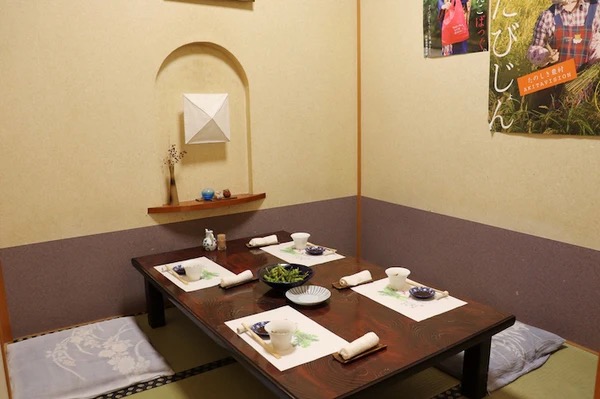
Some hotels in Japan may offer a choice of Western or traditional Japanese rooms. However even if you prefer a Western room, there may not be one available that night. A Western room is what we would term a regular hotel room: beds, carpeting, a desk and chair, etc. Japanese rooms are what you might find in a traditional Japanese home as in the picture above: futons not beds, a low table called a zataku rather than desk, legless chairs called zaisu for the low table, sliding washi paper doors to enclose the main room, and perhaps a separate sitting area with regular chairs and small table (hiroen). There is always an alcove (tokonoma) with decoration, often a scroll or painting. Hotels catering to business travelers often have Western rooms; resort hotels may have only Japanese rooms or maybe just a few Western rooms. Ryokans usually do not have Western rooms, which means that you will be sleeping on a futon rather than a bed. A futon is similar to a mattress but much thinner and consisting of dense batting.

Futons with comforters on tatami floor

Futons are kept in a closet and put out by the staff while you’re at dinner. They are then stowed in the closet the next day. You won’t be able to lounge on your futon during the day since it won’t be out when you arrive. You’ll either have to sit at the low table or in the sitting area. If you expect to get “work” done on your laptop, there isn’t a convenient desk to use and you’ll have to make do with the small or low table or your lap. Because futons are thinner and denser than a mattress and there are no springs, they feel quite different. Some futons are thinner than others and they may feel hard to you. Your back may or may not like sleeping on a futon. On thinner futons your hip, shoulder, or lower back bones may be uncomfortable due to the minimal cushioning. If your futon is just too hard, you can try taking a spare futon from the closet and stacking two (or three) together to make it softer. Traditional Japanese futon pillows are smaller, denser, and less comfortable than the foam or down pillows we’re used to. They are stuffed with buckwheat hulls usually. If you find them uncomfortable, you can stuff some of your clothing in a sack to use instead. Also getting up from a futon takes more effort than a bed since you’re on the floor—you can’t just slide your legs off the bed and rise. If you’re next to the low table, which is moved by the staff from the center of the room to the side when they make up your futon, you can brace yourself against it to help getting up. Some ryokans have a piece of small furniture that looks like a freestanding armrest for a zaisu. This is intended to help you get up from the floor. Finally, futons have comforters, which you will welcome in cold weather but can be too hot in warmer weather (well, at least for me).

Japanese rooms have tatami flooring so you’ll need to remove all shoes while in your room; it is very rude to walk on tatami with footwear of any kind as it soils and degrades it. So you are either barefooted or in socks while in your room. In Japan cleanliness is highly valued.

In some ryokan or minshuku (small, private guesthouses) there may not be a private bathroom. The toilets and sinks may be in a common area. If you’re in the habit of waking in the middle of the night to use the bathroom, you may find this inconvenient. But many have en suite toilets. Ryokans with an onsen may omit a private bath/shower in which case you’ll have to use the onsen to shower up at the end of the day’s ride.

Bathrooms.
Bathrooms run the gamut at inns in Japan. A lot of hotels with Western rooms have all-in-one bathrooms, i.e. bathrooms that look manufactured as one whole unit and then retrofitted to a hotel room. In actuality these hotels are certainly new enough that rooms were constructed with a bathroom in mind and I guess a smart manufacturer must be building them specifically for hotels trying to minimize the square footage in the hotel room. These bathrooms are typical Western bathrooms just smaller. They contain a sink, toilet, and bathtub/shower. Everything is tightly squeezed in. Showers sometimes have no curtain; this isn’t too surprising because showering/cleaning in an onsen there are no curtains or barriers to contain the spray. Some bathrooms that have no tub and you just shower on the floor, which has a drain. These bathrooms always have a stool and a bucket, which is what you’ll find in an onsen. Some hotels and ryokans have separate rooms for the toilet and the bath/shower not unlike what you’d find in old Victorian flats in San Francisco. At ryokans these toilet rooms often have toilet room slippers, i.e. slippers left in the toilet room and used only while you’re in there. They are always a different color than the slippers provided in the room and to make things glaringly clear they are marked “Toilet” for the ignorant Westerners. Since in a traditional Japanese room with tatami flooring you’ll be padding about in either bare feet or socks, toilet slippers make sense in order not to soil the rest of the room.

Toilets.
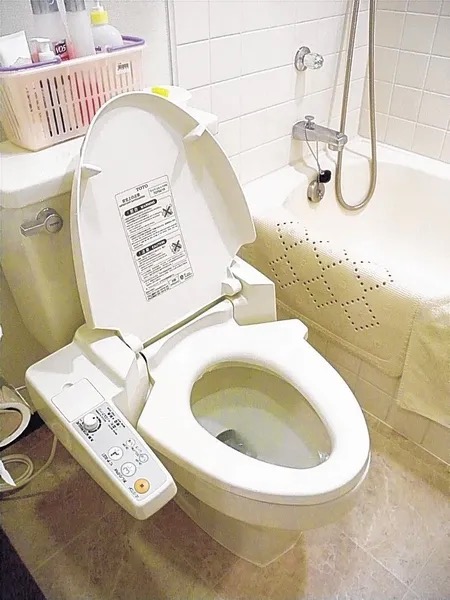
Toilets in Japan are similar to bidets; there have an electric powered water jet to wash your bottom and then blow dry it; toilet seats are often electrically heated. If you are not familiar with the style of toilet, you’re in for a surprise if you accidentally activate it! Because the control panel and/or remote control is in Japanese, it can be very intimidating for the novice and you’ll probably avoid using it. However use Google Translate to decipher them or see this link and this link. And yes, there is toilet paper too. Japan also has “squat” toilets similar to what you’ll elsewhere in the world but these are never in hotels or ryokans. Some restaurants and bars still have squat toilets; some public toilets are squat but the number seems to be decreasing as they are replaced by newer toilets.

Like much of the rest of the world, you won’t find plush terrycloth towels in Japanese inns (but some high end hotels do have them). In my experience Japanese towels are adequate although sometimes they’re a little smaller than in the US. If the hotel or ryokan has an onsen you will find towels in the closet or armoire in your room rather than the bathroom, one large towel and one small one for each person. These are to be used at the onsen and brought back to the room.

Typical Japanese toilet

In ryokans your room will often include either an electric teapot or a carafe of hot water for you to make green tea, which is kept in a container on the zataku. (Sometimes they are placed in the tokonoma.)

Screenshot

Yukata.
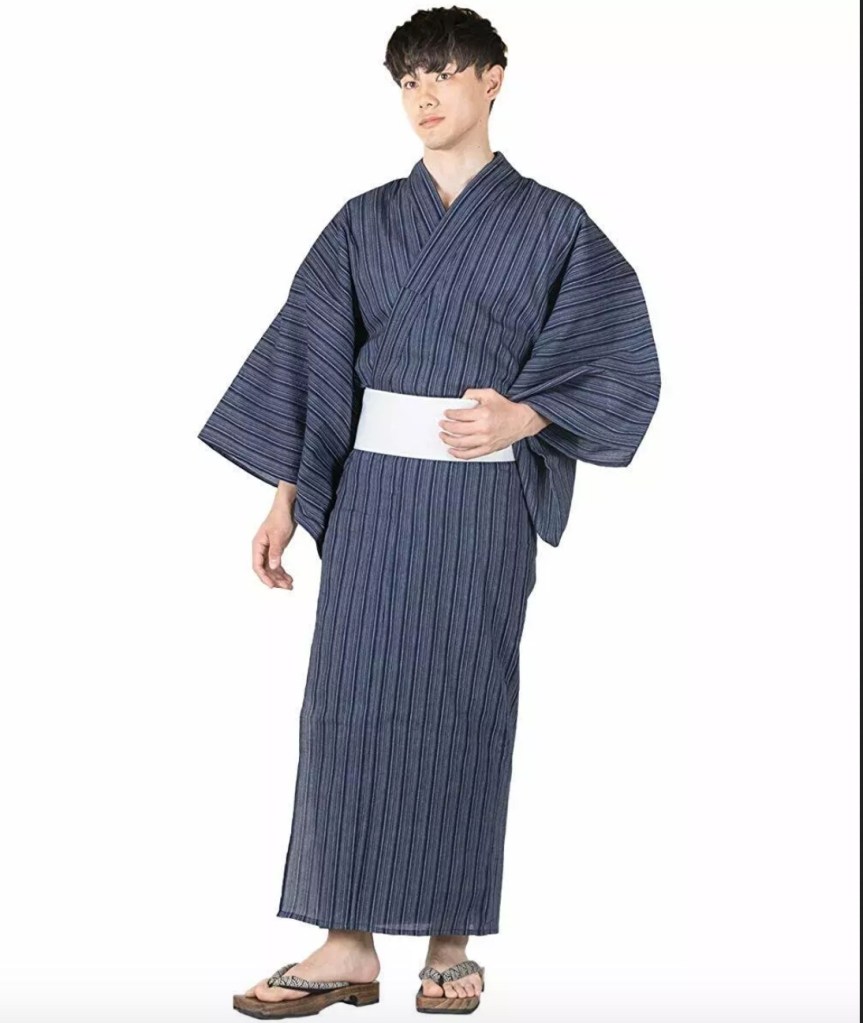
Ryokans and most hotels include yukata robes. Usually they are in the room when you arrive. However at larger onsen hotels, i.e. you may have to select your size yukata in the lobby. A yukata is a floor length robe with a sash that you wrap around your waist (twice) to hold the robe in place. The proper way to dress yourself is to put the right side of the robe under the left and then wrap and tie the sash to the right. (Note that putting the right side over the left is only done for the deceased.) In colder weather there is a jacket you may put over the yukata. Yukata resemble bathrobes but their function is for casual lounging of any sort. Walking around the premises and even on the street in a yukata—especially if it’s a hot springs town—is accepted. Going to your meal in the hotel or ryokan in a yukata is common. Yukata come in different sizes, usually small, medium, and large; if the one in your room doesn’t fit, you’ll have to ask at reception for a different size although some places have only one size. If you don’t select a yukata in the lobby, it will then be in the closet along with any things needed at the onsen (if there is one). You can find more detailed information at this link.

Slippers are at the entrance of the ryokan but in hotels you will find them in your room. You don’t wear your regular slippers in the toilet room (nor in a Japanese room at all!) nor go in barefooted. Use the toilet slippers. If the toilets are down the hall, you’ll always find toilet slippers there for your use. Slippers in ryokans and hotels tend to be on the small side for Americans males. If you’re a size 10 or above, you should plan to pack your own slippers or flipflops unless you enjoy cartoonishly clomping along in tiny slippers. You can probably walk around in your socks or barefooted in the ryokan although I must admit that I have never seen Japanese do this. In hotels you are allowed to wear shoes even into your room unless it has tatami mat floors. But even in hotel rooms without tatami you will find slippers in your room for your use. Ryokans are another story. I have yet to stay at a ryokan or minshuku that allowed street shoes or cycling shoes to be worn indoors. When you arrive you’ll find slippers at the front door. Usually there is a step or two up to the ryokan floor and that’s where you are expected to take off your street shoes or cycling shoes and leave them there. There is usually an area with cubby holes to park your shoes for your stay; there is absolutely no reason to bring your cycling shoes into your room. If you plan to change into street shoes to go explore the area or head to a konbini, you should bring them to the front door and change into them there and leave them there when you return.

Onsen.
Onsen are hot spring baths and Japan being a country with a lot of volcanic activity they can be found everywhere. There are onsen towns, destinations where Japanese people go specifically to take the baths. Hotels and ryokans can have onsen facilities too as hot spring water is often piped into the buildings. What we typically think of as hot springs in the US are not the same as onsen, as the former are usually not developed and are almost always outdoors in remote areas. Onsen are usually quite developed as the volcanic water is tapped and piped into facilities throughout an onsen town. Onsen can be indoor or outdoor but are usually indoor. Whereas a hot springs is considered an unusual luxury in the US, onsen are quite common and a big part of Japanese culture. This isn’t too surprising as baths were public faciliies for most of Japan’s history. Onsen have separate bathing areas for men and women. This is because you are expected to be naked in the onsen. Do not wear swim clothes in the onsen! If you’re uncomfortable being in public naked, onsen are not for you (which is a problem if your ryokan doesn’t have en suite showers.) There are typically set hours when you can use the onsen. They are closed for cleaning every day.

There is a whole ritual for using the onsen that I won’t explain in detail. But after disrobing and storing your clothing, room key, etc. you enter a bathing area adjacent to the hot water. You are expected to clean yourself well before you enter the pools. Going directly in the hot pools without bathing is deeply frowned upon (and yet I have seen Japanese do it!). Typically you clean yourself on a stool in an open stall; there might be a standing shower also. There is a bucket you fill with water to rinse yourself after soaping up. But I just use the hose from the tap to rinse. This is not an area where you horse around (also frowned upon). A more detailed explanation can be found at this link. After cleaning up you can enter the pool(s). If there is one pool it will be somewhere around 104-108F; multiple pools will have different temperatures. In my experience the pools are all tiled nicely, shallow, and some have steps you can sit on. Keep in mind the water is hot spring water so it will have almost always have a distinct mineral smell. The pools are not deep—they aren’t for swimming or even full immersion: when sitting on the bottom your head is above water. The idea isn’t to immerse yourself fully—keep your head above water. You spend as much time as you want in the pool(s) and then usually you get out, rinse off, and towel off before you leave the bathing area to get dressed. Your onsen ‘kit’ will include a small towel, about dishrag size or smaller. This you can use to wash yourself and “dry” yourself before leaving the pool area for the dressing room. When you get in the pool you place this small towel on top of your head for “storage” (or so I am told).

Using the onsen after a day’s ride is a great way to warm up if it’s been chilly or raining and they really help you recover from the ride in addition to helping you relax. A beer afterwards probably helps too! (You should not drink alcohol before entering the onsen.)

Won’t be allowed in onsen!

One thing you should know about onsen: tattoos are often forbidden. If you’re heavily inked this is potentially a problem and you should ask the guides or staff at the onsen. This is perhaps more an issue at a public onsen than at a private onsen at your accommodation. Tattoos are frowned upon at onsen because of the association of ornate tattoos with membership in a yakuza, Japanese crime syndicates.

If you’re at an onsen town (as opposed to an onsen that is part of your accommodation), you’ll have to walk to the onsen and pay a small fee to use the onsen unless the fee is already part of the tour. You’ll probably walk there in your yukata along with the towel and small towel from your room.

Heating and cooling.
Japan can be very cold in the winter and very hot and humid in summer, which incidentally make spring and autumn the more comfortable times to do a cycling tour. Japan doesn’t have a native source of oil or gas for energy and relies completely on imported oil. The other major source of electricity is nuclear power. Consequently Japan tends to be parsimonious in consuming electricity, so for heating and cooling you’ll find minisplit units, i.e. ductless heat pumps, which are very efficient. There will either be a remote control or a wall mounted control that you’ll have to set for heating, cooling, or just fan as well as the temperature you prefer and sometimes a timer. Of course it’s all in Japanese, so in order to know what you’re doing you’ll either have to read Japanese or use Google Translate to decode the text on the control. Here is a link with a detailed explanation.

Kerosene is also used for room heating in Japan. This is mainly at private homes. But if you stay at a private home such as in Shirakawa-go, you may encounter them. They put out a lot of heat but they also have that kerosene odor. Worse they can emit a huge amount of CO2 into your room.

Electrical outlets.
Outlets in Japan take the same two-prong plugs as in the US (although they are 100 volt, not 120 and 50 cycle, not 60). If you are bringing devices that have a three-prong plug, you’ll want bring an adaptor. Depending on the age of the accommodation you may or may not have sufficient outlets in your room. Older ryokans may have just one wall outlet in the room so you may want to bring along an extension cord with multiple outlets just in case.

WiFi.
I have yet to stay at a hotel or ryokan in Japan that did not have WiFi. Cell coverage in Japan is quite good, comparable to France’s (i.e. there are no dead zones) so you can also use your phone even in remote areas. In older hotels you will probably find an Ethernet connection (!) at the desk in your room. USB outlets? You’ll find them in newer hotels but probably not anywhere else so bring a hub if you’ve got lots of devices to charge.

Laundry.
Laundry is always a chore when you’re cycle touring. If you’re doing a short trip—a few days—it might be possible to carry a fresh set of cycling clothes for each day. For a longer tour, say over a week, your limited luggage is going to dictate how much clothes you dare to bring. Keep in mind that you’ll often need to bring additional cycling clothes for rainy weather or if you expect to encounter chilly conditions. Experienced cycle tourists generally plan to wash their clothes in the bathroom sink/shower/tub when they arrive at the destination hotel/inn and hope that it dries out by the next day. A rotation of three sets of bottoms and jerseys will usually do. You’ll always have a clean set in case you can’t do your laundry one day due to lack of a private bathroom, late arrival, early dinner, or just being too tired. There are a bunch of tips for handling laundry while on tour that I won’t go into here. But briefly having a clothes hanging cord such as Rick Steve’s, carrying laundry detergent such as Woolite, and knowing how to get as much water out of your clothes so it will dry quickly are the main ones. Clothes hangers? There may be enough to hang your washed cycling clothes on but don’t count on it–hang it in the bathroom on on the little rack in your room if your lodging has an onsen.

Japan has one convenience that beats touring in Europe: washing machines and dryers are common in hotels. In our experience practically every hotel (but not ryokan) has a coin laundry room that guests are welcome to use. Many have machines that will automatically dispense detergent. This is a real boon when you’re touring because instead of having a burdensome chore to do when you arrive at the hotel when you’re tired and/or hungry or have already had that post-ride biru (beer) or two, you can just dump your clothes in the washing machine for about 200 Yen (about $1.25) and retrieve it later. It’s worth every yen for the convenience! We’ve seen top loaders and front loaders in hotels but even the top loaders seem to have a high speed spin to remove as much water as possible. This makes drying even faster. You can then hang your clothes in your room or throw it in the dryer for another 100 Yen or so to make sure it’s dry by morning. You won’t need to do too much deciphering of the Japanese text because the operation of the machines is so simple. Use Google Translate if you’re not sure if detergent will be dispensed automatically. (If you see a detergent for sale in the laundry room, that’s a clue!) For travel we bring a few detergent pods we can throw into a washing machine if we need to.

Convenience machines.
Japan is the land of vending machines. There are vending machines for drinks everywhere on the street including in the middle of nowhere in the rural areas. This is also true in hotels. There is usually a vending machine area in hotels not just for juice and soft drinks but also electrolyte beverages (‘Pocari Sweat’!), hot coffee, cold coffee drinks, and green tea. Often hotels have filtered water dispensers, ice machines, hot coffee or espresso machines, and ice cream chests, and even a popular probiotic, Yakult. At hotels with onsens you may see machines dispensing beer outside the onsen. There is one other common convenience machine: a microwave oven. If you head to a nearby konbini (convenience store), you can get plenty of food items that you can heat up in the hotel microwave including soup, noodles, fried food, food bowls, etc. (Most konbini can microwave your food for you also.)

Bicycle Parking. If you’re on an organized tour, the guides will have it sorted out where you park your bike. This is the time to let the guides know—if you haven’t already—that you’re having a problem with your bike such as wonky shifting, noise, worn brakes, etc. Theft in Japan is much rarer than in the US especially bicycle theft. In general it’s usually safe to leave your bike unattended if you’re visiting a site such as a shrine, going into a store, or stopping to get a meal. That said at night I’ve noticed that our group’s bikes are cabled together if they are left in front of the hotel or ryokan in a larger city.

Cycle Touring in Japan, Part 3: Food

Joe McClinton, a former Spoker who is fluent in Italian and who has led bike tours in Italy, told me before I went to Italy to cycle for the first time in 2000, “So-called Italian food here is very different from what you’ll be eating in Italy.” At the time I didn’t understand what he said but it turned out he was right—what we get here is really Italian-American food, i.e. something derived from southern Italy that has been modified because immigrants couldn’t get the same ingredients here then modified again in restaurants for the American palate. The same goes for Japanese food: what we get here is just a subset of what you’ll get there and it’s different anyway. The number of food items and dishes we’ve eaten there that I’ve never ever encountered in the Bay Area is very high. Yes, you can get sushi and sashimi here and nowadays you can even get fresh ramen, which has recently become popular. But the variety of fish from which they are derived is much more diverse. Speaking of which, if you don’t like seafood you may have a difficult time eating in Japan. Seafood whether it be the myriad types of fish, crustaceans, or mollusks is found everywhere and various kinds of seaweed are eaten all the time. In fact dashi, the broth used throughout Japanese cooking is made from bonito tuna and seaweed. Common kinds of seafood eaten regularly in Japan include sea snails, octopus, and eel, which we rarely see here even in Japanese restaurants.

This isn’t to say that meat is uncommon—it’s not. Wagyu and Kobe beef are famous and everybody loves fried chicken, karaage. KFC has had great success in Japan because fried chicken is so loved. At Christmas time—yes, the Japanese celebrate Christmas even though they’re not Christians—people line up to order their bucket of KFC and Christmas cake, which often runs out if you don’t reserve in advance. But the proportion of food that is ocean derived is very high compared to the US.

If you’re vegan or vegetarian, be prepared to have a more difficult time in Japan. Buddhist cuisine, which is vegan (mostly), can be found at the temples but there are very few restaurants in that niche and they’re usually in the big cities. Animal derived food products are ubiquitous from dashi, which is made from bonito tuna, to sauces made from fermented fish., and ramen soup broth made from pork bones. Although tofu is readily available, you may not find that in some restaurants. And much of the time it’s opaque exactly what ingredients were used in a dish. Another complication is that where Japanese Buddhists draw the line is different from vegans: many Buddhists consume dairy since they believe that no killing is involved in obtaining milk and animals produce milk to feed their young. If you strictly vegan, then you will need to look for places that serve shojin ryori, or Buddhist cuisine, which is mainly at temples.

If you’re avoiding gluten, Japan is a really tough place. Although the prevalent grain products are rice and buckwheat, there are many common foods that contain gluten such as soy sauce and miso. Food package information is in Japanese and deciphering it for gluten is sometimes completely opaque.

When it comes to eating out in restaurants, you’ll often find that restaurants offer just one ‘type’ of food—ramen restaurants serve just ramen (but sometimes soba or udon too); sushi restaurants serve just sushi. When you’re out in the countryside you may have no idea what a place is serving unless they have pictures or it’s obvious when you look at the kitchen or what other patrons are eating. If they have a menu, you can use Google Translate to decipher the text.

Low table requiring sitting crosslegged or seiza style: not for the inflexible

On Cycling Japan tours most of the dinners are included, usually at the hotel or ryokan. But sometimes we are taken out to a restaurant and even on free nights we would occasionally go with the guides to a recommended venue. Their choice in eating establishments is always excellent, places that we would never find by ourselves. In traditonal restaurants it’s not uncommon to be seated at a low table rather than a standard height table and the flooring is often tatami so you’ll have to remove your shoes when you enter the restaurant. You will need to be flexible too in order to sit seiza or crosslegged on a cushion. Sometimes you can get a low chair or stool to sit if you’re not flexible enough to sit on the floor but depending on the number of westerners—and it’s always westerners who request the chairs!—there may not be one available.

Low table but inset for legs for “normal” posture

Some places you may be seated at a low table but there is a hollow space underneath for you to put your legs and sit in a normal position. Then you only need to be flexible enough to get your legs under the table and later out from under. At hotels this isn’t an issue because they always have standard height tables and chairs for everyone.

What’s for breakfast?

Traditional breakfasts in Japan are quite different than here. Expect to get fish of some kind, white rice, and miso soup. In many hotels you’ll see a mixture of traditional and western foods although they may not be exactly what you eat at home. For example there is a traditional egg omelot (tamagoyaki) but it’s made with sugar and dashi in a square pan and folded into a roll; there are no fillings. You may see what look to be hard boiled eggs in a bowl; they’re not—they’re uncooked. Breaking a raw egg and putting it on a bowl of rice is common. (Eggs in Japan undergo inspection and cleaning to reduce the chance of salmonella contamination.)

Common breakfast food: natto over white rice

A traditional breakfast food is natto, fermented soy beans that have a very gooey texture served on rice; it’s definitely an acquired taste! Don’t expect toast, bacon or sausages, or pancakes. Cereal is rare except for cooked rice. Yogurt is sometimes available but don’t count on it. Hotels generally serve some western breakfast foods e.g. scrambled eggs and may have bread or rolls. A change we’ve noticed over the years is that coffee is more available; at ryokans it’s usually green tea for a hot drink. In hotels it’s not uncommon to have a green salad available at breakfast. It’s rare to have salad at dinner. For me that’s great because I love salad at any time of the day! I’ve been surprised at the paucity of vegetables served at any meal. Vegetables are served but they are in small quantities. One change in Japan is that coffee has become increasingly popular and available although this is rarer at ryokans than at hotels.

If you have difficulty stomaching a Japanese breakfast—fish or natto first thing in the morning can be a bit much—you can plan either to buy something ahead of time at a konbini or else pack something from home to eat instead. Of course you don’t do that at the table where you’re being served as that would be rude. Roger brings instant oatmeal that he makes in the room with the electric teapot or hot water.

There are always some vegetables but the quantity is quite small compared to what I’m used to eating. Like the American diet in Japan people prefer carbs (rice or noodles) and protein (seafood or meat) with vegetables mainly being window dressing. This can be quite different from a traditional rural meal, which is vegetable rich. But modern life has come to Japan too.

Whole grain products are rare, or at least I’ve never seen them. All rice except at perhaps some western oriented restaurants in Tokyo is white. Although bread was originally brought to Japan from the West, it’s found everywhere in Japan. But finding whole wheat bread is difficult.

Desserts and sweets are ubiquitous but apparently the Japanese palate is different as they are almost always less sweet than they are here. But I think that’s a good thing because the higher level of sweetness overwhelms the flavors of the dessert, which are often delicate. Although you may not be served ice cream at a restaurant or ryokan, it’s found everywhere in Japan especially soft-serve ice cream and a variety of Magnum-type ice cream bars at convenience stores and markets.

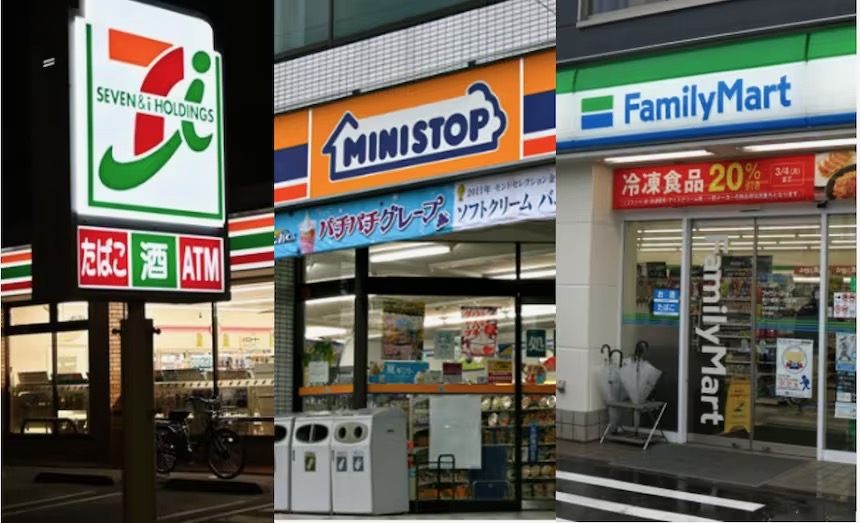
7-11, Ministop, Family Mart: some konbini

Speaking of convenience stores, called konbini in Japan, it’s on a completely different level. First, they’re everywhere and lots of them. If you’ve been to Hawaii you’ve noticed that there are ABC stores on practically every other block. That’s what it’s like in towns in Japan. There is fierce competition between stores. You’ll see 7-11, Family Mart, Lawson, Circle K, Yamazaki, and Ministop. Second, these small stores are stocked with items we could only dream of here; they have a little of everything from household cleaning products, clothing(!), toiletries, stationary as well as a huge variety of foods. They’re like mini-Targets. Konbini like convenience stores here stock a variety of beverages and snacks. But in Japan they always sell hot food—croquettes, fried chicken, skewered meat—as well as an enormous variety of packaged sandwiches, salads, pastries, onigiri(rice balls), sushi, and a shit ton of Japanese prepared foods you never see over here. They also have a variety of plates or bowls of food that just need to be warmed up for a meal such as noodles, rice bowls, soups, gyoza. You can put together a full meal there! If you’re wanting a quick meal and don’t want to go into a restaurant, these stores are the solution. Occasionally you’ll find fresh fruit but fruit is mostly precut in sealed plastic cups. At checkout you’ll always get asked (a) do you need a bag (10 Yen additional cost)? and/or (b) do you want that heated (if you’ve bought something microwavable)? They usually throw in hashi (chopsticks) or a spoon if they see you’re buying something that needs one or the other. Some konbini cashiers do not handle your cash and instead your total payment due is displayed on a screen and you feed your cash payment into the machine. Then it dispenses any difference you’re owed. You’re always given a paper receipt on checking out.

Until the ill-fated 2020 Olympics in Japan the only places you could get Japanese cash was either the post office or…7-11! Japan is still primarily a cash-based culture and credit card use is much lower than here. Consequently many businesses do not accept credit or debit cards and you must pay in cash. This is especially true outside of big cities. Since 7-11 like most konbini was open at most hours, it is the most convenient place to go to get money. With the Olympics Japan expected an influx of foreign visitors who would need cash and the government liberalized the use of ATMs allowing currency exchange. Now other konbini chains have ATM machines and you’ll be able to get cash more easily. In order to use your card you’ll need to have set up your debit card with a PIN if you haven’t already (and notified your bank that you’re going to Japan.) If you’re at a restaurant or konbini, be sure you have sufficient cash. By the way, there is no tipping in restaurants. If you leave change on your table, you’re likely to find the staff chasing after you to give it back.

Although public toilets in Japan are more common than here, konbini are also places that offer public toilets.

Foreign food. As you know Japan has an incredibly deep and sophisticated food culture and it has benefited from contact with other cultures. Noodles almost certainly came from China originally just as was the case in Europe. Some foods from elsewhere somehow strike a chord in Japan and they become adopted and often transformed. A oft-cited and to us strange example is spaghetti napolitano. This so-called Italian dish is actually from contact with the US post-WW2. This dish is noodles with a ‘tomato’ sauce made from ketchup. Like the British, Japanese seem to prefer their bread without any crust, so you’ll get sandwiches with the crust completely removed. Speaking of bread, the most common form is milk bread, which resembles Wonder Bread but is tastier. Another interesting transformation is Mont Blanc. Originally from Italy/France this is a delicious chestnut puree served with whipped cream, sometimes made into a meringue. But somehow in Japan this dish now called monburan has been transformed into a cake with chestnut puree or cream. (It’s also very delicious!) Another foreign food that has been completely absorbed into Japanese cuisine is curry. Kare Raisu–curry rice, i.e. white rice with beef, deep fried pork cutlet, chicken, or just vegetables and Japanese curry sauce is ubiquitous. Although the sauce is definitely curry derived, being similar to Madras curry, it’s not what you would get at any Indian/Pakistani restaurant here.

Times for breakfast, lunch, and dinner are similar to the US. On Cycling Japan tours lunches are not included in the tour package but we almost inevitably eat together at a specific spot that the guides have picked out. There are probably several reasons for this and I’ll go into detail in a subsequent post. Lunch usually runs between 500 to 2000 Yen.

A kaiseki dinner example

Dinners at hotels and ryokans. These are almost always kaiseki dinners (at large hotel/resorts you may have a gigantic buffet). Kaiseki is the Japanese equivalent of formal dining and involves multiple courses anywhere from about 7 or 8 up to about15. Most of the dishes are small, usually a bite or two. Depending on the number most of them will be set at the table when you arrive. Larger kaiseki involves subsequent dishes being brought to the table. Often there is a Sterno cooker or two at your setting where you will heat or cook some of your food yourself. Typically there is sashimi, tempura, a savory egg custard with seafood, Japanese pickled vegetables, soup usually miso, various seafood dishes, various vegetable or seaweed dishes. Rice is often served last unless you ask for it during the meal. Kaiseki meals have amazing variety and no two seem to be the same. Since each dish is on the small side, if there is something you really like, well, that’s all you’re getting for the meal. (There aren’t any seconds except for rice.)

Presentation is paramount in kaiseki so be sure to look at your food before you gobble it down. Although much of the food you’ll be able to figure out, there may be dishes whose ingredient(s) is unfamiliar. The food is inevitably very fresh; seasonality is important in Japanese cuisine so don’t expect to get corn in December. These meals are not dash and dine affairs; expect to linger over dinner.

Alcohol is always available at dinner time usually beer or sake; in Kyushu you may have shochu as well. Shochu is a fortified sake. Sake is like wine in that it’s very local so the sake you may get in one region is completely different than what you’d get elsewhere. This doesn’t seem to be the case with beer, which is always one of the big brands e.g. Kirin, Asahi. Craft beers can be found in the big cities but seem to be absent in the countryside. By the way, drunk driving is taken seriously in Japan. If your BAC is 0.05% or higher, you’re impaired enough to be arrested. That applies to cycling too so alcohol at lunch time is forbidden on tours.

The Road Less Traveled (for now): Wildcat Canyon

Wildcat Canyon: “Alright Mr. DeMille, I’m ready for my close-up.”

Wildcat Canyon has been left to languish after half the road collapsed during a storm in March 2023. The problem is that it’s a county road and there’s been insufficient money to do a repair. Federal money is supposed to be coming to Caltrans and the county had said that construction will begin this spring and maybe be completed by fall. Keep in mind that construction schedules are works of fiction.

But I’m not grumbling about Wildcat being closed for this long. Why? Because it’s been closed to cars, not bikes, and since closure it has been heaven to ride. I wish the county would never repair this road! Initially when it failed everybody diverted to alternate routes including cyclists. Well, one of those alternate routes is Lomas Cantadas/El Toyonal, which goes by our house. For about a week there were cyclists(and cars) thronging the road. This road, if you don’t know, is part of the Berkeley Hills Death Ride and for good reason: it’s 3.5 miles long and most of it is 10+% grade with significant chunks above 12% and a maximum of about 18% in at least two locations. So most cyclists don’t like to ride up the road. The only other nearby alternate route is to use Highway 24. (Yes, cyclists may ride on the shoulder of 24 from Orinda to Fish Ranch Road.) Then someone realized that the road failure on Wildcat left just enough roadway for bikes to get by and no one was doing any enforcement. All the bike traffic has since returned to Wildcat. A day or two after the collapse I rode out Old El Toyonal to take a look at the closure, went by the barriers (my bad), and saw that about half the road was still in place. The only hassle was having to lift your bike to go around the K barrier at the bottom. Sometime after the initial closure the K barriers and obstructive fencing were moved to make it easy for bikes (and motorcycles) to get by.

Since then Wildcat has become a sanctuary of peace and quiet. Prior to the closure Wildcat was a cut-through for cars wanting to avoid the Eastshore Highway (i.e. I-80 by Berkeley), the jam on I-580, and the back up on 24 up to the Caldecott Tunnel. If you made the mistake of cycling on Wildcat during a commute period, you were in for a series of close passes some on blind curves or the impatient driver sitting right on your ass telegraphing the message that if you didn’t get out of his way right now you were going to get fucked. Because it’s curvy just like Redwood Road, it’s also a casual speedway for sports cars and motos. For now it’s our private Idaho. Although not exactly: motos ignore the closure signs and routinely take Wildcat now that the K barriers have been moved and even some cars are still using the road from Inspiration point to Old El Toyonal. The latter are probably associated with the Orinda Horse Association, which has its stables right at the turnoff to Old El Toyonal. It’s unnerving to be blasting down Wildcat and suddenly come upon a car!

Despite being “abandoned” Wildcat is kept in shockingly good condition. Initially debris from the dense oak tree cover just rained down on the road willynilly with no car traffic to push it out of the way. Riding it was a bit of an obstacle course but nothing compared to Planet of the Apes or even Old Scenic Road to Martinez before it was reopened. Has a sweeper been run on Wildcat during the closure? I haven’t seen one but I have no other explanation for why it isn’t knee deep in debris. Some regular upkeep must be going on even if it’s a “closed” road. Recent storms knocked down some old oaks on the road and they’ve been quickly and mysteriously cut up and moved to the side. Nonetheless you still have to be attentive to random tree branches on the road as well as the copious piles of horse manure deposited by the OHA members, who no longer have to cling to the narrow dirt shoulder and can use the road full-on (until they encounter a moto or a car).

Riding Wildcat is almost like being on a BLM road except that it’s paved. Without the roar of cars it’s like being in a forest all by yourself except for the occasional fellow cyclist. The old oaks turn the road into a tunnel of sorts although you can look to the east and peek through the trees to catch a glimpse of Briones Reservoir and the hills surrounding all that EBMUD land, which since the December storms are now approaching peak green.

For bicyclists Wildcat is a significant paved road to get between Berkeley and Contra Costa. Those on the other side take Wildcat to do the Three Bears or head further afield east to Diablo or south to Pinehurst. It’s part of the Pinehurst Loop that goes up Pinehurst, Skyline, Grizzly Peak, and back to Orinda. If you’ve done the Fall Social ride, you’ve taken Wildcat from Phil’s up to Inspiration Point and dropped down to do the Three Bears and then returned the same way. It’s a nice, fast descent and the way back to Berkeley is a challenging climb sure to burn your legs and lungs but without the scary steep grades you’d find on 24 or El Toyonal.

These days I’ve been enjoying Wildcat a bit differently. I’ve been riding my mountain bike up El Toyonal and then dropping down Old El Toyonal to Wildcat and up to Inspiration Point. Then I head onto the Nimitz Trail in Tilden Park. It’s a short ride between eight and fifteen miles depending on how far I head out the Nimitz. It’s a good ride for clearing out my head since it’s peaceful and quiet and with essentially no traffic and it doesn’t take long to do the ride. If you don’t live near Wildcat, you obviously can’t avail yourself so easily of its tranquility. Of course having to travel to Wildcat from further away, e.g. San Francisco, would defeat the purpose in that you’re dealing with all the hassles of transiting to Wildcat and probably losing more repose than you’re gaining.

In the meantime Wildcat is still closed but perhaps not for very long. If we are lucky, it will still be shut for the Fall Social next October. But for now I’m taking advantage of this boon from nature.

Wildcat Canyon Road post collapse March 2023

Cycle Touring in Japan, Part 2

Our tour was not self-supported by any means. (For more information about self-supported touring in Japan, speak to David Shiver or Phil Bokovoy.) There are several companies in Japan that provide supported cycling tours. These are usually van supported tour so one’s luggage is hauled from stop to stop and varying degrees of on-road support are offered. We’re lazy so we have opted for package tours that have specific itineraries, van support, and all hotel/inn bookings handled by the tour company. In addition the company we have used, Cycling Japan, which by the way is Japanese owned and run, can provide rental bikes both regular or e-bikes (along with spare batteries if you burn through one during the day). They provide road bikes, hybrids, or touring bikes depending on your preference and they set them up according to your measurements.

Whether to bring your own bike or rent one. Taking your personal bike overseas is an undertaking unto itself. If you take your own bike, you will have to haul it in addition to your other luggage. Airlines have gone back and forth on whether to charge for bikes as oversize luggage; check airlines for the latest policy. If you plan to do any additional traveling while you are overseas after your tour, you will either have to find a way to stash your bike such as left luggage or you’ll end up hauling it with you even though you don’t need it. Sometimes it is possible to ship your bike to your start destination. If so, you need assurance that it will not only arrive intact but on time. (The same goes for flying with your bike. Airlines lose bikes occasionally and yours may not arrive on time.) If you want to use your e-bike, you will not be allowed to pack the lithium battery packs in your stowed luggage—it’s illegal. You will then have to take it with you into the cabin and there are limitations on the battery size and the number of batteries that can be brought onboard.

Renting a bike means you’ll shed the burden of packing, hauling, and unpacking your bike. But you may get a rental bike that is not to your satisfaction. When you take your own bike, you have a bike you’re familiar with and set up just as you want. Since Roger uses e-bikes exclusively, he has to rent one. Before going to Japan I had never rented a bike and had always brought my own touring bike that is kitted out the way I prefer. The first time we went to Japan with Cycling Japan I decided to try a rental because it would make the travel logistics so much easier not to lug a bike around. I’ve been fairly satisfied with their bikes even if they are more modest—but not always!—than what I would ride at home. Cycling Japan does a good job of fitting the bikes after you arrive. The other major positive is that since we are renting the bikes from the tour company, they assume the responsibility for maintaining the bikes while on tour whether that be providing fully charged battery packs, repairing flats (!), or fixing something major. On our first tour in 2016 my rental bike bottom bracket failed just before lunch one day; Kenichi swapped it out for a new one during lunch. Yes, they carry spares of everything including a fully functional road bike just in case someone’s needs repair that can’t be done immediately! Another time my freehub died just as we arrived at a ferry port. While waiting, Dai tried to fix it but couldn’t. (The pawls turned out to be shot.) So he just swapped in a spare rear wheel. If these incidents had happened with my own touring bike, I would have had to hunt for a bike shop to do the repairs. (Do not delude yourself thinking that nothing wrong can happen with your own, carefully maintained bike. We’ve seen broken derailleurs, shot shifters, broken saddles, broken seatposts, you name it, on other people’s “carefully maintained” bicycles.) If you do bring your own bike, at least have it tuned up or checked over by a pro (= not you) before you pack it.

The fitting adjustments are done on the first day of the tour, which is a non-riding day. I’ve learned over subsequent trips exactly what else I need to bring to Japan to make my rental bike work better. You are encouraged to bring your own saddle and pedals since those are highly personal contact points on the bike. Cycling Japan’s bikes have front and rear lights. But I bring more powerful lights because of the tunnels as well as a bell to use when I’m dealing with traffic. Although they provide a large rear saddle bag, I also bring a handlebar bag to carry my camera, snack food, supplies, as well as an additional place to stow clothing. By the way, in Japan brakes are set up English style, i.e. the left hand brake lever controls the rear brake and the right hand lever controls the front brake. This is the reverse of what we’re used to.

An advantage of a package tour is you’re relieved of making a lot of decisions such as where to stay, where to eat, and how far to ride or which road to take and all the associated research involved in making those decisions. Although you may not know the nittygritty details in advance, you do know the general architecture of each day and have an idea of how easy or challenging the route will be as well as the sights you might see along the way. The disadvantage is that you’re also limited to a set route and spontaneity is severely reduced. If you want to go somewhere else on a day, you’d better be able to figure out a route to your hotel/ryokan for the night! On the other hand you’re availing yourself of the company’s expertise and experience in crafting a rewarding experience. Never underestimate the value of locals’ knowledge. Another disadvantage is that because we are traveling with predominantly English speakers, we tend to cluster together rather than being forced by circumstance to interact with Japanese people. The few opportunities we have been afforded to speak directly with locals have been because they spoke some English; those interactions we cherish. Of course if you speak and understand some Japanese you’ll be able to interact more freely and likely have a much more rewarding experience while on tour. Another disadvantage of a set tour is that you’re on a schedule so even if you’d like to linger longer at a particular town you can’t. Certainly for a first-time visit to an area of Japan a tour is a great introduction and you can in the future plan to go back to explore in more depth the areas that caught your fancy.

A package cycle tour is not like riding at home. At home you can take a day off when you like or skip a day because it’s raining or unpleasantly hot. On most package tours that are point-to-point the best you’re going to be able do is maybe ride in the van. But that may not always be possible. You wake up every morning knowing you’re going to be riding regardless of the weather or how tired you feel. Unlike Northern California most of Japan can be rainy at almost any time of the year. Every tour we’ve done there has had some rain, sometimes very light all the way to torrential, all-day maelstroms. So you’re likely to be riding in the rain at some point whether you like it or not. Regarding weather summer in all but Hokkaido can be insufferably hot and humid. But even Hokkaido is getting hotter in summer due to climate change. The best times to visit Japan to cycle are spring and autumn although winters from Kyushu south to Okinawa are milder than on the northerly islands of Honshu, Shikoku, and Hokkaido and comfortable for touring.

Roads. Roads in Japan are generally in better shape than in the Bay Area. Road maintenance is serious business in Japan. Earthquakes and monsoonal storms do tremendous damage to roads whether it be by landslides, collapses, or overflowing rivers wiping them out. So there always seems to be road maintenance going on. Even in the rural areas road failures seem to be addressed quickly. Whereas county road budgets here always seem to be impoverished, Japanese fund maintenance to the extent that even potholes are rare.

Cycle on the left with traffic.

Vehicles use the left side of the roadway as they do in the UK, Australia, and New Zealand so you’ll be cycling on the left side as well, i.e. close to the left edge of the roadway. This can be initially disorienting for Americans and one can forget which lane to use when turning at intersections—turn left and stay to the left, turn right and also stay to the left! If you use a cycling mirror, you’ll need to switch it to the other side of your helmet/eyeglasses/handlebar in order to see the traffic behind you. Traffic laws as well as general expectations of cycling behavior are slightly different in Japan. For example there is no right/left turn on red: all vehicular traffic waits until there is a green light before turning. Cyclists turning right are expected to make ’square’ turns: wait for the green light, proceed through the intersection to the corner, then wait for the green light before going to the right.

Stop!
Peds only (but often ignored)
Multi-use path.

No surprise: road signage is different in Japan. The main difference is the stop sign; in Japan it’s a red triangle rather than an octagon. But occasionally you’ll see “STOP” on the road surface. Informational signs are mainly in Japanese but city names are usually also in Roman characters. Most other signs are standard. You will also see a sign allowing bicycles to ride on sidewalks as well at not allowing bicycles. But the latter are often ignored as long as you’re respectful of pedestrians.

Because Japan has a very long history its roads are similar to what you’ll find in Europe: an extremely fine and dense network of tertiary roads. These roads are used mainly by locals and local delivery trucks and businesses; people traveling point to point and larger delivery trucks instead stick to the main roads. It is not uncommon to be on a road so isolated and narrow that two cars can barely pass each other—and these are small, narrow Japanese cars! It almost goes without saying that these roads are lovely to ride on. Of course to get to these tertiary roads you inevitably have to take the major roads and many coastline roads are pretty heavily trafficked especially near the bigger cities. Roads in Japan are often narrower than what our Highway Code would require. Lanes are usually narrower and the presence of a reasonable shoulder is hit-and-miss. Bikes are expected to ride on the left edge of the lane if there is no shoulder; the idea of “taking the lane” is indeed foreign in Japan—drivers do not expect you to be in the middle of the lane. That said we’ve had exactly one incident in the thousands of miles we’ve ridden there when a driver seemed so uptight about being behind a line of cyclists that he sped up furiously to pass us even when it was patently unsafe to do so; in other words he did what would be have been matter-of-fact here!

Tunnels are common in Japan.

Tunnels. If you ride in Japan you’re going to be going through tunnels. Along the coast tunnels are cut through bluffs over which no road could be constructed. Given that we’ve cycled on 15%+ grades on coast roads—similar to the rolling hills on the San Mateo coast—that’s saying something. Their benchmark for when it’s too-steep-better-dig-a-tunnel seems a lot higher than here. Tunnels vary in Japan from short galleria like you’d find in the Alps to long and dark with dismal or no lighting. Tunnels are the “short cut” so expect to encounter trucks. No matter how much I tell myself that Japanese drivers are better and more considerate than US drivers I still am unnerved when I hear the roar of a diesel engine behind me in a tunnel. So I’ve made sure to use powerful lights to be seen as well as to see the pavement and warn oncoming traffic of my presence.

Driver behavior. Driving behavior in Japan is unlike anything we have encountered in Europe and certainly here at home: drivers actually observe the speed limit. And the speed limits in Japan are lower than they are here. Typically the speed limit is 60 KPH on arterials and 40 or 30 KPH on ‘residential’ roads. Drivers also are much more patient waiting behind cyclists before making a pass. Turning at red lights is illegal and cars observe this law making it much safer for pedestrians and cyclists. When passing automobile drivers seem to have a good sense of the ‘edges’ of their car and pass with a sufficient gap. Cars and trucks are overall smaller than in the US and even Europe and they’re going more slowly than we are used to.

Cycling on sidewalks is common.

How do locals cycle? Riding a bike on the sidewalk is very common in cities. That said those cyclists are usually running errands and going very slowly (less than 10 MPH). Cyclists occasionally do ‘salmon’ although to a lesser extent than here. We only occasionally have seen Japanese recreational cyclists and that’s usually on a Saturday or Sunday when they have time for a ride. Do Japanese cyclists obey the letter of the law? Nope. They’ll turn at a red light as long as it’s clear. They also cycle ‘salmon’ in cities. But in general they are respectful of car drivers and don’t engage in provocative behavior; in return drivers don’t mete out punishment passes and attempt to terrorize cyclists.