The Sonoma-Marin Area Rapid Transit (SMART) train system is set to launch this spring providing train service for 43 miles between San Rafael and northern Santa Rosa. This system uses the existing rail right-of-way of the Northwestern Pacific Railroad corridor, which parallels Highway 101. The current plan is to open service at no charge until July 4; from July 4 to Labor Day tickets will be half-price; after Labor Day tickets will be full price. SMART is set to use Clipper Card and cost of a ticket depends upon how many zones a passenger traverses, anywhere from $3.50 to $11.50 one way. Trains are planned every half-hour in both directions during the commute period (5-9a, 3-7:30p) with one midday train. Eventually service will be extended southward to the Larkspur Ferry Terminal and northward all the way to Cloverdale.
For bicyclists this is doubly good news. First, a multi-use path adjacent to the train corridor will also open providing a mostly flat highway between San Rafael and the Sonoma County Airport, the current northern end. Entry points to the corridor are unclear at the moment, but one can presume reasonably that there will be numerous access points all along the path. At some point the Richmond-San Rafael bridge bicycle path will be completed and this opens up an interesting ride from the East Bay over to Marin and the SMART corridor.
Second, SMART is planning to run two-car trains (and presumably might add cars as the service need grows) with each two-car train capable of carrying 158 seated passengers, 160 standing passengers, and has space for no more than 24(!) bicycles depending on the number of wheelchairs, stroller, and flip-up seats. I guess we can safely assume that SMART is going to allow bikes on board. This opens up the possibility of some very interesting multimodal bike rides if you don’t want to ride on the SMART multi-use path. For example, without using a car we would be able to ride over to San Rafael, catch the SMART train and take it to Petaluma or Santa Rosa, where there are some beautiful rural roads. After the extension to the Larkspur Ferry Terminal is completed in a couple of years, we will be able to catch a ferry to Larkspur, take the SMART train north, and start a ride.
After SMART opens we’ll be sure to do a few scouting trips and plan some DSSF rides up north that won’t involve using a car.
Our brethren in Los Angeles have redesigned their club jersey. If you’d like to support them while sporting some fashionable duds, then zip over to their website to place an order. DSSC is offering two jersey designs, a limited edition “L’Orange” and an always-fashionable black club jersey. You can get either design in short sleeve, summer short sleeve (a lighter fabric), sleeveless, or summer sleeveless. You can add matching shorts, bib shorts, or performance bib shorts. All are made by Champion Systems in either club cut or race cut. That is a lot of choices! Prices are super reasonable too: only $55 for the short sleeve jersey and $73 for the bib shorts. When they have enough orders for a minimum, they’ll place it with Champion Systems; this is expected to be towards the end of May with delivery in early July. You can either send them a check or use PayPal, but don’t send them payment until you are sent an invoice and that won’t be until they’re real close to placing the order.
Roger and I belong to several cycling clubs including Different Spokes. All of them seem to struggle at one time or another with finding enough people to step forward to fill essential club roles such as producing a newsletter, plan events, do outreach, and lead rides. In the case of Valley Spokesmen and Grizzly Peak Cyclists, both of which are large clubs and put on annual century rides, even finding volunteers for the already organized scut work—making rest stop food, registration, clean up, etc.—has been hard work. Judging by newsletters convincing members to step forward and lead a ride is the most common complaint. Even now Different Spokes has not had an official Ride Coordinator for well over a year (but kudos to David Goldsmith for continuing to field ride waivers despite having given up the position). Fortunately Different Spokes rides are being regularly hosted despite the lack of a taskmaster to prod the membership; unfortunately it’s mainly by the usual suspects (primarily David Gaus, David Goldsmith, Joseph Collins, and me) taking the lead, with other members leading rides less frequently. The four of us are fairly prolific ride hosts so the Different Spokes calendar gets at least minimally populated through the year, and most weekends have at least one club ride.
Why people lead rides is probably due a great deal to personality type—some people want the attention (“All right Mr. DeMille, I’m ready for my close-up!”), some feel the need to give back, and some just need to be in control. I’m not sure which type I am but I do recall that not too long after I joined Different Spokes I didn’t think it was a big step for me to host a ride and I did so. Yet I realize that for some the prospect of hosting a club ride is daunting—maybe it’s the felt responsibility for the group, the feeling that “my rides are all boring—who’d want to do them?”, or the fear that no one would show up. Yes, I’ve hosted rides where no one else showed up, and you know what? I still got to do a great ride, as I often ride alone anyway. And I get to do the ride I want to do!
In the early days of the club there was actually—gasp!— competition in the elections to fill the officer positions. We had real elections, i.e. more than one person vying for the posts! Somewhere around the time Dennis Westler was President (the early ‘90s) competition for club positions waned. Dennis did such a superlative job as President that he was pressed into service year after year until it became a running joke that he was President-for-life and that we had become a ‘banana republic’. Now it’s like pulling teeth to get members to willingly take on the scut work of keeping the club alive and kicking. Besides the dull work of making sure we comply with 501(c)3 rules, we need enthusiastic folks to plan club events, handle communication, assist in running the website, pay bills, maintain the membership database, lead rides, and encourage new members.
Newer members may not realize that the club almost disappeared about 15 years ago. Club participation was declining and there was a proposal to fold Different Spokes into the SF Bicycle Coalition, to become a subgroup. There were enough believers in Different Spokes that the motion was defeated and a small cadre stepped forward to revitalize the club, which it did successfully. We ought to thank Chris Laroussell for stepping into the breach and reinvigorating our club. Chris could be a polarizing figure but she was enthusiastic, truly believed in Different Spokes, and volunteered when no one else would. We’re not exactly in the same situation today but we sure could use an injection of volunteerism from members.
What happened? During a period when both recreational and commuter bicycling are undergoing a resurgence, shouldn’t clubs like Different Spokes be growing by leaps and bounds? But clubs of virtually every persuasion, not just cycling clubs, are dealing with cultural pressures that are depressing engagement: lack of time due to long work schedules, general alienation and numbing, transience, and ever increasing superficiality in human interactions. With more acceptance of homosexuality in the Bay Area perhaps the pressure for LGBT folks to flock together has diminished. This is the post-gay hypothesis: LGBT folks are accepted ‘enough’ that we no longer are ghettoized or have to self-ghettoize for physical and psychological survival. A quick perusal of the media shows that despite having a lot of straight allies these days LGBT folks are still getting bashed physically and verbally, so I personally don’t believe we’re post-gay yet. “Religious freedom”, anyone? But it is easier than ever for LGBT cyclists to join a mainstream cycling club and at least not get overt flak if not downright acceptance. Grizzly Peak Cyclists is a fine example; Not only does the club have a large number of women members but lesbians and straight women seem to mingle concordantly.
My suspicion is that many LGBT clubs that were founded in the ‘70s and ‘80s have had a hard time maintaining membership and vibrant involvement. But I don’t think in Different Spokes’s case it is simply the membership aging out; our demographic doesn’t seem to be relentlessly shifting up much age-wise. Cycling in this country—it is slightly different in the UK and Europe—is such a solitary sport. You can do it by yourself, which is one of its attractions and advantages; you don’t need to field a team, a partner, or reserve a court/tee time/field. You just go out and ride. If LGBT cyclists come to Different Spokes and don’t feel like it’s their cup of tea, it may be a disappointment but it is no big deal to return to riding by oneself. I’m curious how the active members of Different Spokes came to see the club as their club enough to want to invest their energy. Was it a friendly encounter on a club ride, the type of rides we typically offer, a particular social event? There must have been a positive experience to induce folks to want to hang out with the club. Conversely those who sniff out the club and then decide it’s not for them either had a negative experience, realized that the club wasn’t exactly what they thought it was, or they just weren’t impressed and moved on.
Clubs can create energy and enthusiasm that leads to involvement and willingness to volunteer; it’s not just a matter of folks with energy and showing up and leading rides. If the space you create is welcoming, fun, purposive, lacks rancor, and meaningful, then people generally will step forward with little encouragement. People will commit to something they believe in and for which they have hope. Inspiration leads to action.
Today we have the AIDS LifeCycle as the main cycling event that raises money for the San Francisco AIDS Foundation and which involves the participation of literally thousands of riders. But the progenitor of the LifeCycle was the Different Spokes AIDS Bike-A-Thon, which began in 1985, 30 years ago. As I mentioned previously in the ChainLetter blog, just 63 riders completed that ride. They were the ‘pioneers’ of bicycle AIDS fundraising . But who were those riders? I thought that current Spokers might be curious to learn more about some of those first BAT riders. Surprisingly only a few of them were members of Different Spokes. One of those riders was Bob Bolan who, although now living in LA and no longer a Spoker—but an esteemed DSSF emeritus nonetheless—is still avidly riding his bike at age 68 (although not the red Tesch mentioned below; the Tesch died in one of Bob’s hell-bent crashes and he’s currently sporting a Spectrum titanium.) Bob and I got to know each other especially well after we bought and rode a racing tandem in the mid ‘80s and early ‘90s when we routinely terrorized centuries. Bob was and is preternaturally fearless so he captained and I stoked, and that meant all the fear got thrown to the back seat. So I learned to close my eyes and trust that Bob would get down a steep descent or through an chaotic paceline in one piece. He even managed to steer us through a steep, curving downhill where we broke 56 mph!
The following club profile was published in the July 1989 ChainLetter. This was during the dark days of the epidemic before protease inhibitors were discovered, fundamentally changing the treatment of HIV disease, and when mortality was nearly certain. What’s Bob doing today? In his own words: “I’m Medical Director and Director of Clinical Research at the Los Angeles LGBT Center, where I have been for the past 19 years. I divide my time between patient care, administration, oversight of my large medical staff, doing research and working on local and national public health projects. These days I am mainly focused on HIV testing, linkage to medical care, the intersection between STDs and HIV, HIV prevention using pre-exposure and post-exposure prophylaxis and other risk reduction tools. I am married and my husband, Duke, is an RN who works at Keck-University of Southern California. Our two kids, Malcolm and Blair (American Eskimo dogs) round out our family and make for a noisy household in Pasadena. Things are very good. When my patients ask me nervously about my plans to retire I tell them not yet—I’m having too much fun!” And by the way, Bob has a few LifeCycles under his belt too.
Dr. Bob Bolan, the Man with a Mission
I’ve had the pleasure within the past year to get to know one of our more reclusive Club members, Dr. Bob Bolan. Although Bob and I have ridden together occasionally, it wasn’t until Bob diagnosed that we both suffered from Terminal Tandem Lust and a serious case of speed addiction last year that I really got to know him.
Bob rides the way he works: single-mindedly, efficiently, and fast. Having recently acquired a new red Tesch superbike, he is now burning up the pavement and making life rough for the other animals in the Club. You may see him in one of his new skin suits in a local race, or zooming up and down Mt. Tam on a weekend afternoon. Recently he completed the 100-mile route of the Bike-A-Thon and then the following weekend rode the Davis Double Century in 10 hours 25 minutes!
Who is this man who appears in a blur and then disappears up the hill at warp speed? In real life Bob is one of San Francisco’s hardworking AIDS doctors. A family-practice physician specializing in gay-related sexually transmitted diseases, Bob joined the front lines when the AIDS epidemic hit our community in the early 1980s. Bob has been an outspoken advocate for increased awareness of gay STDs both in the gay community and in the medical community. He has taught at UCSF, organized conferences, and written articles about both STDs and AIDS.
A clinician in San Francisco for over a decade with a mostly gay patient base, Bob has had firsthand experience of the devastating effect of AIDS. As you may imagine it’s emotionally stressful dealing with the daily onslaught of his patients’ chronic and debilitating illness, seeing death upfront, and with the Sisyphean task of fighting the AIDS crisis. Bob’s way of taking care of himself is cycling: ”Professionally it’s frustrating dealing with life, death, and deterioration. I feel ultimately powerless in the face of this disease, and bicycling is one way for me to be powerful and to assert my power and strength. The psychological benefit that it gives me is immeasurable.”
Although as a young boy he rode his bike on a paper route, like many of us fairies Bob was a pretty typical sissy growing up—he wasn’t athletic. He soon tired of being mashed by the bigger boys in sports such as football and put his energies into becoming a doctor. But Bob got bitten by the bike bug in the late ’70s when he was working in Madison, Wisconsin. In his cutoff Levis and tennis shoes, he would take off alone on day tours. Back then his longest ride was 45 miles, which seems paltry compared to what he rides now. “When I got home, my knees were so painful! I didn’t have any toe clips—didn’t even know about them. But shortly thereafter I got them to save my knees.”
After he and his lover Timmy moved to San Francisco in the late ’70s, Bob became a more serious cyclist. Since then he has increased his commitment to bicycling. He recognizes the important role of cycling in physical and mental fitness especially given his profession. Bicycling also helped him kick smoking and has kept the nicotine monkey off his back for the past eleven years. Nowadays Bob likes to do long, hard rides such as centuries. He’s not a big fan of touring or of mountain bikes because “you can’t go fast enough—I like to go fast!”
Other reasons why Bob enjoys bicycling so much: “I love to eat, and eat lots of junk food. When I ride I don ‘t have to be as discriminating in what I eat. But we older guys have to be careful because when we ride sporadically our appetites outlive our caloric requirements and then we get fat.” Bob’s favorite thing about bicycling? “Lycra on good-looking men.'” Now that’s something we can all get behind!
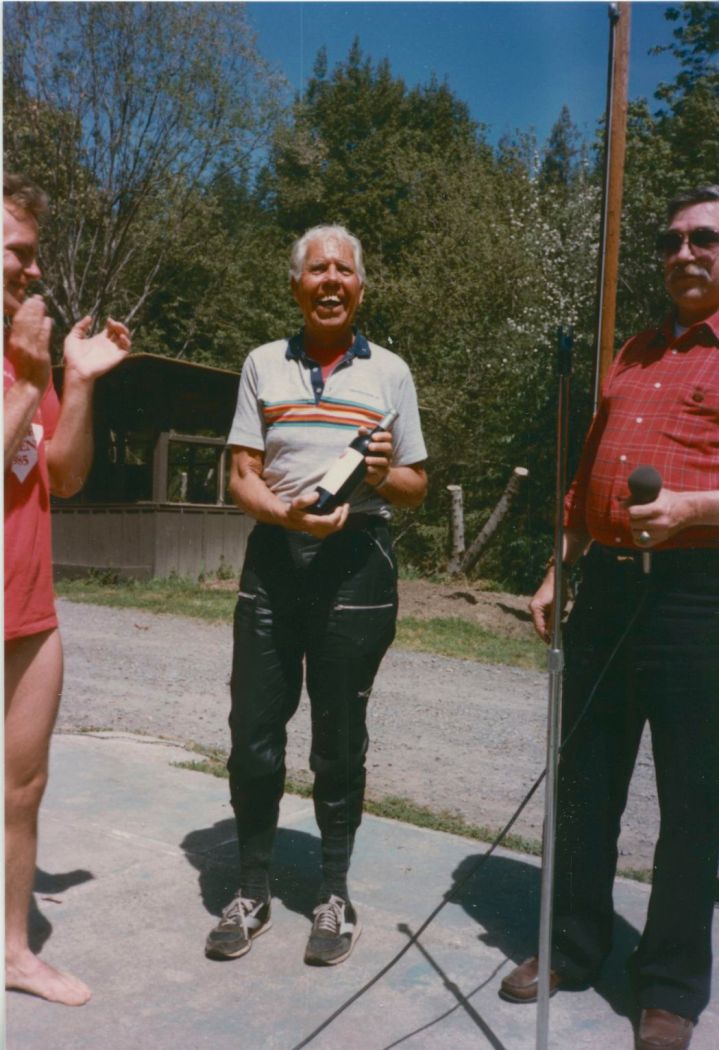
Gene Howard, oldest participant in the first AIDS Bike-A-Thon
Those of us who lived through the early years of the AIDS epidemic recall tremendous fear and despair over a disease whose origin and potential cure were unknown, treatments just feeble stopgaps on the fast track to a final demise, and a constant background pall on the community with each passing obituary. There seemed to be nothing one could do except care for the ill and educate as many people as possible. But one thing people could do was raise money for services and out of this the AIDS Bike-A-Thon was born. The first AIDS Bike-A-Thon (BAT) took place on Saturday, April 6, 1985—30 years ago. By today’s standards the amount raised, $33,000, seems paltry; but at the time it was a substantial bonus for the fledgling SF AIDS Foundation. According to Karry Kelley, the 1985 BAT was the largest amount for AIDS work ever raised at a single event in SF and the subsequent BATs were the largest fund raisers for the AIDS Foundation until the Foundation began the AIDS Walks in 1987. Different Spokes went on to put on nine more BATs before passing the event on to Ruth Brinker’s Project Open Hand; under its aegis it lasted just one more year.
Although Different Spokes played the central role in the initial Bike-A-Thon and its subsequent success, contrary to lore we did not invent it. The San Francisco AIDS Foundation, founded in 1984, approached Different Spokes in February 1985 for assistance and advice on how to run a bicycling charity event in order to raise funds for its operations. The AIDS Foundation was not yet the mainstream behemoth it is today and like many non-profits was dependent on donations. After several meetings between the AIDS Foundation and club officers, the Bike-A-Thon fundraising ride was announced for April—just a little over two months later. Bob Humason, then-President of Different Spokes (and who later was himself to die of AIDS), along with Michael John née D’Abrosca, past President and ChainLetter Editor-in-Chief, were the main forces behind club involvement and working with the SF AIDS Foundation.
Because the BAT was pulled together so quickly it was somewhat slapdash, yet the last-minute event managed to be a success, firing the imagination and zeal of participants—many of whom went on to organize and run subsequent BATs—as well as the San Francisco gay community. Keep in mind that subsequent BATs usually took 11 months to be planned and organized! In retrospect two months to pull off a never-done-before charity event was incredible. Within the club BAT was advertised and pushed for only one month (!) before it took place, a very short time to pull in riders for a 100-mile ride, nonetheless 63 riders managed to take to the road—not bad for an initial effort. In those days Different Spokes was a very small cycling club, so finding people to do a 100-mile ride just from within the club wasn’t going to be sufficient. The main form of recruitment and PR was an information and pledge table set up in front of “Hibernia Beach” on weekends for the month before the ride. [Note for you youngsters: “Hibernia Beach” was the corner of 18th and Castro where the Bank of America now sits, formerly the site of a Hibernia Bank branch, a local SF institution.] Perhaps it seems amateurish today—more suitable, say, for selling Girl Scout cookies—but it somehow worked.
The AIDS BAT wasn’t the first charity event for AIDS/HIV by far nor was it the first mass cycling event to raise donations (the first Multiple Sclerosis Society charity ride took place in 1980). But using cycling was a new idea for the Bay Area. Mass cycling events in the Bay area to date were primarily club centuries not directly concerned with raising funds for a cause (other than the clubs’ coffers), and cycling certainly did not have the sexy public profile it now has. In those days it wasn’t so much skin-tight Lycra as it was white tee shirts and Bermuda shorts; carbon fiber bikes were a mere twinkle in the eye, and aluminum was the ascendent “wonder” frame material.
The ride was called “Pedaling for Pride in ‘85”. To encourage riders there was no registration fee (although you had to register in advance). The only material reward for participating was a commemorative tee shirt and overnight accommodations in Guerneville. The club did organize sag support and first aid. Jerry Walker, who was then the owner of the Freewheel Bicycle Shop on Hayes Street and also a club member (he later was Vice President and eventually also died of AIDS), provided repair services. There were rest stops at 25-mile intervals and checkpoints every 12 miles to make sure everyone was all right.
The route was almost the same as the club’s Guerneville Weekend ride: north up Highway 1 all the way to Jenner and then east on River Road to Molly Brown’s Saloon in Guerneville (the traditional Guerneville Weekend route goes through Occidental to River Road instead). Those hills on Highway 1 took their toll: not everyone made it to Guerneville. But most did and the last one in is the gentleman pictured above at the awards ceremony, Gene Howard, then in his 60s. I recall club members Jim King and Tom Walther, who were considerably younger than Gene and who were barely ahead of him, swearing that they would make it all the way to Molly Brown’s before Gene—darned if they were going to let an “old” man beat them!
The following day there was a big party at the Woods Resort where prizes were awarded under beautiful, warm, sunny skies. Instead of leaving riders to fend for trips back to SF on their own, the BAT kindly arranged car returns for everyone and their bikes.
Instead of calling it a day, the aftermath of the first Bike-A-Thon was tremendous interest and energy in pulling together a second event, this time entirely under Different Spokes auspices. In order to pull off an even more successful event the organizing structure, although entirely volunteer and unpaid, became more formal with the appointment of a BAT Coordinator and committees to make sure all aspects of the event—publicity, fundraising, pledge collection, training, recruitment, facilities, etc.—were on track. Instead of the SF AIDS Foundation being the sole beneficiary, the club decided to recruit community-based AIDS organizations as recipients, a practice that continued until Project Open Hand took over the event. The club went on to organize a total of ten BATS before it burned out and passed the event to Open Hand.
Bike-A-Thon had a generative impact on Different Spokes. The event created a tremendous amount of energy and enthusiasm and in return the goodwill from the event led to a much higher community profile and our highest membership numbers ever, nearly triple the current number. But as the AIDS crisis continued, running BAT took a toll on the club. Partly it was the volunteer nature of the event: unlike almost all charity events, including the California AIDS Ride and the AIDS Lifecycle that followed BAT after its demise, the event was entirely volunteer run and supported by the club. Only in the last two years of the event’s life under Different Spokes was there recognition that the event itself needed to have some income in order to be well run and consequently made itself one of the beneficiaries. BAT was the primary focus of the Different Spokes for its entire run, needing nearly yearlong planning. Although it brought in new members and their energy, it also sapped the energy of the core leadership of Different Spokes. Eventually the club just ran out of juice as the core leadership either died of AIDS or moved on. What we have today is a legacy of community involvement and service that went beyond simply having a good time on a bicycle. Nowadays we have the AIDS Lifecycle that fulfills the same function as the original Bike-A-Thon. It’s a much flashier, well-organized, and successful charity ride, and like the BAT galvanizes and transforms at least some of the participants. There are many differences between BAT, the California AIDS Ride (also gone) and the Lifecycle. But a key difference is that for its first eight years every cent of donated money went to AIDS service organizations—the overhead was covered entirely by volunteer effort and goodwill: over $2.3 million. Now that’s a legacy worth remembering!
Here’s the short sleeve jersey and bib shorts. I’m relieved the colors turned out more vibrant in real life than as they appeared in the drawings. Primal Wear describes this sizing of this clothing as “club” fit i.e. a little more room than in “race” fit. I usually take a medium in “race” fit type clothes, and I ordered small. The bib shorts seem spot on; the short sleeve jersey is not tight (I wouldn’t have expected it to be so) nor voluminous (what I feared). So, it’s in the middle, i.e. it’s not close-fitting but I don’t expect it to flutter in the wind. Here’s a pic from the side:
As you can see, the arms aren’t overly loose either–just about right for my skinny arms!
The vest, or gilet, is reassuringly close-fitting, as it should be to avoid fluttering:
On the other hand, the jacket is, uh, parachute-like even in a small. Fortunately it has a cinch on the right side at chest level that allows you to adjust the fit. Here it is cinched down for my size. I won’t show you what it looks like when it’s open but suffice it to say that if your BMI is anywhere south of about 30, you should be able to get this sucker to fit:
If you ordered any of the 30th anniversary kit, be sure to fly your colors at the next Jersey ride if not before. Let’s see, there’s the Primavera, Chico Wildflower, the Wine Country, Grizzly Peak…




 The Chain Letter