Social Ride: Lunch at 54 Mint Il Forno

IMG_0147
OMG, that pesto lasagna rocks!!!

Mmm, that pesto lasagna was delicious! Not to mention the panini, cannelloni bean soup, and heirloom tomato bruschetta. But I’m jumping ahead…

The September Social Ride brought out nine folks and interestingly none of us were from San Francisco; everyone hailed from the East Bay—Kensington, Walnut Creek, Livermore, and Orinda. And it was almost a completely “new’ crowd, with only Roger and I having done Social rides this summer.

Luckily we got an early start at Lafayette BART because it turned out to be a fairly typical, hot summer day in Contra Costa. It also happened to be weekend of the Lafayette Art and Wine “Festival” (a.k.a. your suburban typical street fair) so the downtown was blocked off and traffic was promising to be nightmarish if you were in a car. We headed out to Walnut Creek and quickly got on the Iron Horse Trail heading north before diverting onto the Contra Costa Canal Trail. Those of you who have the misfortune not to reside in Contra Costa County may not realize that we have a canal system that was originally designed to pump Delta water to the farms and orchards that used to cover the area. One of them is the Contra Costa Canal and it makes a horseshoe-shaped loop through the county and has an accompanying multi-use path that is managed by the East Bay Regional Park District. It’s a great way to get around and mostly avoid car traffic. Also, EBRPD has done a lot of repaving this summer to get rid of the cracks and jolting roots from the trees that line the canal, making the ride even more pleasant.

After rolling north all the way to Highway 4, we got on city streets and toured the Contra Costa County Animal Control Shelter, CCC Sanitary District, and the CCC Gravel/Asphalt Yard before fleeing back onto the Iron Horse Trail going south. We kept to a conversational pace and there was a lot of yakking going on. What did we gab about? Oh, things like: David’s horrible LifeCycle crash but then awesome ALC bro’ deal on a sweet new Cannondale Synapse to replace his mangled sled; the loveliness of working in the California State prison system; why French people don’t invite you to their house; more Kaiser horror stories (as if I hadn’t experienced enough already); how much used Vitus frames go for on EBay; Derek’s butt. You get the picture: nothing important and only the absolutely vital! As Bobby Troup said, “They all meow about the ups and downs of all their friends; The who, the how, the why — they dish the dirt, it never ends.”

We got to 54 Mint Il Forno in downtown Walnut Creek just before noon. It was time for a break, as it was really starting to heat up. 54 Mint Il Forno opened a few years ago originally as the bakery site for the restaurant. But now they serve dinner as well as lunch. Why these Italians left their home to serve real Italian food to Californians, I don’t know but it’s been a grand blessing for us. When you walk into their small storefront you get to gaze at the gallery of Italian sweet, baked goods and also some things that look almost French such as bignés (= beignets in French) and éclairs. Surprisingly only Cameron immediately ordered some Italian cookies proving that he lives by the adage that life is short so eat dessert first. The rest of us swooped on the various kinds of panini, lasagna, salads, and in my case the soup and bruschetta. It was a mountain of food and more of us would have gorged on the sweets afterwards but honestly we were all mighty full.

After lunch Derek and David headed back to Rossmoor, Joe and Lamberto headed back to their place a few blocks away, and the five of us rode back slowly to Lafayette BART in the 90+ degree heat. The average speed was about 11 mph, a tad faster than the 8-10 mph in our ride code but easily within the ability of this group. Next month: Speisekammer in Alameda for German food!

Now Wasn’t That A Fabulous Party?

OPP2015start2
Two-wheeled Party!

The 2015 Orinda Pool Party had 24 attendees, the most ever. Despite seesaw weather all summer here in Contra Costa—heat waves followed by spells with colder than normal temps—the day of the Pool Party we were lucky to hit it just right with sun and mid-70s. Perhaps it was the forecast that brought out the crowd, perhaps it was offering two rides instead of the usual one, or maybe it was the end of post-AIDS LifeCycle ennui. We had the usual, ‘classic’ route up Pinehurst and down Grizzly and Wildcat, and we added a second route for those who wanted more of a workout, just five miles longer, that went out to Lafayette and up the Lafayette-Moraga Regional Trail before rejoining the regular route. Seven folks did the regular route, ten the long, and seven folks did neither and came just to the party.

Both routes have a moderate amount of climbing with the added challenge of short but gritty steepness at the top of Pinehurst. But any recreational cyclist can do the routes riding piano. David Gaus and I led the regular route and it was a chatty affair, in fact like a slightly faster Social A ride! Besides the usual club gossip and girl talk several of us had a long discussion of the recent Velonews article on heart injury and overtraining as we, of course, climbed up Pinehurst. Perhaps that’s why we took it at a “festive” rate rather than redlining it all the way up. Some of us senior members are getting uncomfortably familiar with medical terms like “atrial fibrillation” and “supraventricular tachycardia”. Then triggered by Doug Dexter’s recounting of his recent partial knee replacement, we had to go into boring war stories about our own knee and hip issues. Thank god no one started talking about crashes or head injuries else we might never have shut up about such a depressing subject. The chatter was only briefly interrupted by gasping on the steep upper section of Pinehurst and resumed all the way to Sibley for a rest stop that turned into another round table. Fortunately no one seemed to be in a rush!

This year we had just one female participant, Rana. The low number of women turning out for club events continues to be a challenge for us. We lost a couple of women when we had to reschedule the pool party because of the unexpected BART closure at the beginning of August and they couldn’t make this new date. Rana was fresh from a bike tour all the way down from Alaska (!) and was sporting a fractured bottom bracket housing that creaked every time she pedaled. She quickly allayed my concern, explaining that it was the bottom bracket assembly and not the bottom bracket of the frame itself that was cracked!

We made it to the Brazilian Room in Tilden Park where I was to phone Roger to let him know the group was about a half-hour away from arriving, only to find out there is no cell signal. Seriously? At the center of Tilden Park where there are countless weddings and events?? Thanks, AT&T! By then those on the long route finally caught up, so we all ended up arriving at the party at the same time save for David Goldsmith who had missed the turn at Wildcat and ended up lost somewhere in Tilden Park. He eventually found his way back to the route and arrived long after we’d given him up for dead.

OPP2015inthe pool2
Yammering, not hammering

While we were cavorting in the Berkeley hills, Roger and Jim had done a marvelous job of final tidying and set up as well as preparing the appetizers. Almost everyone ended up jumping in the pool to cool off and refresh. No artful synchronized swimming was seen in the pool; instead folks were continuing to gab up a storm while reposing in the water.

There was tons of food; among the notables were Andrew and Evan’s delicious and beautifully displayed heirloom tomato salad and Doug O’Neill’s fabulous homemade oatmeal cookies.

The non-riders who attended weren’t just the “bike widows”. Some Spokers opted just not to ride, including Dennis Nix, former DSSF VP and new Apparel Coordinator Brian Leath and his partner, and the Den Daddy Derek Liecty. Derek was freshly back from a long 4,500 mile car trip in Europe, another check mark on his bucket list. Apparently he got five speeding tickets too!

Folks must have been enjoying themselves because it was late in the afternoon before they took their leave, sliding down the hill to BART and thence to home sated and tanned.

Ride Report Social A Rides: Three Bears, and Lunch at B Street

We’ve had two summer Social A rides this summer. In July we did the Three Bears out of Orinda ending with lunch at Petra Café; in August we left Millbrae BART and toured Foster City and San Mateo before a delicious lunch at B Street & Vine.

IMG_0134
Veggie Plate at Petra Café

On Saturday July 18 Andrew, Adrienne, and Amyel joined me on a leisurely jaunt around the Three Bears. My husband Roger would have joined us but he had the misfortune of falling off a rock terrace in the garden and injuring his leg! The Three Bears is usually considered a challenging ride and one not really suited for casual cycling, but I beg to differ. Almost any ride can be made a leisurely ride simply by slowing the pace, and that’s easy to do when you’re chatting up a storm. (Okay, it is helpful to have the right gearing too!) Group rides can turn into mini-competitions unless you set the right atmosphere—you’re out to enjoy the company as well as the ride. I’ve never been sure why this classic East Bay ride is called the Three Bears because there are more than three hills and there’s nothing “just right” about any of them. In any case we ended up mostly staying together until Amyel, excited about just having completed AIDS LifeCycle for the first time, had to bound up Papa Bear. The weather was perfect: not too hot, not too cold, just right! Afterwards we went to downtown Orinda for a delicious al fresco lunch at Petra Café, which serves Greek/Mediterranean cuisine. Doesn’t that veggie sampler plate look fab? I think all would agree that the ride was just hard enough too and it made savoring the food all the more enjoyable on a sunny day.

ALong the Bay Trail
Along the Bay Trail

On Saturday August 22 we had a bigger turnout, seven of us: Roger and I, Sharon Lum, Dennis Nix and his friend Richard, David Goldsmith, and Doug Dexter. Both David and Doug are known for their turn of speed, but Doug was recovering from recent knee surgery and David, well, he just wanted to do an easy ride for once. The weather again cooperated and we were greeted with a gorgeous day on the Bay—sunny, mid 70s, and a slight breeze. This made riding along the Bay Trail especially enjoyable, taking in the crisp views of wetlands, planes landing at SFO, and Mt. Diablo in the distance. Riding along the Bay Trail is a great way to do a social ride. You’re mostly free of car traffic, you can comfortably ride abreast, everybody’s moving at a slow clip enjoying the scenery, and there are plenty of places to stop for a brief a respite, take photos, or just to sit quietly. Well, we didn’t do any of the latter but we did mosey, and there was a lot of conversation taking place. We got to explore the bike paths in Foster City before crossing over 101 to San Mateo for lunch. I thought B Street & Vine would have been emptier on a weekend but I was terribly wrong—it was near full and the back patio was being used for a baby birthday celebration. Also the building next door was being repainted, so B Street didn’t have any al fresco dining in front. But we lucked out when the host was able to seat all seven of us indoors immediately. The bruschetta plates were the hit of the day—B Street has a huge variety and they allow you to pick any four for your lunch plate. But I gave it a pass because I had to have their cream of artichoke soup: it gives Duarte’s Tavern’s—the gold standard—a run for the money. After a long lunch and gabfest we moseyed some more through suburban streets back to Millbrae where David’s true nature just had to shine as he took off down the street.

Our next Social A Ride will be Saturday, September 19, where we’ll tour the Contra Costa Canal Trail and the northern leg of the Iron Horse Trail on our way to 54 Mint Il Forno in Walnut Creek. See the Ride Calendar for the details!

2015 Cycle Greater Yellowstone – trip report

2015 Cycle Greater Yellowstone – trip report (David, Gordon, Nancy)

A fabulous, well-run strenuous ride, with spectacular mountain passes, super helpful staff and volunteers, good plentiful food, weather extremes, and a lot of serious riders.  Best rides: Chief Joseph highway, Beartooth Pass (despite smoke, rain and snow!)

Along Chief Joseph Highway

IMG_0063

.

cold seats
cold seats
Beartooth Pass switchbacks


image

Bearclaw Bakery, Cooke City, MT
Beartooth Pass switchbacks


Temps were fine (except for the snow and rain;) and camping was easy (except for the snow and rain;). Did the happy dance in Cooke City hotel room (27 degrees overnight) that David wisely booked in advance (camping at 7700 feet even in August is iffy) and on one rainy day. Worthy cause – to protect wider Yellowstone ecosystem. Rides are outside Yellowstone, route varies each year. New route to past this fall Limited to 350 rides. Planned activities for non-riders. http://www.cyclegreateryellowstone.com/

IMG_0058

road to yellowstone east


IMG_0062 IMG_0063 IMG_0060

Read on for more details…

pickles are good ride food!

What is Cycle Greater Yellowstone? It’s a 7 day ride that supports the Greater Yellowstone Coalition. http://www.greateryellowstone.org/mission/  It’s mission is protect the ecosystem, waters and wildlife that surround Yellowstone. Yellowstone is 2 million acres. Zoologists and ecologists recognize it’s not big enough range for genetic diversity of the big mammals – bears, bison, elk, etc. Need 20 million acres to maintain genetic diversity and a broader range for sustainable big mammal populations, and the ecosystem that supports them (otherwise, inbreeding and unhealthy populations). Greater Yellowstone coalition works with people to preserve the land – state and local governments – via conservation easements ad habitat protection.  Ride is all volunteer except for 2 employees. Beer and drinks donated. Appear to have low overhead. Most of the money goes to the cause. Can princess ride by doing hotels, or Sherpa service, massage. Ride supports local towns’ 4H kids fundraising – cookies, donuts, sherpa service in towns we ride through.


Gordon and grizzly eye to eye


More Pictures:

These are from mostly our “pre-trip”:

Image1
Yellowstone
Image3
Beartooth pass
Image5
Ride to Jenny lake, Grand Teton


Tips:

  • Clothing: Bring full rain gear. Bring hot and cold weather riding gear.
  • Sleeping: Due to weather, consider princessing the whole time, esp if 2 people share a room.  cold at 6 am in Powell, but probably just low 50s. Had breakfast in the gymnasium – Or you can do tent sherpa for 250 each if you share a tent (otherwise 500 solo), or camp for no extra cost.
  • Snacks: No need to bring food, unless you are particular. Mostly cliff or candy bars, chips or Cheetos, packaged cookies. Plenty of calories available.
  • Route: Varied, incredible scenery most days. Does NOT go into Yellowstone or Grand Teton National Parks. If you want to see these, add extra days. Do extra days before the ride, if possible, to acclimate to elevation.
  • Training: This is a strenuous ride. There are long rides and a lot of climbing, as well as winds. Mileage is similar to ALC but more climbing. (30,000 feet elevation (including optional ride day) v. 20,000 feet for ALC). Training is essential if you want to do it all and not get sagged in. But sagging is easy, available, and not discouraged by the staff. All of us sagged a bit due to weather, high winds.
  • Showers, porto-potties, laundry: all good, well maintained. Chairs set out for shower line. Laundry wash basins and soap provided. Some towns had coin-operated laundry.
  • Food: Plentiful. Good. Always real food. Good vegetarian options. You can eat pretty healthy on this ride.
  • Volunteer staff: The road and camp crew were a bunch of enthusiastic, energetic, idealisstic young people. Super helpful and accommodating. People were super nice and responsive and there for the riders.
  • Director: Jennifer was great. Excellent with doing things on the fly, amazingly responsivee to changing conditions – e.g., construction, weather.
  • Sag people were very understanding about picking people up, not explanation needed. Also would let you ride if you wanted to.
  • Mechanics were spectacular – super helpful, very competent, professional.
  • Riders: Oldest 80, youngest 16, average age 55. Virtually all white, professional, straight, except for a few closet cases. Experienced riders. Not recommended for novices
  • Road conditions: Very good, some highway riding, but decent shoulders


What is a Different Spokes Ride?

What is a typical Different Spokes ride? A cursory glance at our ride calendar shows a variety of road rides, in fact only road rides. In 2014 there wasn’t a single mountain bike ride listed—all 108 rides were on the road. The shortest ride was the Three Bears at 23 miles led by Stephanie Clarke and the longest was an ALC Marshall Wall ride at 105 miles led by Joseph Collins. If you tally up the mileage for all the club rides in 2014, you’ll discover that the average length of a Different Spokes ride was 55 miles. The average terrain rating was 3.25, where 3 means “moderate hills with some challenges” and 4 means “hills, some steep climbs, with some relief”. In other words, the typical ride was a bit more than moderately hilly. Finally, the average pace was halfway between B and C, i.e. between “moderate” and “brisk”.

So, it appears the typical DSSF ride was a road ride with a B/C-3-55 rating. If you think about it, that kind of ride is beyond what most recreational cyclists would do on a regular basis. They might do a ride like that as a challenge, as something atypical and extraordinary but not as, say, a default ride. A little closer look at the details shows that of the 96 club rides (I didn’t include Jersey Rides because they have a varied rating depending on the route taken), 57 were B rides, 19 were C, 18 were D, and a measly 2 were A pace rides. Most the rides were listed as B very likely because that’s the “sweet spot” for rides, i.e. supposedly not too hard, not too easy. But well over a third of the rides were either C- or D-rated, i.e. for strong, fast cyclists. If you were looking for a leisurely ride, well, you had a grand choice of just two rides, Ron Hirsch’s Bike to Bakeries ride or the Fall Social Rosie the Riveter ride.

The apparent majority of B rides would lead you to think that most Different Spokes rides are at a moderate pace. But the number is deceptive because, in my experience, many of these rides attract quite a few strong riders and the average pace can actually be quite high. I suspect that there is also some subtle pressure on ride leaders to list their rides at B pace; we’re a small club and a ride that is listed as a B will likely attract more riders than a C or D ride. The B ride has become the default “everybody” ride and more people will show up because in unspoken DSSF culture an A ride is interpreted as “slow” and C or D is interpreted as “race pace”. But this subtext isn’t available to newcomers to the club so a first ride can end up being a slap in the face. On the positive side club B rides always have a few regroups so that slower and faster riders can regroup and hang out, albeit for a short time. But being “dropped” and riding alone might discourage a newcomer from attending another club ride. And, there aren’t slower rides they could try given the dearth of A rides.

Although I haven’t looked at other clubs’ ride listings in detail, I suspect that they have a similar distribution of rides, i.e there aren’t enough easier rides. For example, the Valley Spokesmen club recently sent out an email to its membership asking for more leisurely paced and no-drop rides listings. And this is from a club that is much larger than Different Spokes and even has a dedicated new/slower rider subgroup, the Feather Pedals. As I mentioned in a previous post, ride leaders are likely to be the avid recreational cyclists and the more dedicated club members. So, given their limited time for riding they’re going to list rides they want to do, which are rides at their ability level.

There are really two issues at play here. One issue is the type of rides offered—our ride calendar is slanted towards harder rides—and the other is an ‘accurate’ description in the ride listings. I’ve written at length on the former and the effect it has on some newcomers and slower riders, and here I want to focus on the latter. A ride that ends up having a pace faster than the listing has two effects. First, it introduces some uncertainty in the minds of those perusing the listings. Will that ride really be conducted at a B pace or will it be faster? Riders who can’t keep the pace don’t get to socialize as much or otherwise enjoy the company of LGBT riders if they’re off the back for most of the ride. Those persistent enough to return might, through time, figure out which ride leaders lead fast rides regardless of their advertised pace and avoid those rides, or they learn to enjoy socializing only at regrouping points. But most people would just stop coming on club rides and look elsewhere for socializing. Second, it “raises the floor” for other rides: ride leaders get used to a certain perceived pace as the “B” pace regardless of any objective measurement such as average speed or average speed on the flats. And, if the same people keep showing up and accepting the pace, then it becomes the de facto “B” pace. For ride leaders there is also herd mentality at play: ride leader X lists his rides as B rides and I can keep up with him, so I should list my rides at a B pace too.

The club ride code has morphed through time. Here is the old club ride code (circa 1980s):

Terrain

1 – Mostly flat, easy grades, suitable for beginners (25-miles Bike-A-Thon route, Sausalito bike path, Sawyer Camp Trail)

2 – Few low hills, a challenge (e.g. Cañada Road, Tiburon Loop)

3 – Moderately hilly, some challenge for the average rider (e.g. Twin Peaks, Marin Headlands)

4 – Hilly, some steep climbs with some relief (e.g. Mt. Tam, Berkeley Hills)

5 – Very hilly, steep climbs, for strong riders (e.g. Mt. Diablo, Mt. Hamilton)

Pace (speeds assume a flat ride)

A – Leisurely, with many stops (10-14 mph)

B – Moderate, with occasional stops (13-17 mph)

C – Brisk, with few stops (16-21 mph)

D – Steady, strenuous, with very few stops (20+ mph)

The old club ride code attempts to provide something other than subjective guidance. If you’ve ridden some of the example routes, then you have an idea of how hilly the ride will be. Most people know how fast they can ride on the flats and can determine whether they can keep a B pace or not. If there is one fault with the old ride code it is that the pace categories are very broad: 17 mph is much faster than 13 mph yet both are “moderate”. Nonetheless ride leaders can check their pace against the pace categories to figure out if they’re pushing it or going too slow, at least for flat rides. One problem with the old ride key is that pace on the flat doesn’t reliably translate to pace on a hillier ride. For example, generally a heavier person may be able to keep the same pace on the flats as a lighter person but that is usually not the case when the route becomes hilly: the lighter person usually is faster. So, what might be a “moderate” pace for a lighter person ends up being “leisurely” for the heavier person!

On the current club website the ride calendar has a different ride code. The terrain key is mostly the same as the old ride code although the example routes have been eliminated. I think we would do better to add them back. But more importantly the pace key has no objective speeds. The B pace is “moderate, occasional stops”. Now, what does that mean? Moderate means different things to different people and provides essentially no guidance at all except that it’s harder than “leisurely”. “Moderate” and “leisurely” can only be interpreted subjectively, i.e as perceived effort. The word “pace” is ambiguous because it can be used to refer to an objective rate, e.g. 15 miles per hour, or to a subjective assessment of speed, e.g. “moderately fast.” Without objective guidance, words for pace end up being interpreted subjectively as perceived effort. Two individuals can rate the same objective pace (15 mph) as leisurely, moderate, brisk or strenuous because it’s dependent on their conditioning. A subjective pace key is not going to be very helpful for riders in deciding whether they should attend a ride, i.e. whether they’ll be able to keep up with the group: how would they know how fast a ride is going to be led on any particular day?

If, however, you delve a bit deeper into our website you find another ride key linked to “About Our Rides” (i.e. at http://www.dssf.org/dssf_html/ridekey.php). I’m not sure where this ride key came from but it’s actually better than the one in the ride calendar. Again, the terrain key is the same as on the ride calendar but the pace key includes not just average speeds but moving averages as well:

Average speed                 Moving average speed

A – Leisurely, with many stops                     (5-7 mph)                                (8-10 mph)

B – Moderate, with occasional stops            (7-9 mph)                               (10-12 mph)

C – Brisk, with few stops                                 (9-13 mph)                             (12-15 mph)

D – Steady, strenuous, with very few stops (13+ mph)                              (15+ mph)

Note that the speeds for each category are significantly lower than in the old ride code. That actually accords fairly well my own experience and correlate well with my Garmin data. Those average speeds look very low but keep in mind they include stops and incorporate flats and hills.

One could argue that both subjective and objective descriptions of pace have their flaws and neither is better than the other. Objective average pace suggestions obscure the significant difference between a ride done at a consistent speed versus one that oscillates between very fast and slow—both might have the same average speed. The best job I’ve seen for trying to provide guidance to participants is the Grizzly Peak Cyclists ride code. GPC suggests that you time yourself on the Three Bears loop in Orinda. Your time determines the typical pace you would be comfortable riding according to their ride key. Yet nothing prevents a GPC leader from inaccurately listing the pace of a ride and only corrective feedback from participants might encourage the ride leader to change the listing the next time. In other words despite having a more objective way for determining your pace, you still are at the mercy of the ride leader’s skill at accurately listing the pace of their ride and their zeal in sticking to it.

Ride pace may technically be independent of ride length and hilliness but it’s not surprising that they actually go together. Cyclists who are stronger generally prefer to do longer and harder rides, so a faster paced ride is likely to be longer and probably have more climbing too. So what happens when the B ride starts to inflate? Not only does it get faster, it also might get longer and involve harder routes, and I think that is happening as well. That means for the B-paced rides, they also become longer and hillier overall.

So why do so many rides get listed as B rides regardless of their difficulty? In all the years I’ve been in Different Spokes I’ve rarely if ever heard a complaint that a ride wasn’t led fast enough vis-a-vis the ride listing, but I’ve certainly heard complaints about rides being led faster than some riders felt they could handle. Was that misjudging one’s ability, being fooled by the ride listing, or the ambiguity of the pace key? Perhaps all three. Of course participants can ride at whatever pace they’re comfortable doing as long as they know the route or have a map, so the real concern behind the complaint isn’t the pace per se but that getting dropped is lonely and discouraging and not the social experience one is looking for in a group ride, as if being LGBT in the first place—even here in the Bay Area—wasn’t isolating enough. Group rides are inherently social, so when riders can’t keep pace, no matter what the listing, they’re probably not getting the socializing they were hoping for. I’m not blaming ride leaders for this situation: ride leaders who list challenging and fast B rides really do think they are riding at their B pace. But the assessment of pace has been skewed that “moderate” now encompasses such a very wide range of speeds and it isn’t a helpful label.

In my opinion the B rides have become problematic. They’ve become faster, a bit longer, and overall a bit harder. It’s the “moderate” ride but acts more like a “brisk” ride. With the current dearth of A-paced rides, this leaves those who are discouraged by our “moderate” B rides with no alternatives. Has there been a similar speed up on A pace rides? Unfortunately we don’t know because so few A rides are listed these days. Perhaps if enough A rides were led, we might see that they too have undergone inflation and become faster than originally intended. Newer riders probably should be cautioned about B rides even though they are the only viable options in the club given the lack of A rides. Increasing the number of A rides will be difficult given the general lack of interest in leading rides at all coupled with the club’s lack of a core group of ride leaders who like to ride slow(er).

The solution for the meager number of easy, leisurely paced rides, awaits. But the solution is easier for the “fast” B-paced rides. Ride leaders can take a look at the recommended moving average speeds at the club website (and included above) and use it in selecting a pace label rather than basing it on solely on how difficult it feels. If this had been done last year, I suspect that quite a few “B” rides would have been classed as C (or even D!) Note that I’m not suggesting that rides be led slower, just that ride leaders who are entertaining listing a ride at a B pace attentively evaluate whether they are actually going to end up having a ride that conforms to the DSSF ride key—there’s nothing wrong with listing your ride as a C or a D if that’s the pace you plan to take.

Revisiting Fred-dom: Cycling Mirrors

Fred and mirror
Just add white knee socks!

Back in the day no racer or wannabe racer would be caught in public sporting a cycling mirror. That shame was relegated to touring cyclists and nerdy safety geeks, i.e. “freds”. No pro racers ever used a mirror, instead preferring to quickly glance back if necessary. Of course no one seemed to care or notice that pro racers almost always raced on closed roads and thus had no need to spot a semi hurtling towards them from the rear. However there has always been a silent group of cyclists who, fred-dom be damned, tried a mirror and “never looked back.” My descent into fred-dom may have begun with wearing a Bell Biker helmet in 1975 (who among you even remember when bike helmets didn’t exist?) but was confirmed when I started using my first mirror, a Third Eye attached to that very helmet! Fashion? Who cares! For the first time I could glance backwards to see traffic without having to crane my neck all the time. My anxiety about being unexpectedly rear-ended was allayed. I was sold! Fortunately nowadays our sport is so large that what was once a fashion faux pas is, well, passé. I see lots of recreational cyclists roaming the Bay Area (and the world!) with cycling mirrors. Apparently I am not alone in being drawn to the fred side. And with good reason: as in a car, a well-made rear view facilitates being able to see behind quickly and assess the traffic situation (or just check out the hunk who’s sucking your wheel). If you’re thinking of bucking the PRO mentality or if you’re just pragmatic but have never considered the utility of a mirror, let me enlighten you on mirror basics.

Not all cycling mirrors are the same. Not by a long shot. Not only are there different types of mirrors but some seem to have been designed by someone who’s never ridden a bicycle. When you think ‘bicycle mirror’, you’re probably imagining a heavy, metal contraption that your dad once bolted to the handlebars of your Schwinn Stingray (if you’re as old as I am) or if you’re younger, maybe your bmx rig. You can still get that kind of mirror, but you also have a plethora of lighter and more elegant (if such a word can be used to describe a cycling mirror) choices. The most common kind attaches either to your helmet or to glasses, but you can also get mirrors that attach to the end of your handlebars. Bar end mirrors supposedly eliminate the disadvantage that helmet and eyeglass mirrors have, which is that they are easy to knock accidentally and either dislodge, break, or throw out of alignment; A bar end mirror is supposed to solve that problem by being placing away from your face, where you’re most likely to brush it with a hand. However you’ll see in the comments below that they have their own set of problems. My own experience is entirely with eyeglass and helmet mirrors and my comments will be restricted to this type. I’ve also drawn upon Bing Wu, Nancy Levin, and David Gaus to comment on their experience with their cycling mirrors. Other general complaints about helmet and eyeglass mirrors are that they tend to be too flexible and bounce, that they are small, and that they constantly need to be adjusted; actually the latter problem also afflicts bar mounted mirrors.

If you’re already using a mirror, you’ve probably figured out what works for you and are sticking with it. If you’ve joined the Children of PRO cult, you’ve already stopped reading this blog post. If you’ve made it this far, you’re on the cusp and are at least open to the idea of going fred. First of all, a mirror is not going to solve all your cycling woes. It’s not going to cure cancer or stop climate change. It might make it easier for you to look to the rear—that’s all. For about $20 you can give it a try—that’s not a lot of dough to invest on an experiment. Some people just don’t like mirrors for whatever reason. More power to them. But I can tell you why I use a mirror. For years I just turned around and looked. Maybe it was because I heard something, I was changing lane position to avoid an obstacle or another cyclist, or I was just anxious. A mirror can make that quick glance a tad easier. That was the key: it was quick even if not always thorough. If thorough were important and I had enough time, then I’d turn around and look. Over time I have come to use the mirror very frequently because it’s so easy to check the rear; it’s now second nature to me. Even if I have to move evasively to avoid glass or road debris, I have learned how to do a really quick glance backwards before veering. A mirror also allows me to check on anybody who’s in my draft: I can see if they’re losing contact, how close they’re on my wheel, and how hard they’re working. If someone is losing contact in the back, a mirror allows you to check quickly and then slow down. Conversely if you’re trying to lose someone, a mirror allows you to assess the situation and respond accordingly, i.e. stomp harder! So a rear view mirror isn’t just for safety—you can used it to check your overall traffic situation and that includes your fellow riders’ position and status. And it certainly allows you to check well before you hear the rumble of a car engine.

Finally a mirror, no matter what type, brings its own set of minuses. Yes, it’s one more thing you can lose or break. Yes, they can go out of adjustment. They’re mostly smaller than you’d prefer and the mirror is probably of just adequate quality. I’ve found that these cheap plastic mirrors scratch if you clean them with paper towels. So just don’t. Another minor annoyance I’ve experienced is that although they’re all light, it’s still enough mass to cause my helmet to rotate slightly forward unless I have my chin strap very tight, which I don’t like. It’s no big deal but it’s annoying if you’re wearing tall sunglasses that then start to hit the helmet brim. Whatever. You decide what is or is not a deal breaker for you. Nobody’s invented the perfect cycling mirror yet.

3rd Eye Foam

Third Eye. Third Eye makes four kinds of helmet and eyeglass mirrors and I’ve used them all. I’ve had the most experience with their mirrors. They cost between $10 and $17. The Hardshell Helmet mirror is now a misnomer. It was intended for helmets such as the original Bell Biker or MSR helmets that had a distinct and separate outer hardshell to which it could clamp. I’m not aware that any such helmets are made these days. Nonetheless it worked very well as it attached quite firmly and didn’t move at all. Unlike the other Third Eye models it had limited adjustment—if you needed to see at a different angle that you couldn’t attain by pivoting the mirror on its tiny ball joint, you simply moved the whole thing around the perimeter of your helmet and reattached it—but that was its strength because it had a short plastic arm that reduced bobbing. Third Eye makes a Pro mirror that is ugly as sin: it has a hideous foot that you stick directly to the side of your helmet. The arm is long and was prone to oscillating when riding over rough road. And, you can’t detach the mirror, so traveling or packing the helmet was a pain. I never cared for this model. Strangely, the model that I like the best and have used for years is the “Foam Helmet” mirror. This model was supposed to stick directly to the EPS and was developed back in the day when the best helmets were just EPS forms covered with lycra such as the first Giro helmet. Those helmets are long gone but I’ve found that this model works very well with modern helmets. It has a Velcro-like pad (they call it Dual-Lock) that adheres to any helmet surface; you then attach the mirror to it. You can easily remove it if you’re traveling or just want to ride without it. The arm is relatively short (but not as short as the Hard Shell) and thus bounces less. The mirror is on the small side but it’s big enough because it’s held closer to your face than other helmet mirrors. If I need to see more, I just sweep my head  ever so slightly to take in a larger angle of view. One minor problem is that the Dual-Lock system, although more reliable than the Velcro that they used before, requires a firm push to remount the mirror or else you might lose that mirror at an inopportune time. (Side story: I lost one going around a GG Bridge tower when a huge gust blew it right off and into the Pacific!) Finally, Third Eye also makes a model for eyeglasses. There are better eyeglasses mirrors than these. Because they’re made of plastic—like all the Third Eyes—I’ve found the mounting tines break easily in attaching and detaching them from different glasses. They’re just not sturdy or durable enough unless you intend to put them on one pair of glasses and leave them there. All the Third Eyes are made of a black plastic that seems to become more brittle as it ages—they all end up breaking eventually. The ball joints tend to be too tight initially and thus finicky to make fine adjustments but then loosen annoyingly as they age and need more readjustment as time goes on. But it doesn’t matter because they end up breaking anyway. The one positive is that they’re cheap and easy to find in just about any bike shop, so replacing them is no big deal. I find I get a few years of heavy use out of one until either the ball joints go south or the plastic breaks. Did I mention they’re cheap and easy to find?

Blackburn

Blackburn Helmet Mirror. Despite an inexpensive cost of $13, avoid this mirror. It’s similar in design to the Third Eye Pro mirror but with a more discreet mount. Unfortunately the arm is made of thin, long black plastic so the mirror bounces violently on rougher road and you can’t make out what’s behind you. It’s very light but that very lightness contributes to the problem. The mirror adjusts easily and seems to hold its adjustment better than the Third Eye models. The mirror is, like the Third Eye Foam Helmet model, on the small side. I’ve toyed with the idea of either putting down a thin layer of rubber putty on the arm or of gluing a thin rubber strip to it in order to damp the oscillations. Did I mention that it bounces a lot?

Reflex

Cycleaware Reflex Helmet Mirror. Now we’re moving up the price ladder to $20. This is the other mirror that I’ve had years of use. Obviously I liked this one otherwise I would have dumped it a long time ago. Unlike the Blackburn or the Third Eye mirrors, the Reflex has a thicker mirror arm, a plastic encased metal wire, that is not only very durable but also bendable, allowing you to get it exactly *just so*. The mirror and arm are easily detachable from a small plastic base, which you stick onto your helmet, so it’s good for traveling or packing. You can also rotate the entire arm and mirror upward and out of the way if you don’t want to use the mirror temporarily or need to wipe sweat from your face. After more than a decade (yes, ten years) I’m still using the same Reflex mirror! Over the years the ball joint at the base has loosened a bit so that the mirror can rotate downward slowly over bumpy roads. The stickum adhesive has also gone south but my home fix was simply to replace it with easy-to-get double-stick tape, and it’s still working fine. I bought a replacement about three years ago thinking that the original one was on its last legs, but it just keeps working! The Reflex vibrates slightly, just slightly more than the Third Eye. But it’s not enough to be bothersome. The shape of the mirror is vertically oblong; it would be better if it were oblong horizontally in order to increase the angle of view.

Hubbub

Hubbub Helmet Mirror. Costing $29 by mail order, the Hubbub uses a different construction and attachment method than the other mirrors. It’s constructed of thin but durable wire that you bend to clamp to the underside of your helmet by simple mechanical force. Although it’s easy to detach and change position, it’s decidedly low-tech and may result in compressing or slightly indenting the EPS on the inside of the helmet. It’s probably not compromising the safety of the helmet, but any time you dent EPS you should think twice as the integrity and safety of the helmet is due to its ability to compress upon impact. The mirror shape is large and octagonal and provides a nice angle of view without annoyingly obscuring your forward vision. This mirror is also easy to detach for traveling, packing, or just to take it off if you don’t want to use a mirror. It’s quite rigid and does not vibrate very much (all mirrors will vibrate some) probably partly due to the lack of any ball joints and no plastic. But the lack of easy adjustability is also a pain as for example when it’s cold and you ride with a cycling cap under your helmet. Now the mirror’s position is very likely to be incorrect and it’s not easy to change without bending the metal arm. And then you have to bend it back when you ride without a cap. By the way, the metal is springy so it’s not easy to bend. But as long as you don’t ride with a cap or balaclava under your helmet (or always ride with a cap), this mirror works fine.

Take A Look

Bike Peddler Take A Look Eyeglass Mirror. It took me years to get around again to using a cycling mirror that attaches to an eyeglass frame rather than a helmet after using the cheap Third Eye version. This type of mirror is probably the most popular type and I can see why: it’s simple, very adjustable, fits any eyeglass frame, and provides an excellent rear view. Keep in mind that eyeglass mirrors can be bumped just as easily as helmet mounted ones. The mirror is rectangular and longer in the horizontal direction—exactly what you want in a cycling mirror. Instead of ball joints the Take A Look uses friction-fit cylindrical metal joints, one for each spatial axis, so you set the mirror at exactly the correct angle. Unfortunately, for moving the mirror inward or outward you’ll need to bend the main arm. To move the mirror closer, you simply move the attachment further back on the eyeglass frame. It goes without saying that wearing a cycling cap under your helmet does not affect the placement of the mirror because it’s not attached to the helmet in the first place. Another advantage is that you need only one mirror if you have, as I do, several helmets. The cost is a reasonable $13 to $20. The main disadvantage? You need to wear eyeglasses. On the other hand since they fit glasses rather than a helmet, I’ve found them useful when I’m walking on trails or multi-use paths, as I’ve discovered that 95% of cyclists don’t give an audible warning when passing pedestrians. So, it allows me to be fredly even when I’m not riding my bike! As expected they do add a slight weight to your glasses, and if you’re picky about eyeglass weight, this may be a deal breaker.

Safezone

Safezone Mirror. This is a helmet mirror on steroids. The price is also on steroids (or maybe the manufacturer is on drugs): $40! It’s much larger than the other helmet mirrors and the mounting system is, uh, “industrial strength”: it’s OMG large. I guess the fashion philosophy of the Safezone is ‘say it loud, say it proud—I’m FRED!’ You attach the Safezone to your helmet using zip ties, so this one isn’t super-easy to remove. But it is easy to adjust: the arm is made of Locline, interlocking plastic bits (similar to the arms of a Joby Gorillapod, if you’re a camera person) so you can get the mirror into any position you want. I haven’t used one but Bing has. He opines: “I haven’t had anything besides the Safezone mirror. But I do like it, mainly because of its huge surface area which gives me a really clear view of everything behind me. I can see the road, the sky, the cars and other bikers. Downsides – because it’s so big, it can partially block the view of what’s in front of you. It’s a bit of an art to adjust it so that you optimize rear and front view. It attaches to your helmet via cable/zip ties, so it’s never seated all that snugly and can wiggle around. So you constantly have to fiddle with it. But it’s fairly flexible and will usually go the way you want it to. It’s just that the moment you take your helmet off and put it back on, it needs a bit of readjustment. It looks dorky and won’t win any fashion prizes. People say I look like Robobiker. You get used to it though. Bottom line, I have no desire to get any other mirror. This one does the trick quite nicely. My first, and hopefully last. At least until it breaks.”

Mirrycle mirror

Mirrycle Mirror. If helmet or eyeglass mirrors aren’t your thing, you might consider a bar-mounted system. Nancy uses a bar-mount mirror but instead of mounting to the brake lever of drop bars it attaches at the bar plug. Hers is made by Mirrycle but a quick search on Amazon.com shows that there are dozens of bar-end mirrors available. They run about $18. The Mirrycle has a short arm that moves the mirror outward, presumably so that your left arm won’t obscure your view. Nancy prefers a bar mounted mirror because she hasn’t had good luck with eyeglass and helmet mounted ones—they don’t fit well or they fall off too easily. She likes her mirror because it’s large and she can see a lot, but because it protrudes outward from her bars she says it’s sometimes in the way, say, when you want to lean it against a wall on the left side. She hasn’t had any problems with it. Keep in mind that if you’re concerned about weight, most bar mounted mirrors including the Mirrycle are going to weigh more because of the larger mounting system and mirror. But seriously, if you’re sporting a mirror, low weight is probably at the bottom of your check list, right?

Roadie

Cycleaware Roadie. This is another bar end mounted mirror but it’s decidedly more PRO (if any mirror can be PRO). The Roadie seems to be a copy of a Swiss-made mirror, the Sprintech Racing, but at a lower cost, $20 versus $28 for the Sprintech. The Roadie has a flat mirror whereas the Sprintech Racing has a convex mirror. Unlike the Mirrycle the Roadie (and the Sprintech) does not protrude outwards; in fact It’s sleek and aero but consequently also smaller. Because the mirror is further away and not upsized you may find that the view is somewhat restricted. (The Sprintech compensates for its diminutive size by using a convex mirror but that potentially introduces another problem: spatial distortion. You get a wide angle of view but it makes it harder to gauge how close a car or other rider is or how fast they’re approaching you.) The mount is a ball joint that allows you to pivot or rotate the mirror for a better angle. But David has found that the joint loosens in time and doesn’t stay put. David moved to a bar mounted mirror after he got new glasses which did not allow him to attach a mirror. After he used a mirror he got hooked just as I did, so he got the Roadie as a replacement.

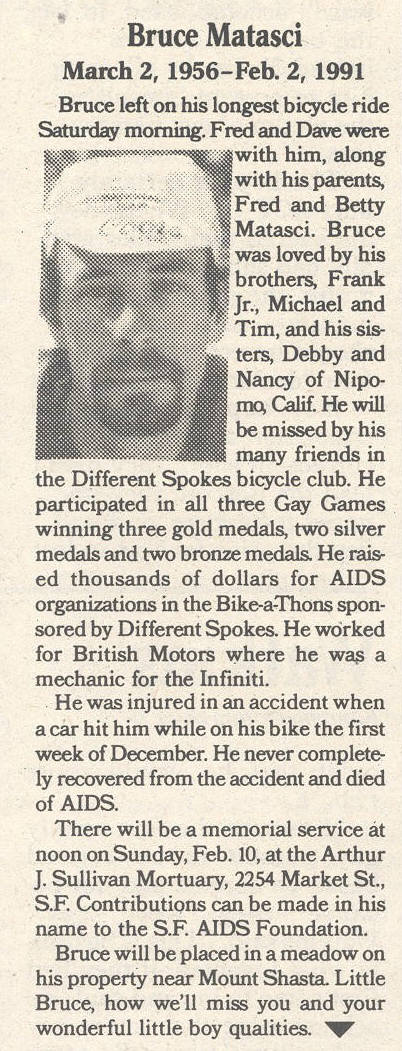
The First Bike-A-Thon Riders: Bruce Matasci

Dennis Westler, former Different Spokes President, wrote this obituary, which was originally published in the March 1991 ChainLetter. Dennis’ recollection of Bruce is spot-on. Bruce had the distinction of having having been a member of the Specialized Bicycle racing team and having raced against a young Greg Lemond. He was the cyclist that many of us in the club aspired to emulate. I interviewed Dr. Bob Bolan about that first BAT and he recalled that he rode the event at full speed and that only one guy was ahead of him. He kept trying to reach this guy and never could—he just vanished up the road. At each rest stop he’d pull in just as this rider was taking off. He couldn’t remember who that guy was. Bob asked me if I was that guy! Uh no, it wasn’t me because I didn’t ride in the first BAT due to graduate school. Who was the ultra fast rider who got to Guerneville first? Bruce. And, as Dennis mentions Bruce had a fist full of Gay Games cycling medals as his palmares! Bruce’s BAR obituary is found here.


In Memoriam, Bruce Matasci 3/2/56-2/2/91

Out on my bicycle last weekend, in every strong graceful cyclist who approached, I thought I saw Bruce. And I had to tell myself over and over again that he was gone.

Back in the early 1980s when I joined Different Spokes, bicycle racers seemed like some godlike breed. I would see them training in their bright, tight clothes. They never seemed to smile; they would snarl at you as they passed. I loved the sport, but the practitioners of it seemed so awful.

And then there was Bruce—smiling, kind of quiet, but friendly. Fiercely competitive but so full of enthusiasm for the sport, he would always offer instruction and encouragement. He was attractive. He was effortlessly masculine. He was licensed! Here was a racer with no chip on his shoulder.

I remember riding with him in the road race in Gay Games II. I had been training furiously. We were both riding in mid-pack. The race was hard and exciting, and to me it was amazing to be able to keep up with him. In the last 200 yards, he put on a sprint and just sailed off. Hammering ’til I thought I’d bust a vein, I couldn’t stay on his wheel. That man was strong!

I remember the first Bike-A-Thon, riding up to the Russian River. That night Bruce, Walter [Teague], and I were driven to a party way out in the country. It was to honor the participants, we were told. Unbeknownst to us it was a radical faery collective. Surrounded by men in fanciful costume and aboriginal makeup, we were afraid to touch any of the food or drink for fear they were laced with psychedelics. As the group began some bizarre ritual led by a man seated inside a pyramid of saplings, we knew we had to leave. Bruce, Walter, and I walked miles back into town in the rural darkness, talking and laughing, and I felt close to Bruce for the first time.

I remember riding with Bruce in last year’s Bike-A-Thon. He had not been training heavily but was still able to work my butt off. He probably already knew at that point that his health was declining but he chose to tell no one but his partner Fred. He went to the Games in Vancouver despite his knowledge, and was triumphant as he had been in the two previous Games. The last time I rode with Bruce, he seemed as strong as ever. Early in December he was struck by a car while riding, and never really recovered from the accident. He died from complications of HIV infection.

I will remember Bruce for the rest of my life for many things—his humor, his skill, his honesty and clear sight, his ability to care, his big legs. I will see his image when I strive to be better on my bike. And I will see his image when I strive to be better as a person.

-Dennis Westler

The First Bike-A-Thon Riders: Dr. Bob Bolan

Today we have the AIDS LifeCycle as the main cycling event that raises money for the San Francisco AIDS Foundation and which involves the participation of literally thousands of riders. But the progenitor of the LifeCycle was the Different Spokes AIDS Bike-A-Thon, which began in 1985, 30 years ago. As I mentioned previously in the ChainLetter blog, just 63 riders completed that ride. They were the ‘pioneers’ of bicycle AIDS fundraising . But who were those riders? I thought that current Spokers might be curious to learn more about some of those first BAT riders. Surprisingly only a few of them were members of Different Spokes. One of those riders was Bob Bolan who, although now living in LA and no longer a Spoker—but an esteemed DSSF emeritus nonetheless—is still avidly riding his bike at age 68 (although not the red Tesch mentioned below; the Tesch died in one of Bob’s hell-bent crashes and he’s currently sporting a Spectrum titanium.) Bob and I got to know each other especially well after we bought and rode a racing tandem in the mid ‘80s and early ‘90s when we routinely terrorized centuries. Bob was and is preternaturally fearless so he captained and I stoked, and that meant all the fear got thrown to the back seat. So I learned to close my eyes and trust that Bob would get down a steep descent or through an chaotic paceline in one piece. He even managed to steer us through a steep, curving downhill where we broke 56 mph!

The following club profile was published in the July 1989 ChainLetter. This was during the dark days of the epidemic before protease inhibitors were discovered, fundamentally changing the treatment of HIV disease, and when mortality was nearly certain. What’s Bob doing today? In his own words: “I’m Medical Director and Director of Clinical Research at the Los Angeles LGBT Center, where I have been for the past 19 years. I divide my time between patient care, administration, oversight of my large medical staff, doing research and working on local and national public health projects. These days I am mainly focused on HIV testing, linkage to medical care, the intersection between STDs and HIV, HIV prevention using pre-exposure and post-exposure prophylaxis and other risk reduction tools. I am married and my husband, Duke, is an RN who works at Keck-University of Southern California. Our two kids, Malcolm and Blair (American Eskimo dogs) round out our family and make for a noisy household in Pasadena. Things are very good. When my patients ask me nervously about my plans to retire I tell them not yet—I’m having too much fun!” And by the way, Bob has a few LifeCycles under his belt too.


Dr. Bob Bolan, the Man with a Mission

I’ve had the pleasure within the past year to get to know one of our more reclusive Club members, Dr. Bob Bolan. Although Bob and I have ridden together occasionally, it wasn’t until Bob diagnosed that we both suffered from Terminal Tandem Lust and a serious case of speed addiction last year that I really got to know him.

Bob rides the way he works: single-mindedly, efficiently, and fast. Having recently acquired a new red Tesch superbike, he is now burning up the pavement and making life rough for the other animals in the Club. You may see him in one of his new skin suits in a local race, or zooming up and down Mt. Tam on a weekend afternoon. Recently he completed the 100-mile route of the Bike-A-Thon and then the following weekend rode the Davis Double Century in 10 hours 25 minutes!

Who is this man who appears in a blur and then disappears up the hill at warp speed? In real life Bob is one of San Francisco’s hardworking AIDS doctors. A family-practice physician specializing in gay-related sexually transmitted diseases, Bob joined the front lines when the AIDS epidemic hit our community in the early 1980s. Bob has been an outspoken advocate for increased awareness of gay STDs both in the gay community and in the medical community. He has taught at UCSF, organized conferences, and written articles about both STDs and AIDS.

A clinician in San Francisco for over a decade with a mostly gay patient base, Bob has had firsthand experience of the devastating effect of AIDS. As you may imagine it’s emotionally stressful dealing with the daily onslaught of his patients’ chronic and debilitating illness, seeing death upfront, and with the Sisyphean task of fighting the AIDS crisis. Bob’s way of taking care of himself is cycling: ”Professionally it’s frustrating dealing with life, death, and deterioration. I feel ultimately powerless in the face of this disease, and bicycling is one way for me to be powerful and to assert my power and strength. The psychological benefit that it gives me is immeasurable.”

Although as a young boy he rode his bike on a paper route, like many of us fairies Bob was a pretty typical sissy growing up—he wasn’t athletic. He soon tired of being mashed by the bigger boys in sports such as football and put his energies into becoming a doctor. But Bob got bitten by the bike bug in the late ’70s when he was working in Madison, Wisconsin. In his cutoff Levis and tennis shoes, he would take off alone on day tours. Back then his longest ride was 45 miles, which seems paltry compared to what he rides now. “When I got home, my knees were so painful! I didn’t have any toe clips—didn’t even know about them. But shortly thereafter I got them to save my knees.”

After he and his lover Timmy moved to San Francisco in the late ’70s, Bob became a more serious cyclist. Since then he has increased his commitment to bicycling. He recognizes the important role of cycling in physical and mental fitness especially given his profession. Bicycling also helped him kick smoking and has kept the nicotine monkey off his back for the past eleven years. Nowadays Bob likes to do long, hard rides such as centuries. He’s not a big fan of touring or of mountain bikes because “you can’t go fast enough—I like to go fast!”

Other reasons why Bob enjoys bicycling so much: “I love to eat, and eat lots of junk food. When I ride I don ‘t have to be as discriminating in what I eat. But we older guys have to be careful because when we ride sporadically our appetites outlive our caloric requirements and then we get fat.” Bob’s favorite thing about bicycling? “Lycra on good-looking men.'” Now that’s something we can all get behind!

Social Ride: Brunch at Assemble!

Assemble 1
At Assemble for brunch!

Once the mainstay of the club the social brunch ride has fallen onto hard times. Whether it’s just the times we live in or unnatural selection we just don’t have many short ambles that involve dining rather than velocity and lactate threshold as the goal. There was a time when Leon’s BBQ—now long gone *sob*—across from the San Francisco Zoo was a common Decide ’N Ride destination. Nowadays Spokers prefer to ride longer, faster, and dine on Clif bars or quick and lackluster sandwiches. So Roger and I didn’t expect a big turnout. We had four RSVPs but then the weather, a rare rainfall, led us to postpone the ride to the following day and we lost a couple. DSSF old-timer Sharon Lum and relative newcomer Bill Knudsen ended up joining us in what turned out to be the perfect day for a bike stroll, a fabulous brunch, and a view from the new Bay Bridge.

Fortunately the weather turned out to be spectacularly beautiful—mid-60s, bright sunshine, and light breeze—making any trepidation about having postponed the ride on short notice melt away. For those who don’t know, Assemble is the restaurant in the old Ford assembly plant right on the Bay in Richmond. It’s conveniently located on the Eastshore section of the Bay Trail, a very popular, easy cycling route from Emeryville all the way to Point Richmond. Their signature dish is a chicken pot pie but also make a variety of American comfort foods using ingredients from their organic garden. The ride along the Bay Trail has nearly continuous views of the Golden Gate and the Bay, and wetland restoration has turned former garbage dumps into pleasant, natural retreats in our highly urbanized environment. Old-timers will recall that the area along the Emeryville section of I-80 was populated by junk and driftwood, which intrepid artists turned into whimsical sculptures; only a few remain today.

We met at Macarthur BART and rolled down 40th Street bikeway to the Emeryville IKEA, making our way under I-80 onto the Bay Trail. Because it was a sunny Sunday morning other cyclists, joggers, and strollers were out in force. But we weren’t hurrying the pace so it didn’t matter. Bill was recovering from a nasty cold, which was also keeping Wandersen too ill to ride that day. Sharon, who came out of cycling retirement for Derek’s Old Farts Confab a few weeks ago, really hadn’t been riding her bike in earnest for eons; she came up from San Jose because she was curious about the Rosie the Riveter Museum, which is next door to Assemble. The ride was essentially one long, ambling conversation. Bill and I rode mostly within earshot of each other while Roger and Sharon chatted quietly in the back. Consequently I didn’t hear much of what they were chatting about. I don’t recall all the details but Bill did recount his and Wandersen’s recent ocean cruise, the niceties of winter in Chicago, how he met Wandersen, and how icky his cold was. The excitement of the day was contending with the traffic going into Golden Gate Fields for race day. Although Roger and I had ridden through the horse track grounds many times it has never been on a race day and consequently it has been empty and barren. But not this day! Cars were streaming into their vast lot and filling it quickly. Golden Gate Fields also has the only hill on this section of the Bay Trail, a steep but mere blip.

Once at Assemble we didn’t have to wait long for a table. The interior is industrial chic and I was surprised it wasn’t jammed on such a great day; perhaps people were outside having too much fun? Roger and Sharon had the chilaquiles, Bill the sliders with fries, and I the fish and chips; Roger and I also split a bowl of potato kale soup. On paper they sound mundane but in execution Assemble’s dishes were definitely a notch above. Thusly sated we lolled a bit outside and peeked in the Rosie the Riveter Museum before heading back. Everyone decided to check out the Alex Zuckerman bike path onto the new eastern span of the Bay Bridge, so we rolled back through Emeryville into a stiff headwind coming through the Golden Gate. If you haven’t been on our very own ‘bridge to nowhere’, you’re missing something special. It’s about eight miles out and back, and if the weather is good (and it was) you’ll get unusual views of the Bay as well as an up-close-and-personal view of the deconstruction of the old eastern span. At the end you’re almost within touching distance of Yerba Buena Island. Signage indicated that the path is scheduled to be completed by this summer! I rather doubt it seeing that the gap between the existing path and Yerba Buena is still ‘challenging’. But when it is completed it will be a splendid ride out into the middle of the Bay and no doubt we’ll plan a fab brunch on Treasure Island!!

All Good Things Must Come to an End

Spokers,

It’s a fact of life that all good things must come to an end. So it is with the 2015 March Saddle Challenge. If you signed up for this year’s Saddle Challenge, please finish entering your miles cycled during March within the next few days. You can use the Saddle Challenge link on the DSSF homepage, or go directly to:
http://www.dssf.org/dssf_html/sc/

In addition, if you made a pledge, please mail a check (made out to Project Inform) to the DSSF post office box, so we can donate all money raised on behalf of Different Spokes:
Different Spokes San Francisco
P.O. Box 14711
San Francisco, CA 94114

Of course, even if you didn’t sign up or make a pledge, you are still welcome to make a tax deductible donation to Project Inform as part of the Saddle Challenge. Just send your check to the address listed above. We will forward all checks received to Project Inform.

Based on miles entered so far, I am pleased to announce that 11 riders have cycled a total 4,435 miles in March and raised $493 for Project Inform. Congratulations and thanks for participating!

Sal
President, DSSF