Den Daddy’s Secret Old Farts Confab

Old Farts!
Old Farts!

Perhaps there is no greater sin in the gay community than to become old. Lord knows there’s only so much good a jar of pearl cream can do before one is forced to throw up one’s arms in exasperation and don a veil. Or just hide. And hide we did, sort of, until at Derek’s behest this past Sunday a rather exclusive gathering of old (in both senses) Spokers convened over in the East Bay at—where else? Rossmoor!—for a ride, a nosh, and to catch up on the latest personal news (“So, what have you been doing for the past 25 years??”) I don’t know when this evil idea of an old farts confab first came to Derek. But as part of his bucket list he wanted to pull together as many Spokers from the early days of the club as he could locate and, as he put it rather unartfully, “After having been the ‘old guy’ in the club since the early days of the club, I wanted to see how all of you would feel when you were finally old!” To add insult to injury, he opined, “And some of you don’t look half bad now that you’re old!” Ah that Derek, such a card.

It wasn’t listed in the club ride calendar, as if it would have mattered since almost none of the old Spokers are still members or would even bother to look at the club website. But through word of mouth/email almost thirty of us showed up for a leisurely ride to Danville and up to Blackhawk for a coffee stop before returning back to Rossmoor for a post-ride nosh ‘n josh with a few others who forwent the ride. There was a lot more grey or white hair (or lack entirely thereof), widening waistlines, and creaking joints than your typical Different Spokes ride. For the most part these old Spokers could still turn the cranks but maybe it was at a more casual pace than one tends to find on club rides these days. Derek may have been the oldest in years. Those of us who were in our twenties or thirties when Different Spokes was formed are now older than Derek was when he joined in 1983!

In any event, the purpose of the ride wasn’t to lay waste to each other in anaerobic battle as it was to schmooze and socialize. When was the last time you did that on a club ride? We went down the Iron Horse Trail to Danville and then up Camino Tassajara to Blackhawk where we stopped at a Starbucks for refreshment. I suspect some of the livery we were sporting would either elicit guffaws or strange looks in the club nowadays. Yes, there were a few ‘contemporary’ bikes—Matt O’G’s carbon Tarmac probably being the most recognizable—but they were far outnumbered by the old school road bikes—for example, a couple of Vitus 979s, ancient Cannondale aluminum steeds, a mid-90s LiteSpeed, a lugged steel Guerciotti—and the old school mountain bikes (yes, we used to have a very active mtb group) with nary a bit of suspension or hydraulics in sight. Even some of the garb was old school: t-shirts, Bermuda shorts, tennis shoes; Eric Jansen sported the original club jersey from 1988, a true relic of the age (he also rode an original Bridgestone mtb, a brand that was probably the most popular in the club during the late ‘80s).

And what would a club ride not be without at least someone getting dropped and getting lost? That fate befell Tom Jewell and Paul Quintilian, who eventually made their way back to Rossmoor, their SF sense of navigation having been temporarily derailed by the lack of fog and Muni tracks. We followed Derek into Rossmoor proper and reconvened at the Rossmoor Gateway Club, where we met those who chose not to ride, for more refreshments and more chatting.

I won’t bore you with the entire guest list. There were many who couldn’t make it for one reason or another anyway. Peter Renteria was the only original club founder who could come, along with his husband Kevin, who met through Different Spokes and then vanished. (Me: “When was the last time you guys rode your bikes?” Kevin: “About 23 years ago!”) Dennis Westler, who was President for umpteen years in the late ‘80s and ‘90s showed up; he now leads rides for Performance Bike. Almost everyone present had ridden in at least one Bike-A-Thon; someone there had ridden in them all. Many had been in a club leadership role at some point such as board members, BAT coordinators of various flavors, and plenty of ride leaders. Joe McClinton and Rachael Ginsburg, both of whom used to lead tours for the club, came out as did Sharon Lum, who pioneered many now-eponymous standard club rides. There were a few original 1985 BAT riders: Karry Kelley, Paul Quintilian, Dennis Westler, and Peter Jenny. Strangely there were four ChainLetter ex-Editors in attendance: Doug O’Neill, Rob Bregoff, Don Lapin, and I. Overall it was an exceptionally involved group of oldsters.

On a personal note, not only was it a chance to reconnect albeit briefly with old friends but I also got an opportunity to chat with several Spokers whom I hadn’t had the pleasure of meeting before. In the back of my mind—and I suspect in the minds of others in attendance as well—were thoughts and memories of old Spoker friends who had passed on. Thirty-three years is ample time to lose many friends and club members. This was one last time to ride in spirit with them as well.
The First AIDS Bike-A-Thon

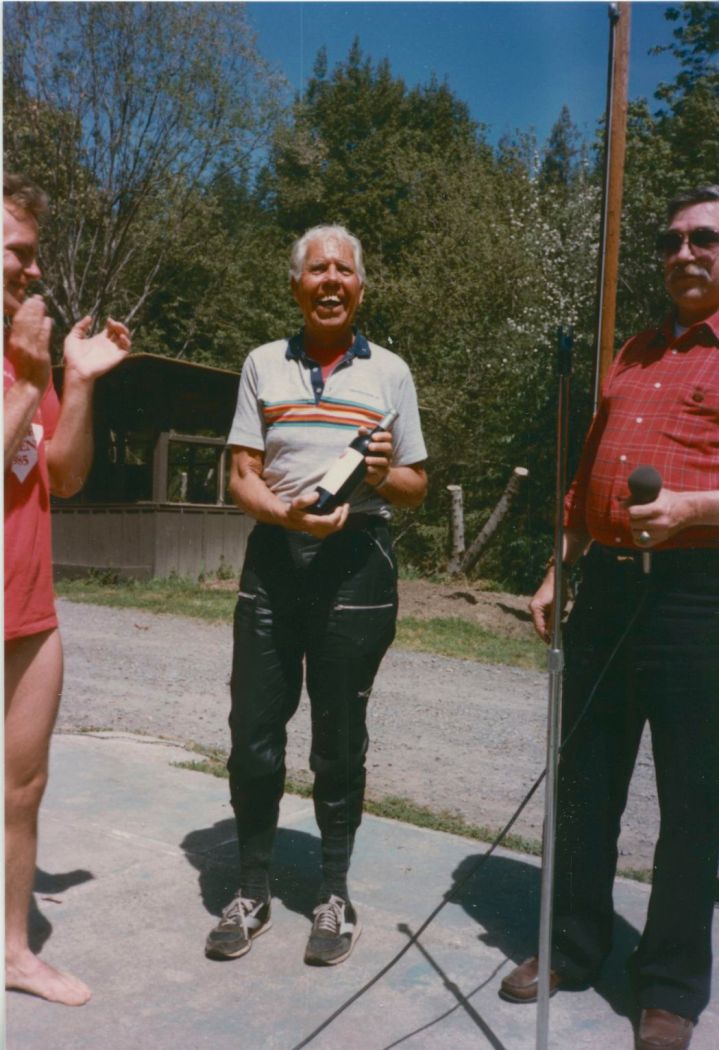
1985 BAT Gene Howard
Gene Howard, oldest participant in the first AIDS Bike-A-Thon

Those of us who lived through the early years of the AIDS epidemic recall tremendous fear and despair over a disease whose origin and potential cure were unknown, treatments just feeble stopgaps on the fast track to a final demise, and a constant background pall on the community with each passing obituary. There seemed to be nothing one could do except care for the ill and educate as many people as possible. But one thing people could do was raise money for services and out of this the AIDS Bike-A-Thon was born. The first AIDS Bike-A-Thon (BAT) took place on Saturday, April 6, 1985—30 years ago. By today’s standards the amount raised, $33,000, seems paltry; but at the time it was a substantial bonus for the fledgling SF AIDS Foundation. According to Karry Kelley, the 1985 BAT was the largest amount for AIDS work ever raised at a single event in SF and the subsequent BATs were the largest fund raisers for the AIDS Foundation until the Foundation began the AIDS Walks in 1987. Different Spokes went on to put on nine more BATs before passing the event on to Ruth Brinker’s Project Open Hand; under its aegis it lasted just one more year.

Although Different Spokes played the central role in the initial Bike-A-Thon and its subsequent success, contrary to lore we did not invent it. The San Francisco AIDS Foundation, founded in 1984, approached Different Spokes in February 1985 for assistance and advice on how to run a bicycling charity event in order to raise funds for its operations. The AIDS Foundation was not yet the mainstream behemoth it is today and like many non-profits was dependent on donations. After several meetings between the AIDS Foundation and club officers, the Bike-A-Thon fundraising ride was announced for April—just a little over two months later. Bob Humason, then-President of Different Spokes (and who later was himself to die of AIDS), along with Michael John née D’Abrosca, past President and ChainLetter Editor-in-Chief, were the main forces behind club involvement and working with the SF AIDS Foundation.

Because the BAT was pulled together so quickly it was somewhat slapdash, yet the last-minute event managed to be a success, firing the imagination and zeal of participants—many of whom went on to organize and run subsequent BATs—as well as the San Francisco gay community. Keep in mind that subsequent BATs usually took 11 months to be planned and organized! In retrospect two months to pull off a never-done-before charity event was incredible. Within the club BAT was advertised and pushed for only one month (!) before it took place, a very short time to pull in riders for a 100-mile ride, nonetheless 63 riders managed to take to the road—not bad for an initial effort. In those days Different Spokes was a very small cycling club, so finding people to do a 100-mile ride just from within the club wasn’t going to be sufficient. The main form of recruitment and PR was an information and pledge table set up in front of “Hibernia Beach” on weekends for the month before the ride. [Note for you youngsters: “Hibernia Beach” was the corner of 18th and Castro where the Bank of America now sits, formerly the site of a Hibernia Bank branch, a local SF institution.] Perhaps it seems amateurish today—more suitable, say, for selling Girl Scout cookies—but it somehow worked.

The AIDS BAT wasn’t the first charity event for AIDS/HIV by far nor was it the first mass cycling event to raise donations (the first Multiple Sclerosis Society charity ride took place in 1980). But using cycling was a new idea for the Bay Area. Mass cycling events in the Bay area to date were primarily club centuries not directly concerned with raising funds for a cause (other than the clubs’ coffers), and cycling certainly did not have the sexy public profile it now has. In those days it wasn’t so much skin-tight Lycra as it was white tee shirts and Bermuda shorts; carbon fiber bikes were a mere twinkle in the eye, and aluminum was the ascendent “wonder” frame material.

The ride was called “Pedaling for Pride in ‘85”. To encourage riders there was no registration fee (although you had to register in advance). The only material reward for participating was a commemorative tee shirt and overnight accommodations in Guerneville. The club did organize sag support and first aid. Jerry Walker, who was then the owner of the Freewheel Bicycle Shop on Hayes Street and also a club member (he later was Vice President and eventually also died of AIDS), provided repair services. There were rest stops at 25-mile intervals and checkpoints every 12 miles to make sure everyone was all right.

The route was almost the same as the club’s Guerneville Weekend ride: north up Highway 1 all the way to Jenner and then east on River Road to Molly Brown’s Saloon in Guerneville (the traditional Guerneville Weekend route goes through Occidental to River Road instead). Those hills on Highway 1 took their toll: not everyone made it to Guerneville. But most did and the last one in is the gentleman pictured above at the awards ceremony, Gene Howard, then in his 60s. I recall club members Jim King and Tom Walther, who were considerably younger than Gene and who were barely ahead of him, swearing that they would make it all the way to Molly Brown’s before Gene—darned if they were going to let an “old” man beat them!

The following day there was a big party at the Woods Resort where prizes were awarded under beautiful, warm, sunny skies. Instead of leaving riders to fend for trips back to SF on their own, the BAT kindly arranged car returns for everyone and their bikes.

Instead of calling it a day, the aftermath of the first Bike-A-Thon was tremendous interest and energy in pulling together a second event, this time entirely under Different Spokes auspices. In order to pull off an even more successful event the organizing structure, although entirely volunteer and unpaid, became more formal with the appointment of a BAT Coordinator and committees to make sure all aspects of the event—publicity, fundraising, pledge collection, training, recruitment, facilities, etc.—were on track. Instead of the SF AIDS Foundation being the sole beneficiary, the club decided to recruit community-based AIDS organizations as recipients, a practice that continued until Project Open Hand took over the event. The club went on to organize a total of ten BATS before it burned out and passed the event to Open Hand.

Bike-A-Thon had a generative impact on Different Spokes. The event created a tremendous amount of energy and enthusiasm and in return the goodwill from the event led to a much higher community profile and our highest membership numbers ever, nearly triple the current number. But as the AIDS crisis continued, running BAT took a toll on the club. Partly it was the volunteer nature of the event: unlike almost all charity events, including the California AIDS Ride and the AIDS Lifecycle that followed BAT after its demise, the event was entirely volunteer run and supported by the club. Only in the last two years of the event’s life under Different Spokes was there recognition that the event itself needed to have some income in order to be well run and consequently made itself one of the beneficiaries. BAT was the primary focus of the Different Spokes for its entire run, needing nearly yearlong planning. Although it brought in new members and their energy, it also sapped the energy of the core leadership of Different Spokes. Eventually the club just ran out of juice as the core leadership either died of AIDS or moved on. What we have today is a legacy of community involvement and service that went beyond simply having a good time on a bicycle. Nowadays we have the AIDS Lifecycle that fulfills the same function as the original Bike-A-Thon. It’s a much flashier, well-organized, and successful charity ride, and like the BAT galvanizes and transforms at least some of the participants. There are many differences between BAT, the California AIDS Ride (also gone) and the Lifecycle. But a key difference is that for its first eight years every cent of donated money went to AIDS service organizations—the overhead was covered entirely by volunteer effort and goodwill: over $2.3 million. Now that’s a legacy worth remembering!

Saddle Challenge 2015 – Half Time Report

We’re now half way through the 2015 March Saddle Challenge. Beautiful cycling weather so far this month has led to a very strong start by the 13 participants. With people rapidly racking up the miles, it looks like we could well raise a record amount of money for Project Inform. So far, the participants have raised $336 out of an expected total of $916. Please help put us over the $1K mark; it’s not too late to sign up, enter your miles retroactively, and join the fun.

Based on miles entered into the SC Web site so far, the top 3 positions remain unchanged from the last report: David Sexton with 545 miles, Sal Tavormina with 435 miles and Gordon Dinsdale with 353 miles. Ron Hirsh and Will Bir have shown a burst of activity over the past week jumping into the 4th and 5th positions with 262 and 164 miles respectively. To round out the group that has recorded over a century, we have David Gaus with 159 miles, Jerome Thomere with 138 miles, and Nancy Levin with 100 miles. Rumor has it that some riders may be saving up their miles in order to enter them at the end of the month, so be prepared for a wild, unpredictable, and exciting finish!

As a reminder, the Saddle Challenge is the Club’s annual event in March to challenge each other to get out on our bikes and ride! Choose a goal for yourself: 100 miles, 300 miles, 900 miles…! Whenever you come back on the SC page, you’ll be able to log your miles, watch your progress and see what other members are doing.

The Saddle Challenge is also a way for members to raise money for Project Inform where Ron Wilmot, a long time DSSF member who started a fund-raising ride, the Ron Wilmot ride. You can choose to pledge per mile or a lump sum. Of course this part is entirely optional.

Other stats: 2,354 miles have been ridden so far towards the total goal of 5660 miles.

Happy riding!

MARCH 2015 SADDLE CHALLENGE – Week 1

So far, 13 intrepid cyclists have signed up for the Different Spokes March Saddle Challenge. We’re on target to raise $916 for Project Inform! Please help us reach an even $1K. Remember, it’s never too late to join. Just go to http://dssf.org/dssf_html/sc and enter your first and last name, and the password and then you can retroactively enter your miles for the month. To get the password, send an email to: president@dssf.org

At the end of the first full week of cycling, David Sexton is out in front with 346 miles! Sal Tavormina is a distant second with 217 miles followed by Gordon Dinsdale at 171 miles. Two more cyclists have ridden a century or more, Nancy Levin and David Gaus, with David Goldsmith close behind at 97 miles. Other riders who have entered miles include Evan Kavanaugh, William Bir, Jerome Thomere and Ron Hirsch.

With mileage goals varying from 100 miles for the month (which is 25 miles a week, quite doable), up to 1000 miles, the Saddle Challenge makes it easy for any member to participate and not feel like they have to be a fast or high mileage rider to compete.

As a reminder, the Saddle Challenge is the club’s annual event in March to challenge each other to get out on our bikes and ride! Choose a goal for yourself: 100 miles, 300 miles, 900 miles…! Whenever you come back on the SC page, you’ll be able to log your miles, watch your progress and see what other members are doing.

Don’t forget: every mile counts. So, if you commute with your bike, it’s even better!

The Saddle Challenge is also a way for members to raise money for Project Inform where Ron Wilmot, a long time DSSF member who started a fund-raising ride, the Ron Wilmot ride. You can choose to pledge per mile or a lump sum. Of course this part is entirely optional.

Other stats: 1,264 miles have been ridden so far towards the total goal of 5535 miles.

Happy riding!

October 2014 DSSF Board Meeting Minutes

Date: Monday 20 October 2014

Time: 6:30 pm

DSSF Board Meeting Minutes: Sal Tavormina / President , David Gaus / Vice President, Ron Hirsch /
Treasurer, Roger Sayre / Secretary, David Goldsmith / Ride Coordinator

1. Call to Order – Sal called the meeting to order at 7:03pm

2. Public Comments – No public comments received.

3. Approval of Minutes – Minutes from the Board meeting of 6/18/14 were approved without comment

4. President/Membership Coordinator’s Report

a. Sal noted that DSSF currently has 122 paid members for 2014.

b. Sal also updated the Yahoo Group and it now has 73 members.

c. 2015 membership renewals: Sal will send out a membership renewal notification in early December prior to the holiday party. A second membership renewal notice will be sent out in early January.

5. Treasurer’s Report

a. Financial report: Sal thanked Ron for his work. Current financial status is: $5,200 in total current assets
$200 in income from membership dues since May. Income from membership dues has dropped in the last few months as it typically does during the latter part of the year.
$750 in income was generated by the “Jock Sunday” event at the Lookout

b. Ron will find previous years budgets for the holiday party. It was around $1000. In the past the policy has been to charge attendees a nominal sum ($10) to help with expenses. Sal would like to see if it’s possible to not charge people this year.

6. Ride Coordinator’s Report

a. The ride calendar is looking good for the rest of the year. Rides have been well attended.

b. There have been 12-15 people lead rides this year as compared to 25 ride leaders last year.

c. David Goldsmith would like to coordinate a ride leader appreciation dinner for sometime in January. He suggested a Chinese restaurant with a per person cost of $15-$20. Sal will be out of town from November 20th to mid-January, so won’t be able to attend before late January.

7. Web/Blog Editor’s Report

a. Jerome was unable to attend the meeting so there wasn’t any report

8. Secretary

a. Schedule for 2015 board elections: An email will go out to all DSSF members on December 1st requesting nominations for board positions. Nominations need to be submitted by December 31st. A second email will go out on January 1st announcing the candidates for board positions and requesting that members vote for each position before January 31st. Election results will be announced February 1st.

b. Ideas for recruiting people to run for board positions. Current board members indicated a willingness to continue on in their current positions for another year if no new candidates step forward, but new blood is needed. In addition to the board, several other positions remain unfilled. Ron will talk with Will Hayworth about possibly taking on something like membership or ride coordinator. Sal will speak with Bill Knudson to see if he’d be willing to take on a position. Jeff Pekrul also expressed interest in becoming more involved, perhaps as treasurer. Other people to approach about possibly becoming more involved might be Jacob Morgan, & Steven Sherrifs

c. David Goldsmith would like someone to replace him as ride coordinator.

9. Special Events for 2014

a. The events coordinator has been unfilled for the last year so there’s no one to plan special events. Brendan Patrick has indicated he might be willing to take on this job at some point in the future, but he’s unable to do so at present.

b. The DSSF holiday party is scheduled for December 13th after the monthly Jersey Ride. Jeff Pekrul has offered the use of his home for the party. Someone else will need to arrange for the food and clean up. Sal will contact Joseph Collins to ask if he’d be the point person in organizing the party. Chris Contos could be able to help if Joseph is unable to organize the event. David Gaus will email Sal contact information for the caterer that was used previously. In previous years DSSF also paid for the clean-up after the party. In order to make arrangements we need to get an idea of the number of attendees. Sal will send out invitations through Yahoo groups asking for an RSVP. Previous years have had 25-30 attendees.

c. There was discussion of whether DSSF should have a booth at the Pride Festival in June 2015. The general consensus amongst the board members was that having a booth at Pride was a lot of work and cost (roughly $600) for not much benefit. Participation by DSSF members has been declining over the last few years, and it hasn’t been particularly effective in attracting new members. If any DSSF members feel strongly that DSSF should continue to have a presence at the Pride Festival they’re encouraged to contact a board member to discuss. David Goldsmith suggested that an alternate possibility would be for DSSF to sponsor an on-screen ad at the Frameline film festival as a way of doing outreach during pride week instead of having a booth at Pride. The cost would be around $1,500 and includes “on-screen recognition” and two gold-level passes to the festival that could be sold or raffled, making the actual cost somewhere in the neighborhood of $1,000. The general consensus was that the potential benefits weren’t worth the time and expense.

d. Big Sur Ride: David Gaus spoke with Julie Brown and they selected the weekend of Sept 26-27 for a ride down the coast to Big Sur. These dates conflict with the DBD. Due to small group of riders in this year’s DBD there’s some uncertainty whether the DBD will be continued next year. David will discuss it with Chris Thomas. Organized rides must stay under 50 participants, otherwise permits are required. DSSF will need to pick up $140 cost for liability insurance. David Gaus will organize a series of training rides in the spring

e. A ride leader appreciation dinner will be scheduled for January 31st 2015

f. Weekend trips: Due to the vacancy in the event coordinator position, DSSF has gone for 2-3 years without a weekend trip. A weekend trip to Lake Tahoe used to be an annual event many years ago. Tony Moy has tried on several occasions to revive this trip but has had difficulty finding accommodations able to house a large group. Tony says that the large home rented for previous DSSF weekend trips has been unavailable for several years, but is available again. Tony also sent out an email via Yahoo Groups suggesting a weekend trip to Solvang.

10. Other Business

a. David Gaus distributed a “Safety & Group Etiquette” pamphlet that Sport’s Basement uses for the group rides they sponsor. Sal will review and edit, and have Jerome post to the DSSF website.

b. DSSF Apparel coordinator, Bob McDiarmid, previously reported that Primal Custom Cyclewear – DSSF’s vendor for the team kit – is running a special on custom kits – reducing the minimum number of orders required to ten pieces. (meaning one jersey and one bib = two pieces). He posted a poll on our FB group page earlier this year to determine interest. Sal will follow up with Bob McDarmid about whether there’s enough interest to put in a jersery order. DSSF hasn’t had tee-shirts many years, so we might want to consider coming up with a tee-shirt design and include that with the order.

c. David Goldsmith mentioned that he’d been talking with a DSSF member who’s on the board of another organization that’s been using “Wild Apricot” software to do many of the things DSSF needs done. They’re apparently quite happy with the software and suggest that DSSF might want to consider it for our needs. The thought is that it would integrate into one software platform many of the functions that DSSF currently has on different software platforms. There was a consensus that this would be worth further research.

11. Next Meeting

a. Sal will schedule a meeting for sometime in February after he returns from vacation in mid-January

Antisocial Darwinism: Survival of the Fittest?

Howard Neckel was one of the original members of Different Spokes when it was founded back in 1982. I recently found out that Howard was no longer a member and wanted to find out why after 32 years he no longer was a part of the club. In his own words here is what he related to me—

It’s been a while since I’ve realized that I’m just not in the kind of shape I was when I was younger. As much as I’d like to ride with other gay cyclists, I just can’t manage to keep up with the ones in DSSF.  A great many of the posted rides are in the 70+ mile category, but even when I try the shorter ones I get dropped. The core group of Spokers are very strong riders, and weaker riders like me get left in the dust. After a few repeats of that scenario, you ask yourself what the point is of participating in a club ride because you’re essentially riding solo after a quick hello at the start. It’s a sad fact of life but I have deal with the fact that I’m 67 now and not the rider I was even ten years ago, and certainly not when I first joined the club. I simply don’t “qualify” for DSSF rides anymore. It’s a shame since they’re right here in town and it’s a gay club—two big pluses. But almost all the club’s rides target the core group of really strong riders. The club doesn’t have a contingent that accommodates older, slower folks like me. That may also hold true when it comes to slower-but-NOT-older riders, for example those new to the sport who might not yet have built up a lot of speed and endurance. As a result I’ve been riding mostly with Western Wheelers. Their club is large enough that the guys who really like to burn rubber plan their own separate rides; those who like to go at a more leisurely pace with social regroups plan theirs. Actually, many rides manage to accommodate multiple skill levels simultaneously by having a slightly earlier start time as well as longer routes for the stronger riders. The multiple routes will often intersect either for lunch midway or for snacks at the end. Personally, I tend to ride with the middle (and sometimes low-middle) skill range and that allows me to talk to folks along the way and at regroups, several of whom I am happy to count as good friends now.

Unfortunately Howard’s experience seems to be shared by quite a few members and participants. Over the years I can’t count the number of times I’ve spoken with cyclists about why they didn’t come back to a Different Spokes ride or rejoin the club and with them expressing the same frustration as Howard’s: they were dropped at the beginning of a ride and ended up riding alone or riding at a faster than comfortable pace to keep up, and otherwise just didn’t get a chance to socialize with other Spokers. In fact you have only to look back to 2012 on this very blog to see the same comments mentioned by others. Those new riders who do keep up perhaps get the kind of social experience we are all looking for and consequently they might come back. They get positively reinforced because they are stronger (or more stubborn) riders. Similarly for women cyclists, they might come on a ride, see that there are very few or no other women, and then not come back. Perhaps given the dearth of dirt rides over the past ten years mountain bikers also eschew coming to Different Spokes. The result is the same: we end up with a club with the same kind of members it already has, i.e. fairly fast, or at least very avid, male road cyclists.

This wasn’t always the case. When Chris LaRussell was President, it was no surprise that having a female leader helped raise the club to near gender equity with about a 40% female membership [I believe this may also have been the case when Cathy Cavey was President in the ‘90s]. There also used to be a very active dirt contingent—why it has faded away is not clear to me. But dirt riding ascended in the early late ‘80s precisely because there was a core, active group of riders including the President at the time, Dennis Westler. It may be lost on the current membership that the original core group of Spokers were touring cyclists, not racers or wannabes. Those early club rides for the most part took place at a friendly pace with just a few animals off the front. However one aspect that has changed over the years is the age distribution. In the ‘80s the club was heavily skewed towards the twenty- and thirty-something cohorts. The number of older cyclists (older than 60) was very small—who remembers Gene Howard or Walter Teague? But those younger riders have aged up and gone grey and like many clubs, cycling or otherwise, the age distribution has shifted upward. Even our current President is a retiree!

Howard is right though: the club’s rides target the faster riders precisely because they have stepped forward to lead more rides. When a free weekend day to ride is a precious commodity, you want to do rides you enjoy and not rides you might do out of a sense of obligation. You can’t fault folks for doing what they want to do; after all, being a club member isn’t like your job (or your family!) where sometimes you just have to do things even if you don’t like it. And being a small club naturally makes it harder to cater to and invite the kind of diversity we’d like to see. The general rule of thumb for volunteer organizations is that ten percent of membership will step forward and do the work. That means of our 130 members about 13 people are club officers, ride leaders, and volunteers who do the work that makes a club run and survive. That’s not a lot of people to cover all the bases, is it?

Yet the quandary is that we’re all the worse for it. The club is supposed to be an umbrella for all LGBT cyclists, not just fast ones. How can it welcome all of us if it offers nothing to the majority of cyclists? The club takes on an increasingly one-dimensional mien that just turns off other riders and drives them away rather than towards us. At some point this becomes a self-replicating process. Think about it: it takes a abnormally committed and perhaps somewhat crazy person to come to the club and say, “Well, this club doesn’t offer what I want, so I’m going to jump in and change it!” Yet that’s what we seem to be saying, i.e. “If you don’t like it, well then roll your own!” A normal person would walk away and keep looking, and that’s exactly what most new riders (and now some old-timers) seem to be doing. Fortunately for Howard he’s found another club where he feels welcome and that seems to have embraced him with open arms. The irony and sadness is that we, a LGBT club, don’t have something to offer the Howards out there. Of course, if you’re happy doing the rides that the club currently offers, the answer is you do nothing because the status quo is perfect in meeting your needs. So nothing changes.

But for those on the margins of the club or even for those of us more actively involved but disturbed by this trend, is there a way out of this quandary? There’s a part of me that thinks that not only does it not have to be this way but that we as a club actually do have a responsibility to change it. I don’t believe that our current state is an inevitable step in the evolution of our club. I ride infrequently with Different Spokes, but I do manage to show up on a few B or C rides every year and even the very infrequent A rides (I mean, other than the ones that Roger and I lead). Occasionally there are new faces that I never see again, and I wonder why. Were they simply “bees” that flit from flower to flower all the time or did they just not have a good time with us and why? We rarely get post-ride verbal feedback from those who *don’t* come back; of course, not coming back is feedback, n’est-ce pas?

I don’t know what the solutions should be. For the Howards out there, their solution is more clear: roll up one’s sleeves and try to change Different Spokes or move on to a club that offers rides that meet your preferences. Unfortunately there aren’t any other LGBT clubs in the Bay Area, so you end up riding with “straight” clubs. It would be lovely if some in the club were just to step forward and say, “Okay, I’ll do it.” But I think that’s not likely to happen given the current lethargy. However if you are a member and want to see things change, it doesn’t hurt to take the initiative to make it so. If you want to see more leisurely paced rides, why not volunteer to lead one? Perhaps those of us who’d like to see more “A” rides on the ride calendar should start talking to each other about planning and co-leading rides. You don’t have to do it alone. It won’t change unless either we do it or we luck out and the Messiah miraculously shows up to lead us. If you’d like to see more diversity in our ride listings, give me a holler, speak out on the blog, or comment on the DSSF Yahoo! group site.

Fading

IMG_0056

Autumn in northern California is always a strange time, a neither-fish-nor-fowl period. If you think for a minute, you’ll realize that we don’t have four real seasons here; it’s more like three seasons: a short, green spring; a dry, dusty brown summer; and a wet (we hope), cold winter. This year was no different. The transition period we call ‘fall’ was practically nonexistent, as we had a hot Indian summer followed by a perfectly warm period with plenty of sunny days. Riding this fall has been decidedly excellent because of blocking Pacific highs sending almost all the rain into the Northwest keeping us dry and giving us plenty of enviable riding days. And in Contra Costa where I live, we went from blistering heat in October to November days that were warmer than summer in SF! Well, it has all come to an end. I finally had to don knickers and a long-sleeved jersey this week.

But not before we had one last blast up Morgan Territory and Mt. Diablo last Saturday. Morgan Territory Road is one of our few remaining Road Less Traveled routes, at the margins of Bay Area urbanization and dangling by a thread from becoming just another subdivision. Just down the road are Clayton and Concord, and probably what’s keeping Morgan Territory from being invaded is the current lack of water. But for now it’s ours and it provides a beautiful experience of what the nearby San Ramon and Diablo valleys were like a mere 30 years ago before Walnut Creek, Danville, and San Ramon engulfed all the open space. (Yes, it’s difficult to imagine now but in the ‘80s we simply crossed over the Berkeley hills to ride on country roads.) David Goldsmith led the four of us up Morgan on what has become a fall tradition. Summer on Morgan Territory is like a friendly visit to a furnace—not the best time to go—but fall is perfect if you don’t have rain—it’s not boiling hot, the weather is kind, and the leaves are turning, giving one a taste of what Easterners experience annually (and tenfold in grandeur). When you’re not anoxic and semi-conscious because of the 14% and 16% bumps on the climb, you’ll realize that you’re all alone on a beautiful, winding road surrounded by trees turning luscious colors. At the top, Morgan Territory Preserve, you’ll find a view of Mt. Diablo from the south and a panoramic vista towards the Livermore valley. For the most part we lucked out and the sky was clear allowing for great views. But as we rested at the Preserve and ate our snacks the moist air driven up the west side of the mountain was condensing and clouds began covering the hillside. Chilled by the breeze we set off on the descent to Highland, which sadly always ends in a frighteningly fast blink of an eye. All that altitude gone in minutes aided by a double-digit grade, the near complete lack of traffic, and decent sight lines that only made us accelerate with abandon. After lunch at Domenico’s in Danville, David made us climb up Diablo for more fall fun. By now it was cooling off and all my clothes went back on despite the uphill. It was still sunny but the autumnal heat was now gone. David and David continued on to the top while Roger and I descended back to BART. A good end to a near-tropical “fall”: an all-day, 82-mile ride with friends. Next stop: winter rain riding!

Tantalizing…

IMG_0053

There it is in the photo: the new Carquinez Scenic Trail, beckoning… I shot that photo through the locked gate at the western end of the trail a couple days ago. Carquinez Scenic Drive, the long abandoned county road connecting Crockett and Martinez above the Carquinez Strait, will soon be reopened. It could be open for public use as early as this Friday, Halloween, but no later than Saturday, November 8. The road was closed to car traffic in 1983 and left to decay. But it’s always been open to pedestrians and cyclists willing to hazard the narrow, winding road with broken asphalt and missing sections due to storm runoff. Like a vision out of “Planet of the Apes” it was civilization returning to its original form—large weeds sprouting up between the chunks of road, rusted signs, and a slow, crumbling ambience. A few years ago the East Bay Regional Parks District agreed to assume control of the road and the final stages of resurrection are complete. The road has been rehabilitated, the cliffside stabilized, and striping freshly painted and signs erected. Cars will still be banned and the road is even being incorporated as part of the Bay Trail.

Riding along Carquinez Scenic Drive was one of the popular rides in the early days of Different Spokes when it was called “the Port Costa Loop”. In fact the ride was offered for the first time in March 1983 perhaps because the road had been closed and suddenly was a lot more cycle-friendly.

In a way it’s sad that it’s been “improved”. The road has mostly intact albeit crumbling but it was easy to cycle on a road bike. The sections which had slid away were easy to roll over although one might never know from winter to winter how much of the thin trail would still be intact and the only “damage” would be a little bit of mud on your bike if it were wet. The views along the cliff are nothing short of spectacular on a sunny day and shouldn’t be missed. At least now more people will be able to enjoy them.

Carquinez Scenic Trail

On Saturday November 22, assuming the weather is favorable, we’ll roll out from Orinda and take in a big loop through West Contra Costa County and check out the renovated Carquinez Scenic Trail, née Drive. You’ll also be able to ride through historic Crockett, home of C&H Sugar, and go up the back (easy) side of Pig Farm before tackling the Three Bears. Of course, you’re free to check it out yourself beforehand if you can’t wait!

For more information, go here.

2014 Fall Social Recap

Group

We had a big turnout for this year’s Fall Social at Phil Bokovoy’s house in Berkeley. The last hurrah of excellent weather must have encouraged a spate of Spokers to roll over to the East Bay for the traditional rides, the ever-popular Three Bears and the beautiful Rosie the Riveter stroll by the Bay. This year’s Social took place about a week earlier than usual and that may have had something to do with the sunny, warm conditions during a time of year when things could go either way, “earthquake weather” or the onset of a cold autumn. Fortunately we had the former and that made lolling in Phil’s backyard especially comfortable and convivial. Having the event a week earlier also meant that it didn’t have to contend with the after effects of a Halloween Saturday in the Castro!

The Rosie the Riveter ride, which had been dwindling in popularity in recent years, had a resurgence of interest as seven folks took in the spectacular views along the East Bay waterfront. David Shiver and his son Roberto came along as usual. Years ago Roberto first started coming in a buggy towed behind his daddy’s Cannondale; he then graduated to a trail-along, and now he’s on his own bike, a mini-mtb. A slightly larger group of about ten folks did the Three Bears, and they managed to beat the Rosie group back to Phil’s although just barely.

Phil

Phil, as usual, butterflied and barbecued a delicious turkey, and we had a wide assortment of salads, appetizers, and of course yummy desserts including Jim’s homemade apple cobbler. The dish was slung while folks inhaled their dishes. You just had to be there. Thanks again to Phil for hosting the soiree [sic] and to everyone who contributed! Next stop: Holiday Party…

Dirt Riding

IMG_0044

Last weekend I did a club ride starting in Pescadero and out Cloverdale Road into the back side of Big Basin State Park via Gazos Creek Road. After arriving at the park headquarters it continued up car-free Escape Road, a bypass to Highway 236 (Big Basin Way), and onto China Grade and then down Butano Fire Road back to Cloverdale Road and the start. This was a 40-mile, mixed-surface ride–Cloverdale was of course asphalt, Gazos Creek Road was a dirt and gravel fire road, Escape and China Grade were decaying asphalt, and Butano was a dirt fire road. If you can’t find that ride on the DSSF calendar, it’s because the club wasn’t Different Spokes–it was Grizzly Peak Cyclists. There was a time when dirt riding was very popular in Different Spokes but off-road riding has, excuse the pun, fallen by the side of the road. And that’s unfortunate because off-road riding not only can be loads of fun but it’s a relaxing way to escape the ever-present threat of death/injury by car. When I’m riding on the road, there is always an energy-draining vigilance for wayward deathmobiles that makes the ride a little less calming and refreshing as I would like. I know there are a few Spokers out there who mountain bike because I’ve talked to you; if there are others, you are definitely keeping yourselves well hidden. Or, perhaps you just don’t look to DSSF as the right venue to get your dirt yayas? Maybe it’s time for a revival–how about posting a dirt ride on our ride calendar!

Riding a pure road bike such as a Colnago C59 wouldn’t be my first choice for going up Gazos Creek Road, but I did do the entire ride on my old commuter bike, a Redline “cross” bike. I simply swapped out the road tires for some 700×32 Continental Cross tires. The gearing was a little bit tall–the low gear was a 34×26–but I was able to stand and grunt until, well, until I had to get off and walk, which was a few times more than I’m used to because Gazos Creek has some short walls that were definitely greater than 15%. The State Park had also dumped gravel on these sections to stabilize them against erosion and that made them treacherous even when ascending at a measly four miles per hour. But walking is all part of the fun because you’re in the woods next to a trickling stream, no cars in sight, and no urban noise to spoil the experience. Heavenly! The nice thing about a road or ‘cross bike on a ride like this is that it was really a mixed-surface ride, partly on dirt and partly on various qualities of pavement. Having a road bike made the asphalt sections fly by and the bigger tires were perfectly adequate for fire road conditions (well, except the gravel parts). My fellow riders were all on “mountain bikes” (they had front suspension and I didn’t) but two of them were also used as commuters and had un-mountain bike-like tires. In the middle of the ride as we were resting at the top of China Grade at the start of the next dirt section, three young studs on road bikes zoomed past us heading the way we had just come. Drop bars, no discs or cantilever brakes, no triples. Just like Jobst Brandt! (Google that name if you don’t know who he is.) As we dropped down Butano Fire Road I could see their skinny tire tracks in the dirt. They had come up Butano on regular bikes, which goes to show that you can ride off-road on fire roads even with road tires. No big deal.

You don’t necessarily need a mountain bike to ride off-road. There is a hidden trove of dirt roads throughout the Bay Area and there are quite a few “mountain bike” trails that can be ridden with varying degrees of grace on a road or ‘cross bike. Mt. Diablo State Park has a warren of fire roads as does the Santa Cruz Mountains. The East Bay is blessed with the Regional Parks District, which includes Tilden, Redwood, Sibley Volcanic, Black Diamond Mines, and Chabot, all of which have fire roads which are open to cyclists. Nowadays fire roads and double-tracks merely elicits yawns from fat tire afficionados–“Give me single track, the gnarlier the better! Rock gardens? Yeehaw!” You might not be able to clean Eldridge Grade on your road bike but there is still plenty of off-road riding away from cars. Just keep an eye out for those dirt roads you pass all the time on your road bike and never venture to explore!