Orinda Pool Party Recap

We had a packed house for the Orinda Pool Party last Sunday. I’m not sure what provoked more people to sign up this year—we had 30 people express interest in attending. The typical number is somewhere from 16 to 22 but we did have one year when 28 came and boy, was that crowded and hectic. Part of the reason we had a big turnout this year may be the mild summer. For Contra Costa that’s fantastic because in recent years summers have been inferno-like. Having a summer that is actually cool has been weird but also soothing. Of course “cool” for us is 75F, which would be a warm day in San Francisco. I understand that it’s also been cool and overcast a lot over there. We lucked out this year because the ride was in the low 70s and by the time people were at the house it was low to mid 80s making it a very hospitable day to jump in the pool and paddle around.

We also had a turn-around this year: 15 people did the ride. In the distant past that would have been unremarkable because other than the bike widows everyone rode. For the past few years the trend has been to skip the ride and just come to the pool party. Not a problem for Roger and me but this *is* a cycling club. Last year was the nadir with just six riders, or just one-third of the whole gang. Nonetheless this year we had a smattering of non-riders, due to injury, surgery, indolence, or because they’re bike widows.

Unfortunately several people who had registered had to cancel last-minute due to illness. And yes folks, Covid is still out there! We appreciate that those who felt sick declined to attend because exposing us might have led to ugly consequences. Also the slightly reduced number took some of the pressure off of Roger and me. We had only so many folding chairs and scrounged pool and patio chairs and tables in order to have enough places for people to nosh and carry on. The patio deck was still pretty crowded.

The menu this year was a repeat of last year. Roger gets great satisfaction smoking pork ribs and each year he gets better and better at it. Last year they were fall-off-the-bone tender, maybe a little too tender. This year they were perfect. The vegan riblets seemed to go over well again and were a good break from veggie burgers. Maybe next year we’ll get really creative with a vegan/veggie main dish. (But don’t hold your breath.)

Making food for 25 people is stretching the limit of what our kitchen can do. We just don’t have enough large pots and pans to make it easy. So there is always a lot of shuffling of pots and bowls to contain everything. At university I lived in a coop where we cooked our own meals for the 50 of us every night; I wished I had those pots and pans! Alas, we had to make do by preparing dishes repeatedly, i.e. instead of just quadrupling a recipe we made the same recipe four times. Fortunately our smoker can accommodate enough pork ribs to feed a big crowd and that’s good because smoking them takes over five hours.

Adding all our food—ribs, pesto pasta, green salad, brown rice salad—to the food that everyone else brought meant everyone left well sated. Roger in a fit of excess decided to bake a large ricotta peach cake to add to the mass quantities. This year’s peach harvest was more than ample and it happened to coincide nicely with the pool party.

At lunch Roger and I finally got a chance to sit down and enjoy the whole thing. I wished we could have spent more time hanging out with you all. For us playing Perle Mesta has us bouncing between preparation and greeting folks. I did get a chance to catch up with Karry, Jordan, and Tim even though my time with Gordon and Doug, whom I made an effort to persuade to come to this year’s party, was much more limited. (Anyway I’m glad you both came—I hadn’t seen either of you in literally years.) We had several newer members attend this year and I’m glad you all got a taste of a longstanding Different Spokes tradition as you never know when these things collapse and fade away. (Maybe that’s “when we collapse and fade away.”) We wish we could accommodate you all. But unless others also want to cook up a storm, the Pool Party is going to remain a limited attendance event. And for those of you who missed out, be sure to register in advance next time. Tim missed out last year and, lesson learned, this year he was one of the first people to sign up!

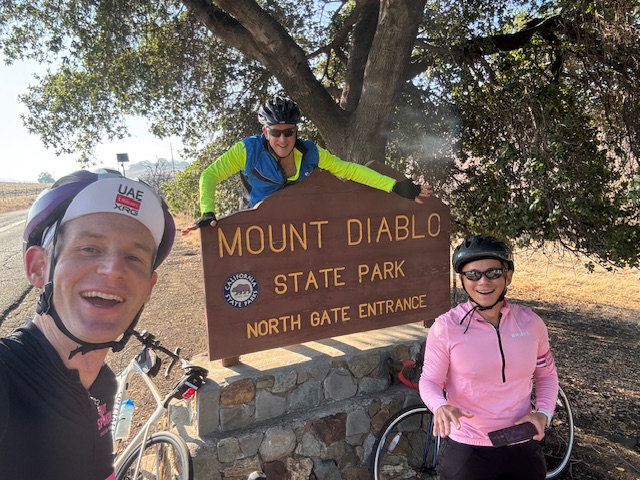
Tim (middle) looking happy he signed up in time!

Interview with Peter Jenny: The First AIDS Bike-A-Thon

Peter Jenny (left) & Jamie Moran (right) at a rest stop on 1985 Pedaling for Pride in ’85

Introduction
I first met Peter Jenny in 2015 at Derek’s “Old Farts” gathering. Derek managed to round up about 25 or so of us going back to the very early days of the club and up to the early 90s. I knew almost all of the attendees—some of whom I hadn’t seen in decades—but there were a few I did not know. We took turns introducing ourselves and Derek asked who among us had done the AIDS Bike-A-Thon especially that first one in 1985. Peter raised his hand. I took notice and introduced myself to him and we had a brief chat. I mentioned to him that I had been mulling over interviewing the surviving riders of the first BAT about their experience and he responded positively and said he would participate if I ever got it off the ground.

I first interviewed Bob Bolan shortly thereafter mostly because he’s a good friend. Then I put the project on the back burner when I became involved in other club business.

When I revived the idea this year as part of the 40th anniversary of the 1985 Pedaling for Pride Bike-A-Thon, I contacted Peter again and he was game. This interview was conducted by phone.

It’s possible that Peter and I may have ridden together or were at a club meeting. But I do not have a distinct recollection of having met him in the early ‘80s. I was riding very infrequently with the club. Also some of the rides in those days had a dozen or so riders and the monthly club meetings always had a good turnout so it’s entirely possible we just didn’t get a chance to talk to each other back then. Peter was quite young when he hooked up with the club, about 21. I recall only one other member who was younger than Peter back then. The population of Different Spokes was young but mostly late twenties to early forties with a scattering of older members such as Derek Liecty, who was in his fifties.

Peter like the previous interviewees recalls only snippets of that ride, not a surprise since it’s been over forty years. But Peter like the others does recall the era and what the club was like at that time and the impression it made on him. Unlike MJ or Jim King, Peter wasn’t involved organizationally in either the Bike-A-Thon nor the club; he was “just” a member and perhaps better represents the typical experience.

AM: I realized that one thing I didn’t really have about you is a little bit about your personal history like when you lived in SF or how you ended up in SF, and all of that. Just tell me a bit about that.

PJ: Sure, brief overview: I grew up in the East Bay in Piedmont and I graduated from high school in 1980 and came out then. I lived in the city for five weeks in 1983 in a sublet. But otherwise I was crossing the bridge a lot. Friends and I would go hang out, walk around the city and go to bars and things, underage and- I don’t know if I can say that?

AM: Sure! [laughs]

PJ: So growing up in the Bay Area and San Francisco was not too far away, so I didn’t feel isolated as a gay kid growing up in kind of a conservative town.

AM: Okay. But basically you’re local. You’re a Bay Area person.

PJ: Oh totally. Yeah.

AM: Okay. A common story is: you move to San Francisco from someplace else because you’re gay. But that didn’t happen with you. You were already a local.

PJ: Right. Yeah, I was very lucky to have that.

AM: Okay. How did it happen that you came to join Different Spokes or find out about Different Spokes?

PJ: Well, I was very shy and was trying to meet people. I wanted to have dates and I was working in cafés and in a produce market and was kind of bumping around in junior college. This was age 19, 20, 21 and I found Different Spokes and I was a cyclist and so I thought, “oh that sounds fun”. You know It’s always fun: you meet people easily when you have a common interest like that. So I started going to meetings over there near the Panhandle [AM: the Page Street branch library] and in I guess like ‘83, early ’83 and then kind of started riding with them more in ’84 and ’85.

AM: Okay. Presumably you joined the club around that time besides riding.

PJ: Yeah.

AM: Is that how you heard about the BAT was through the club?

PJ: Oh yeah, it was through the club. It was through the club, not through the community because I wasn’t really involved with the gay community in the city at all. But just through people in the club because I’d do the Decide ’N Rides and things like that. [AM: the Decide ’N Rides were leaderless rides. People would show up at McLaren Lodge at 10 AM and decide where to ride.]

AM: Okay. You know that first BAT happened really quickly. I’m not sure when it was announced to the club as a whole. It was after the beginning of February, I think, [AM: It was more like late February.] and it happened April 6. So it was an extremely short period of time. There was a club meeting once per month so there were at most two club meetings where people could have heard about it.

PJ: Oh wow. That’s amazing.

AM: Yeah, It’s pretty astonishing.

PJ: Well, I think there was such a grass roots thing going on in the city and then in the gay community people could organize pretty quickly and to get the participation. I think it was the Woods where we stayed. I know where it is but I can’t remember the name, and then I don’t know how much help they had but it seemed like a pretty organized ride.

AM: Yeah, I got more of the back story when I interviewed Jim King who was another rider but he was also very involved in subsequent BATs and then of course I interviewed Michael John who was one of the principal organizers of that very first BAT. Basically the division of labor was that the club handled recruitment and getting riders and organizing much of the stuff on the first day, the ride up on Saturday. And then Sunday was the AIDS Foundation with their volunteer appreciation event and providing lodging and the buses back to San Francsco. But then subsequent BATs it was all the club that did everything. It wasn’t split up, the AIDS Foundation and the Different Spokes.

PJ: I see, that’s really interesting. I did the ’86 one too but then I got busy with other stuff and didn’t do any ones after that.

AM: So what led you- you did the first BAT. That was a hundred miles. What led you to do that?

PJ: Well, I was a strong cyclist and I liked the idea. It was participarting, I just liked participating in these things. I think you asked me something about some relationship between me and the AIDS crisis and was that something that spurred me on. I suppose there was some of that. I mean ‘cause we were completely freaked out. You know! [laughs]

AM: Yeah, I lived through it. I went through that same era.

PJ: So you know, and I don’t know if you were living in the city. It was a little different in the city.

AM: It was. I was living on Haight Street in the lower Haight. But I was so busy I don’t think I did a ride for like a year or a year and a half after I joined [the club]. But anyway then the AIDS thing happened and it was pretty freaky.

PJ: Yeah, it’s interesting to see on Facebook the AIDS memorial thing and they profile all these different people. At this age it really hits home how many people were infected and died. I was just a young kid kind of bumbling along being careful. But you just don’t grasp it and you think “Oh my god, we lived through that! What a time!” So when you ask me about the BAT, it’s like god I wish I had something more, there was some deeper drive to do this. [laughs]

AM: Well I wouldn’t say it’s a common thing but people think you did the BAT because you were a Different Spokes member and maybe because you knew somebody who had AIDS. It was more than simply an abstract issue. The common thing you hear is that we were all helpless and we wanted to do something and this was something to do: raise money. We couldn’t get rid of AIDS but we could raise money to help people who were infected and dying.

PJ: Well right and that’s the thing. That was probably the basic thing where it was doing something, something. I didn’t think where the money went or what the money was necessary for. I mean I heard about the different projects and things that were trying to help people and the scrambling to provide services and I didn’t really know anybody then. I mean you mentioned Hal who had been the librarian. So Hal was the first one and then I just remember being in the Castro and seeing guys who were not well and then a year or two later guys that I knew and guys in the club were getting sick and things. So then it become much more…

AM: Real.

PJ: Yeah, real. Yeah, I was just sort of a dumb kid goofing around in college and in cafés and things. I later inherited a house in the East Bay and so I started redoing that in ’85 and that’s why I ended up not really participating in Different Spokes much after ’87 because I was just literally up to my waist in stuff.

AM: I see. So your period of being more involved in the club was really from what ’83 to about ’87.

PJ: Yeah, ’83 to about ’87, probably ’87. I did some rides then. Yeah.

AM: Did you by any chance know Jerry Basso?

PJ: I didn’t know him very well but I really liked him. He was such a nice guy. And very friendly. Were you friends with him?

AM: Yeah, I rode with him a fair amount. He and I liked to do the same rides. Hal was someone I knew of but didn’t know personally. I knew he was the librarian and I probably met him at a club meeting but I don’t have a distinct recollection. I never rode with Hal but I rode with Jerry quite a few times and so when Jerry…I don’t know if you know that Jerry died of AIDS.

PJ: Yeah, I knew that.

AM: He showed up on a ride. He was gone for a while, wasn’t participating in rides and we thought oh y’know people come and go and he’s just really busy. And then he showed up and talked about having vision problems.

PJ: Oh man!

AM: And of course my first thought was: I wonder if he has multiple sclerosis because that’s not uncommon. I wasn’t even thinking of HIV [laughs]. But then you start talking. I remember talking to Dennis [Westler] and probably others, “Gosh I wonder if he’s infected or not”. And then he just didn’t come back. He was like dead two months later. He was sick and apparently what happened was his family lives in Atherton, and he went there, and they took care of him. And when he died there was such stigma around AIDS they didn’t want, they wouldn’t admit the fact that Jerry had AIDS. But we all thought “hmm, interesting timing”.

PJ: Wow, so that wasn’t given as the reason. I mean was there a memorial?

AM: No. Nothing, nothing. There was nothing public.

PJ: That’s so terrible.

AM: Michael John told me this: when the quilt was being developed and we wanted to make a panel for Jerry, his family just no no no no no. No, they didn’t want that.

PJ: Really! Oh god.

AM: He was really the first person in the club that I knew personally who died of AIDS and then after that there were a slew others that came. But he was the first.

PJ: And Jerry was sweet. And there was somebody else…I dunno there was like a little group of those guys and there was another couple of guys who were racers and I rode with them.

AM: Who raced? Huh. People in the club who raced? That’s a really small group!

PJ: Yeah, I think there was just a couple of guys.

AM: Yes, Chong. Did you know Sam Chong?

Yes! Again not very well. Like I talked to people on rides but I was just- I lived in the East Bay. I made some friends though Different Spokes and dated some of the guys and things. But I wasn’t like super social with everybody. But I remember him. Yeah, I know that there weren’t a lot of racers and actually I don’t know if they were doing criteriums or if they were just wearing the garb and had racing friends. I would ride with them because I was a strong rider and I kind of thought about racing but I was kind of spacey and would hit people! You know when you’re riding in a pack, I didn’t want to get injured. I crashed enough on my own!

AM: What about Bruce Matasci? Did you know Bruce?

PJ: Bruce…

AM: Bruce was the strongest rider in the club. He was an ex-pro and he had raced against Greg Lemond. When Greg was a junior, Bruce was racing in the seniors and Greg was kicking everybody’s ass. Greg was like 16 or 17 and beating everybody. I remember Bruce telling me that. And Bruce actually had a stint as a paid rider with Specialized Bicycles. Bruce was incredibly strong. He’d just dance up those hills and wait for us. He was incredible to watch. I think at the time— this would have been about ’85. He wasn’t racing at that point, he was car mechanic by then. He had raced before that. And Sam I knew was interested in racing. Mike Cannon, Mike was probably a little bit later. I don’t know if you knew Mike. He was an electrical engineer working for I think HP and living some place on the peninsula. And he raced. I think he was Cat 3. He was very strong.

PJ: No, I didn’t know him. I think Bruce sounds really familiar and he knew one of the guys I’m thinking of…yeah, throwing names out, some of them I can come up. In the photos I’ve been seeing- someone posted a bunch of stuff through Instagram from ’84, ’85, ’86 and I recognize a ton of people in there.

AM: You said you were a strong cyclist. Had you ever ridden a hundred miles before?

PJ: I’d done a couple of centuries and I rode 60 miles lots and a hundred miles wasn’t that more. I think I’d done a double century that year. So yeah.

AM: Wow, okay! Some people who did BAT their standard ride was 20 miles, and then there was Bruce who did it and he was an ex-racer and then Bob Bolan did it too and was doing centuries as well. So for those guys it wasn’t a big deal to go to Guerneville. But for a lot of other people it was. There were some riders who didn’t make it. They didn’t have the stamina to make it all the way to Guerneville.

PJ: Oh yeah! I think they had a sag wagon? I think someone was sweeping.

AM: Yes, there was ! [laughs] We’ll get to that in a bit!

PJ: I was living- before this, for the two years before this I was going to City College in SF and I lived in the East Bay and I would ride my bike to Macarthur BART, put it on the bike shuttle, go over to the city and I would ride with my books up Market Street and over Market and down Teresita to school and then I would ride back up over Market or sometimes over Twin Peaks and ride back to the thing. So I was riding with two panniers full of books every day and that was kind of my training for everything, rain or shine.

AM: That’s good training!

PJ: I mean I know there were people who kind of struggled. But it was a great thing because everybody was embraced. It wasn’t like us and them. It wasn’t divided up that way [on that first BAT.]

AM: Do you remember what bike you rode that day?

PJ: Yeah, I had a Miyata 610.

AM: Did you have a triple crank or was it a double?

PJ: It had three rings, yeah.

AM: That seems to be pretty standard for people who did that ride, the ones who made it.

PJ: No one-speeds.

AM: Yeah, no! Any other ways that you were involved with the LGBT community at that point in time? Were you doing any sort of HIV or AIDS work or any kind of political work? The cafés what you worked in were they gay cafés?

PJ: Yeah, they were very gay. I mean it was in Oakland and I was working at more of a lesbian café or very lesbian-centric, on College Avenue. I wasn’t involved in any HIV stuff I think because I was just terrified. I would volunteer for things. I grew up sort of volunteering for stuff. We went to the First Unitarian Church in Berkeley and volunteerism and protest was a big deal. So it wasn’t a foreign thing. I wasn’t like heavily involved in anything. I might have gone to some protests and stuff and I would go to Gay Freedom Day and things. And I worked in these communities but I had a big mix of friends. So I wasn’t really immersed in the gay community that much. I felt like I didn’t fit in really because I was like…I drove a truck [laughs]. Mark [Paez] said someone saw my truck parked in front of his apartment once and said, “He can’t be gay and drive something like that!” That was my reality. [laughs]

AM: The day of the ride, do you remember much about the day of the ride? Do you remember what the start was like when you left the Castro?

PJ: God no, I don’t remember it being particularly difficult. I saw your questions about this and people’s reminiscences like, oh my god I don’t remember much at all. I remember when we got to Guerneville and we were kind of hanging out there. I remember it was sort of a party. But it was like another hundred mile ride where we kinda connected with people along the way.

AM: Yeah. Were you riding with anybody? Were you riding with friends or were you just riding by yourself?

PJ: I’m not sure. I would ride with Jim Lindauer y’know. [AM: Jim Lindauer didn’t do the BAT. Peter must mean he rode with Jim at other times.]

AM: Oh, I remember Jim.

PJ: Yeah, he was a friend of mine. I’m afraid I kept in minimal contact with him over the years and then he died in 2019. But he and I would ride- it’s funny to see these pictures that were posted of me hanging out together a lot. He helped me a lot with my bike. He liked me and…a very nice man. I think I might have ridden with him if there was anybody. Actually I kind of made friends with Eric Johnson. [AM: another BAT rider] And he stopped- he kinda dropped out I think because he was studying diesel mechanics and he had been in the military, a very nice guy. But I think he may even have dropped out then.

AM: Okay, okay. Was there anything memorable about the ride, that stuck in your mind?

PJ: Well like I said it was mostly it was at the end. I don’t remember the route. I thought it [the ride] would be like I said, easy and it was pleasant and nothing sticks out as being much different from a regular century and then we got up to the Woods [AM: Molly Brown’s] and that was fun. I wish I had more to offer in terms of those kinds of memories for you.

AM: I was going to ask you a question about that. So the arrival is what sticks in your mind. But I was going to ask you: the club had actually led a couple of weekend rides from SF to Guerneville prior to BAT. Did you participate in any of those, either of those?

PJ: No I didn’t. I rode on a couple of rides to like Pigeon Point, overnight rides, but I didn’t know about the ones to-

AM: The Guerneville Weekend rides.

PJ: Yeah. Yeah, I wasn’t really like tuned into Guerneville. Mark Paez, we were friends then and he grew up there and so I would go up there with him. But it really wasn’t kinda my thing. So it wasn’t on my radar if there were rides.

AM: Okay. What do you recall about the arrival in Guerneville?

PJ: More again like ending up at the- is it the Woods?

AM: The ride officially ended at Molly Brown’s which doesn’t exist anymore. But that’s where the ride ended. But did you spend the night in Guerneville?

PJ: Yeah, so I think it was at the Wildwood or something. As you’re driving out of Guerneville it’s on the left. [AM: Peter is probably referring to Fife’s.] There were cabins and it was kinda wild what was going on there [laughs]. You could hear people going at it.

AM: How that worked out is that the AIDS Foundation arranged for inns in Guerneville presumably to donate lodging overnight for the cyclists. Basically everybody got spread out. You weren’t all staying in one place, like a few people were at this place, a few people were at another place. So when you mentioned the Woods I thought well maybe that’s where you were farmed out or where you chose to go to spend the night. But the event officially ended at Molly Brown’s. It’s on the left just before you come into Guerneville from the west and it doesn’t exist anymore. It’s now an Autocamp, I don’t know if you’ve heard of Autocamp.

PJ: Yeah yeah yeah. Well I drove through there. You know we lived in Sea Ranch for 18 years and so I was driving through there a couple times a week. So it’s familiar. The Autocamp may have happened since. We left in 2020.

AM: It’s just not there anymore. Anyway that’s where the end was, the finish point. Then people went and stayed at different places. But then Sunday it was the volunteer appreciation event that was put on by the AIDS Foundation and that included people who had been involved in the BAT. I know you were there because I saw your picture, the one with the people up on stage. Do you remember anything about that?

PJ: Kind of a vague memory of being up on stage. But I think it was up at the Wildwood or something.

AM: No, that was at Molly Brown’s. [AM: I was wrong. It was at the Woods and I may have confused Peter.]

PJ: Molly Brown’s…how weird. Okay. God, usually I have a better memory of things like that. It’d be interesting to see the photos.

AM: So when you got to Guerneville, how’d you feel? Do you remember?

PJ: Kind of overwhelmed. It was kind of a hard, heavy duty gay thing— maybe it’s my perception of being at one of the resorts in the Russian River ‘cause I was like 22 and kinda hadn’t really done anything like that. I think I pitched a tent or something and it was a party atmosphere and that’s kind of what I remember. I remember then the next day I wanted to get home and I don’t know if it was like the buses were late or something like that and I knew a woman who was up there and I tried to hitch a ride with her back to the Bay Area. And I ended up riding back [on the bus] and I sat with Eric and that was kinda fun.There was a bus. They put the bikes in like a Greyhound bus kinda thing.

AM: Yeah yeah yeah. Okay. The AIDS Foundation arranged to bus people back. But some people just got back on their own. They didn’t get back [by the bus].

PJ: Right. Yeah people who had- I don’t know if they were support and had driven up there or friends of people who rode up there.

AM: Yeah. So you got on the bus that was arranged for everybody.

PJ: Right, I spent the night and then got on the bus.

AM: Do you remember where you stayed that night in Guerneville?

PJ: I wanna say- I was thinking it was at the- and I have to look and see if I’ve got the name right. It was at the place on y’know if you’re driving west on 116 out of Guerneville, it’s on the left and it was…

AM: Driving west out of Guerneville, okay.

PJ: Well, kind of yeah I mean out of downtown but you’re still in kinda Guerneville.

AM: Was it Fife’s?

PJ: Yeah, I think that was it.

AM: Okay. The Sunday ceremony what I’ve heard is that that was a long event. Basically people were lolling about on the lawn.

PJ: Yeah.

AM: There was food there and people were lolling about on the lawn. Do you remember much about that?

PJ: No, just like I said, sort of a party thing. That’s sort of the vague memory I have. People were hanging out. I just don’t have really specific memories.

AM: Okay. So that’s mainly the questions I have about the event itself. So this was a pledge event. Do you remember how you got pledges?

PJ: Yeah. So that was tough because I tried to get pledges from friends and everybody [laughs] was kind of in the same boat: poor. And so I got a bunch of $5 pledges, not a whole lot. I kind of struggled with that. Some guys got thousands of dollars, I mean did really well. I was kind of begging from my friends! [laughs]

AM: Okay. So you didn’t do anything aggressive like go to stores or organizations and say,”Hey do you want to support me on my ride to Guerneville”? [laughs]

PJ: No, I wasn’t that resourceful. I did not do that. This was a bigger deal and I realize that people got big amounts of money that these guys were really organized and put it out there. But I just went to places I knew and friends and things.

AM: Okay. At that time HIV and AIDS were kind of either very scary and there wasn’t a lot of information about it or people didn’t know anything at all. They were totally in the dark about it. And I’m wondering to get pledges from people, what was their reaction when you told them “I’m gonna ride to Guerneville to raise money to fight AIDS”?

PJ: I don’t remember anybody being negative about it because like I said I posted something at the place I worked, which was this very gay café on College Avenue and then friends who were gay and my friends were- I think everybody was supportive. We were freaked out about it, young gay men, and we were reading what we could and then straight friends knew less as I came to find out, obviously as you can imagine. But there was never any bad resistance. It was more like people just didn’t have much money to give.

AM: The last thing I wanted to ask you was how old were you when you did that first BAT in ’85?

PJ: I was 23.

AM: 23 okay. Yeah, you might have been one of the youngest people to do it.

PJ: Oh really? I guess so. Mark’s a year older than I am, Mark Paez, but he wasn’t there and Eric was a little bit around my age. I guess Jerry Basso and those guys were – they wasn’t too much older than I was.

AM: I don’t recall how old Jerry was but my guess is that he was probably 30.

PJ: Oh wow. Yeah?

AM: He wasn’t 20. If he was, then he was a very old-looking twenty year old! [laughs]

PJ: [laughs] Well I know I was kind of the youngest one there and I think I was kind of treated like that, you know what I mean? Sort of like young and goofy [laughs]. Goofball. Yeah, well anyways it’s great to get to chat about this. It’s so interesting to sort of dust it off. I wish I had more to…

AM: No, actually what you’ve contributed so far is impressed me because first of all remembering something that happened 40 years ago is hard. It’s hard period and there’s absolutely no way that you can remember something unless it was something that affected you, you know like a traumatic event.

PJ: Right yeah. We’re old, yes, and there are certain things I remember more clearly from then and I just don’t know- I mean it was a fun- y’know it was…it was fun. I really liked Different Spokes but blank!

AM: I actually have one other question. Did either being a member of Different Spokes or doing the BAT or both have some- did it have an impact on your future or was it just one of those things that you did and then you moved to whatever, the rest of your life? Did it hold some significance for you or was it like “no no, I was just a cyclist and hung out with Different Spokes”?

PJ: Well, y’know I was never athletic growing up. I rode a lot and then to join a group where it was like “oh okay I can hold my own with these people”. It was significant. It was funny— these kinds of things happen to people at a younger age whether they did sports in high school.

AM: Maybe you got some confidence.

PJ: Yeah, that and then also meeting some really nice people, Jim Lindauer, and Mark Paez, I didn’t know Eric for very long, But there were some good friends made. It was a good experience. It wasn’t like anything else. I mean it was also a sense or community, I guess, you know being in the East Bay, and I worked and had gay friends and things. But being a part of a group like that that was in the city and then doing stuff like this, like the BAT where they were kind of diving into providing services for people and people were sick in the club, it was a really significant exposure for me that way and nothing else has been like that. So I suppose…so that’s what I would say.

AM: Okay, sounds good. Peter, thank you very much.

PJ: Oh sure Anthony, it’s great to chat and thanks. Good luck with it.

AM: Okay and thank you, Peter, I really appreciate it.

PJ: Oh no problem at all, alright take care.

AM: Take care.

PJ: Bye.

Epilogue
As with Bob Bolan, riding a hundred miles in a few hours wasn’t a dramatic challenge for Peter as it was for most of the participants. He remembers the ride as “easy”! I rode up to Guerneville several times for the club’s Russian River Weekend back then and I had also been doing centuries. Although I wasn’t wiped out upon arrival, I would never call that ride easy. Obviously all those commutes by bike made a difference in how he experienced the ride itself. Peter echoes comments by others that the early phase of the AIDS epidemic was on everybody’s mind—there was no escaping the fear, anxiety, and grief—and that reverberated through the club and was the incentive to ride the Bike-A-Thon: we had to do something. Although Peter grew up in the Bay Area, had been out for a few years already, worked at a gay business, and had a circle of gay friends already. Yet he found a community in Different Spokes based around common activity and eventually a common goal (Bike-A-Thon). These days kids are coming out earlier and earlier but back then coming out after high school still would have been very daring. The club was a way, as it was for many back then, to connect with other LGBT folks in a much less daunting environment than the gay bars.

Interview with Dr. Bob Bolan: The First AIDS Bike-A-Thon

Bob at the start of the first Bike-A-Thon (from the BAR)

Introduction.
This interview was conducted ten years ago and then put on the shelf until now. In early 2015 Derek Liecty organized a secret “Old Farts” of Different Spokes gathering where about 30+ former members from the 80s and early 90s convened to catch up with each other. It was immensely enjoyable and out of that gathering I became interested in documenting “the lost history” of the club and especially of the AIDS Bike-A-Thon. Shortly thereafter I interviewed Bob, who had been a member when he lived in the Bay Area. Although he decamped to Southern California in the mid-90s for professional reasons, we’ve been in touch through the years (and not through FaceBag!) I asked Bob to be interviewed first primarily because it was a good excuse to get back in contact with him after a two-year hiatus when he stopped riding or so I thought. Little did I know that he was back on his bike six months later—addiction is hard to beat!

Bob and I go back to the mid-80s although neither of us can recall exactly how we ended up being such frequent riding buddies. I have many fun memories of riding with Bob since our personae, riding abilities, and work ethic were very much in alignment. We always had a friendly competition! Then we jointly purchased a racing tandem probably because both of us realized that instead of beating each other up on the bike, we could work together and just slay everyone through combining our strengths. Bob and I rode a lot of centuries on that tandem and we were always doing it very fast. A ride with Bob on the tandem was always exciting. And fast!

Bob, as you’ll see in the conversation, was an unusual BAT rider because he was already fully involved in the AIDS epidemic even at that early time. As a practicing doctor in San Francisco with a predominantly gay male patient base, he was seeing AIDS make sick and kill almost every day. He was also already an avid cyclist. So the AIDS Bike-A-Thon may have been a challenge but it wasn’t a new one for him since he was already seasoned from riding centuries.

AM: When you did the Bike-A-Thon (BAT) in ’85 were you already a member of Different Spokes?

BB: I think I was not…what I was… well alright, I’ll just let you ask the questions and I’ll get to what I was.

AM: So I’m just wondering- the point of this: was doing BAT, was that a reason why you might have joined the club afterwards?

BB: Well yeah, I think so because it turns out that really the punchline is that I was already president and chairman of the board of the San Francisco AIDS Foundation. That was from June of ’83 to about June of ’86. So I don’t remember that my being in that position really had much if anything to do with having the BAT and having the AIDS Foundation be the beneficiary. But I think that the fact that the club did do it sort of prompted me to become a member. That’s how I remember it.

AM: Okay. Actually I just wrote an article about the history of BAT published on the club blog.

BB: Yeah, you sent me a draft of it.

AM: So my understanding was that the idea of BAT didn’t come from the club. It didn’t come entirely from the club, that the AIDS Foundation approached the club. They said “we wanna do some kind of charity event for the AIDS Foundation and we thought it might be cycling”, and then the club just went, “we can do that” and pulled it together in basically two months.

BB: I must have had something to do with the idea because the AIDS Foundation in 1985 was not that terribly…lemme see, where was our office? Were we still on…did we move to Tenth Street? I can’t remember. I mean we didn’t really have that huge of a staff and I would have been in close communication with our fundraising people, whoever they were. So I probably had something to do with- if not coming up with the idea although I don’t remember that I did, with at least nurturing it and saying yeah that sounds like a pretty good idea, let’s reach out to y’know… [AM: Bob did not come up with idea; it was Ricky Johnson according to MJ.]

AM: So the next question is obvious: how did you hear about the BAT? Obviously since you must have been involved in it, certainly through the AIDS Foundation you knew about it.

BB: Yep.

AM: Yeah, and the reason why I put this question is because this event was pulled together—the first meetings apparently between the club and the AIDS Foundation were in February and this event was April 6 and there was an information table put out on Hibernia Beach for the month of March. I’m thinking March, that’s like a month to get all the pledges and people to ride! [laughs] So it’s conceivable that you could have walked by there and said, “Hey that’s a great idea! And wait, I’m president of the AIDS Foundation. I should do this!” [laughs]

BB: I don’t think it happened that way. I think it’s much more likely that I had something to do with pointing them in the club’s direction.

AM: That makes much more sense. So why did you do the BAT?

BB: Well, I figured that if the AIDS Foundation was gonna be a beneficiary and I was a bicyclist, that it would be improper for me not to ride! [laughs] Y’know I just wanted to show support and gratitude to the bike club for doing it.

AM: Okay. What kind of cyclist were you before BAT?

BB: I was what I would call a ‘cycling enthusiast’. I mean I didn’t train for the ride. I was probably riding centuries at that point. I’d have to look through my old pile of…

AM: Maps and things, patches. [laughs]

BB: Yeah, patches and patches and patches. I still have a pile of those things someplace in a drawer up there. [laughs]

AM: So the BAT was a hundred miles. So you probably had done a hundred mile ride [already].

BB: Yeah absolutely, absolutely.

AM: There were definitely people on that ride who were like, “A hundred miles? I haven’t even done twenty!” [laughs]

BB: Right, right, right! Right.

AM: There were some people who actually didn’t make it all the way. Not many but there were a few. Do you remember which bike you rode? You rode a road bike, right?

BB: Yeah, I did ride a road bike. I don’t remember what bike I had. I was thinking about that after I read through the questions and probably I had a Bianchi.

AM: Yeah, I remember you having a Bianchi and I think that ended up smashing into a garage.

BB: That’s exactly right and I think it was exactly that Bianchi because subsequent to that I did the Davis Double century and it was when I came back from the Davis Double century I was so wiped out that I forgot to take my bike off the top of the car and went into the garage with it. It was all right around that time.

AM: Okay. So again this is a question I already know the answer: Did you know anyone who had AIDS before you did BAT?

BB: Sure!

AM: Yeah, you knew lots.

BB: I knew lots, right. I knew lots.

AM: And that was because you were doctoring these people.

BB: Yep yep. But interestingly at that point by the time of the AIDS BAT I didn’t have any personal friends or acquaintances. That came later.

AM: Okay. Now there was a doctor [in Different Spokes] who rode a bike with tri bars. He worked at the Davies Medical Center and he died of AIDS and I know you knew him. I think his name was Charlie but I’m not sure.

BB: Right! Yeah just- right, Charlie, exactly. Just as you said that, it was Charlie…what the hell was his name? He actually had hepatitis B or C as well because he eventually developed ascites and- what the hell is Charlie’s last name? But yes I remember him on his bike with the aero bars. Wow, that’s interesting.

AM: Yeah. That might have been well after BAT because I knew Charlie from doing club rides and I wasn’t riding that much in ’85 with the club. I was just starting to ride, I think, ‘cause I think I joined…the year before the Olympics and I was so busy with graduate school. I think the first ride I did with the club was in ’84 and then I didn’t really start leading rides until ’85. So I’m not really sure. I might have run into Charlie in ’85.

BB: Yeah. His name might come to me. When did you and I meet? We must have met-

AM: I don’t remember. You mentioned meeting up on Skyline and I do remember that, that somebody introduced us. I was on a club ride, I think, and somebody introduced us. You were either on that club ride or you were doing your own ride and we ran into you.

BB: Right, exactly.

AM: And it might have been Ron Decamp who introduced us.

BB: I don’t remember.

AM: But somebody introduced us and I don’t know when we started riding together but I knew that’s when we met. I had forgotten that but when you mentioned that it came back to me.

BB: Yeah. Good, cool cool right. So at least we share that memory!

AM: How involved were you in the LGBT community at that point?

BB: Oh wow, quite a lot because of the AIDS Foundation.

AM: So the BAT didn’t draw- you were already drawn in.

BB: Now, remember I was also a member of the Bay Area Physicians for Human Rights.

AM: Oh right!

BB: And in ’85…so my first connection with the gay community when I came to San Francisco in 1979 was with the Bay Area Physicians for Human Rights (BAPHR) and I eventually became the secretary and then president elect of that organization and I was the president elect at the same time that I was president and chairman of the board of the AIDS Foundation. That was my most manic year and I think it was probably ’84. That’s when I realized that I just didn’t have a life. [laughs] So I stopped the Bay Area Physicians for Human Rights and just devoted my energies to the AIDS Foundation.

AM: Okay, what I was trying to get at and I think I had that picture is that you were already a pretty enthusiastic cyclist. So the AIDS ride was not an incentive to draw you into riding you were already doing that. But you probably became a member because of the club, because of the ride. But you were already pretty well hooked into the gay community as well. You knew a lot what was going on with HIV and AIDS in the community at that point.

BB: Yep.

AM: So it wasn’t new to you at all.

BB: Not at all.

AM: Okay.

BB: At that time it was old, tired news.

AM: Do you remember the day of the BAT? Can you recall what it was like? Like did you ride down from your house to the start or did you drive down? Do you remember anything, the beginning of that ride?

BB: I don’t. Tell me where it started.

AM: It started in the Castro, in front of the Castro Theatre. And my suspicion is that it was a…it was a…

BB: A mass start?

AM: Yeah, a mass start.

BB: Yeah. I don’t remember that…yeah…the first thing- my first memory is actually riding along the- toward the coast. And it was probably up near what, Olema?

AM: Oh really, that far north.

BB: Occidental or something like that. That’s my first real memory and I don’t know if that’s because I was getting tired and hungry or exactly what the deal was. But I don’t remember any of the rest stops. All I remember is by the time I got there I was riding alone and I was chasing somebody. [laughs] Who I never caught. [laughs]

AM: Yeah, I’m pretty sure that person was probably…

BB: Probably Bruce.

AM: Yeah, Bruce was very strong in those days.

BB: Right and you know actually when I got your email about that, that’s possible. I subsequently met him on another ride after he was sick and I didn’t know that he was sick and he had probably had changed quite a bit. So even if I had- you say he died in ’91 or ’92?

AM: I can’t remember exactly when he died. [AM: He died February 2, 1991.] But it was before the accident [AM: Tom Walther and I were hit head-on while driving to Guerneville.] so it probably would have been- and I believe I was already living with Tom. So it would have been possibly ’90, ’91, maybe even early ’92 that he- ‘cause I remember going to his memorial service at that Irish mortuary right on Market Street near the Castro. Duggans, Duggan’s Mortuary.

BB: Oh yeah, right. Yeah, so my only real clear memory of him was a ride that we did and it was a loop ride and it was in Marin. And we did a loop and I don’t know how many loops we did or whether it was a criterium or what the hell it was. But I remember that I lapped him and I remember that he- I knew that he was a strong rider and I didn’t know that he was sick but he looked a lot older and I remember I said something, I was just making small talk with him while we were riding and I said something about oh this was a bitch of a ride and I said something about my age and I said so you’re probably my age and at that point I was in my late 30s. He said he was like 30 or something like that. So I mean obviously he was sick and had aged. So it was entirely possible that that was him who was ahead of me.

AM: Yeah. I can’t remember. In fact every road ride, there’s a not a single road ride that I did with him that I ever beat him up a hill. He just was like ‘bye’ [laughs]. I’d just see him pull off on the front, just like disappear up the road. It was like, okay I guess I’m chasing Bruce, sigh. [laughs]. So he was pretty awesome and I remember him telling me he used to race with Greg Lemond and I said, “Yeah I can believe that!” [laughs]. “Yeah yeah, I think you raced with Greg.” He was probably Cat 1. Pretty strong.

BB: So yeah I don’t really remember anything else about the ride itself except pulling into the parking lot. So how many rest stops were there? You said about every 20 miles or 25 miles?

AM: There was rest stop every 25 miles and a check point every 12 miles to make sure people were alright. I think because this was such an unheard of thing to go a hundred miles and there were a lot of people who had not ridden this length and they wanted to make sure that you were not in trouble and they would sag you out if you said I’m done, I’m out of here.

BB: So I’m really not getting any more memories. I mean it was one of those kind of rides, that it was hard work and when I’m on a hard work ride, I just kind of put my head down and work and I don’t really look around and enjoy much of it. [laughs]

AM: I know you well enough to know that any ride you do is a hard ride [laughs]. But I would have thought that the camaraderie of the start would- it wasn’t a race but it somehow it turned into another race for you and I’m wondering how that happened. [laughs].

BB: Well, I’ll tell you, it really is the story of what cycling was to me during most of the ’80s and that was a response to my frustration over not being able to really do much or accomplish much of anything that I could see for my patients and then we weren’t making any significant headway in the AIDS crisis and we were struggling to get money for it. We were always struggling. It was always just an ever building crisis of more people dying, more people getting sick, less attention, little attention on the part of governments, and not enough funding and so on and so forth that I was constantly frustrated and cycling became a release for me. It was something that I could excel at, I could be strong, I can look at a hill and I can say I can get myself up to the top of that hill and I can get there fast and strong. You know it was a compensatory mechanism. So when I got on the ride, it was like okay here I am, I’m the president of the AIDS Foundation and I’m going to burn through this ride! I wasn’t trying to a hero or anything. It was just like that was my element.

AM: Okay okay. So if Bruce or somebody had not been in front of you, you still probably would have been going pretty hard. It wasn’t just chasing Bruce but you just-

BB: Oh yeah, yeah yeah yeah.

AM: Okay, that makes more sense to me now. So the next question is: did you ride with friends or by yourself, and obviously you rode by yourself.

BB: [laughs] I think so.

AM: The next question is what was memorable about the ride and it sounds like you don’t really have strong memories of it except that you were busting your gut trying to get to Guerneville and catch this guy [laughs]!

BB: [laughs] Yep, that was pretty much it!

AM: Okay. What was the hardest part of the ride or of the day. Did you have a moment where you like had a cramp or something- you said why am I doing this or you just…put your head down and did it?

BB: I do remember that- actually I just flashed: I remember the last—either a check point or a rest stop, I don’t remember which—and it was the last one before Guerneville and I remember pulling into it just as Bruce was pulling out and I knew that I had to stop because I was fried and so my ‘nemesis’ was in my sights and I thought that if I just stopped for a few minutes I’ll catch him before the end. That’s the clearest memory that I have. [laughs]. So this isn’t turning out to be a really good camaraderie story for you.

AM: Yeah, it says a lot about you though [laughs]!

BB: Yeah, [xxxxx]

AM: So this experience of doing BAT as you look back on it now…was it a positive experience, a negative experience, a mixed experience and why?

BB: Oh, it was a positive experience. I mean it was a positive experience because it was…I remember it was really uplifting and really- it was really cool to be part of an event that so many people participated in enthusiastically and pulled together so quickly and that had the same focus. It was the first time of actually doing something that was…I don’t know…I wanna say altruistic but…like people were doing it for a cause, you know. It was a shared cause experience. It felt incredibly affirming. I just remember feeling very proud of not only my accomplishment on the ride but proud that I was doing the work that I was doing and a part of something big.

AM: Okay. Yeah, I know what you mean. I think it’s one of the reasons why Lifecycle- I think all these events have sort of a cult feeling to them-

BB: Yep.

AM: -is that there is something about when you realize- or you have a revelation of the efficacy of concerted group action. There’s a collective action that has a desirable, positive effect especially when you’ve been doing something that seemingly doesn’t have a reward, like fighting AIDS. What I didn’t mention in the online article is that this was when Reagan was president. [laughs] Do you remember what that was like? That totally sucked!

BB: Yeah, that totally, totally sucked. That’s absolutely right. Right. He never said the word AIDS.

AM: We were pretty much on our own. That’s what I remember is: if you’re expecting any help or sympathy, give that one up right now, you’re gonna do this on your own.

BB: Yep.

AM: I think the BAT was a response from within the community, y’know people who were sick, some people who were sick, some people who weren’t sick, a lot of us who were afraid we were going to get sick, to do something when nobody gave a fucking damn about what was happening.

BB: Yep, that’s exactly right.

AM: I get why I hear back from people who fall in love with Lifecycle of why they do it. It’s like yeah, y’know, it feels good to be part of something where there is a goal, you accomplish the goal not only in terms of the ride but of your fundraising and guess what? That money goes to do really good work. It’s just like a win-win-win all the way around. So I get why people get into that, like ‘I’m going to do it again, I’m going to do it six times, ten times!’ Because it has a really positive- I wouldn’t call it endorphin-like but the reinforcement is very good.

BB: Yeah, it’s very potent, very, very potent.

AM: Yeah yeah yeah. So did doing BAT change you in any way? Or do you think it did. Or didn’t?

BB: I think it just affirmed what I already knew, that bicycling for me was a very powerful…compensation, a way of feeling strong, and it just felt really good to sort of marry that own personal feeling of accomplishment and compensation with kind of an objective knowledge that I was turning it into something that was benefitting more than just me. And I think that feeling kind of persisted after that. Though it probably was important to me and changed the way I looked at things.

AM: Did you do any subsequent BATs or was that the only one you did?

BB: I think that was the only one I did. Yeah, How many did you say there were?

AM: There were a total of ten that were sponsored by the club and 11th one was done only by Project Open Hand.

BB: Yeah, I did one here in Southern California…actually it was a club century. It wasn’t a bike-a-thon.

AM: Okay. Um…but you subsequently did Lifecycle.

BB: Yeah, I did the California AIDS Ride…

AM: Oh, you did the California AIDS Ride?

BB: Yeah, I can’t remember which one I did. I did that a couple times and I think I’ve done a total of- I think I’ve done a total of three times, maybe four.

AM: Okay. So these other questions are: did doing the BAT, was that an incentive for you to do other charity rides or activities. Or did it encourage you- the other way to look at is did it encourage you to cycle more?

BB: I don’t think it encouraged me to cycle more because I was already doing cycling. Yeah, I don’t think it encouraged me to do more charity events because by that point I was pretty much consumed with doing the work with the AIDS Foundation and keeping my private practice going.

AM: Do you remember what it was like to arrive in Guerneville?

BB: [laughs] Yeah, I was happy and tired and I rolled into that big parking lot and I remember the big parking lot from once I got off the road. I remember ‘oh my god I gotta go all this distance to the front door!’ [laughs] and this was after I’d ridden a hundred miles. [laughs]. I was fried by the time I got there I couldn’t even barely get across the parking lot!

AM: Oh okay [laughs]. Um there was supposedly as I understand it there was a ceremony at the Woods the next day. Did you hang around for that?

BB: Probably yeah. I saw in the blog that you did. I don’t remember that. Yeah, I mean I probably did but I don’t remember it.

AM: Okay. Actually there is one surviving picture that I have. It’s a panorama shot. You know, it was shot on film and apparently Tom took the images and tried to overlay these 2.5×4 inch print photographs of the people who were there at the ceremony. [AM: It was probably MJ, not Tom who did this part of the album.] Of the course you can’t see everybody’s faces because of the way it’s cut and people are standing behind other people and I looked through that group and I tried to see your face and I didn’t see it. [AM: I overlooked Bob. He is actually in the photograph.] And it wouldn’t surprise me if you had decided, like you had done the ride and you were gonna go home.

BB: Yeah, ‘cause I really don’t remember how the hell I got home. I know that I didn’t ride my bike. I know that much.

AM: [laughs]. So Timmy [AM: Bob’s late partner] didn’t pick you up, you have no recollection of that or?

BB: I don’t remember that.

AM: Okay. They were gonna bring people back from Guerneville.

BB: Right, yeah, right. I saw that you mentioned that and…I mean it’s possible. You know what? It’s probably more likely that I met Tim up there and that we peeled off. That’s probably much more likely although I don’t remember it clearly because whenever we would go places that’s typically what we would do is, you know, I’d bring my bike and we’d drive and we’d get a certain distance from whatever our destination was and he’d stop and I’d get my bike out and I’d ride the rest of the way. That was pretty typical.

AM: Okay. Do you remember what it was like to get pledges and raise funds?

BB: [laughs] I don’t remember that part at all!

AM: Okay. And you didn’t do any preparation or training for the ride. You did it. But you were already in pretty good shape.

BB: Yep.

AM: Okay, well that pretty much ends all the standard questions that I have here. I’m just wondering if you have any other recollections or musings on BAT.

BB: No, I was hoping that as you described more that it would spark more memories. But I’ve given you the only ones that I really have. [laughs]

AM: Okay, well you’re the first I’ve interviewed, and I suspect that a lot of people are going to be in that position because going back 30 years to this event [AM: It’s now 40 years.] is—unless it had a really profound impact, you know “the event that changed my life”—the recollections are probably going to be mushed up with all the other things that were going on at the time.

BB: Right exactly, yeah yeah, I think that’s exactly right because as I said for probably the first…I would say from about 1982, which was when I really first started seeing [AIDS] patients in my practice- I mean I had seen a few people before that time who were sick but we didn’t know what they had yet. But from about 1982 through probably 1988 or so, it was- that six years was just a blur. It was just awful and you know there was very little uplifting during that time. I mean it was just meeting after meeting after meeting, disaster after disaster, patient dying after patient dying. It was an awful time. And so it’s hard to have any really strikingly good memories come out of that.

AM: Yeah, well you were unusual because you were really on the front lines. In terms of people who were involved in BAT, you were really on the front lines. You were in the foxhole.

BB: Yep, I was in the foxhole, definitely.

AM: I guess that’s about it. I really don’t- I can’t think of anything else that I wanted to ask people about the event.

BB: Well, if I think of anything else, I’ll shoot you an email.

AM: Surely, you know if something comes to you later either a memory or something you wanted to share with people about the whole experience of having done the BAT, please let me know. But it sounds like the main thing I got from everything you said was that particularly for a person in your position that it was the one positive experience where you felt empowered because of the collective action of the group, to do something positive- I mean it didn’t end AIDS but it was something you could do that, a group of you could do, as opposed to just you alone were doing in your practice.

BB: Yeah, exactly.

AM: Okay, well Bob thank you very much. I very much appreciate you giving me your time.

BB: Well thank you. Oh yeah thank you for doing this. It was fun. It was really, really good talking to you.

Bob and I at Hibernia Beach for the 40th Anniversary ride in 2022.

Epilogue.
Bob’s narrative show how stressful it was to be a doctor during the early years of the AIDS epidemic. This was all pre-AZT, meaning that there were only palliative and experimental treatments of unknown efficacy; AZT, the first pharmaceutical that dulled the impact of the HIV, wasn’t approved for treatment until March 1987. Along with his private practice Bob was involved with the creation of the SF AIDS Foundation while simultaneously involved with BAPHR. How distressing it must have been to feel helpless every day in the face of an onslaught of burgeoning illness and death. Cycling became his primary release valve for all that stress and he channeled that energy into becoming an even stronger cyclist. Cycling like other endurance sports is an endeavor in which diligence and hard work do lead to improvement in bitter contrast to the early days of the epidemic when everyone, doctors included, were at a loss about how to stem the flood that was coming. Every day was a rearguard retreat in a battle when you had no ammunition. When Bob and I started to ride the tandem together, which was probably around 1988, we would often ride to Marin across the Golden Gate Bridge and he was so agitated/aggressive/angry from his work that when we went around the towers he barely slowed down. He steered the bike like we were slaloming around the tower and I recall at least two times when he nearly scraped me off the back of the bike because he didn’t slow. We were going so fast that he had to lean the bike over to round the towers forgetting that he needed to turn wide in order for the back of the bike to make it through the curve! One year at the Tierra Bella century in Gilroy on the descent of Hecker Pass Road he had us going so fast that in a righthand curve he couldn’t keep our line and we bounced across the oncoming lane into the opposite dirt shoulder. Fortunately there wasn’t a car coming and we didn’t crash. Every ride with Bob was at 110% That certainly helped me be a better cyclist in order to keep up with him! Not long after, Bob was doing intervals on the Marin bike path and popped a vessel in his brain and ended up in the hospital: a stroke caused by insanely high blood pressure during an interval. Only then did Bob finally start to slow down (at least on the bike!) A little. Maybe that experience helped him see that his work albeit meaningful was also such a psychological stressor that it could kill him.

The other notable point of Bob’s story is how that first BAT—as I’m sure it was for many other riders—had a positive impact on collective helplessness. It was collective group action to do something about AIDS that gave so many people a path out of despair; it certainly strengthened many people’s resolve to get involved and do something! When you are alone, despair comes easily; but when you’re fighting together, hope returns and inspires resolve in the face of a seemingly hopeless situation.

Conversation with Jim King: The First AIDS Bike-A-Thon and How the Bike-A-Thon Became A Club Project [revised 7/30/25]

Jim King at the Great Western Bike Rally in 1989

Introduction.
Jim King was a very early member of Different Spokes and served as the club treasurer in 1985 and 1989. He was also one of the 63 riders who rode the first AIDS Bike-A-Thon, “Pedaling for Pride in ’85” in 1985. He was the Bike-A-Thon Coordinator for the subsequent year 1986, the first of nine that the club did on its own. Afterwards Jim served on the AIDS Bike-A-Thon for seven years organizing the accounting of all the pledge checks that riders had collected. By his count the Bike-A-Thon (BAT) tallied $1.25 million dollars in donations during his tenure.

This interview took place on May 6 at Jim’s place. He and I had a wide-ranging conversation—what else happens when two old farts get together to reminisce about the early days? Perhaps unfortunately I talk almost as much as Jim did. But I hope my comments add to his remembrances. Jim talks about his recollections of the first BAT and provides some interesting history about how the second BAT came to be. Much of our conversation has been edited out because we talked about many members from the early days that were tangential to the main topic. Even so it’s long!

Several names come up repeatedly. Bob Humason was the club’s third president and just after he took office he was approached by the nascent San Francisco AIDS Foundation about helping out with a “bike-a-thon” it wanted to run to raise money. He was also the BAT Coordinator in 1989. Bob later died of AIDS that same year. Michael John, or MJ as he was always called, was the club’s second president as well as newsletter editor for several years. You can read his recollections about the first BAT here. He and Bob were instrumental in organizing the club to assist with that first BAT. They both rode in the first BAT as well as having organized it.(!) He currently lives in Asheville, NC. Tom Walther, another early member, was the ChainLetter newsletter editor after Michael John and did publicity for subsequent BATs. He was the BAT Coordinator in 1987. Tom and Jim were very close friends and rode the first BAT together. (Tom was also my partner and later died in 1994 due to a car accident.) Bob Munk also rode in the first BAT and later may have worked on the subsequent BATs but I’m not sure in what capacity. Bob died in 2015. Charlene O’Neil was involved year after year in organizing BATs by coordinating logistics. Mike Voight was the BAT Coordinator in 1990. Karry Kelley held various positions in the club and was president one year. He’s still a member. Matt O’Grady was the BAT Coordinator in 1988. Jerry Walker was a longtime member and was the president one year in the late ‘80s. He was also the owner of the Freewheel Bike Shop on Hayes St. and did repairs for the first BAT. He died of AIDS in 1993.

The video mentioned in our conversation is a short video of unknown origin about the AIDS Bike-A-Thon in which several of these people appear and/or talk. It appears to have been shot in 1988. After being sequestered for decades in my basement after inheriting it from Tom Walther, it was revealed at the 40th Anniversary banquet in September 2022. You can view this video here.

AM: So were you a member of Different Spokes before you did the ’85 Bike-A-Thon (BAT)?

JK: Yes.

AM: Presumably you heard about the BAT through the club.

JK: Yes. I just remember the AIDS Foundation came to the club and said “We’d like you to ride for us”, and we started asking them questions like, “What’s the route gonna be?” “Well, you’re gonna ride from the Castro Theatre to Guerneville up Highway 1.” We said, “Well, where are the rest stops and the lunch stop gonna be?” And they said, “What’s that?” And we said, “What about sag support?” and they said, “What’s that?” So we had to tell them what they had to provide the riders and we said, “How are the riders going to get home the next day?” and they said “Well, we figured they’d just ride back to San Francisco.” [laughs] And we said, “No, they’re not gonna ride a hundred miles the next day! And they’re gonna have to stay overnight up there and are you gonna help with that?” “Uh, no.” So basically they hadn’t really thought this thing through. So I’m not sure who but I’m sure people from the club [AM: It was MJ and Bob Humason.] sat down with people from the Foundation and helped educate them about what they would have to do on the road to support riders so they could make it up there. I was watching the video [AM: The video of the 1988 BAT first shown at the 40th Anniversary celebration.] where somebody [AM: Mike Voight.] was talking about that first BAT and they said they thought there were ten riders. I think there were more like 30 to 50 riders.

AM: You watched Mike Voight talking, the ’88? Okay.

JK: Yeah. It was more like 30 to 50 riders, maybe closer to 50.

AM: So the BAR said 62 and that’s the count I have. But in club newsletters it says 63. So I’m not sure. When I wrote an article about the first BAT I quoted 63. But then I was on the phone talking with MJ, it only added up to 62. [AM: There were in fact 63 who started the ride.]

JK: That’s much closer than what Mike had said in the video and my recollection is that we raised about $33,000. They took our pledge forms that day and we said, “What are you doing?” and they said, “Well, we’re going to collect the money”, and then three months passed and they never collected a dime. So I believe Tom Walther and somebody else [AM: Probably Bob Humason] marched into the AIDS Foundation offices, found the desk where all the pledge forms were, and picked them up and took them. And somebody at the AIDS Foundation said, “You can’t take those. Those are ours.” and they said, “No, we’re gonna take them and we’re gonna collect the money and we’re gonna give it to you. You guys are obviously too busy to do this and you have more important things to do.” So we ended up going back and collecting our pledges several months after the BAT happened.

AM: Wow! I did notice that in the ChainLetter, like in September there was a short article about that, about that there was a certain amount of pledge money that hasn’t been collected. And I was thinking, well that was like four months after the BAT and it sounds like the AIDS Foundation per your recollection really made very little or no effort to collect the pledges.

JK: Yeah. They clearly didn’t have the personnel to do these things and they had more important things to do, and all of that is what led Different Spokes as a group to decide that we were gonna do the BAT the next year and we would make the Foundation a beneficiary.

AM: So basically offloading that from the Foundation.

JK: Yeah, we said let us do this—and I think Tom was a big driver—I’m not sure who else, and I was more than happy to support what Tom wanted to do. [laughs] So somebody told the Foundation that we were gonna do that. Their response was, “No, you can’t do that, it’s ours.” And we said, “No no no, we’ll do it. You’ll be the beneficiary. But you clearly don’t have the bandwidth to do these things, you have other things that were more important to do.”

AM: Yeah, they were pretty new at that time.

JK: Yeah, they were pretty young. I don’t know who was the executive director at that time. Was it Tim Wolfred back then?

AM: It might have been Tim, yeah. [AM: Jim Ferrels was the executive director when the SFAF formed but Tim Wolfred replaced him sometime in 1985. Jim was probably the ED at the time of the first BAT.]

JK: It might have been Tim. So I don’t know if he would remember anything about this. I do remember that the Foundation was not initially [laughs] embracing the concept that we were just gonna take it over. But we promised them that they would be a beneficiary, and I don’t know if they remained the sole beneficiary for more than one year. But then eventually we decided that we wanted to incorporate other beneficiaries.

AM: No, there were eight beneficiaries the second year of which the AIDS Foundation was one of them. There were eight. In that discussion I’m really curious as to how that happened. Maybe you’re not aware of this: the club put on an event for about three years called Double Bay Double [AM: It was four years, not three.]. This was like around 2015 or so [AM: It was 2011-12, 2014-15.]. It was really the project of a member named Chris Thomas, who was a rabid ALC rider. And he decided we’re gonna put on an event that’s gonna be a loop in the Bay Area and it’s gonna be totally under the radar because we don’t want to do permits or anything, and we’ll recruit ALC riders to do this and they’ll collect money, and the AIDS Foundation doesn’t have to do anything. We’ll just show up at the door with-

JK: This was around 2015? So after we stopped doing the BAT.

AM: Oh yeah, long after we stopped doing the BAT. And he did it for like three years and then he moved to Nevada [AM: Utah]. Apparently it was quite successful. It was much lower cost—really low cost, like hardly anything at all. Of course the amount of money they collected was much less. It might have been on the order of maybe $50,000 each year. Very much like the first BAT. But the AIDS Foundation had to do nothing other than receive a check from Different Spokes. So after BAT 1 it sounds like, “You don’t have to do that stuff. We’ll do it.”

JK: Yeah, and they weren’t happy about it but then we were kinda like you don’t really have a choice because we’re your riders and we’re gonna do this BAT and you’re gonna be the beneficiary. [laughs]

AM: And apparently they were okay with that at some point.

JK: They could have tried to sue us and said that we were stealing something that probably wasn’t trademarked in any way.

AM: The club had the DBA for BAT.

JK: Eventually yeah. Then maybe we pulled something.

AM: Yeah. I only know this because Tom was concerned that Bob Munk or Mike Voight were gonna try and pull a coup to take BAT away and the DBA had expired. So he and I went down to city hall and refiled it to make sure that the club had the DBA for AIDS BAT.

JK: Yeah, at some point Bob Munk started documenting the whole BAT, how it was done, each committee, what the committees did. He sat down with everybody and he documented all of this. But then we found out that he took it and he started selling his services to other cities to put on a bike-a-thon using our documentation with no acknowledgements. We found out that while he was doing it- when he was doing it we thought well this was great. We’re gonna have all this documentation pulled together. But then we figured out that he was doing it so that he could use it to be a consultant to other cities and charge them a fee and help them put on a bike-a-thon using everything he learned from us and we were a little miffed by that and he kinda left the organization at that point. But at some point he had some level of documentation more than anybody else had ever done.

AM: Interesting. That’s too bad. You know he’s dead.

JK: Is he?

AM: Yeah, he died in, I think, Santa Fe like around the beginning of the Pandemic, not because of the Pandemic but around the time of the Pandemic, like 2019 or 2020 [AM: He died in 2015.]. He passed away and I read his obituary and it was published- he had moved to Santa Fe at that point.

JK: Did it say what he had died from?

AM: I don’t remember. It was some time ago that I read the obituary.

JK: He must have been only about 60 or something ‘cause he was probably my age or younger.

AM: Yeah, I don’t know. I’m sure I could find the obituary again. If you just search online for Bob. That’s why I did. I’m not sure why I was looking for Bob Munk’s obituary. But I came across it and sure enough, it sounded like the Bob Munk that had lived in San Francisco. He was gay and had done AIDS work blahblahblahblah, so this must have been the right Bob Munk. That’s too bad because that would have been wonderful to get that documentation because that’s actually one of the questions I had: how the committees formed and how that came about.

JK: Yeah, I don’t know…I don’t even remember what year I became in charge of the thing. [laughs] Was it year 2?

AM: Yeah, it was year 2. You’re listed in the ChainLetter as the Bike-A-Thon person! [laughs]

JK: We ran it out of my living room for seven years.

AM: Oh my god!

JK: And after seven years I kinda burned out and I gave them a year’s notice that when we finish collecting the pledges this year, I’m out. I rode the first one with Tom [Walther]. We were two of the last bikers to come in. [laughs]

AM: So that’s the story that Tom had told me, that the two of you were riding together and that Tom told me he was concerned that Gene was going to beat the two of you into Molly Brown’s! [laughs] I don’t know if that’s your recollection.

JK: [laughs] Yeah, well my recollection is that I could have ridden a little faster but I wanted to ride with Tom so I didn’t want to leave him behind. So yeah I dunno. I don’t remember him saying anything about Gene but I guess maybe we came in before Gene. But Gene was like 70 or 80, right?

AM: He was the last in. At the time he rode? I think he was 65.

JK: 65, he was much older than we were. So yeah, so we rode in together and I think we stayed at my friends’ house and we used them help us to get our bikes back to the City the next day.

AM: So you didn’t use the buses to get back?

JK: No, we did not take the buses back. I did not. I came back with my friends because I had friends who had a house in Guerneville. So I’m pretty sure Tom and I stayed with them.

AM: Do you have a recollection of whether you stayed to greet Gene when he arrived?

JK: I don’t really remember but I would guess we did.

AM: Especially if you weren’t that far ahead of him! [laughs]

JK: We wouldn’t have left a rider out there on their own. I’m sure that we knew that there was sag support keeping an eye on him. But I’m almost sure we would have stayed.

AM: What MJ told me that was at some point they knew Gene was the last rider and that they had a sag wagon behind him and when it got dark, they turned the headlights on so that he could see and be safely escorted into Guerneville.

JK: Yeah, I think we stayed until after dark so I’m sure we stayed for Gene to come in.

AM: MJ also told me that apparently the Foundation had a huge spread of food at Molly Brown’s and that everybody had their dinner. Well, Michael John and Bob had their dinner there and then they went up to Elfen Lodge and crashed. So they had no dinner up at the accommodations where they were staying. It was just at Molly Brown’s. Is that your recollection?

JK: Yeah, I’m sure we ate there when we got in especially if we were waiting for Gene. I probably had a beer!

AM: Do you remember much about the ride itself?

JK: Um…I know I had never ridden a hundred miles before in my life. So I wasn’t sure I could do it when we set off on this thing. I had never ridden up Highway One so I didn’t know how much climbing there was going to be. But I did know there was climbing. I also knew that there was kind of a steady climb about 12 miles from Jenner into Guerneville basically. That last leg is about 12 miles on River Road. I do know that part of River Road well and it’s a gentle climb all the way.

AM: If it’s a climb, it’s a gentle because it goes down to the mouth of the river.

JK: Right. I really don’t remember much else about the ride itself.

AM: What about the start? Do you remember much about the start in the Castro?

JK: Did we start in front of the Castro Theatre? I think we started in front of the Castro Theatre. In subsequent years we started at Collingwood Park right behind Most Holy Redeemer, yeah. I don’t remember much. The number 62, 63 rings a bell. I know it wasn’t 10 when I was looking at the video and what Mike said. I have a very firm recollection that what we raised was $33,000. I don’t remember much about the morning but we probably started about 6 AM. [AM: It was 6:45 AM.]

AM: I think MJ quoted a time.

JK: When was it, early June that we did it?

AM: Oh, it was April 6th, so it was probably still spring-ish and the days aren’t that long. So it was probably a bit early but I don’t think it was 6. That would have been too early; the sun would barely be up. It’s probably in the old ChainLetters when the start would take place. What he had told me was that…based on what he had told me I thought, “you guys didn’t ride right? because you were organizing all this stuff.” He said, “No no no, Bob and I both rode. We thought we had things pretty much under control by the day of event and we had pledges and we were gonna ride” and he said that at the start he was talking about, “Look at all these people!” He couldn’t believe he got over 60 people to ride. It wasn’t just 60 riders, it was a mass of publicity. There was TV stations, Supervisor Louise Renne was there to wish people “bon voyage” and the event apparently caused a stir, a good stir.

JK: Right.

AM: And so they were both quite happy that it had turned into an event that had publicity and it wasn’t just like this little thing happened to raise money. But in fact it had gotten some press.

JK: It was probably one of the first big AIDS fundraisers.

AM: Yeah, probably.

JK: ’85 was very early in the epidemic.

AM: So you rode up with Tom and you don’t have any other distinct recollections. What about the food stops along the way?

JK: Yeah, I don’t remember the rest stops. Yeah, I don’t remember any.

AM: What about the effort, you had never done a hundred miles before.

JK: [laughs] Well, Tom helped pace me because Tom was riding slower than I was.

AM: [laughs] Yeah, Tom rode quite slowly!

JK: There were times that I backed off and just rode with him and that was probably a good thing because it probably helped pace me. I think it was almost dark when we rode in. We might have been the last two riders before Gene. [laughs] But I think Gene was quite a bit after us and yeah, you’re right—it was dark by then. I think we kind of rode in at dusk. I was happy that we finished it.

AM: Okay. You had never done a hundred miles. What kind of riding had you been doing? What was your typical ride?

JK: Club rides that were probably 20 miles, maybe 25 miles. Some of them up in Marin where it was hilly. But I don’t even recall getting out there and doing any training rides. [laughs]

AM: [laughs] Hmm, so how did you prepare for this?

JK: I’m not sure I did! I think I just tried to go on club rides every week to make sure that I was in shape and the bike I was riding is probably the bike that’s downstairs in the garage right now, a Fuji that I bought in the ‘80s, an 18-speed touring bike that didn’t have toe clips. I wasn’t wearing clip shoes or anything. I couldn’t tell you for sure that it didn’t- it’s an 18-speed Fuji that I still have.

AM: Oh boy! Oh boy. Let’s see…so I’m thinking here you are, you’re kind of a recreational cyclist and admittedly it was a club project. But…I’m thinking for myself there’s no way if I hadn’t been riding regularly there’s no way I would have done a hundred miles [laughs] and yet you said “I’m gonna do this!”

JK: You know, people we know are dying. Jerry Basso, his family taking him down to Atherton or wherever they lived and we never say him again. Those things were happening way too frequently. So…

AM: That was one of my questions: did you know people who had AIDS or had died of AIDS at that time?

JK: At that time? I’m not sure if Jerry had been diagnosed already at that point.

AM: I don’t think so. [AM: Jerry rode in the first BAT and was healthy at that point.] I think it was after, like ’86.

JK: Yeah probably after. Let me see, ’85…I think after. I’m trying to think…my old landlord, he wasn’t diagnosed ’til after ’86 ‘cause I lived in that house until ’86.

AM: The one person that MJ mentioned was Hal Baughman. I don’t know if you knew Hal Baughman.

JK: Uh-uh. I didn’t know him.

AM: He was the club librarian and he was a cycle tourist. He liked to do those overnight trips that Bob Krumm and Shay Huston and some others liked to do. He was also a smoker. There are pictures of him smoking after a ride! [laughs] That first gay pride that the club did, he had a broken leg and he’s sitting in the back of Richard Palmer’s truck and I remember in a ChainLetter people referring to him as “Marian the librarian” and it’s because he was the club librarian at the time. And in the subsequent gay pride there’s a picture of him riding his bike and he’s really gaunt and he’s got a sign saying “I have AIDS and I’m riding my bike” or “I have HIV”—one or the other—”I have AIDS and I’m still riding my bike”. Although I didn’t know Hal personally I knew people outside of the club, a guy I knew from some political work who was a wonderful organizer and was a good dancer too, he got sick and died really quickly.

JK: The ones I can think of right now, the close friends that died in the late 80s or early 90s that I can remember. I have a photo album in the back with several pages, all of obits of people I knew, some well some not so well, that I found in the BAR and kept them all and put them all in an album.

AM: I have a similar collection too. Okay, well I was just wondering to what extent that may have motivated you to do the BAT.

JK: Yeah, obviously. Well, the federal government’s inaction, the president who wouldn’t say the word AIDS.

AM: Were you doing any other AIDS work or AIDS advocacy at that point?

JK: No, eventually I went to Washington twice though to open the Quilt in later years. Probably late 80s was the first time. I went with Karry Kelley once or both times.

AM: He’s gone on some club rides. He was at the 40th anniversary too.

JK: Yeah, and I was out of town or I would have been there. But yeah, I was traveling.

AM: He was really struck by that video. I was going to ask you: do you know the origin of that video?

JK: No! I was wondering. I’d never seen it before.

AM: You hadn’t?

JK: No.

AM: So, it was shot on, I think, one-inch video. It’s studio- in other words, it was shot on a studio camera. It wasn’t shot like a handheld, y’know consumer. It was clearly shot by somebody who was in the TV industry and I have only the vaguest recollection why Tom had it is that it was made for PR purposes although it was never got used for anything.

JK: Or they did a news segment on it and he managed to get a hold of a copy of it.

AM: Yes. I knew this video was somewhere and when I moved in with Roger I knew I hadn’t thrown it away and it took me forever to find this video because I wanted to show it at the 40th. And so it had it digitized. But I never had the complete story on, “Now, why was this video made?”, who was responsible for making this video. So it’s just going to be a bit of lost history, I think.

JK: It looks like a news segment but there’s nothing on it to indicate what news channel had done this.

AM: I’m thinking that Tom knew somebody in publicity through his publicity work, in the TV industry to get them to basically freelance to make this video and edit it down and so forth. But nothing seems to have been done with it. Anyway I’m glad it’s revived. Anyway I showed that video- and I’m trying to think, Bob Bolan was there…there were a fair number of early club people—Bob Gilchrist, Tim Shea—but I remember Karry being like almost in tears. It just… and him making the comment to me that the club was—there were people there that had died and the club was such an important part of coming out as a gay person and I was like I completely understand where you’re coming from because I had that reaction too. Anyway the video has been preserved and we now have it on our Flickr site. The Foundation actually asked for a copy. There were people from ALC who were there and in the organizing end of ALC with the Foundation, they said we would like a copy of that video because we need to think about what we’re gonna do— this was two years ago—about what we’re gonna do about AIDS Lifecycle and of course they’re gonna end it. This is the last year of AIDS Lifecycle. I don’t know if you knew that or not.

JK: Yeah, I know that ‘cause I sponsor a couple of people. Yeah.

AM: Okay, that was just another question because I was curious as to what you knew about the video. Do you remember anything being especially difficult or positive about the ride that day? Anything that struck you?

JK: No. It struck me that I was amazed that I was able to do it, the whole thing because it was my first ever century! [laughs]

AM: Do you remember how you felt at the end? Were you like wasted or?

JK: [laughs] Probably wasted and exhilarated that I had done it. It was something to celebrate clearly.

AM: Do you remember anything about the next day, the Sunday volunteer appreciation event, the thank- you that the AIDS Foundation put on at Molly Brown’s? [AM: The event was at the Woods, probably the original location near Armstrong Redwoods State Natural Reserve, not at Molly Brown’s]

JK: Was it at Molly Brown’s again on the Sunday? [AM: Jim was right to question this.]

AM: Yeah. It was the next day.

JK: I don’t recall that. I’m sure that I stayed at my friends John, Paul and Ray’s house and that was before John was diagnosed with AIDS ‘cause he died in the early 90s. And I stayed at their house I would have been brought back for that event the next day and then I would have ridden back with them.

AM: How did you get pledges? Do you remember anything about getting money?

JK: I just started asking friends. They were probably all friends. I probably didn’t ask anybody from work. I was at that point theoretically still closeted.

AM: Okay. So then they probably would have known about HIV/AIDS at that point since they were mostly friends?

JK: ‘Cause they were friends, so they would have been mostly gay men.

AM: Did you ride any subsequent BATs?

JK: Once. In one other year could I make the time to ride, and I managed to get friends to take over the accounting that day so that I could actually ride again.

AM: Okay, so that’s pretty much—unless you have anything else that strikes you about that first BAT, that you can remember.. If something comes to you later, just shoot me an email.

JK: No. No. Okay. Nothing.

AM: Okay, so then the other topic is this transition from BAT 1 to BAT 2. So I think at the beginning, although there’s nothing the ChainLetter that says it, that this was a one-off.

JK: Yeah, when they came to us, they said we’re going to have a bike-a-thon for AIDS and we need you to ride.

AM: Yeah, and I didn’t know about the case of the pledges not being taken care of and that that somehow played into the club, you and Tom, saying you guys can’t do this so we’re gonna do it.

JK: Uh-huh, Yeah.

AM: So do you remember anything about how it is that the second BAT-?

JK: I think- well, I know that some time in late summer or fall we realized that none of the pledges had been collected because my pledges were all from friends of mine and they never heard a word from the Foundation. There was never any effort to reach out to them, and I don’t know what we had provided on the pledge form, whether it was their address or their phone number or what. But none of my pledgers had heard anything and had made their donation. So I think Tom went into the AIDS Foundation office with somebody else from the club and found out where the pledge forms were and took them. [laughs]

AM: That sounds like Tom! [laughs]

JK: And then we started collecting- then we went and collected our own pledges. I don’t know if we reached out to all the cyclists or we just started collecting for other cyclists too. But we sat down and started collecting the pledges. And somewhere after that we decided that the next year we would hold the BAT, and there was a lot of discussion in the club about whether the club had the bandwidth to take on something like this. But that we had to do something and obviously there were enough people in the club who felt that we had to do something about the AIDS epidemic and it was something we all wanted to do and we decided that we would hold the next BAT. And somebody at some point told the AIDS Foundation and they were not immediately receptive to the concept! [laughs] and we were kinda like, well, you need us to ride [laughs] and we’re gonna do it and you’re gonna be a beneficiary, just let us do it. And eventually they y’know didn’t try to stop us. So I didn’t think that we expanded to other beneficiaries on year two. I thought it took a couple of years. But if you can find documentation that says we did-

AM: There were eight beneficiaries for that year. I think it was AIDS Emergency Fund and-

JK: Okay. Open Hand-

AM: -Open Hand, the Foundation and-

JK: Project Inform if it was already around? if it was around yet but it may not have been.

AM: I have those ChainLetters here. I can pull them up if you’re-

JK: So my recollection is that the next seven years we basically ran it out of my living room. And we figured out how to set up committees that would do things. Char ran logistics, different people ran different committees…

AM: [laughs] This is January ’86 ChainLetter and this is an interview with… Jim King! about how the ’86-

JK: -Wow. Okay we set up three groups to focus on the big areas, fundraising, promotion, post-event celebration. Bob Munk, my god- I guess I should go through it and read all that. So I will have to read all that if you could give me access somehow.

AM: Yeah, I can. It says here that Jerry Walker and Nadav Aharonov were responsible for post-event celebration. I’m thinking, “Really, Jerry Walker?” Like he’s so [x]- he was so in the ozone. [laughs] How did anything ever get done with Jerry?

JK: [laughs] Well, it was a party though! It might have been up his alley. And the other thing I specifically remember is that in the seven years we raised one and a quarter million dollars ‘cause I kept a tally.

AM: Yeah um…Matt O’Grady gave me a figure. Or maybe it was Karry. He said I think $2.3 million from beginning to end.

JK: Oh, during the seven years- and probably the first year was $33,000.

AM: We ran it for ten.

JK: What’s that?

AM: We did it for ten years and then the eleventh year was Project Open Hand.

JK: Okay. Including the first year the Foundation did it?

AM: Yeah, altogether there were eleven BATs, Pedaling for Pride, nine that the club did just by itself, and then the eleventh one was we’re burned out and Project Open Hand wanted to take it over. So we don’t know what they collected but they only did it for one year and that was that.

JK: So I think I was involved in seven of those nine and then I decided- told the guys- like I said I gave them a year notice that next year I’m not gonna run this thing ‘cause I’m burned out.

AM: Yeah, understandably.

JK: During my time my tally had come to one and a quarter million dollars. I don’t have any boxes of records or anything from those days. But I remember the whole process we had set up of batching checks and all the checks went straight to the beneficiaries. They were never written to the BAT; they were always written out to a beneficiary, and we ran like adding machine tapes on every batch and delivered them to the beneficiaries every week or two. And it took months to collect pledges after the BAT. We collected a lot of them the day of.

AM: Yeah. Here they are. These are the beneficiaries of ’86.

JK: Okay. Hospice of SF, wow. Oh, the Pacific Center in Berkeley.

AM: There was a previous article saying that to try to get- expand beyond SF, to get more people involved so people would be willing to collect pledges or ride if the services were from their county rather than just being in San Francisco.

JK: Yeah right, so we had Sonoma, we had Berkeley.. were was ARIS? ARIS sounds familiar but I’m blanking out on what Aris Project was. [AM: ARIS was AIDS Resources, Information and Services in Santa Clara County.] I knew Shanti obviously. The AIDS Fund, which eventually became…

AM: Wasn’t that the same as the AIDS Emergency Fund?

JK: Yeah, I think it became the AIDS Emergency Fund, and then that got folded into…a lot of these organizations have been folded into other things.

AM: Yeah, they’ve all vanished.

JK: I don’t know the People With AIDS, PWA…

AM: There were so many small ones. They didn’t last for very many years.

JK: Yeah. Well, we stuck with the model that we raised, begged, borrowed, and stole everything…to put on the event so that the checks never went to the event, not one dime that the riders collected. I think we encouraged the riders to collect their pledges and send them in to us, send the checks in to us because that just made more sense. And then we would tally them. But the day of the event a lot of riders turned in their pledges because a lot of them just brought pledges with them, and I had a bank of accountants every day sitting in the basement of Most Holy Redeemer Church- or the Rec Center. But I think they were at the Most Holy Redeemer basement on adding machines and I was there every day, except for the year that I rode, running tapes and sorting checks by beneficiary and by the end of the day we had the first set of pledges ready to go to whoever the beneficiaries were that year.

AM: Wow! That’s amazing.

JK: And I conned a lot of my friends who were accountants into doing that and so one year I felt like I had a good enough team to handle that that I decided I was gonna ride again. And then one of the big things I remember is year…3, I think? when that straight man took a fall in the rain and a truck ran over his helmet-

AM: Oh, I remember that!

JK: -Gene somebody.

AM: Yes, oh my god I remember that.

JK: -and it was a straight man. We were shocked. The first thing we did was pull his waiver and lock it up somewhere, in somebody’s safe deposit box in case we ever needed it. We didn’t really know if our waivers were legally sound because we couldn’t afford legal advice. And people went to see him. I think Tom went to see him in the hospital, a group of people from the AIDS BAT went to see him and we was like, “It was my own fault. I know better. I caused this. Don’t worry about it.” We were all worried that he was going to sue us and that was gonna be the end of the AIDS BAT. And he was a straight man, he was riding because he had friends that had AIDS and it was wet that morning, it was raining, and he took a turn too tight and slid, skidded his bike and went into oncoming traffic and went under a truck. And we were all like in shock ‘cause somehow word got back to us. I don’t think we had cell phones back there. I don’t know how we knew. We knew on the ground back at the Rec Center.

AM: Probably because the police. There was probably an ambulance and police were there.

JK: Yeah. Word got back to us that this had happened, who it was. We found his rider waiver and put it away and sat around waiting for the news.

AM: I had completely forgotten about that! But I remember that now, yeah.

JK: Gene somebody, Gene Franco I wanna say was his name. But we were all super impressed that this was some straight man and he wasn’t- he was taking responsibility for the accident.

AM: Whew, amazing, yeah.

JK: But in the end he was okay. He was very lucky. Thank god he was wearing a helmet when he went under that truck. That was one of the more dramatic days of the BAT, for me. [laughs]

AM: So you were the coordinator for that second year. Was that thrust upon you or is this something like you stepped forward and said I wanna do this?

JK: It was probably a little bit of both! [laughs] It was probably Tom telling me I could do it!

AM: Oh okay [laughs] “But I’ll help you!”

JK: -“You’re very organized”. Yeah, “But I’ll help you!”

AM: That sounds like Tom! [laughs]

JK: Yeah, I don’t remember- y’know looking at that article, I don’t remember that those were our committees because it didn’t talk about logistics. It talked about promotion and fundraising and-

AM: It looked a bit impoverished to me, that list. [laughs]

JK: Yeah, yeah. But I mean obviously we had people in charge of logistics pretty quickly. The route, we decided that we would do concentric loops that- my recollection is that the second year we did a 62-mile, 100 kilometers, to China Camp.

AM: That’s my recollection.

JK: And then we had smaller loops trying to encourage, trying to teach people that anybody can ride 20 miles. And a lot of people were like oh my god I couldn’t ride this, like I couldn’t do 20 miles y’know ‘cause they don’t have a concept that-

AM: There was a 25-mile BAT route in SF and I remember the markers. For years they were on the roads here, these yellow markers. They were round with an arrow in them. [laughs] ‘Cause part of it was on my commute to San Francisco State and I’m going to work and I’d see those arrows! [laughs]

JK: So they didn’t wash away? [laughs]

AM: No, they were there for years, for ages. It seemed like the only time they ever went away was when they repaved the road. So I needed to know that route for the 40th anniversary because I thought oh I wanna do the 25-mile BAT route and I had to go strictly on memory because- Karry says that he has a map of it but it’s in the house and he doesn’t have access to the house [right now]. Okay, this is my last question. You were the BAT coordinator. What was it like? Were you like totally stressed or was it a joyful experience? [laughs] What do you remember?

JK: [laughs] I don’t remember being terribly stressed. I mean there were times where you can- you’re doing volunteer work and I’m working full time and my job involved working 60 hours a week in the winter, y’know as an accountant during the busy season I was working all the time so I hadn’t much tine. So I’m sure there were plenty of times where I was supposed to do this this week for the BAT but I hadn’t gotten around to it. So I’m sure there stress about all that. I don’t remember: did we always do the BAT in April? I don’t remember.

AM: No, it moved to May, thank god. Better weather.

JK: The weather’s really iffy and shorter days.

AM: Better in May!

JK: Yeah. Obviously I would just be coming out of busy season which pretty much didn’t end ’til April. So I was probably fairly stressed doing my part of the BAT. But the reality was that we had all these working groups that did logistics and other things. So I wasn’t doing any of that. I was just trying to coordinate the working groups and helping to make sure that they’re keeping up to speed, getting up to speed on what they need, figuring out the route, doing training rides, and organizing everything we’re gonna do the day of. Like I said, we went and begged, borrowed, and stole everything, all the food…I remember Walgreen’s became a big supporter. Of course they became rich off the AIDS epidemic but they became a big supporter. So I’ve always been a big supporter of Walgreen’s here in the Castro because they were one of the few companies that stepped forward early on and gave us stuff for free that we needed. We needed picnic supplies and all sorts of things like that to do the rest stops, and I can’t remember where we got the food donations, coffee donations, and beverages. I’m sure we went to the bike shops and things for support. But Char [AM: Char O’Neil] handled a lot of the logistics. She probably got a lot of those donations and she hopefully- she has a good memory and she could be a big help here. I’m trying to remember who else ran any other committees.

AM: Okay, I need to talk to Char. Well, Tom was doing publicity.

JK: What’s that?

AM: Tom was doing publicity.

JK: Yeah. I’m sure we got like the Walgreen’s window at times and we probably pressed the beneficiaries to provide volunteers for the day of event.

AM: Oh for sure, yeah. Oh for sure, those tables were staffed by volunteers from the beneficiaries. They’re all wearing their beneficiary T-shirts. [laughs]

JK: Who did we have who did T-shirt printing? I think we knew somebody in town who did T-shirt printing and we were able to get a lot of the T-shirts and stuff for free. I mean we got everything for free or we raised some monies separately by going to our friends and asking for a donation to help put on the BAT [laughs] in order to pay for things we couldn’t actually get for free. We got use of the Eureka Valley playground for free from the City, I think. I don’t think we ever paid for that. I think at one point we used part of Most Holy Redeemer. But I think we used their basement that they used for bingo. I think we used that for the accounting the day of. But it was a huge volunteer effort. But for those people who worked on it there was a year-round commitment. We finished one year like Char said on the video, we finished one year and by like January or February we needed to get started on the next year even though we had just barely finished collecting pledges from the prior year.

AM: Okay, I think we can wrap this up.

JK: Yeah?

AM: Thank you very much, Jim.

Epilogue.
Several things struck me about Jim’s recollections. First, Jim like many of the other riders had never ridden a hundred miles before. The BAT was their first century. Jim, Tom, Bob Humason, and many of the members probably didn’t do much more than light recreational cycling before the big day. The route to Guerneville isn’t mountainous but it has well over 6,000 vertical feet of climbing. Amazing!

Second, that the club ended up putting on the BAT for so many years could have been just an accident of timing. The new SFAF was undoubtedly swamped providing services to a burgeoning population of clients. The AIDS epidemic was still young but growing exponentially and the SFAF was newly formed and surely lacked funding to do much more than just part of its core mission. Contrast that with today where the SFAF is a large and mature bureaucracy with a developed fundraising arm. The SFAF if it had been more organized might have nixed the club doing those early BATs. It wasn’t until 1987 that the SFAF put on the AIDS Walk in San Francisco and clearly by that time it had enough resources to organize a major fundraising event. With the BAT offloaded to Different Spokes it benefitted from getting monies it didn’t need to work very hard for and with little financial investment, which was probably a godsend in those early days even if the BAT was run differently than they would have wanted. There is no doubt in my mind that SFAF would have preferred to be the sole beneficiary of all those BATs rather than share any largesse with other AIDS organizations—no non-profit wants to cede monies to others unless it has to. But the larger profile that having many beneficiaries provides—more outreach in more Bay Area counties—probably helped SFAF indirectly in raising their profile and fundraising.

Third, Jim mentioned that the ride waiver the BAT used in year 3 had not been vetted by legal counsel because the BAT couldn’t afford it. That seemed shocking until I remembered that our club waiver was in a similar same situation in those days. Different Spokes was a threadbare social club. (It still is, unfortunately.) We didn’t have liability insurance until years later when we were able to get a policy we could afford through the then League of American Wheelmen (now the League of American Bicyclists). The failure to have the waiver vetted by legal counsel was not due to a devil-may-care attitude but from BAT just not having any money. That the logistics committee was able to scrounge up almost everything it needed to put on a huge event like the BAT year after year just from begging for donations is amazing and almost surely was a headache and major stressor for the organizers. No wonder they burned out. Money isn’t everything but it does help.

Fourth, Jim’s burnout after seven years illustrates pretty clearly the downside of this model of fundraising. There is a moral purity about being a 100% volunteer effort. But the volunteers on the BAT committees had real lives as well and so BAT, albeit a job of the heart, was still a job that you have to squeeze into your existing employment, your family, and just finding time to relax and unwind. The other model—having professional fundraisers or paid staff—comes literally at a cost. Staff cost money and professional fundraisers keep their eye on the profit margin. The California AIDS Ride and AIDS Lifecycle without doubt have raised a lot more money than the BAT ever did or ever could do. And in real life moral purity is always second (or third or fourth) to the bottom line. Ironic as it may be, if Bob Munk had succeeded in selling his services so early on, perhaps even more money would have been raised in the early days to help with the epidemic albeit for other cities. But that was part of the zeitgeist of the time coming out of the counterculture: follow your heart and give to your community, help each other out. That the BAT went on for so long on volunteers is a testimony of every volunteer’s dedication and perhaps that is what is most praiseworthy and should be remembered. Behind the BAT Coordinator were equally dedicated committee chairs and their volunteers working daily up to the event and well beyond its aftermath.

Tired and Shoe-worn

40 and not so fabulous anymore
Young and hunky!

I had to get a very old bike out, one that I hadn’t ridden in decades and was moribund, in order to set up some cleats. For over 25 years I’ve been exclusively using some variation of SPD cleats. Before that I was using Look Delta cleats on all my road bikes. They worked very well for me for many years. Between mountain biking, doing a lot more bicycle touring, and commuting by bike I ended up on SPDs because they’re much easier to walk on. Walking on Look cleats on smooth floors is an invitation to slip and fall. The negative heel is an annoyance also. But I have always liked the vise-like grip I had with Look black cleats so I thought I’d try them out again.

Except that the ancient Adidas Eddy Merckx shoes—they are 40 years old!—that had the Look cleats were worn and stretched out from tens of thousands of miles and I could barely fit in them now. I also can’t fit an orthotic in these old shoes. I was going to set up a new pair of shoes with Look Delta cleats. The last time I had Look cleats fitted was when the old City Cycle on Union Street was still run by Clay Mankin. He and his staff did an excellent job using a Fit Kit RAD (Rotational Adjustment Device) to get the cleats angled perfectly. I never had an issue of knee pain (except when I did something stupid). But Clay is dead and City Cycle as a uber-professional shop is long gone.

I came across a tool called Cleat Key, which clamps to a shoe with a Look cleat and then you can measure the angle you are toed-out or toed-in. I was able to use this to measure the angle of the cleats on the old shoes and to some degree replicate it on the new shoes.

I say “to some degree” because it turns out there is some artistry involved. I got the cleats mounted with the angle of the cleats the same as the angles on the old shoes. Then I did a test ride. It didn’t feel quite right—the left shoe felt like it was toed-out too much. But it wasn’t. I readjusted the cleat and tried again. Better but still not quite right. With the old shoes I didn’t feel like my foot wanted to move in or out—the cleat angle was just right.

Then I tried backing the angle down by half, which is a lot. It felt better. Hmm, that was not what I expected!

In looking at the two sets of shoes I noticed something for the first time: those old Adidas have a very aggressive heel lift whereas the new shoes have a flatter profile. This also fit with something I felt on this old bike: I was straining to reach the pedals on the downstroke with the new shoes. With the old shoes, pedaling didn’t feel odd and I wasn’t straining at the bottom of the pedal stroke. That was probably because the high heel lift gave me slightly more leg extension.

So my speculation is that the angle of toe-in/toe-out is also affected by the shape of the sole, specifically the amount of heel lift. Hence fitting new cleats involves some artistry. It’s not just a straightforward measure-and-replicate procedure.

I have a different tool for measuring cleats for my SPD shoes, made by Ergon. It’s essentially the same idea: measure the location of the cleat and the angle of your current shoes, then replicate it with the new shoes (or if you’re replacing just the cleats, on your old shoes). This has worked very well for me over the years and I never had to tweak the angle adjustment on a different pair of shoes. This is probably because SPD-compatible shoes are almost all MTB shoes and the soles are much flatter. Comparing the old Adidas shoes to some newer road shoes, the degree of heel lift on the Adidas is far more pronounced. Perhaps this has changed over the years in general. In addition most versions of SPD have some float so getting the toe-in/toe-out a little off is usually okay.

The lesson for me is that there is more subtlety involved in why things “work” or “don’t work” on a bicycle. Despite what you may have read or heard about fit and equipment, there are likely many more variables involved, some of which may yet be uncovered. This experience also reinforces a nascent belief that ultimately one should pay attention to how things feel rather than just the objective numbers.

That was all a long digression even if related, which it is. The old bike that had the Look pedals is one that I rode in all conditions. I commuted on it, rode centuries, did errands, you name it. Since it’s an old ten-speed bike it had 20 mm tires—yes, 20 mm, a size you can’t even buy anymore. Tires that narrow were common back in the ‘80s and 90s. They felt fast as long as you pumped them up to pressures that today seem ridiculous. In my case it was 95 front/105 rear PSI. At that pressure they felt rock hard when you pressed on the tread. I hadn’t ridden on this bike in I don’t know how many decades; the tires and tubes probably go back to the mid-1990s. But I pumped them up and they held pressure, so I took it out for a spin in the neighborhood to check out the cleat alignment on my new shoes.

The bike felt great! This was a light bike by 1980s standards. But today it wouldn’t even qualify. It’s so old it doesn’t have a freehub—it has a heavy, steel, 7-speed freewheel. So when you pick up the rear wheel it feels like a boat anchor. But the wheels have light rims and those incredibly narrow—and hence light—tires and tubes. So the bike just zings even uphill. Surprisingly those narrow tires did not feel horrible. I was expecting that at those astronomical pressures it would feel like I was riding on steel rather than rubber. Instead it felt comfortable. Admittedly a big part of that comfort is attributable to the design of the frame and fork. After over a decade of riding big rubber—30 mm wide or more—I thought riding 20mm tires would be hellish. It wasn’t. Which makes sense because my recollection of riding them was that it was pretty “normal”.

This isn’t to say that riding 20 mm tires is no different than riding 28 mm tires. It’s definitely noticeable. But it can be a difference in degree, not in kind, and if you’re on reasonable asphalt narrow tires can feel very, very fast particularly when you have light rims. They just spin up quickly and feel nimble and spritely. And as mentioned, the rest of the bicycle affects how those narrow tires actually feel.

Contrary to our previous belief that narrow tires are faster than wider tires, we have evidence that the opposite is at least sometimes true, i.e. wider tires such as 28, 32, 35, and even 40 mm tires can be just as fast or faster than a 20 or 23 mm tire. So right now there is a trend to switch to wide rubber. This has been such a sea change that 20 mm tires are no longer available from any of the major bicycle tire manufacturers.

Until about 2005 I wasn’t willing to ride anything wider than 23 mm; 25 mm width tires seemed enormous and overkill. Plus, they were heavier. Now I’m mostly riding on 30 mm, often on 35 or 42 mm tires. The trade off for their plush comfort is that those tires are heavier and they require more effort to accelerate on the flats or uphill.

Almost all discussions about tire widths focus on speed. If you’re racing, then that’s a legitimate concern. But as recreational riders the remit we give our tires is more complex. Given the choice all other things being equal, cyclists will go for lighter. But we also don’t like to be beaten to death over bumps and pavement irregularities, which are increasingly common in decaying Bay Area roads. How fast or slow a tire feels and how comfortable or uncomfortable they seem are, for recreational riders, subjective evaluations. Something that feels fast may be objectively slower. What is comfortable for one cyclist may not be for another. I happen to live in a community with one of the highest pavement quality indices in the Bay Area, i.e. I get to ride on really good asphalt most of the time. Going out for a ride on 20 mm tires is a very pleasant experience—zippy, fast, and moderately comfortable. Conversely when I ride in Sonoma county, which has some of the worst PQI numbers, e.g. Sebastopol is 50 (the PQI scale is 0 to 100 with 100 being the best), I’m on at least 30 mm tires. Since I don’t care to swap tires or even wheels when I go for rides—that’s way too much work!—I stick with the 30 mm tires all the time.

Like with the shoes and cleats, tires are to a great degree a question of feel and what we prefer rather than an objectively determined decision. It’s worth trying different width tires (and pressures) and seeing what you like the best for different conditions. So experimentation is worth it since it’s ultimately a personal decision. And pay attention to your bike setup if you change shoes or cleats!

Tire hell: is this the future?

Today I read this review of the new Pirelli tire at cyclingweekly.com. Road tires keep getting fatter and fatter. This one is 40 mm wide, which makes me wonder when we’ll get to the “too wide” red line for road bikes since 28 mm tires seemed positively bloated just three years ago and we’re already settling on 30 mm as the new normal with 32 mm tires starting to edge in. Nancy already rides 32 mm and I envy her. Of course the problem for many of us is that when you have short reach rim brakes, which was the norm until gravel bikes hit the scene, you’re pretty much done at 28 mm. Anything wider and you’re looking at getting a bike with disc brakes or possibly a bike that can take medium reach brakes such as a Rivendell.

But this isn’t a post about tire widths. It’s about tire fitment. The writer of the review said the following: “…the P-Zeros are one of the hardest tyres I have ever had to fit. I had at least half a dozen attempts and a good couple of hours of wrestling. Two of the chunkiest tyre levers I own finally got them over the line, and sheer brute force. This incredible tight fit meant that there were little to no arguments when it came to inflation, as they popped up almost instantly with a track pump and sealed straight away – a silver lining, despite my red, raw hands.”

Two hours to fit a tire on a rim–is this a joke? Now imagine yourself on the road and having to fit a flat with this tire and having to get the tire off and back on the rim.

In fairness to Pirelli this tire occupies a murky grey area between road and all-road/gravel. So the likelihood that it’s intended to be used tubeless is fairly high. It also has flat protection belts. So getting a flat is probably less likely than with a light, thin road tire. If you set them up tubeless, then hopefully you won’t have to demount the tires and the sealant will do its job or you’re carrying a Dynaplug. Yet I have used Continental Gatorskins and even Specialized Armadillos, which are highly flat resistant, and flatted them.

The other stupid development forcing the use of extremely tight tires is hookless rims. These reduce the margin of error for fitment even more so that tire manufacturers have to protect their ass by producing tire beads so tight so that the average consumer not blow them off a hookless rim.

The development of such ridiculously tight fitting tires is not a good thing. You should be able to do a roadside repair with any tire and the Pirelli and its ilk are a step backward. If you’re racing, fine. But that’s a special use case. For everyday riders being able to handle a tire repair on the road is not a luxury, it’s a necessity. I don’t have a team car behind me to swap out my bike when I get a flat. Tires like the Pirelli make roadside repair next to impossible and that is patently stupid.

Portable Battery Powered Pumps

Portable battery powered bike pumps are now officially a “thing”. Previously a novelty they are now center stage as the next bike toy to market to the masses, at least the masses who stay up with trendy things. It seems anything electric will sell these days. Shifters? No mechanical cables for me—I have wireless! Rear view mirror? No thanks, I’ve got Varia radar! Minipump? Nope, now I’ve got a battery powered inflator!

I admit I originally approached the arrival of battery pumps with disinterest and rolling eyes thinking, “No one needs this stuff!” Yet curiosity got the better of me when I found out you can get one with a digital pressure gauge and a battery powerful enough to inflate four road tires from zero to 90.

I was never a fan of CO2 cartridges because it’s one-and-done in the negative sense: after you’ve blasted your cartridge you have nothing left to do a roadside repair except rely on the benevolence of your ride mates. If you’re alone, then you’ll have to call for a ride or if you’re lucky, do a short walk to the nearest bike shop. When I carry a CO2 inflator, which isn’t often, I always have at least two cartridges and I also carry a pump. I am less interested in saving weight as much as I was in saving my arm from pumping 250 exhausting strokes on a minipump. Although incurring two flats on a ride is a low probability event, it does happen. Or at least it’s happened to me. More than once, which may say something about how poorly I ride or that it just sucks to be me.

The best solution I’ve found is a “minipump” that you can pump like a floor pump such as the Topeak Morphe. There’s even a model with a gauge. But it’s about twice the size and weight of a typical minipump. It makes short and easy work of inflating and it’s always there for your multiple flats. But it is heavier than a minipump and it’s ungainly and immediately puts you in the Fred zone. As someone who loves his helmet mirror, helmet visor, and bell that’s the last thing I should be concerned about. That Topeak has saved my ass many times.

Let’s see–press a button or do 200 arm pumps?

But what if you could have it all, or almost all? Battery inflators are getting there. They’re not any heavier than a decent minipump. The fredly Topeak Morphe G that I love is 220 grams; the battery powered inflator is 161. The Lezyne Gauge Drive HV, which is a decent minipump is 140 grams; the Silca Tattico, which is either at or near the top of the heap of minipumps, is 165 grams. So there. The inflator I bought can inflate four tires and the bigger model even more. And all you have to do is push a button and sit back.

On an impulse buy—it was on sale—I snagged a Cycplus inflator, the middle sized model AS2 Pro. (The small size has no gauge and I think does only two tires.) I haven’t had to use it roadside yet but I’ve been playing around with it and I’m impressed. It doesn’t take long to charge up, well less than an hour. It’s a simple press-on Presta/Schrader head or you can use a separate hose that allows you hold the little beast away from the spokes. You set the pressure you want and then hit the start button. What ensues is a startling racket as the little motor is loud. This is not a pump you’re going to want to use indoors unless you want to wake the dead. Your family members and your dog or cat will hate it. It pumps up your tire faster than a minipump. Your arms get a vacation and no reminder that going to the gym might be a good idea. You will also notice that the little pump gets pretty hot from the adiabatic effect; hence the rubber cover to shield your dainty fingers.

I’ve used it on tires with butyl and TPU inner tubes and it’s fine. I haven’t tried it on tubeless tires yet but I imagine it will work as well. The inflation rate is steady—about 2 psi per second—so most likely you will not be able to use a battery pump to set your tubeless tires unless you have a really stellar fit between your rim and tire. I’d be a little concerned about getting tire sealant into the pump because it’s not a cheap device. They run about $100. Nonetheless a hundred dollars is a hundred dollars when you get a decent minipump for about $50 or less.

If you’re not running tubeless, then by the time you eventually get that hella tight tire off the rim, insert a replacement tube and then wrestle the tire bead back onto the rim, your thumbs and arms are probably done for the day. Or maybe you just have weak, scrawny arms that are better for lifting a cocktail than applying force to a minipump 200+ times. You are not going to regret having a battery powered inflator.

Of course it’s another battery powered device, which means that if you forget to charge it or the electronics go south, you’ve got just a brick. At least it isn’t a heavy brick. (That’s why I carry a pump too: always have a plan B.)

Do I trust this device? Yeah, sort of. For short rides near home I’m good. But for longer rides especially if I’m away from home I’m still carrying a pump because, y’know, boy scout and be prepared. Maybe at some future point I’ll be so utterly confident that I’ll forego the pump. But it’s awesome not to have to pump at all for just 161 grams of extra weight!

There is little doubt in my mind that battery pumps are going to make CO2 obsolete for all but racing, when time is of the essence. And since you can’t carry CO2 cartridges on a plane, for travel the battery pump is the way to go. It has a USB-C port so just charge it up with your iPhone charger. (Sadly no magnetic induction charging. Yet.)

You may have noticed that everybody and their brother is coming out with battery inflators. You might notice that they almost all have the same form factor and seem to have more than a passing resemblance to each other. My guess is that they are likely all coming from the same factory in China with some minor design and branding differences. They probably all work more or less the same.

Get one. You won’t regret it.

Maybe the next time we give prizes at a membership meeting a lucky soul will walk away with a new pump…

Thoughts on a “Gravel” Ride

I did a “gravel ride” recently that had me mulling over this genre of cycling. In our area is gravel biking any different than mountain biking? Clearly in the Midwest, where gravel biking was created, it is different. The Midwest is not mountainous and has an immense network of farm roads that are not paved and usually covered with gravel. When folks go gravel riding here, they’re riding on fire roads and trails that we’ve been riding with mountain bikes (and sometimes just our road bikes). It’s not like “gravel” roads are appearing out of nowhere in the Bay Area. Although gravel is used to patch fire roads and some trails, long sections of pure gravel in the Bay Area are like hen’s teeth. So is there any reason to get a gravel bike at all?

The loop I did is similar to a loop that Grizzly Peak Cyclists does every Thursday on their regular mixed terrain ride: up Pinehurst to the East Ridge Trail and then climb to Skyline before entering Sibley Volcanic Park to roam about and then drop steeply into the Wilder subdivision of Orinda. In total it’s about 22 miles. I had ridden East Ridge before but only going downhill; I’ve ridden in Sibley a fair amount but hadn’t gone into Wilder, which is technically private property.

I did this ride on a Cannondale Slate, which if you’re not familiar, is an older all-road bike. A concession to dirt is the 42mm slick tires and front suspension with about one inch of travel. That suspension is only good for smoothing out small bumps. In contrast my mountain bike has 53mm knobby tires and a lot lower gearing, 22 gear-inches versus a high 33 on the Slate.

The advantage of this kind of bike is that riding pavement is not a lot different than riding on a road bike. Getting to East Ridge was relatively easy. If I had been on my mountain bike it literally would have been a drag. The fatter, knobbier tires are great in the dirt but less so on asphalt. I don’t do any pure dirt riding nor do I drive to a trailhead to ride. So some kind of bike with more road-like gearing and quicker tires are better on the paved sections even if they’re not optimal for dirt. But once I started climbing on East Ridge I immediately felt at a disadvantage. It’s a stairstep climb with multiple short, steep sections broken up by flatter and sometimes even downhill sections. I could have used that lower gearing on the steep sections. The surface was also highly variable even though East Ridge is a fire road. The surface is rutted by runoff and it hasn’t seen a grader in many a year (if ever); and you encounter every kind of dry surface imaginable except for a rock garden: sand, slick rock, hardpacked clay, inconsistent gravel, debris rocks, and lots of ruts. The inconsistent surface meant I had to be attentive to my weight distribution to steer straight, not lose my front or rear wheel, and not topple over. In other words, it was just like mountain biking. The major difference was that I was on drop bars instead of flat bars. Did I mention I was undergeared?

East Ridge looks like a remnant fire road—it’s quite wide—but I had forgotten how steep it is. I was immediately in my lowest gear and struggling to spin up the first section, which is quite steep. The trail stairsteps up for almost its entire distance alternating very steep with flatter and even a few short downhill sections. But the steep sections were rutted from runoff and the surface wildly varied from sandy to rocky to slicker rock and there was plenty of pebble sized gravel here and there. The trail looks like it hasn’t seen a grader in years. In a couple of places the park district had dumped a lot of loose gravel and spread it out, and it was definitely trickier to stay upright. It was very challenging for me, much more technical than I was expecting. If you were introduced to gravel biking thinking it was just going to be road riding except on non-asphalt, you would have been rudely made aware that this kind of gravel riding is actually mountain biking. The only thing missing was a serious rock garden with baby heads.

Fortunately it was in the late afternoon when most walkers and cyclists would have finished their jaunt already. So there was little traffic, which was good since I wasn’t sure I was going to be able to keep a straight line trying to stay upright while navigating a host of obstacles and sketchy terrain. Someone bombing downhill would have presented just another trail hazard (or vice versa).

In my pain reverie I heard the distinctive whirring sound and was gently passed by two people on e-mountain bikes. They didn’t look like newbies either—they were pedaling smoothly. At that moment boy, I wished I had one too! (er, of course I mean a mountain bike!)

There were sections I wish I had a dropper post. The steep pitches especially the ones through ruts and rocks (which was almost all of them) would have been safer if I had been able to move my butt back easily in order not to go over the bars and to keep more weight over the rear wheel. This was really important on the gravelly downhill sections when I could have easily lost control of either wheel.

Sibley presented similar issues although in general it wasn’t as steep. I usually ride Sibley on a cross bike with 35 mm tires and it is fine because the dirt roads weren’t horribly rutted and were mostly hardpacked dirt. But currently there is a thin layer of gravel on some of the roads making it not only bumpier but also more treacherous on slicks.

Behind Sibley to the east is Wilder. You exit Sibley through a gate where you’re informed you’re entering private property. Wilder originally was intended to be a gated community a la Blackhawk. But I believe the developer went bankrupt (or so they say) and the city seems to have brokered an arrangement where the community is no longer gated. But I’m not sure how legal that trail is. On the other side of the gate is a straight, old-fashioned singletrack that is a steep downhill (>15%), rutted, rocky, and for extra fun has a super quick hairpin where you can practice quickly hoisting your front wheel to avoid launching into space. I was tightly on the brakes the entire way down. (This is why disc brakes are a godsend for mountain biking.) When I got to the streets of Wilder there was no indication that this was an actual trail other than a couple of orange traffic cones placed on the curb. The views were great but I was more focused on not crashing!

Now in Wilder it was surface streets until I got near the back entrance where the paved road ends and it becomes an emergency exit/entrance. There the road is a broad section of thick gravel completely covering the entire width of the street. Now that was more like what you’d find in the Midwest. 42 mm slicks might be fine for packed dirt but I would have felt a lot less anxious if I had had my mountain bike with its 53 mm tires. I carefully traversed the gravel section and eventually got onto Orinda streets where it was asphalt all the way home.

Overall I would have been better off on my ancient mountain bike that doesn’t have a whit of suspension. The lower gearing, fatter and knobbier tires, plus the longer wheelbase would have been better for these fire roads and trails. Getting to the trailhead on a mountain bike is certainly possible. But one of the reasons you see lots of mountain bikers driving their rigs to the start is that dirt bikes are just ponderous and slow on pavement. I used to ride my mountain bike from the City to the Headlands or Tam all the time. But that was all pre-suspension when a mountain bike would roll like a road bike except you were on knobbies. Joan certainly has no problems hammering her full suspension mountain bike on the roads. But she’s a pretty smooth pedaler and rarely stands—she just spins faster if she wants to accelerate.

There just comes a point where a “gravel” bike is overwhelmed by trail conditions and you’re better off with something that can handle gnarlier terrain. This is probably why gravel bikes are evolving in the direction of mountain bikes: really slack head angles, long top tubes, dropper post, one-by, suspension—basically becoming drop bar mountain bikes. But why not just ride a mountain bike if you need that much dirt technology? And around here that’s mostly what we have for gravel riding. What I’m seeing now is gravel bikes primarily being ridden on the road but then used to hop onto shorter sections of non-pavement; basically gravel bikes around here are used as all road bikes. It’s ironic because when mountain bikes hit the scene folks were riding them all the time on pavement because they were more comfortable bikes. Now I’m seeing the same thing with gravel bikes. The fatter tires, longer wheelbase, and more upright posture make road riding more enjoyable.

If you’re thinking of getting a gravel bike for riding on dirt around here, you may want to consider something closer to the mountain bike side. Or else just get a mountain bike—it’s not going to hold you back at all. However if you’re like me and ride a lot of pavement to get to the dirt, you’ll need to think about the compromises you may have to incur. Or else stay on the easier dirt byways and leave the gnarlier stuff for your mountain bike. If you live in SF and your dirt riding is mostly going to be the Headlands and maybe some fire roads on Tam, what are marketed as gravel bikes will likely be a good choice since most of that is broad, flat fire roads with little technical stuff. Just make sure you’ve got low gearing!

Ride Recap: June Jersey Ride and Short & Sassy Tib Loop

Ed. Chris, the ride host for June’s Jersey Ride, submitted the following.

“We had a good mix of riders in age range and pacing.  Kate, Sara, and Alden took off, being veterans of ALC.  I believe they did last year’s ALC but not this year’s.  David G. took off as well on the hills of Paradise Drive.  I tried to keep up until the cold realization that he’s on the Short & Sassy and I had better save some for the return trip and climb up to the Golden Gate Bridge.  I definitely hadn’t quite recovered from the Three Bears ride, led by Nancy and Cathy, the previous weekend. We lingered a bit longer over lunch.  Everyone seemed excited to be part of this ride and catching up socially.  I paid dearly on the ride home but we got safely back in the Castro by 2:30 PM.”

Members can see more photos of the ride on the club website.

Ride Recap: Three Bears and a Bit(e)

At Briones Regional Park

I had a fabulous time on Cathy and Nancy’s Three Bears ride this past weekend. Since this ride is in my town it’s hardly new territory for me. That said I tend to take it for granted as it’s generally a ho-hum ride for me since I’ve done it a zillion times. The Three Bears is the East Bay’s Tiburon loop. For out-of-towners Tib loop is wonderful. But if you live in SF it’s such a go-to route that it fades into the background of your awareness and even becomes dreadfully boring. But doing a ride alone and doing it with friends makes all the difference in the world.

It’s also one of our lucky, stuck-in-the-middle-of-the-suburbs rides that doesn’t feel like that at all. It’s mostly rural road because development isn’t allowed to happen. A big portion of the ride abuts East Bay Municipal Utility District land and its watershed so it’s essentially unblemished. Having San Pablo and Briones reservoirs as scenery doesn’t hurt either. The rest of the adjacent land is ranches—a scattering of cows, horse stables, and scattered homes. The one oddity is a Jewish cemetery stuck between two ranches. It’s always rather quiet and peaceful, disturbed only by the sports cars and motos who use Alhambra Valley Road and Bear Creek Road to practice laps. You can ride the Three Bears for relaxation, for training hard—it has a series of short, challenging inclines for long intervals or threshold workouts—or to get away from civilization.

The Three Bears loop is not without its blemishes. The most distressing is that San Pablo Dam Road is slowly slumping into the reservoir. The wet winter of 2023 caused more serious damage to the roadway including one big slump, and although some of it has been “repaired” it’s immediately apparent to any cyclist avoiding the plethora of obstacles—big cracks, uplifting, roadway debris, broken bollards—that the road could use some love from a paver. But the county doesn’t have the dough for such a major repair, so this is our new normal. The second bit of ugliness, which we didn’t have to abide this past weekend much to my amazement, is that sections of the Alhambra Valley Road and Bear Creek are dumping grounds for household furniture and appliances. I’ve counted as many as 15 big piles on one ride. But this time I didn’t see any. I did notice that there is now a big sign posted with phone numbers to report illegal dumping; at one point there was a security cam placed at one location that was often the site of a truckful of crap time after time.

In addition to the co-leaders Cathy and Nancy, were Stephanie, Michelle, Chris, Peter, and I. The weather was partly cloudy but it soon became full sun and the temperature never strayed from comfortable. I almost didn’t make this ride due to hosting guests from Germany for the past week, leaving us with a raft of delayed household tasks. But a half-hour before the start I decided to take a break from being rushed and dutiful and instead indulge in the company of fellow Spokers after a week of non-riding.

I had a chance to chat with almost everybody at some point. I really appreciate the effort Nancy and Cathy are putting into leading rides this summer. They’re testing out routes and if they like them, they’ll post them on our ride calendar. You should definitely keep your eyes open for more of their enjoyable forays! Cathy now has more free time to ride so we should be seeing more of her. Peter’s sporting a new bike full of the latest greatest and apparently is able to ride more now that his hip seems to be somewhat under control. Apparently that is why he has rejoined the club too.

For me this was a social ride full of conversation and with little intent to go fast or keep up; in fact much of the time I was in the back. Back in the day my rides with Different Spokes were “social” in the sense that the animals all went fast but we chatted when we occasionally slowed down. Being in grad school and working part time wasn’t conducive to hanging out much after rides since I always had to be somewhere or hit the books. I’ve slowed down considerably in both senses and riding amiably and chatting are one of my favorite pastimes now.

Despite being contradicted by other riders I am not convinced that the one short but steep hill on Castro Ranch Road is not Baby Bear. Yes, it’s not on Bear Creek Road. But the other little lumps sandwiched between Mama, Papa, and San Pablo Dam Road can’t all be Baby Bear even though bears actually can have litters of three cubs. In order not to do damage to the story of Goldilocks, my vote is still for the ugly lump on Castro Ranch Road as the one and only official Baby Bear.

We stopped on Alhambra Valley Road so that some could remove excess wardrobe and there I noticed how striking the few oak trees stood against the now dun colored hills and the blue sky. Usually I’m enamored of the lush green grass and poppies we get in spring. But even the dry season has its beauty. While on Mama we stopped to take in the view of Briones Reservoir, which is currently full to the brim to get ready for the summer heat.

For a change Cathy and Nancy added Old El Toyonal after the Bears. To get there of course you have to go up Wildcat Canyon Road, which is currently still closed to cars but open to bicyclists. But that will end this July when the county finally will begin the repair of the collapsed section, at which point the bottom of the road will be closed completely until construction is done. The bottom of Wildcat is fairly steep but not horrible. Without cars it’s a dream. If only we had more roads like this! If you think Wildcat is steep, try climbing up the only other alternative, El Toyonal, which has multiple sections greater than 15%! At Old El Toyonal we cut left by the horse stables, which was bustling with activity and continued up, again without cars. Nancy remarked that OET reminded her of Morgan Territory Road and that is indeed an apt comparison (especially now that Morgan got a long needed repaving a couple of years ago!) OET is quiet, almost completely hidden under tall trees, and a challenging uphill climb as well. Once we turned onto El Toyonal we dropped by the manse where I bid the group “tata”. What a nice morning! To those of you who forwent this ride, please join Nancy and Cathy for their next social adventure!